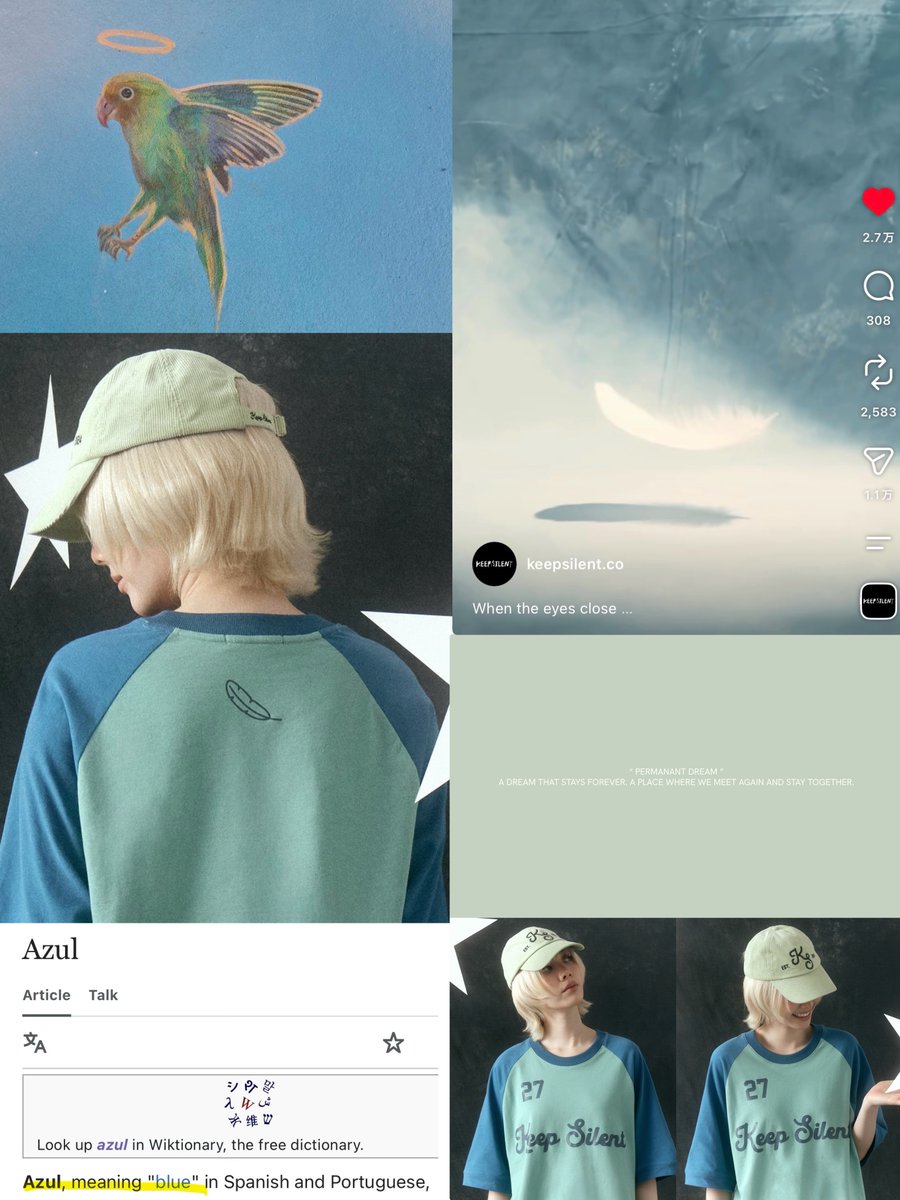
Orm : Orm kept the feathers too.
Ling : Right, the bird that Ling bought for Orm.
Orm : I casually mentioned to Ling that Orm wanted to go back to raising birds. Then on my birthday, Ling acted all sketchy, and brought the little one back in her arms. In this life, I've never been happier with any gift than this one. Miss it so much. It had a short life due to illness.
It seems that Abu really was sick. The weather changed and its condition worsened.🥺😭😭
Orm: I still keep its feathers (Abu's)
Ling: Yea, the bird I bought for Orm
Orm: I casually told Ling that I wanted to have a bird again. Then on my birthday, she started acting all secretive, slipped out without telling my mom, and came back carrying the little one. I’ve never received a gift that made me happier than that. I miss it so much. It had a short life because of its illness
I miss Abu too 😭🥺
Orm : Orm kept the feathers too.
Ling : Right, the bird that Ling bought for Orm.
Orm : I casually mentioned to Ling that Orm wanted to go back to raising birds. Then on my birthday, Ling acted all sketchy, and brought the little one back in her arms. In this life, I've never been happier with any gift than this one. Miss it so much. It had a short life due to illness.
We miss Abu too 🥺
#LingOrm #หลิง���อม
@linglingsirilak
@ormmormm
LingOrm and Abu: LINGORM IS REAL
At a charity auction, Orm brought a painting she had created herself, a portrait of Abu, the little parrot who was her closest companion. Abu wasn't just any pet; he was a birthday gift from P'Ling, a gesture filled with care, warmth, and quiet affection. Throughout the bidding, Ling never took her eyes off Orm. She didn't track the rising price tags; she watched Orm's expression shift as the artwork neared its final bid, immediately picking up on her sadness. When the price hit 200,000 baht, Ling raised her paddle to bid, determined to preserve that memory for Orm. Orm was stunned, bursting into tears. Ling simply said softly that she wanted to hang the painting in her new home.
The bids kept climbing far beyond that point. Ling continued to raise her paddle, but Orm reached out to hold her hand back. Orm shook her head, whispering that the price was already far too high and that she didn't want Ling spending so much money on her account. Ling smiled, reassuring her in a gentle whisper, 'It's okay. If you want it, I'll win this painting back for you no matter what.'
Ultimately, Orm shook her head once more, and Ling respected her wish, stepping back from the auction. The painting sold for a record-high sum, with all proceeds donated to charity. Only late that night did everyone learn the truth: Orm's Abu had just passed away.
Ling had known all along, deeply understanding the grief Orm was carrying. For Orm, Ling was ready to pay any price if it meant softening even a fraction of that loss.
P.S. The little one mentioned keeping some of Abu's feathers as a keepsake. Coincidentally, the latest KS apparel line matches the exact colors of Abu's feathers, bringing back memories of this moment 🥹🥹🥹
#หลิงออม #LingOrm
#หลิงหลิงคอง #LinglingKwong
#ออมกรณ์นภัส #OrmKornnaphat
@Ch3Thailand_33@Ch3Plus
dear ,
If I could summarize everything above into one message for you , it would be this:
Don't try to solve a changing media economy by waiting for traditional TV advertising to become what it was 10 years ago.
TV still has value, but audience behavior has fundamentally changed. People are now moving between television, streaming, social media, creators, events and digital commerce and advertising investment follows that attention.
We see exactly the same transformation in the Middle East. major series now live across television and streaming platforms. And producers don't market them only through TV commercials anymore. Actors create digital content, influencers participate, scenes become trends, music becomes social content and audiences themselves amplify the series.
The content is no longer only the product. The ecosystem around it is part of the product.
Look at Spider-Man. The investment doesn't stop with making the movie.
That's how one entertainment property can move from:
content → conversation → experience → commerce.
BEC already has something extremely valuable in LingOrm: attention, loyalty, brand attractiveness, international interest and an audience willing to participate.
Now please invest around it.
invest smartly !!!
Invest in quality content. Smart social-first marketing. Dedicated creative resources. International PR. Regional partnerships. Brand collaborations. Streaming. Experiential activations. Licensing. Commerce. invest in a dedicated team
And don't simply copy-paste LingOrm's formula onto another artist. Build the infrastructure for everyone, but build a unique strategy around each talent. LingOrm are valuable precisely because their positioning, chemistry, audience and commercial identity are their own.
The objective shouldn't be “How can TV advertising save BEC?”
It should be:
“How can every strong BEC IP create multiple sustainable revenue streams?”
TV + streaming + artists + events + brands + social + licensing + international markets.
That's how a media company can stand stronger during an economic downturn: not by depending on one revenue stream, but by making every valuable IP work across an entire ecosystem.
And with LingOrm, BEC already has a very powerful place to start.
Don't only monetize the attention they already have. Invest intelligently enough to expand where that attention can go.
#LingOrm #หลิงออม
photo credit to #dior and to our future global stars #linglingkwong #ormkornnaphat
A perfect example of what I mean by smart entertainment marketing is Spider-Man: Brand New Day. #spiderman
Sony obviously invested in making the movie itself but production is only one part of the business. They also understood something equally important:
How people behave today.
#TomHolland and #Zendaya didn't simply appear in a trailer and wait for audiences to buy tickets. Sony Pictures and UGC brought them to Paris for a dedicated fan event, with a free Spider-Fanzone for up to 1,000 people, direct interaction with fans and a cinema experience built around the new trailer and the Spider-Man universe.
Why?
Because today audiences don't only want to watch entertainment.
They want to experience it, photograph it, share it and feel part of it.
And then look at what happens around the movie itself.
Spider-Man starts appearing far beyond the cinema.
#McDonald's developed Spider-Man: Brand New Day meals, collectibles, themed packaging, Happy Meal products and in-store experiences.
#Takis turned its chip packaging into limited-edition Spider-Man designs and supported the collaboration with influencer partnerships, retail experiences,
real-world fan activations and movie-ticket incentives.
Suddenly Spider-Man isn't only something you see for two hours inside a cinema.
You see Spider-Man while eating.
You see him while shopping.
You see him on packaging.
You see him on social media.
You see creators talking about him.
You see promotions connected to cinema tickets.
You see him becoming part of everyday culture.
That's the strategy.
The distributor isn't saying:
“We made a great movie, so people will automatically come.”
They're creating multiple reasons for people to discover the movie, remember it, talk about it and finally buy a ticket.
And this is exactly what I mean when I say BEC needs to think beyond simply releasing content and relying on fans to share it.
Imagine applying that mindset to a series or artist ecosystem:
series → artists → social content → creators → brands → products → activations → fan experiences → livestreams → tickets → international PR
Each element sends people back to the others.
And the smartest part is that not every activation has to be expensive.
That's why I keep saying:
Marketing isn't what you do after the content is finished. Marketing becomes part of the content ecosystem itself.
And that's the opportunity I see for BEC with LingOrm.
The fandom already knows how to amplify them.
BEC's opportunity is to build more intelligent bridges beyond the fandom with brands, creators, international PR, fashion, retail, experiential activations and culturally relevant partnerships.
Don't simply ask fans to share more.
Create something the wider public wants to share too.
That's how entertainment moves from content to culture and from attention to revenue.
#LingOrm #หลิงออม
credits:
third photo credit to vogue
first photo credit to the lebanese marketer second photo credit to macdonald lebanon
Like I've always said, I don't believe traditional TV advertising can remain the main growth engine it once was. I don't know what television will look like 10 years from now, and nobody can predict that with certainty, but the direction of audience behavior is already clear: attention is becoming increasingly fragmented across streaming, social platforms, creators and digital ecosystems.
And I'm sure BEC's management understands this too ( i hope that) the increasing importance of Events & Artist Management itself shows why diversification matters.
I'm not going to speak about every artist under BEC because, personally, the case I'm interested in analyzing is LingOrm.
And I believe LingOrm are a special case that needs its own strategy.
BEC shouldn't look at what worked with LingOrm and simply copy-paste the same formula onto another pairing or artist.
Learn from the business model? Absolutely.
Build better infrastructure for every artist? Of course. But you cannot manufacture the same positioning twice.
What BEC should be asking is: What is uniquely working here, and how do we invest in it without destroying what made it work?
I've seen this transformation happening in the Middle East too.
Some of the region's biggest film and series producers now invest heavily not only in the production itself, but in how that production travels digitally. Major Arabic content lives across broadcasters and streaming platforms such as Shahid and Netflix, while marketing increasingly happens far beyond a traditional TV commercial.
You see actors creating social-first content. Influencers collaborate around a series. Celebrities participate in trends. Scenes become memes. Dialogue becomes sound. Songs travel independently from the show. Creators make audiences curious enough to watch something they might otherwise never discover.
The marketing becomes part of the entertainment.
And that's where I think BEC needs to invest aggressively if it wants to reduce its dependence on declining traditional advertising revenue.
Invest in the quality of the series.
Invest in storytelling and production tools that make audiences emotionally attached.
Invest in social-first creative teams and real-time content.
Invest in international PR and market-specific PR.
Invest in strategic creator and celebrity collaborations.
Invest in digital distribution.
Invest in experiences and activations that people want to photograph, recreate and share.
And most importantly: invest smartly.
An activation doesn't have to look expensive to become powerful. Sometimes one brilliant idea creates more conversation than an enormous media budget.
Asian and Thai entertainment culture is different from the Middle East, just as both are different from Hollywood. The strategy therefore cannot simply be imported from another market.
But the economic challenge underneath is increasingly similar:
How do you turn attention into sustainable revenue when audiences no longer live on one screen?
For LingOrm specifically, I wouldn't rely only on #fandom sharing, #trending hashtags or the expectation that fans will organically carry every campaign.
Their fandom is already giving BEC enormous organic amplification.
BEC's job should be to multiply it.
Give that audience better content to distribute. Create collaborations that reach people outside the fandom. Build international PR around the markets already showing interest. Develop activations that become conversations. Connect series, artists, events, brands, fashion, streaming and commerce instead of treating each one as a separate product.
Because shares are valuable.
But a strategy cannot simply rely on people sharing. It needs to give people something worth sharing.
That's the investment I would make in #LingOrm.
@Ch3Thailand_33@Ch3Plus
#LingOrm #หลิงออม #marketing #strategy
I actually find this article very interesting, because behind what looks like a negative headline about BEC is a much bigger story about how the media business itself is changing and, within that story, a very interesting signal about LingOrm's commercial value.
The headline It's closer to this:
LingOrm's major activities are generating meaningful business for BEC, but the growth of Events & Artist Management and other non-TV businesses is not yet large enough to fully offset the weakness of BEC's much larger traditional TV advertising business.
And that distinction is important.
According to the analyst estimates cited in the article, BEC's target price was reduced from 2.34 baht to 1.70 baht. Profit forecasts for 2026 and 2027 were cut by approximately 30% and 32%, to around 147 million and 170 million baht, while revenue forecasts were reduced by approximately 20% and 18%, to around 3.428 billion and 3.638 billion baht, largely reflecting weaker-than-expected TV advertising revenue.
Yet management reportedly expects the second half of 2026 to improve from the first, partly through growth in Events & Artist Management.
And this is where LingOrm become particularly interesting.
The article specifically identifies the LINGORM Thailand FAN MEETING TOUR 2026 in Khon Kaen, Phuket and Chiang Mai as activities expected to contribute revenue in Q3, while LINGORM “THE WORLD BETWEEN US” CONCERT at Impact Arena is expected to contribute in Q4. It also points toward fan meetings, fan signs, livestreaming and increasing brand collaborations.
So, very simply:
TV Advertising ↓
Events & Artist Management ↑
So what is BEC's real challenge?
From my perspective after more than a decade working in advertising and creative, I wouldn't define BEC's problem simply as “TV advertising is down.”
That's the symptom.
The bigger challenge is adapting the business model quickly enough to where audiences, advertisers and commercial value are moving.
This isn't uniquely Thai.
The world has changed, times have changed, and people's attention has changed. Advertising money follows attention.
My millennial generation grew up around scheduled television. Then came VHS/DVDs, CDs, MP3s, YouTube, smartphones, streaming and eventually an environment dominated by social platforms and algorithms.
Today, audiences decide what they watch, when they watch it and on which device.
Advertising followed exactly the same evolution.
More than ten years ago, much of our advertising work revolved around print, flyers, posters, traditional outdoor and TVCs. Today, many client conversations begin with social content, creators, Google/display advertising, platform-specific campaigns and digital OOH.
I'm working now on a Samsung Back-to-School campaign, for example, where the advertising focus is social media and digital OOH. Why? Because you follow the target audience.
That doesn't mean television suddenly has no value.
It means television is no longer automatically the center of the media ecosystem.
Even my mom demonstrates this perfectly. She can still consume traditional media while sending me Instagram Reels asking, “Is this real?” and occasionally ordering something because she saw an Instagram ad. Every time another mysterious package arrives, our family starts wishing Instagram would close for a week. 🤣
Professionally, though, that's fascinating.
The same consumer can watch TV, discover a product on Instagram and purchase digitally.
Even Ramadan shows how much this has changed
In the Middle East, television advertising still has a particularly powerful seasonal period: Ramadan or easter but mainly ramadan
Major series compete for attention, brands compete for premium advertising space, and historically families gathered around television during this period. It remains one of the region's biggest entertainment and advertising seasons.
But even Ramadan has evolved.
Today, major Arabic series are also distributed through streaming services such as Shahid and, depending on the title and market, global platforms such as Netflix.
Why?
Because broadcasters and producers know the audience is no longer sitting in only one place.
And even more interesting is how those series are marketed .. Influencers recreate scenes. Creators imitate characters. Dialogue becomes memes. Songs and lines become trending sounds. Cast content circulates on TikTok and Instagram. Sometimes ordinary users generate enormous organic visibility without being paid anything.
That's why I keep saying:
Marketing. Marketing. Marketing.
Gen Z doesn't only watch entertainment.
They participate in it.
And smart marketing gives them something they want to participate in.
You don't always need an activation that makes people say, “Wow, this must have cost millions.”
Sometimes the smartest activation is a simple idea based on human behavior something people photograph, imitate, debate, remix or share voluntarily.
You don't always need the biggest budget. You need the idea people can't resist spreading.
Watching In Love Forever, I was impressed by the advertising ecosystem around the series, especially seeing established and premium brands associated with it. but still is not enough
Because we need to separate two things:
Quantity of advertising and quality of advertising are not the same thing.
A series can holds many advertisers. That's quantity.
But when strong, desirable or premium brands choose to associate themselves with a property, that can also tell you something about the commercial positioning and audience attractiveness surrounding that content.
So I wouldn't argue that BEC should abandon TV advertising.
I would argue that it needs to stop treating TV as an isolated product.
The show is the beginning of the commercial ecosystem, not the end of it.
A series can generate:
broadcast + streaming + social content + sponsorship + product integration + creators + events + artists + fan experiences + licensing + commerce + international distribution.
That's where the opportunity is.
What would I do if I were looking at BEC's strategy?
I would continue investing in Artist Management, events, concerts, international fan meetings, streaming, licensing, IP development, branded entertainment, merchandising, digital content, international distribution and strategic brand partnerships.
But I would also invest much more heavily in the infrastructure around talent:
dedicated strategy, and team.... stronger creative teams, editing and real-time content resources, international PR, regional partnerships, experiential marketing and market-specific campaigns.
Not simply more promotion.
Smarter promotion.
And there's another issue I think media companies need to be extremely careful about:
You cannot copy-paste one artist's strategy onto another.
If one pairing or artist becomes commercially successful, the solution isn't to reproduce the same formula with everybody else.
That's one of the easiest ways to dilute positioning.
Every artist needs their own identity, audience insight, brand architecture and commercial territory.
What works for #LingOrm works because there is a particular combination of chemistry, fandom behavior, individual identities, fashion relevance, international audience and brand attractiveness around them.
Use the business lessons.
Use the infrastructure.
Use what the data teaches you.
But you can't copy the identity.
Look at global entertainment marketing
A major movie isn't promoted today with only a trailer and posters.
Actors travel internationally. Brands collaborate with the film. FMCG packaging becomes media. Restaurants create limited products. Outdoor installations become experiences. Creators amplify the conversation. Retailers connect promotions to cinema tickets.
( example in the comment)
I've personally seen Spider-Man marketing extend into chips, McDonald's activations, major outdoor executions and ticket-linked retail promotions
( example in the comment)
The smartest entertainment marketing turns:
content → culture → conversation → experience → commerce.
That's the mindset I would apply to LingOrm.
Because with Artist Management, BEC is potentially no longer monetizing only a television slot.
It can build value around, And that is why I keep saying that I see global potential in LingOrm.
Not simply because I'm a fan.
I'm looking at their audience loyalty, international engagement, brand attractiveness, events, fashion positioning and ability to generate attention across markets.
Fashion is one of the clearest bridges between markets
Look at #YayaUrassaya wearing Lebanese designer #GeorgesHobeika, including his bridal couture, or #Kimberley wearing #ElieSaab, alongside her relationship with global luxury houses dior
Both are Thai actresses, yet they are also names I have personally seen recognized within Middle Eastern fashion and celebrity circles AND Middle eastern PR.
That's important.
That's indirect market penetration: people discover the talent through fashion, luxury or culture, and curiosity can eventually lead them toward the artist and her work.
I've experienced a tiny example myself.
I recently had a meeting with a young Saudi producer who loves Dior. I showed her LingOrm wearing Dior pieces. That conversation alone made her interested in those looks enough that she now wants me to pick up an Orm Dior dress and a Lingling Dior bag when I'm in Thailand because that collection isn't available here.
That's an anecdote, not market data, but it demonstrates a basic advertising principle beautifully:
One strong image, strategic placement or culturally relevant collaboration can introduce talent to an entirely new audience.
And that's why international PR matters.
Dior is particularly interesting here
Today, I think we can finally say LingOrm are on a global track, and Dior is one of the clearest signs of that evolution.
Across luxury, we're seeing increasing attention toward Thai talent. Dior has been particularly visible in building relationships within Thailand, while other major luxury houses are increasingly embracing Thai celebrities including LGBTQ+ pairings as part of their broader brand and audience strategies.
That should tell the entertainment industry something:
International luxury sees value in Thai influence.
But I hope the next evolution goes beyond measuring Thai celebrities primarily through engagement, impressions and social visibility.
Because:
Engagement proves people are watching.
Commercial impact proves people are buying.
The real opportunity is when brands can connect both.
And perhaps one day the evolution for LingOrm goes even further: beyond attending events and appearing in campaigns, toward stronger in-store and international market visibility for the luxury houses they represent.
From engagement → to desirability → to measurable commercial influence → to global brand presence.
That is a much more powerful journey.
and that also our job as a fans not only BEC .
And this brings me back to BEC
I don't think BEC's answer is trying to make television behave like television did ten years ago.
Nor is the answer simply producing more fan meetings because fan meetings currently generate revenue.
The opportunity is to understand why certain artists and properties generate attention and then build businesses around that attention.
If #LingOrm can attract brands, sell tickets, generate livestream demand, travel internationally, create fashion conversation and bring audiences into BEC's ecosystem, then the strategic question becomes:
How many different revenue doors can one powerful IP intelligently open without damaging what made it valuable in the first place?
That's the opportunity.
And tomorrow, Gen Alpha will change the equation again. Nobody knows exactly which platforms will dominate five or ten years from now.
That's precisely why media companies cannot build their future around protecting yesterday's format.
The companies that survive are the ones that understand where people's attention is going next and move with it.
So when I read this article, I found something much more interesting: when an analyst discussing the financial outlook of a listed media company specifically identifies LingOrm's fan meetings, concert and related activities as contributors to future quarterly revenue, I don't consider that a small detail.
I consider it a signal BEC should pay very close attention to. @Ch3Thailand_33@Ch3Plus
Because they don't simply have two popular artists.
They have talent around which a much larger commercial ecosystem may be built.
The challenge now isn't creating more noise around LingOrm.
It's converting their existing attention into stronger IP, smarter marketing, international discovery, long-term brand equity and diversified revenue without losing the identity that made people care about them in the first place.
That's LingOrm's power.
And if it is managed strategically, it could also become part of BEC's next chapter.
#LingOrm #หลิงออม
I went back to BEC’s own official 2025 AGM minutes, and the shareholder question about LingOrm was VERY specific.
BEC World 2025 AGM Minutes p.24
A shareholder pointed out that while profit was down 54% YoY, Events & Artist Management had grown 15.4% YoY, and specifically asked whether BEC was using the revenue generated from highly successful partnerships such as LingOrm to further develop and build on that success.
She even gave examples of what that investment could look like:
• Expand the team handling engagements
• Hire photographers, editors & professional content creators
• Continuously release content
• Create a separate official admin account
BEC’s response was that this was an “ongoing matter.” Management acknowledged the strong growth of the Events business and said it would continue working harder, “expand cautiously” and continue developing plans.
Then another shareholder asked about artist management, events, endorsements, safety and activities involving fan clubs including how BEC evaluates the revenue and expenses collected from different artists’ fandoms.
Now fast-forward to the 2Q26 Analyst Meeting.
BEC has clearly expanded the ways LingOrm can generate revenue — tours, concerts, Fan Meetings, Fan Signs, livestreams, merchandise/IP and artist activities.
But did they actually answer what shareholders were asking in 2025?
Did BEC invest more resources into BUILDING the success or mainly create more ways to MONETIZE it?
And perhaps an even bigger question now:
Does BEC truly understand how to strategize around and appreciate JKR and the fandom powering this ecosystem?
Tickets are bought by fans.
Venues are filled by fans.
Brands see engagement from fans.
Global trends are pushed by fans.
Content travels internationally because fans amplify it.
BEC itself acknowledged LingOrm’s significant international fandom and the opportunities it created.
So the fandom’s value was never a secret.
The question is whether BEC sees JKR/fandom as a long-term strategic asset worth investing in, communicating with and supporting or primarily as demand to monetize.
More monetization ≠ more investment.
And monetizing a fandom ≠ understanding one.
A year later, that 2025 shareholder question still deserves an answer.
SOURCES
BEC World — Official 2025 AGM Minutes
See p.24–25 for the shareholder questions & BEC’s response:
https://t.co/Q8lS9AeSP7
BEC World — Official 2025 Shareholder Meeting page:
https://t.co/EKaNO3JB7r
BEC — 2Q26 Analyst Meeting Presentation, 24 Aug 2026:
https://t.co/IOtzvrnrGp
#LingOrm #หลิงออม #BEC #ช่อง3
My work for Goodbye Lara ep8! I was tasked with this sequence and I'm very grateful to the production stuff and the episode director for helping me out. It was a gorgeous sequence to work on. Posted with permission.
LO, GENGA #さよならララ#GoodbyeLara
[Eng Sub] In Love Forever, the last 2 episodes.
💫 วาดฝันวันวิวาห์ 🤍 In Love Forever The Series
💍 Every Friday | at 08.30pm
�� TV press 33, Online click 3Plus
🖋️ Rerun 3Plus Premium, Netflix
#วาดฝันวันวิวาห์
#InLoveForeverTheSeries
#LingOrm #หลิงออม