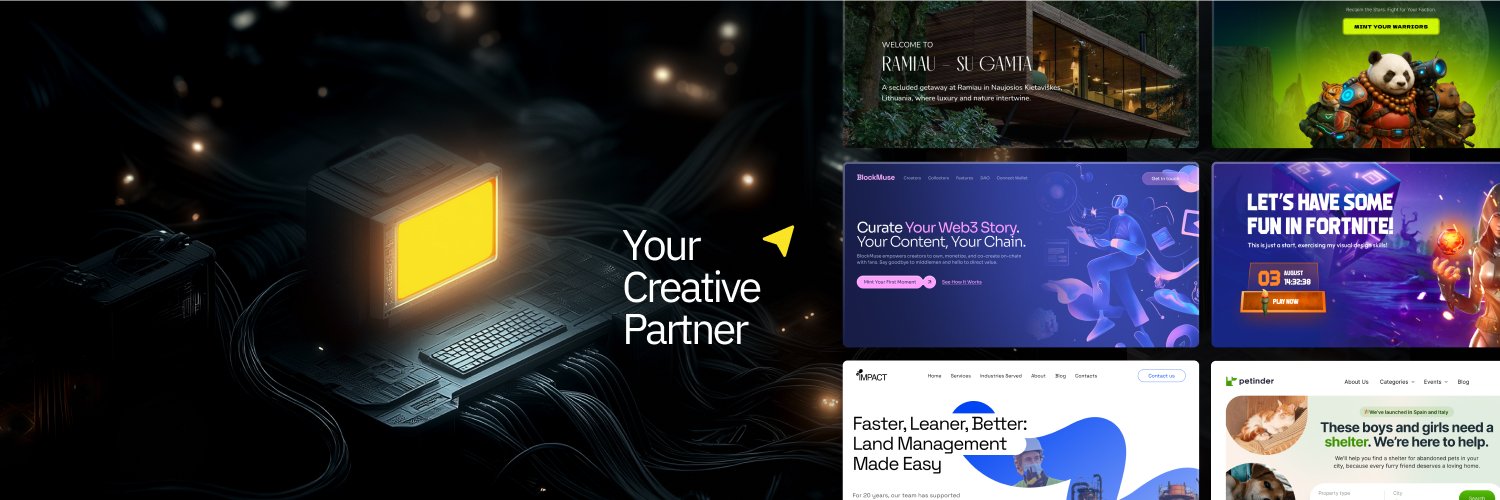
I design brands that say “we’ve arrived” - and websites that back it up.
Book a short intro call - let’s find your brand edge. 💬
https://t.co/J2bNTBPDKc
Always warming to see my founder clients recording me a video testimonial.
In this case it was Edgaras, the owner of the premium segment dental clinic in Lithuania.
"This project was super important for me and I invested a lot of money, and a lot of personal properties. So I needed every single service to be at the very top. So I asked Igor to make a website for our company. The company name is UPÉ Dental."
I design brands that say “we’ve arrived” - and websites that back it up.
Book a short intro call - let’s find your brand edge. 💬
https://t.co/J2bNTBPDKc
Google decides where you rank. AI decides whether you exist.
Over 60% of searches now end without a click. Add an AI answer and it's 83%. People still search. They just get the answer and never reach your site.
So there are two games now. Search discoverability gets you the blue link. AI discoverability gets you named inside the answer ChatGPT and Perplexity hand your customer first.
Most sites are built only for the shrinking half.
How I build for the other half:
- Answer the question first, in plain language
- Let the AI crawlers in (most robots.txt quietly block them)
- Structure for a machine: clean headings, schema, real metadata
- Earn mentions elsewhere, because AI trusts brands the web already trusts
A beautiful site no AI will quote is just a well-dressed secret.
A luxury hotel with no website is just a very expensive secret.
Edgaras had built one in the Lithuanian forest. Real craft, the kind of stay people travel for. And online, not much presence. Meanwhile his competitors, with lesser hotels, had polished sites quietly taking the bookings.
We fixed the imbalance. We designed and coded a website that backs up the luxury he'd already built, led with the feeling of being there, and pointed every section at one direct-booking action. Storytelling first, friction last.
Result?
25 direct reservations a month, booked straight through the site.
The hotel was always worth it. It finally has a way to prove that before anyone arrives.
I argued for the prettier homepage. The client got the one that closes, and I was wrong.
A regional radiology software company hired me to look like a global leader. Three directions on the table.
My favorite led with a cinematic photo hero. Heavy mood, beautiful, award mention.
The one that won did something colder and smarter. It put the real product on the homepage, the interface and the workflow, and surrounded it with the numbers that prove scale: thousands of licenses installed, hundreds of hospital deployments, presence across dozens of countries.
Here's the thing about hospital software decisions. The head of radiology rarely decides alone. They shortlist, then forward the page to a committee and a CFO who have to sign off on something that cannot fail. A mood photo gives them nothing to forward. A product view plus hard proof hands them the argument they need to defend the choice internally.
The photo version sold a feeling to one person. The winning version armed one person to convince five others. One looks like a startup hoping to be noticed. The other looks like an institution that expects to be chosen.
The harder question is how you stop your own taste from outvoting that.
"You can outsource your thinking but you can't outsource your understanding." Karpathy named what's happening, and only half of it. The other half is the atrophy that follows.
The piece nobody is talking about: what happens to your judgment when you stop using it.
The foundational layer in design & marketing (taste, reading a brief, knowing what's wrong before you can articulate it) doesn't grow on its own. It grows under pressure, with feedback, over years. You can pause it. You can also lose it.
I still think hard before and after every AI pass on a project. Not because I'm worried about the output. Because the muscles only stay strong if I keep using them.
That's my personal view: AI isn't lazy. Some people are.
And the foundational learning curve of your craft isn't skippable, only delay-able.
Daniel's entire business model is "insurance companies underpay claims by 747% on average, I close that gap." Designing the homepage concept was figuring out how to say that without sounding ambulance-chasey.
Public adjusters are the lawyers of the insurance world without the law degree. Daniel runs Country Public Adjusters across four states, and his entire business runs on one promise: "your insurer offered X, we'll get you 5-10X."
The design problem: every visual signal that screams "I will fight for you" also reads as "I'm aggressive and possibly shady." Florida-style billboard adjusters have done a lot of damage to the category's perception.
So we did the opposite. Light mode, structured grid, restrained type. Zero exclamation marks. The copywriting and numbers do the talking, the visuals do the trusting.
The lesson I'm taking forward: when the business itself is loud, the design has to be quiet. Otherwise nobody believes you.
Check out the concept I whipped up for him.
The reason your site isn't converting isn't the AI. It's the foundation gap underneath it.
A junior used Lovable or v0 to ship fast. Hero scrolls fine. Colors pass at a glance.
Then you read line one and it's talking to nobody. The CTA fights three other buttons. Brand voice on the about page sounds like a different company.
These aren't AI mistakes. They're foundation gaps.
AI tools assemble. They don't decide. Marketing logic, copywriting that isn't templated, brand visual discipline. These come from the person briefing the tool, and most juniors haven't built them yet.
I started in Photoshop. Hours nudging a single hero. Every one of those hours is what now lets me brief AI tools faster than the juniors using them.
If you're hiring, the question isn't "do you use AI?" Every good designer now does. The question is: show me a homepage you built without it. Or before it. That's the real test.
What's the worst AI-slop site you've seen this month? No links, just describe it.
I design brands that say “we’ve arrived” - and websites that back it up.
Book a short intro call - let’s find your visual edge. 💬
https://t.co/lJc09RQDyK
How do you redesign a brand that was already old before you were born?
Levendi has been selling jewelry in Australia since 1967. When I started the Shopify rebuild, my first instinct was clean-modern-minimal. Six years of SaaS work had hard-coded that as my safe default.
It was wrong. A 58-year-old brand doesn't need to look young, it needs to look right.
I scrapped the first direction and asked a different question: what would a buyer need to feel for the heritage to actually translate online? Subtle hovers instead of flashy ones. Photography that breathes. A checkout that feels like the shop, not Amazon.
Heritage brands don't need a refresh. They need a translation.
The fold (15 sec)
Can I tell who it's for and what they do in the first 2 seconds? If I can't, neither can their visitors.
The CTA path (20 sec)
How many clicks to "book" or "buy"? One clear next step — or five competing ones? Most sites have five.
The proof stack (25 sec)
Named clients, dated case studies, real numbers? Or just "we help ambitious brands grow"?
If a competitor wins on all three → your prospect doesn't need a new site. They need a new offer.
If they lose on all three → you can rebuild their positioning in one slide.
Worth more than 30 minutes of "competitor research."
Most agencies spend 2 hours researching a prospect's competitors before a discovery call.
I spend 60 seconds.
Here's the 3-step audit I run before every founder call:
More in 🧵
Jennifer had 60,000 people visiting her platform every week.
They had no idea what they were looking at.
That was the brief. Not "make it prettier."
"Help us figure out what we actually are."
Here's what happened when a brand finally caught up to its product:
The platform became Beautista.
The 60,000 visitors who were already showing up - finally understood what they'd arrived at.
Jennifer built the product.
I helped the brand catch up to it.