Working at JP Morgan taught me one thing:
Owning beats earning.
If you want to set yourself financially free…
Steal these 7 wealth secrets from JP Morgan's top 1% elites:
$VSH Vishay Intertech might be one of the cleaner “AI picks-and-shovels” names hiding outside the obvious GPU trade.
Vishay makes the boring but critical stuff behind electrification and high-speed hardware — resistors, capacitors, inductors, diodes, MOSFETs, sensors, and power components.
The AI angle is not “they sell GPUs.”
It’s second-derivative AI exposure.
More AI data centers means more demand around power delivery, thermal management, optical transceivers, RF modules, and advanced packaging.
Vishay’s new thin-film submount platform directly touches optical, RF, and high-speed packaging use cases. Earnings are also coming May 13, so attention is building.
Not flashy. Very relevant.
Quiet AI infrastructure name. ⚡
Stanley Druckenmiller: “I like putting all my eggs in one basket.”
Concentration is the most underrated investment advice.
My portfolio had a great month because I was heavily concentrated on $NBIS, $AMD and $AMZN.
When you concentrate on exceptional companies bought at discount, you see the downside as just volatility, and upside as inevitable.
Don’t be afraid of concentrating on your best ideas.
As Buffett once said, “nobody gets rich on their 20th best idea.”
WHERE THE ENTERPRISE AI STACK IS BEING BUILT
1. $PLTR building the orchestration layer of the AI economy through the control systems enterprises need before models can take real-world actions backed by a Rule of 40 score of 127
2. $CRWD, $PANW, $ZS & $RBRK building the security layer of the AI economy across endpoint, identity, Zero Trust & cyber recovery as every new agent, machine identity & AI-generated workflow expands the attack surface
3. $NET building the connectivity layer of the AI economy through the internet control plane that agents, APIs & inference traffic must move across in real time, with Cloudflare sitting behind over 20% of the web
4. $SNOW & $MDB building the data layer of the AI economy through the clean, structured, production-grade enterprise data systems that make AI usable inside real applications and workflows
These are the companies supplying SpaceX:
$AA ($67) - Aluminum. Largest producer outside China. The structural backbone of every launch vehicle.
$ATI ($163) - Titanium. 27% aerospace market share. Just doubled capacity. 68% of revenue from aero/defense.
$FCX ($70) - Copper. Largest publicly traded copper miner. Powers every system on the space stack.
$MP ($64) - Rare earths. Only scaled U.S. mine and processor. Feeds satellite and propulsion supply chains.
$TECK ($59) - Diversified critical minerals. Copper, zinc, and steelmaking coal tied to the full industrial buildout.
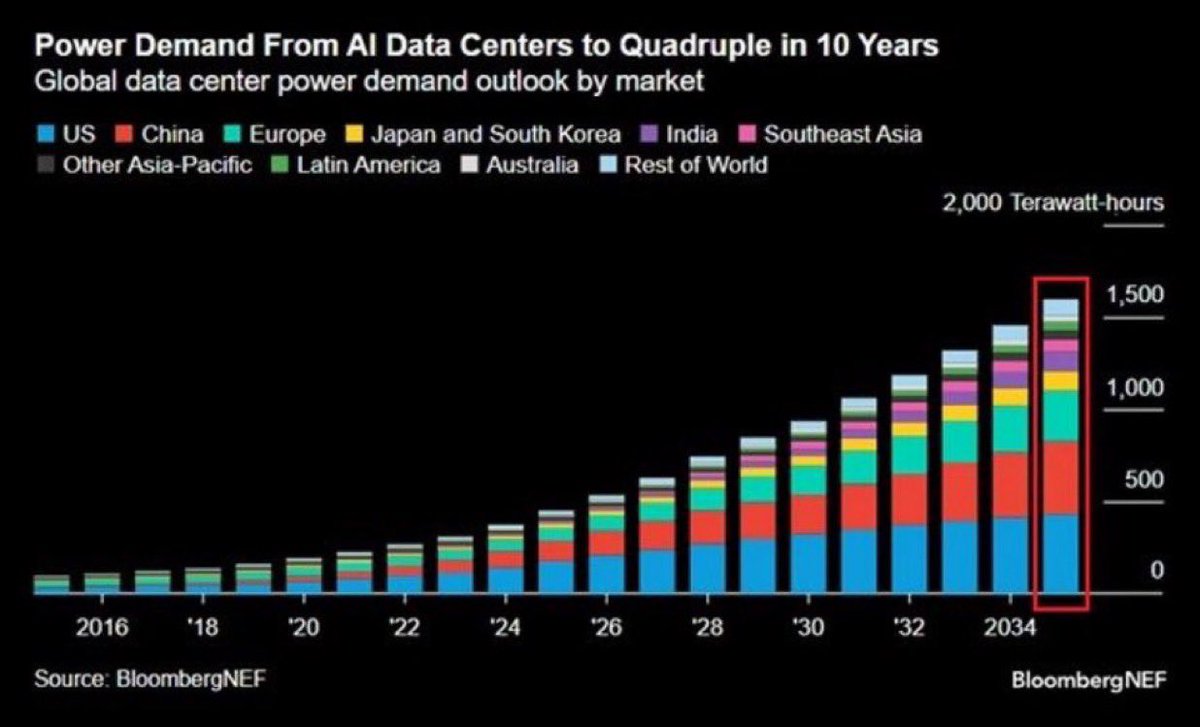
AI DATA CENTER POWER DEMAND COULD 4X THIS DECADE
Battery storage led by $TSLA & $EOSE will stabilize the grid by storing excess generation and discharging during peak inference cycles.
Nuclear will anchor the baseload with $OKLO, $SMR, $BWXT & $CEG delivering nonstop clean power straight to AI campuses while upstream fuel supply from $CCJ, $UUUU & $LEU secures the inputs that make long-duration nuclear viable.
Transmission, turbines & cooling will close the loop with $VST, $GEV & $VRT expanding the grid and infrastructure that move the energy behind AI’s next decade.
Natural gas will keep the grid stable between renewable cycles with $VG & $NEXT expanding LNG capacity to guarantee uninterrupted power for AI loads.
Renewables like $FSLR, $BE & $NEE will drive marginal cost of compute lower by supplying cheap daytime energy that feeds grid-scale storage.