If you find this interesting, please also take a look at the closely related work https://t.co/TpmFMMKrjS by Shrigyan Brahmachari, David Jakab, @HenryDPfister, and Iman Marvian that appeared on the arXiv a few days ago!
New paper out today! In https://t.co/LW4FYEPag0 , we add a new chapter to the recent literature on purifications of quantum states: What if you're not after a symmetric purification, but rather about mapping your mixed states to anti-symmetric pure states in a canonical way?
A big thank you to my amazing collaborators Adam Bene Watts, @JohnBostanci , @danielgrier_ , Sihan Liu, and @gauravmahajn ! This paper was long in the making, and took a winding road to get here, but I'm happy with the journey and the rep theory we learned along the way. ;)
Finally, if this sounds interesting to you, please also take a look at the independent and concurrent work https://t.co/j5eABBZwm5 by Francisco Escudero Gutiérrez, @Junseo_Lee_ , and Sebastian Zur, who approach some of the same questions using adversary methods.
In our new work https://t.co/hXT7ERB7vP , we investigate the power of reverse-time evolution queries in quantum algorithms, with a focus on Hamiltonian property testing.
Huge thanks to my collaborators Natalie and Sergii (@quantSS) for introducing me to the wide world of graph parameters! And extra congratulations to Natalie on the first paper of her PhD! 🎉
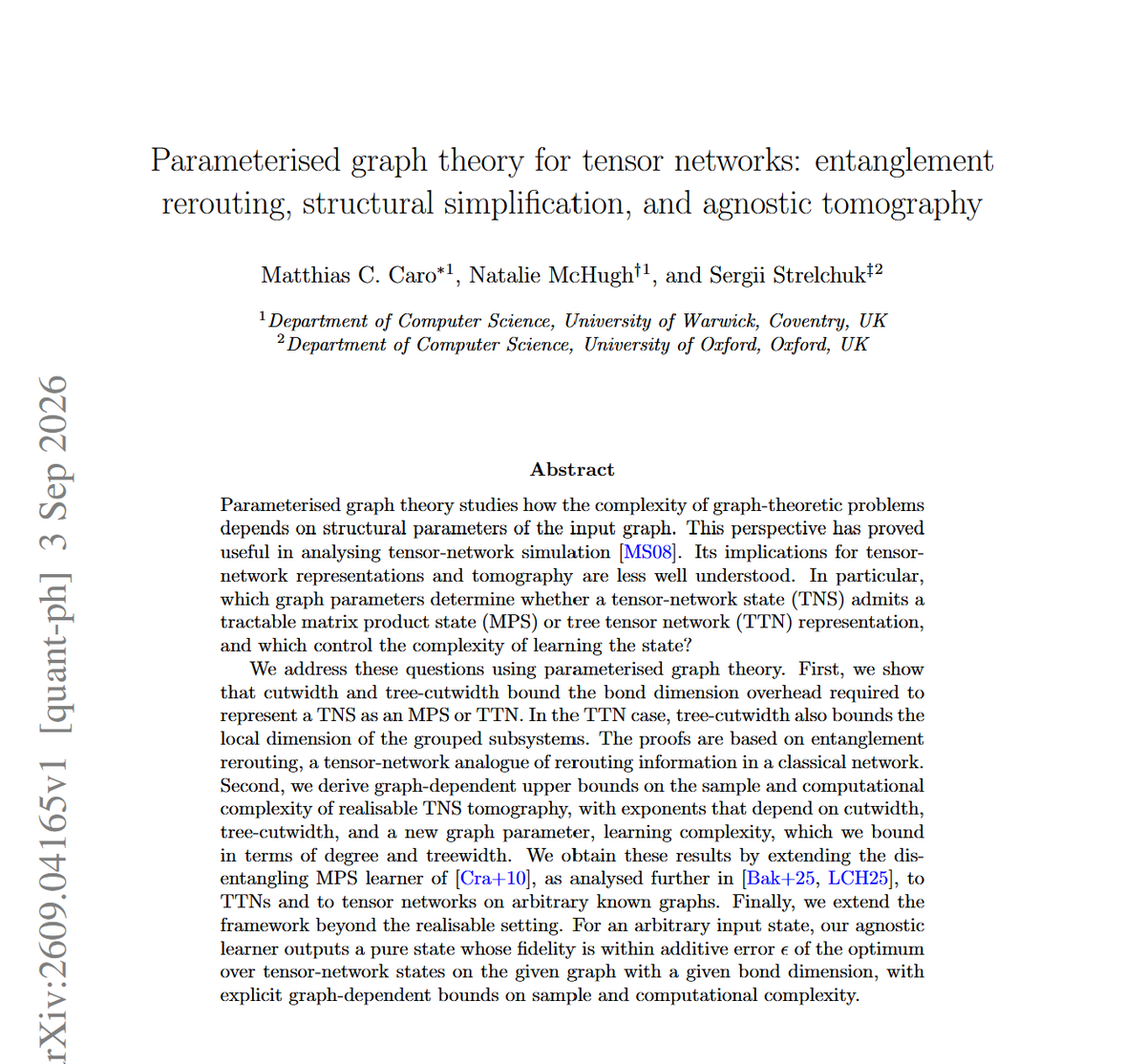
We have a new paper out today: https://t.co/T0ateULWXS . Another title for the paper would be "how I learned to stop worrying and use graph parameters". ;)
And then we use the same angle for tomography of tensor network states, giving realisable and agnostic tomography algorithms, first for tree tensor networks, and then for general-graph tensor networks, with sample and runtime bounds in terms of suitable graph parameters.
Are you a PhD student or postdoc doing outstanding work in the foundations of AI & machine learning, classical or quantum? Then apply to our Rising Stars Workshop organised by @WarwickDCS and the @UniofOxford@ELLISforEurope unit! See https://t.co/T3Uei40Ryy for more information.
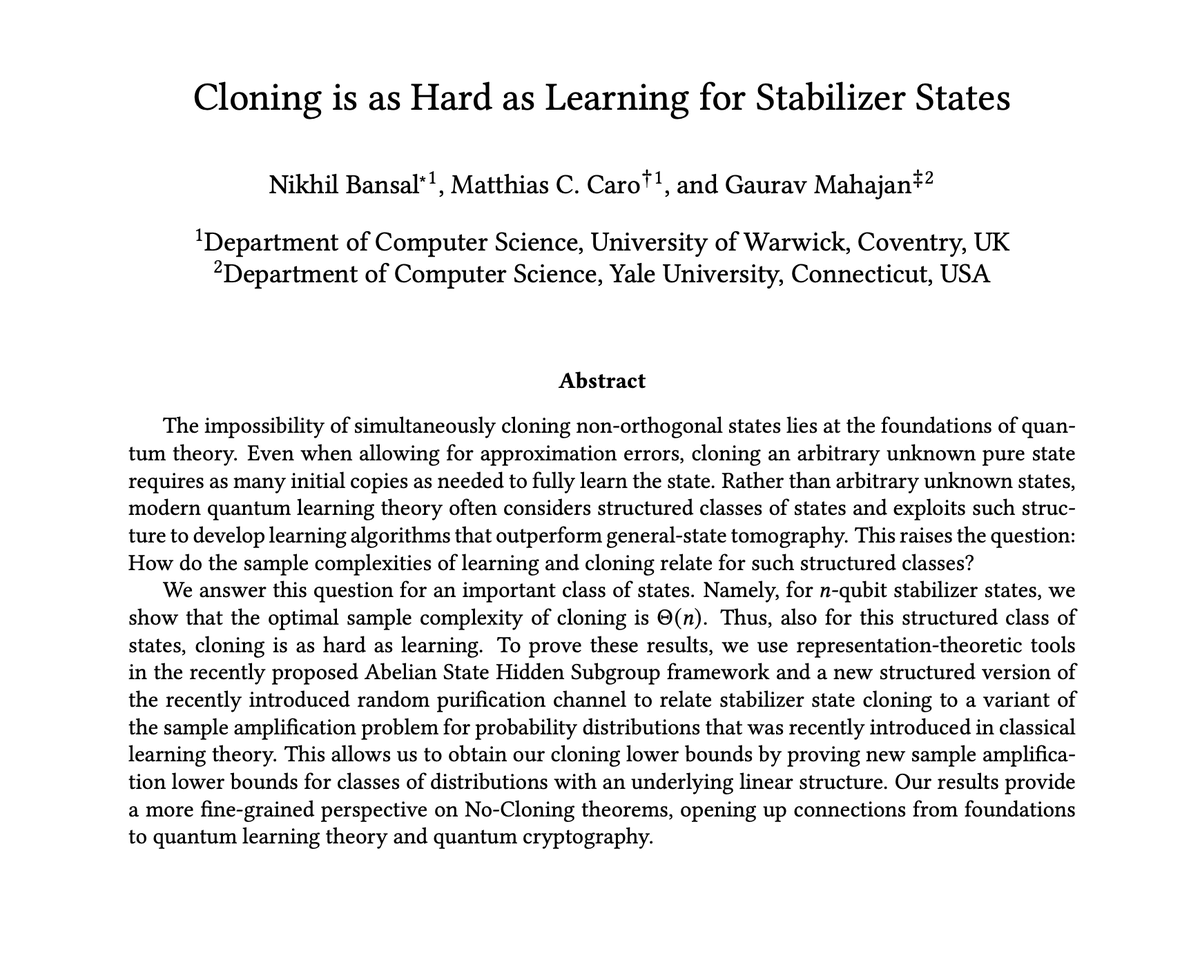
Today, my very first paper with my PhD student @QuantNik and our collaborator @gauravmahajn is out on the arXiv: https://t.co/8yfiv4wVYR
If you are at QCTiP hosted at @UniofOxford next week, do attend Nikhil's talk about ""Cloning is as Hard as Learning for Stabilizer States""!
Can quantum cloning be easier than learning for structured classes of states❓
We ask this question for stabilizer states in our recent work: https://t.co/nDKqPGo4Jw.
1/⚛️
It was a bit nostalgic for me to go back to my mathematical physics roots with this project. Thanks a lot to @BlakajVjosa , Anouar, @danielmalz , and Michael for this fun collaboration, and for teaching me a lot about Gibbs states!
I'm fascinated by desiderata beyond correctness in learning. 🤩 One such property is *privacy*. In our new work https://t.co/eRAX81lxIO, inspired by Canetti & Karchmer's https://t.co/S8Vxv0Apnk, we plant the seeds for defining and achieving privacy in quantum learning theory! 🌱
Can we reliably learn from untrusted, remote quantum data while keeping our learning strategy and outcomes private? In https://t.co/Dsqqht71Tc, we provide first answers with covert, verifiable quantum learning, extending Canetti–Karchmer ’21 to the quantum setting! 🧵👇