Despite a very full plate, I have been needled by a Ghanaian business journo friend of mine based in NYC to have a go at the debate that has taken Ghana's tech community by storm: the draft NITA bill.
My short essay effectively aligns with what everyone else is saying: shred the bill and come back with something more aligned with modern tech reality!
But in the tradition of the Scarab, I try to go into a bit more detail than most mainstream pieces.
I also point out something that seems missing in the debate. With the rapid surge of technologies like AI, everyone is or will soon be doing stuff previously considered "ICT professional stuff."
Licensing ICT professionals is akin to licensing bloggers in today's rowdy information environment: trying to stop a hurricane by blowing fumes from one's mouth.
https://t.co/hrmLM6SKtE
I barely do this but I beg any Ghanaian to read the following write up by Chris-Vincent Agyapong. Bookmark, share etc cos wtf 😳
1/4
“Ghana's NITA Bill 2025: How a Government That Cannot Fix Potholes Wants to Certify Your Keyboard Strokes
There is a particular brand of Ghanaian governance that operates on a simple, well-rehearsed logic: identify the one sector in which ordinary young people, without connections, without family money, without a politician uncle are actually building something for themselves, and then erect a magnificent bureaucratic tollbooth right in the middle of it.
The National Information Technology Authority Bill, 2025 currently making its way through Ghana's legislative machinery with the quiet confidence of a document probably written by a majority of people who have never debugged a line of code in their lives is precisely that tollbooth. It is, in its 105 sections and accompanying Schedule, one of the most breathtaking exercises in regulatory overreach this country has produced in recent memory. And given our regulatory track record, that is genuinely saying something.
The ICT sector is the one industry where a boy from Ashaiman, or, like my friend from Pulima, Aliu Wahab, with a second-hand laptop and a YouTube tutorial, can compete with someone whose father went to Achimota. It is the one space where talent, not tribe; skill, not surname; output, not old-boy network, still carries meaningful weight. It is, bluntly, the only functioning meritocracy left in Ghana's economic life.
And our government, with the NITA Bill 2025 has decided that this is precisely the sector that requires the most elaborate regulatory architecture since the tale of Moses coming down from Sinai with the Ten Commandments.
The Absurdity of Section 46: Certifying Everyone, Everywhere, Always
Let us begin with what is, without competition, the most extraordinary provision in this bill. Section 46(1) states, in plain and unambiguous terms:
"A person shall not be appointed as an ICT professional in a public or private institution unless that person is certified by the Authority."
Read that again. Public or private.
This is not a provision that limits itself to government systems handling national security data. This is not a narrow carve-out for critical infrastructure. This is a provision that means the software developer at a startup in Osu, the data analyst at a logistics firm in Tema, the web designer freelancing from her bedroom in Kumasi, all of them, every single one must first obtain certification from a government authority before they can lawfully be employed.
Who dreamed this up? Under what theory of governance does it make sense for the government of Ghana which cannot consistently process a DVLA licence within six months, which spent years and hundreds of millions on a national identification system that still cannot talk to the health insurance database to position itself as the certifying gatekeeper for an entire profession across the entire economy?
And here is the delicious irony that the framers of this bill seem constitutionally incapable of perceiving: the government's own ICT record is the single most compelling argument against giving it certification authority over anyone. You do not hand the keys of the wine cellar to the person who has been drinking the wine.
Politicians: The One Profession That Needs Certification Most, and Gets It Least
Since we are on the subject of certification, let us pause to consider who in this country is not required to demonstrate any competence whatsoever before being handed consequential power over millions of lives.
Continued below
4/4
The Government's ICT Competitor: Regulatory Capture Dressed as Public Interest
Perhaps the most structurally troubling provision in the entire bill is Section 31, which requires the Minister to incorporate a government-owned e-government ICT infrastructure company within six months of the Act coming into force.
The object of this company, per Section 32, includes managing government data centres, cloud hosting environments, national digital identity services, shared government systems, and enterprise software solutions.
This is, to put it plainly, a government-owned technology company that will offer services — hosting, cloud infrastructure, enterprise software that private ICT companies also offer, and in some cases, currently provide to the government.
The same Authority that licenses private ICT companies will conduct technical audits of this government company under Section 34. The same Authority whose funds come partly from levies on private ICT businesses will oversee a public company that competes with those same businesses for government contracts.
No serious regulatory framework anywhere in the world permits the regulator to simultaneously own and audit a commercial competitor to the entities it regulates. This is not a technical concern. It is a fundamental conflict that undermines the credibility of the entire regulatory architecture.
What This Bill Actually Does
The government of Ghana wants to create a powerful, well-funded authority with broad discretionary powers to license, certify, audit, fine, suspend, and imprison participants in the ICT sector. It wants to fund this authority partly through a levy on the gross revenue of the very businesses it regulates. It wants to simultaneously establish a government-owned company to compete in the same sector. And it wants to extend its certification requirement to private businesses that have no connection to government and no particular reason to submit to state oversight of their hiring decisions.
This is not a regulation designed to protect consumers, promote innovation, or ensure interoperability. This is a regulation designed to expand the state's footprint into the one sector where the state has not yet managed to make itself indispensable.
There is nothing wrong with regulation per se. Thoughtful, proportionate, outcome-focused regulation of ICT infrastructure--particularly where it touches government systems, public data, and national security is legitimate and necessary. Ghana needs clear standards for government ICT procurement. It needs enforceable data protection mechanisms. It needs accountability for public digital projects that regularly go over budget and under-deliver.
But that is not this bill. This bill is a maximalist assertion of state authority dressed in the vocabulary of modern digital governance. It will burden the entrepreneurs who cannot afford compliance costs. It will advantage the incumbents who can. It will drive away foreign investment and talent. It will give a government agency enormous discretionary power with inadequate checks. And it will do all of this while the politicians who designed it remain, as ever, the one professional class in Ghana that answers to no certification board, no licensing authority, and no competency standard of any kind.
If the government of Ghana is genuinely serious about regulating for public benefit, perhaps it might begin with a simple pilot programme: certify Parliament first.
Show us that works, and we will talk about certifying the developers.
Surely, Hon. Samuel Nartey George and his people have to look at the compass again and change navigation.
--Chris-Vincent Agyapong
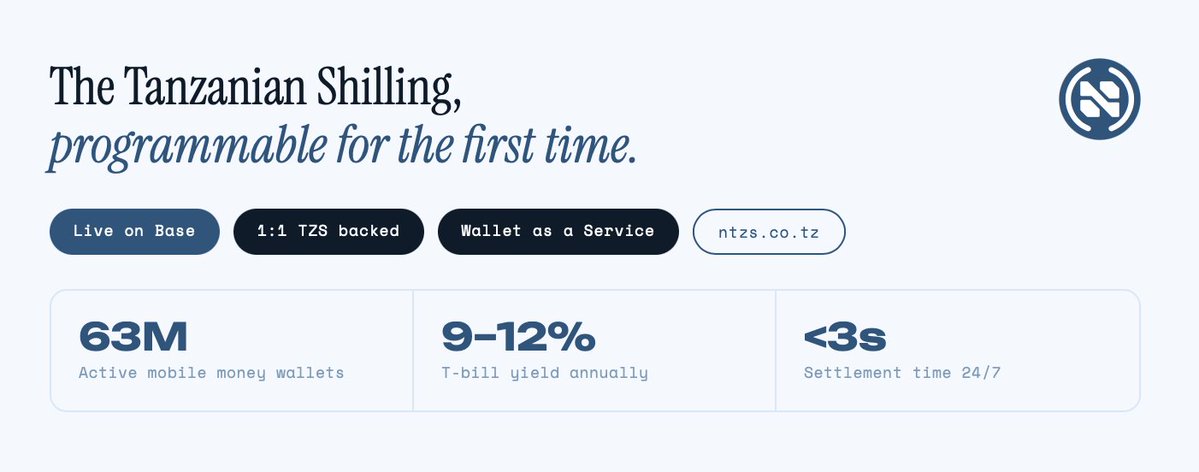
Tanzania's Tanzanian Shilling is now programmable.
nTZS is live today on @base the first regulated digital currency pegged 1:1 to the Tanzanian Shilling. Not a concept. Not a pilot. Live.
What that means in practice:
63 million mobile money wallet holders now have access to a currency that settles in under 3 seconds, earns 9 to 12% yield from Bank of Tanzania government T-bills, and can be programmed to execute payroll, escrow, remittances, and trade finance automatically.
Built in Tanzania. For Tanzania. And accessible to the world.
https://t.co/3UvvpuvqWl
The biggest mistake founders make is falling in love with their solution (the app, the shop, the product) before they understand the Problem.
You might think you know what your customer wants. But until you talk to them, you're just hallucinating.
#ALX#Dohardthings#ALXFA
I see the frenzy around the Ghana Stock Exchange and my first instinct is to stay out of it. But I cannot simply stand by and watch people make grave financial mistakes. These are the kind of mistakes that will cause many people to lose their heads when the tides turn.
As Warren Buffett famously said, “Only when the tide goes out do you discover who’s been swimming naked.” The tides are indeed in full swing. Markets are roaring to life, orders are hitting brokers and all time highs are being set. Soon enough we will see those who are swimming naked because it cannot go on forever.
Some very well-read and knowledgeable people on this platform like @readJerome@DesmondBredu@GameliMartey have served as bulwarks of financial intelligence on Ghana’s side of X and I do not wish to “take their place”. All I ask is for you to hear me on why you might be making a mistake chasing the greens on the Ghana Stock Exchange.
There are very few stocks on the GSE (38 currently). Just by obeying the Pareto principle, there are even lesser solid companies on the exchange. Most companies aren’t making their disclosures properly and have weak financials. The exchange is however portrayed to be full of “cheap” companies that are doing extremely well.
This has caused FOMO among retail investors, driving prices upwards as they rush in to get a spot. The frenzy is not among retailers alone but also among UHNW buyers and institutional buyers. Everyone wants to get a piece of the action in this bull market.
The GSE has recorded an impressive 50 percent plus return this year and has crossed GH¢ 250 billion in market cap. Stocks like MTN, GCB, Benso Oil Palm have done good this year climbing in double digits percentages. These are the smoke screen headlines but underneath all this buzz is a dire problem that unless solved poses a big threat that could derail the morale of Ghanaians to participate in investments of any sort.
In 2021, I had the chance to participate in a meeting that would shape the future of our markets; the launch of IC’s electronic brokerage. Yes, it was in 2021, that our lead broker was going electronic to better serve clients. In this meeting I asked the MD of the GSE what work was being done to bring in market makers who could increase liquidity on the exchange, reduce volatility and thus spur further investment on our exchange. In response I was told that work was being done behind the scenes to increase liquidity and deepen the market. As we speak brokers still match buyers to sellers without the active work of any market maker.
Anyone who has been in finance for a while knows how critical market makers are to the structure of markets. Without them, sellers would have to wait for buyers to be able to offload shares increasing volatility and rendering many unable to participate in the boom.
The GSE lacks this essential mechanism and thus no surprise for me to see that shares are being offered without matching bid size. In most instances orders to buy or sell shares expire. I have suffered this on several occasions. The reason stocks make huge upward moves and equally sharp declines is the volatility created by illiquidity.
As you’re investing on the exchange just know you’re taking a big illiquid risk, what happens when everyone’s rushing out the door in an economic or a market crisis. Who will be left holding the bag. The big moves and order expirations hitting after several weeks should tell you there’s a big problem and not a major opportunity. When it’s time to exit how will you do that.
Many people are falling for the self-styled gurus who post things like “if you had invested GH¢10,000 in XYZ here’s how much you’d have today”. Good luck with getting that much in shares with some notable exceptions easily. This is greed being sold as financial intelligenc
I leave you with some humor about understanding markets. “When your barber starts giving stock tips, it’s time to sell.”
@JDMahama Stop illegal mining, Protect Our Future!
Use drones, satellites & AI to track illegal sites in real time.
Smarter tech = safer forests & cleaner water.
Let’s back the Forestry & Water Commissions with the tools they need. Act now — technology can protect our land!
Quick one : to all up and coming musicians… this era is a bit crazy because you feed off instant feedback to assess your career but that ain’t realistic and I know it’s almost impossible to do otherwise but you have to try… just keep your head under the water and keep going .. most importantly make sure you enjoy your art. Not every songs will be huge on the airwaves but that means nothing just make good art for your core audience and stay consistent !
Horni coin, Ai memecoin inspired by @gork , seems to have potential. Currently at $340k mcap. Wait for a good entry and grab some $horni $SOL
3shfVzKVVBMdbXwzxyqLCJF5GCme32pkfJroiBpBpump
In a bear market i called Bitcoin bottom at precisely 16.5k..
And … I was talking about #Solana and its fundamentals when it was at $8, and people laughed at me, saying it was dead, a scam, that the team had rugged—just nonsense.
I was talking about #Dogecoin and its fundamentals at $0.06, and they said, “But it’s just a memecoin; why do you think it’s so special?”
I was talking about the $Sui ecosystem and its fundamentals at $0.50 and people was asking what’s so special about it .
And now, they are the cryptocurrencies with the most hype… of this cycle… in the Top 30.
..I’ll be there again, calling the Cycle top in the middle of euphoria… and once again, everyone will be laughing...