1. What happens when women, for the first time in history, gain real cultural power? I explore this question in “From Worriers to Warriors: The Cultural Rise of Women,” now in press at @JConIdeas:
https://t.co/Mc77pST0k4
During COVID, behavioral scientists studied why some people weren't worried enough and didn't comply enough. But some of those "problematic" people were pretty reasonable. We ask what behavioral scientists missed, why, and how we can do better next time:
https://t.co/myyMo15Z9z
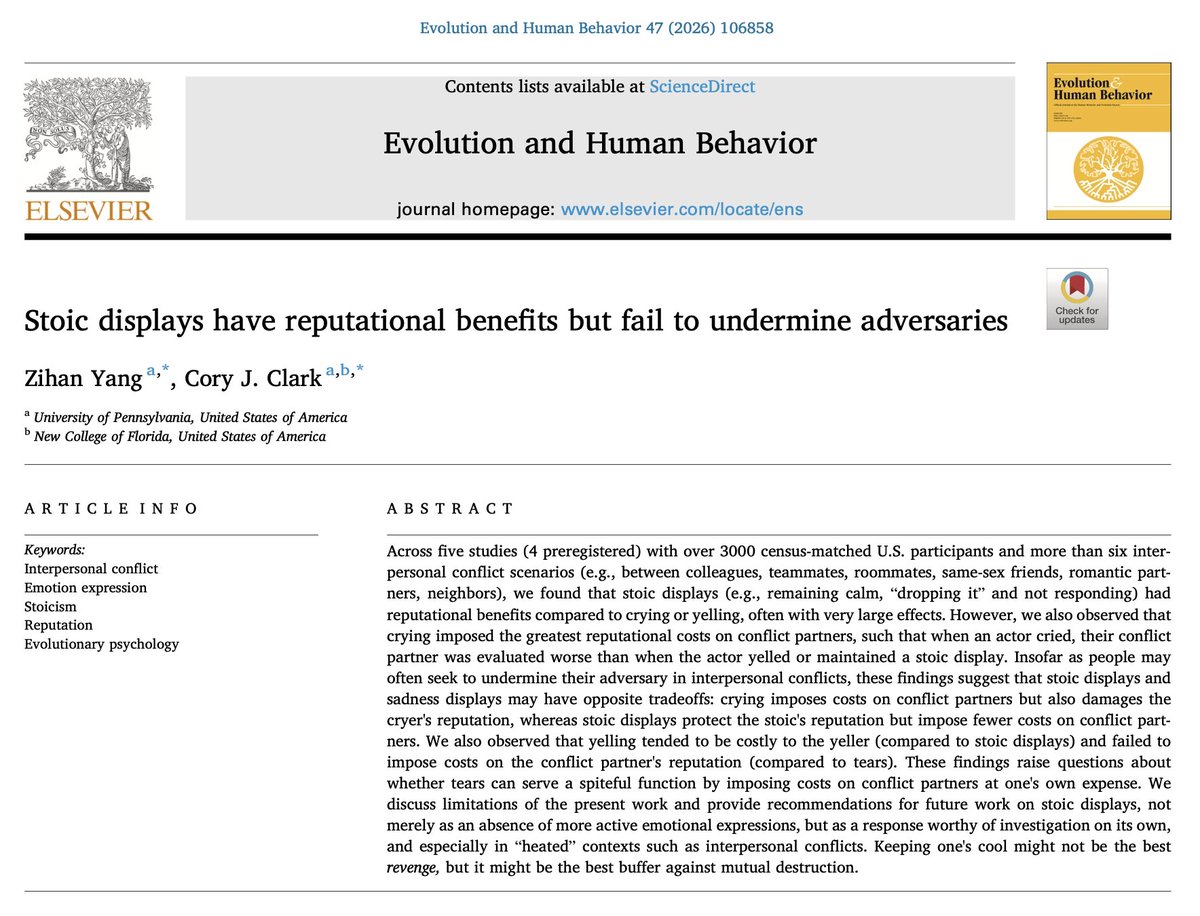
"Across five studies...with over 3000 census-matched U.S. participants and more than six interpersonal conflict scenarios...we found that stoic displays (e.g., remaining calm, “dropping it” and not responding) had reputational benefits compared to crying or yelling, often with very large effects." @ImHardcory
"More Solutions, More Problems."
Check out Cory Clark's (@ImHardcory) and Maja Graso's introduction to their special issue on "Normative Scientific Conflicts" here: https://t.co/mFomuIPjiN
And check out the full special issue: https://t.co/2F8rNKExzQ
2. The coolest result? The adversaries actually updated. What began as substantial disagreement ended in broad agreement after seeing the results of jointly designed experiments.
Led by the brilliant Barb Mellers: https://t.co/0WMJly4yBk
1. Adversarial collaborations are hard.
AI can help make them easier.
Our new PNAS paper used AI to help structure an adcollab on minority salience, identifying points of agreement and disagreement, organizing competing claims, and generating experiments.
5. These findings suggest that trust in science may be strengthened more by acknowledging uncertainty, mistakes, and disagreement than by dismissing critics, minimizing errors, or appealing to authority.
Led by the brilliant Maja Graso.
Read here: https://t.co/gCXWe5KscK
1. Does drawing harder boundaries between science and "misinformation" increase or decrease public trust in science?
In four studies conducted in the context of COVID-19, we tested this question by comparing different approaches to science communication.
https://t.co/gCXWe5KscK
4. Across studies, accountability-embracing messages generally elicited greater confidence than authoritative messages among both Republicans and Democrats.
Such a pleasure and honor to share the stage yesterday (May 27) with these thinkers (@slsatel, @byrne_a, @CHSommers & @ImHardcory), discussing whether science (and perhaps most everything else) has become "feminized." Check it out at @LeorSapir's link below.
Has science become feminized? A discussion on sex differences, scientific culture, and what the evidence says. @ImHardcory presents; @byrne_a, @CHSommers, and I respond. Moderated by @slsatel. Join us @AEI May 27, 10am EST, live or streaming. Register: https://t.co/V4TfWroQqo
@PamelaParesky@HeatherEHeying@CHSommers Possibly me--I believe she mentions my Quillette article (Sex and the Academy) in her article. Although a handful of folks wrote similar things around the same time, so who knows🤷♀️
7. This paper is particularly special because it was first-authored by my brilliant *undergrad* mentee Zihan Yang, who will be starting her PhD at University of Michigan this coming fall. Check out her hard work here (open access): https://t.co/RFarudf3qJ
1. Were the Stoics masters of reputation management?
My latest in Evolution and Human Behavior tests the reputational consequences of different emotional displays in interpersonal conflicts:
https://t.co/RFarudf3qJ
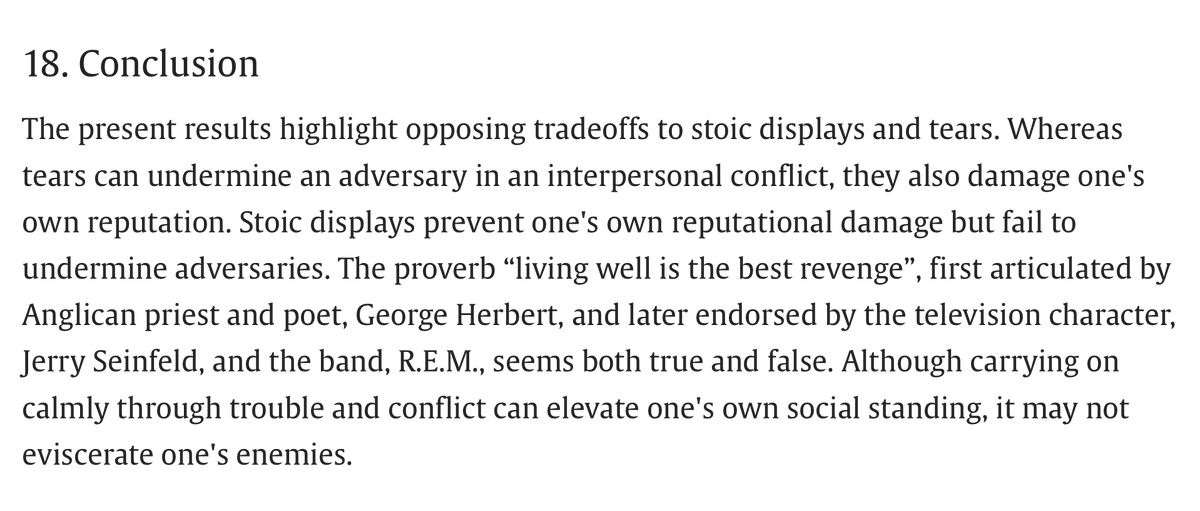
6. These findings suggest that remaining calm and composed in the face of conflict protects one’s own reputation but fails to eviscerate one’s enemies. In contrast, tears seem to serve a spiteful function by imposing costs on conflict partners at one's own expense.