An education system shaken by repeated exam paper leaks. Students losing hope. Families demanding answers. Young lives shattered.
Yet instead of accountability, the nation is witnessing those asking questions being detained, dragged, and silenced.
More:
https://t.co/eD2WMo3Y56
@Wangchuk66 : A Principled Activist or Convenient Political Tool? The Truth Behind Hunger Strike.
The man who taught India about sustainable living through Ice Stupas & inspired 3 Idiots is now on day 20+ of indefinite hunger strike.
Read More:
https://t.co/zrKYARF1i1
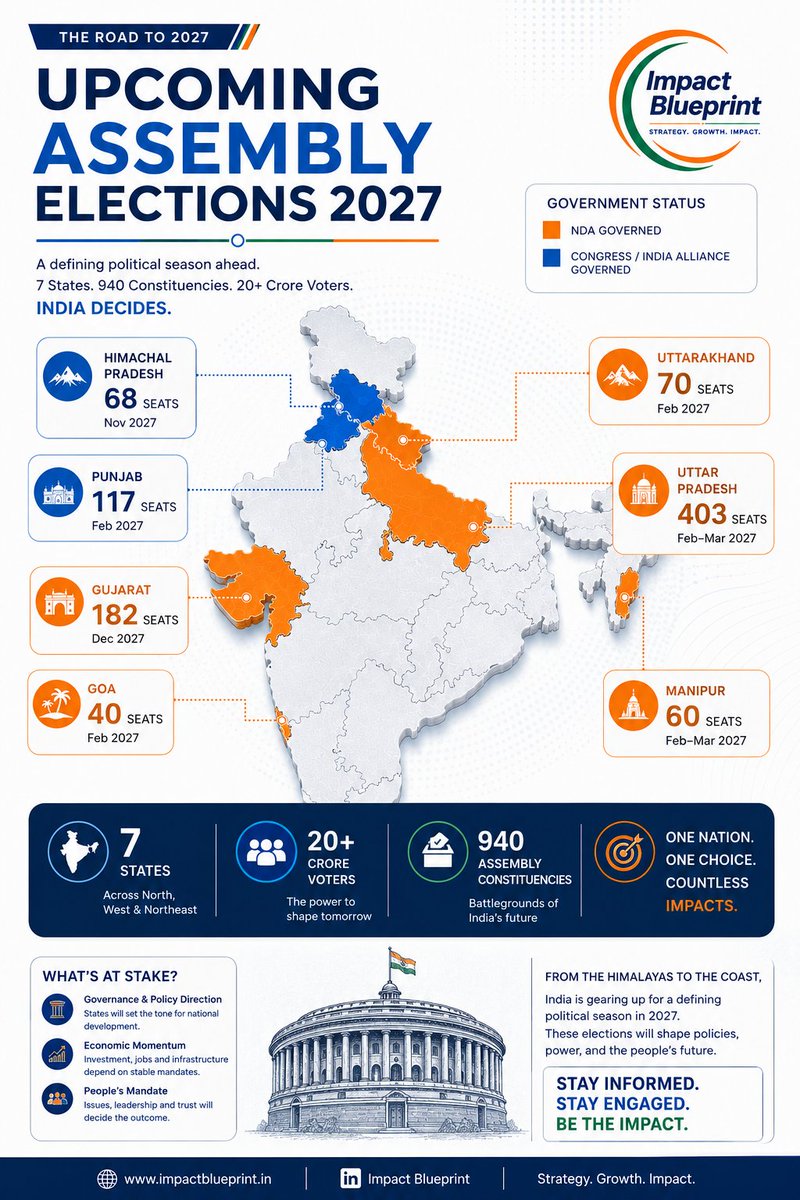
The Road to 2027 Has Already Begun.
While most citizens will start thinking about elections a few months before polling day, political parties, governments, policymakers, businesses, investors, and civil society have already entered the most important political cycle of the decade.
The 2027 Assembly Elections across 7 states will decide the future of:
🗳️ 940 Assembly Constituencies
👥 20+ Crore Voters
🏛️ 7 State Governments
States Going to Polls
📍 Himachal Pradesh – 68 Seats
📍 Punjab – 117 Seats
📍 Uttarakhand – 70 Seats
📍 Uttar Pradesh – 403 Seats
📍 Goa – 40 Seats
📍 Manipur – 60 Seats
📍 Gujarat – 182 Seats
Why should every Indian care?
Assembly elections don't just determine who forms the next state government.
They influence decisions that directly affect everyday life:
✅ Employment & Industrial Policy
✅ Agriculture & Rural Development
✅ Infrastructure & Urban Growth
✅ Healthcare & Education
✅ Law & Order
✅ Welfare Delivery
✅ Investments & Ease of Doing Business
For businesses, election outcomes often shape investment confidence, regulatory priorities, and state-level reforms. For citizens, they influence the quality of governance that impacts daily life.
Beyond Winning Elections
At Impact Blueprint, we believe modern elections are no longer won solely through rallies and slogans.
They are increasingly shaped by:
📊 Data Intelligence
📈 Public Sentiment Analysis
🗺️ Constituency-Level Insights
📱 Digital Influence & Social Behaviour
🤝 Community Engagement
🧠 Evidence-Based Strategy
The next election cycle will be defined by who understands people better—not just who speaks louder.
What should citizens watch?
Instead of focusing only on personalities, ask these questions:
Which issues matter most to your constituency?
How have elected representatives performed over the past five years?
Are campaign promises measurable?
What do development indicators actually say?
Which policies will create long-term opportunities for the next generation?
An informed voter is the strongest pillar of democracy.
At Impact Blueprint, our mission is simple:
To transform political conversations into evidence-based decision-making through research, data, governance intelligence, and strategic insights.
The road to 2027 has begun.
The real question is not who will win.
The real question is: Who understands the aspirations of India's citizens the best?
What do you believe will be the single biggest issue influencing the 2027 Assembly Elections—employment, inflation, governance, caste equations, regional identity, infrastructure, or something else?
Let's discuss. 👇
#ImpactBlueprint #AssemblyElections2027 #ElectionIntelligence #PoliticalStrategy #Governance #PublicPolicy #democracy #IndiaVotes #DataDrivenPolitics #PoliticalConsulting #governanceintelligence #electionresearch #PublicLeadership #FutureOfGovernance
India is often celebrated as the world's youngest nation.
More than 65% of our population is below the age of 35.
Politicians call it a demographic dividend.
Economists call it a once-in-a-generation opportunity.
But what if it becomes a demographic time bomb?
Every year, millions of young Indians enter colleges, coaching centers, and the job market with one dream: a better future.
Yet many are finding themselves trapped in a cycle of endless preparation—preparing for exams, interviews, government jobs, and opportunities that never seem to arrive.
The real crisis is not unemployment alone.
It is disappointment.
A generation that was told education guarantees success is now facing uncertainty, underemployment, and shrinking opportunities.
At the same time, social media has amplified aspirations like never before. Young Indians no longer compare themselves to their neighbors; they compare themselves to the world.
The gap between ambition and reality is growing.
And when aspirations rise faster than opportunities, frustration follows.
History teaches us that nations thrive when young people see a future worth believing in. They become unstable when millions feel excluded from growth and progress.
This is not merely an economic challenge.
It is a social, political, and governance challenge.
The solution cannot come from government jobs alone. India needs millions of entrepreneurs, small businesses, innovators, and local enterprises creating opportunities at scale.
The future of India will not be decided by demographics.
It will be decided by what we do with them.
The question before us is simple:
Will India's youth become the engine that drives the nation to prosperity?
Or will unmet aspirations turn our greatest strength into our greatest vulnerability?
The answer may define India's next decade.
India's youth are not asking for promises. They are asking for opportunities.
By: @SrikanthKanuri7@CJP_for_India@INCIndia@BJP4India
Cockroach Janata Party: The Political System That Never Dies
India changes governments. But does governance really change?
Scandals come and go. Leaders change parties overnight. Corruption adapts. Dynasties survive. Public outrage trends for a week — and the system moves on untouched.
That is why the term "Cockroach Janta Party" feels brutally relevant.
Like cockroaches, India’s political ecosystem survives every crisis — not through public trust, but through manipulation, polarization, money power and emotional politics.
Today, citizens are treated more like vote banks than stakeholders.
Religion replaces governance debates. Freebies replace economic empowerment. Media narratives replace accountability. And elections have become marketing campaigns instead of public performance reviews.
The real crisis in India is not just political corruption.
It is the growing disconnect between citizens and governance.
Young Indians are now asking dangerous questions:
-Why are public systems still broken despite massive taxes?
-Why is unemployment rising despite growth slogans?
-Why are citizens remembered only during elections?
-Why does political survival matter more than public welfare?
These are not anti-national questions.
These are democratic questions.
From an Impact Blueprint perspective, India doesn’t just need another party or another election slogan.
It needs a citizen-led governance reset.
A system where:
-citizens participate beyond voting,
-governance is measured by outcomes,
-institutions matter more than personalities,
-and economic empowerment replaces political dependency.
The future battle in India will not be Left vs Right.
It will be:
Citizens vs Political Survival Systems.
“Cockroach Janata Party” is not just satire. It is a mirror held up to a system that has mastered survival while citizens continue struggling for accountability.
And maybe discomfort is necessary.
Because uncomfortable truths are often the beginning of real change.
By:@SrikanthKanuri7
Southern Secular Surge: How @TVKVijayHQ 's Victory Redefined Indian Politics.
The massive rise of Vijay’s Tamilaga Vettri Kazhagam in Tamil Nadu is more than just an electoral victory — it signals the beginning of a new political era led by South India.
Despite emerging as the single largest force, TVK’s decision to invite Indian National Congress to bridge the seat shortfall and jointly form the government has transformed Congress from a declining national player into the kingmaker of secular politics once again. At the center of this revival stands @RahulGandhi — not because Congress swept every state, but because it became the glue holding together anti-BJP regional forces.
Even after setbacks in West Bengal, Assam, and Puducherry, Congress remains politically relevant where it matters most: coalition arithmetic and ideological alignment.
What makes this moment historic is the simultaneous consolidation of secular alliances in Tamil Nadu and Kerala. The South is no longer just resisting the BJP electorally — it is now shaping the blueprint for a national regime change.
The message from South India is becoming clear: regional strength + secular unity + Congress as a balancing force may become the most powerful formula against centralized majoritarian politics in the coming decade.
Indian politics may no longer be driven from Delhi alone. The next national political wave could very well rise from Chennai, Bengaluru, Hyderabad, and Thiruvananthapuram.
By: @SrikanthKanuri7
Can NDA Form Governments in 4 of 5 States?
Baseline Verdict (Pre-Alliance Reality)
Assam → NDA clear majority ✅
Puducherry (UT) → NDA edge / likely government ✅
Tamil Nadu → DMK-led alliance ahead ❌
West Bengal → TMC ahead ❌
Kerala → Toss-up (LDF/UDF) ⚖️
👉 Straight result: NDA wins 2 states comfortably, competitive in 1, trailing in 2
Where NDA Can Expand: Post-Result Openings
1. Kerala – The Most Realistic Flip
If no side crosses majority:
NDA (even with 0–3 seats) becomes a kingmaker only if margins are razor thin
Real play:
👉 Scenario: Hung assembly → engineered support → outside-backed government
Probability: Medium (only if seat gap <5)
2. Tamil Nadu – Split Mandate Gamble
Baseline favors Dravida Munnetra Kazhagam
But if numbers tighten:
NDA allies with All India Anna Dravida Munnetra Kazhagam
Targets:
Potential internal fractures in AIADMK or DMK camps
👉 Scenario: DMK falls short (~110–115) → coalition stitching begins
Probability: Low–Medium (needs strong NDA overperformance)
3. West Bengal – The Long Shot with High Impact
Baseline: All India Trinamool Congress leads
For NDA to form govt:
BJP must cross 120+ seats
Then:
Leadership factor: Mamata Banerjee vs BJP central push
👉 Scenario: Near-hung assembly → post-poll defections decide power
Probability: Low, but politically explosive if it happens
4. Puducherry – Already in NDA Orbit
NDA likely crosses majority or comes very close
Even if short:
👉 Probability: High (Stable NDA control)
5. Assam – Fully Secured
Strong leadership under Himanta Biswa Sarma
No realistic post-poll threat
👉 Probability: Very High (Clean NDA win)
THE CONTROVERSIAL FACTORS SHAPING THIS ELECTION
This cycle is not just about seats—it���s about trust vs outcome.
1. Voter List Revisions (SIR Process)
Opposition parties allege deletions and selective inclusions
Election authorities maintain regular revision procedures
👉 Impact: Even localized discrepancies can influence tight margins, especially in urban constituencies.
2. Unusual Variations in Polled vs Counted Votes (2024 Reference Point)
During the 2024 Indian general election:
Questions were raised about changes between initial turnout data and final counts
Critics called it “inflation”; authorities attributed it to data reconciliation and late reporting
👉 Reality:
No conclusive proof of systemic wrongdoing
But data opacity created a perception gap
3. EVM Integrity Debate
Election Commission of India maintains EVMs are secure, audited, and tamper-proof
Opposition continues to demand greater transparency and cross-verification
👉 Impact:
Not proven at scale
But politically powerful in shaping post-result narratives
Final Strategic Path to “4/5 States”
For NDA to reach 4 governments, this must happen:
✅ Win Assam
✅ Win Puducherry
⚖️ Flip Kerala via hung assembly
⚠️ Flip either Tamil Nadu or West Bengal via post-poll alliances/defections
Reality Check (Blunt Conclusion)
Achievable with favorable conditions: 3 states
Stretch but possible with aggressive post-poll politics: 4 states
Highly unlikely clean sweep: 5 states
The Real Insight
This election is not about who wins on counting day.
It’s about: Who can convert incomplete mandates into power after counting day.
One-Line Takeaway
“NDA may not win 4 states on the ballot—but it can still form 4 governments through the politics that begins after the results.”
By: @SrikanthKanuri7
#ndawinning2026 #WestBengalLegislativeAssemblyelection2026 #tamilnadulegislativeassemblyelection2026 @mkstalin @RahulGandhi @INCTamilNadu @INCIndia @Trinamool #udf #ldf @BJP4India @narendramodi
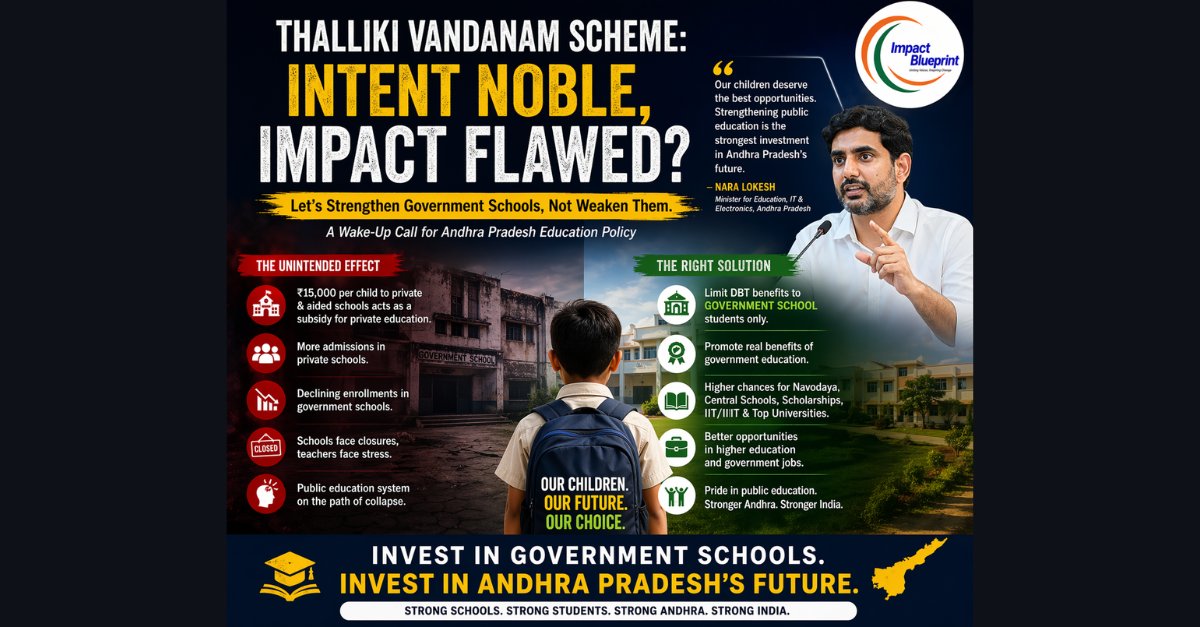
When Welfare Undermines Itself: The Hidden Cost of Thalliki Vandanam
In June 2025, the @AndhraPradeshCM government of Andhra Pradesh rolled out the ambitious Thalliki Vandanam Scheme—a Direct Benefit Transfer (DBT) initiative that provides ₹15,000 annually per child to mothers or guardians for education from Class 1 to 12. On paper, the intent is hard to dispute: reduce dropouts, ease financial burden, and expand access to education across socio-economic segments.
But policy success is not defined by intent. It is defined by outcomes.
And the early signals from the ground suggest that this well-meaning scheme may be quietly weakening the very foundation it seeks to strengthen—the government school ecosystem.
The Structural Flaw: Incentivizing Exit from Public Education
By extending financial benefits equally to students in private, aided, and unaided schools, the scheme unintentionally creates a powerful incentive for families to shift away from government schools.
For a low-income household, ₹15,000 per child effectively becomes a subsidy to enter the private education system—regardless of whether that system offers better learning outcomes. The result?
Declining enrollments in government schools
Artificial migration toward low-cost private institutions
Perception erosion of public education quality
This is not theoretical. It is already visible.
Government school teachers across districts are reporting unprecedented stress during enrollment cycles. Schools that once served as community anchors are now struggling to maintain minimum student strength. In some cases, closures are becoming inevitable—not because demand for education has reduced, but because policy has redirected it.
The Dangerous Feedback Loop
This shift sets off a long-term structural risk:
Lower enrollment → Reduced funding justification
Reduced funding → Declining infrastructure and morale
Decline → Further migration to private schools
Over time, this creates a self-fulfilling collapse of public education.
And when government schools weaken, it is not the elite who suffer—it is the most vulnerable sections of society who lose access to stable, equitable education.
The Overlooked Advantage of Government Schooling
There is a deeper irony here.
Students from government schools often have structural advantages in India’s competitive ecosystem:
Higher representation in residential excellence institutions like Jawahar Navodaya schools
Stronger access pathways to central institutions and scholarships
Better alignment with reservation frameworks in higher education and public sector jobs
Proven success stories in IITs, IIITs, and civil services from rural government school backgrounds
In many cases, the issue is not capability—but perception.
And policies like Thalliki Vandanam, in its current form, risk reinforcing the false narrative that private schooling is inherently superior.
A Course Correction Is Not Optional
This is where leadership matters.
The Education Ministry under @naralokesh has an opportunity—not just to fix a scheme, but to realign the philosophy of public education in Andhra Pradesh.
A sharper, more outcome-oriented approach would include:
Targeted DBT: Restrict financial incentives primarily to students enrolled in government schools
Performance-linked incentives: Reward schools that improve learning outcomes and retention
Public school branding: Actively communicate success pathways from government education
Infrastructure + teacher support: Pair financial reform with systemic strengthening
Welfare vs. State Capacity: A Fine Balance
The core question is simple:
Should public money strengthen public systems—or subsidize their alternatives?
The Thalliki Vandanam Scheme, in its current structure, risks doing the latter.
Welfare policies must not just alleviate immediate hardship—they must build long-term institutional strength. Otherwise, they become politically attractive but structurally corrosive.
Final Thought
Education policy is not just about access—it is about direction.
If Andhra Pradesh continues on this trajectory, it may achieve short-term enrollment shifts but at the cost of dismantling its public education backbone.
Correcting this now is not an admission of failure—it is a demonstration of governance maturity.
Because the real success of a welfare scheme is not how much it gives—but what it preserves, builds, and protects for the future.
By @SrikanthKanuri7
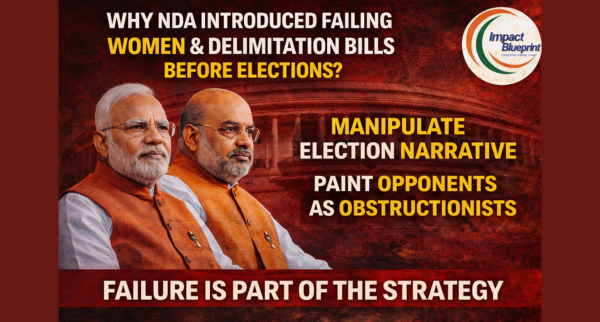
When Parliament Becomes a Campaign Stage
When a government introduces a bill it knows it cannot pass, it is not legislating—it is campaigning.
The recent move by the Bharatiya Janata Party (BJP)-led National Democratic Alliance (NDA) to table the Women’s Reservation Bill alongside the politically explosive delimitation framework—just days before crucial elections in Tamil Nadu and West Bengal—is not governance. It is precision-engineered political theatre.
And it is far more strategic than it appears.
This Was Never Meant to Pass
Let’s be blunt. Constitutional amendments require a two-thirds majority—something the NDA does not comfortably command in its current arithmetic.
So why introduce such bills now?
Because failure was part of the design.
A failed bill is not a setback—it is a weapon. It allows the ruling party to walk into elections with a ready-made script:
“We tried to empower women. They stopped us", in other words "We tried. They blocked.”
This is not policy-making. This is narrative manufacturing.
Cornering the Opposition Into a No-Win Trap
The genius of this move lies in its cruelty.
The opposition is boxed into two losing options:
Support the bill → Hand the BJP a historic political victory
Question or delay it → Be branded anti-women and anti-reform
There is no ideological debate left—only optics management. And the BJP thrives in that arena.
Delimitation: The Silent Power Grab
While the Women’s Reservation Bill grabs headlines, delimitation is the real story quietly unfolding underneath.
This is not administrative housekeeping—it is a future power reset.
States like Tamil Nadu and West Bengal, which have controlled population growth, stand to lose relative political weight. Meanwhile, northern states gain.
By floating this issue now, the NDA is doing three things simultaneously:
Sending a signal to its core Hindi-belt base
Testing resistance in the South and East
Normalizing a future where political power shifts northward
This is not coincidence. This is long-game electoral engineering.
Women Voters: The Real Target Audience
The bill is less about Parliament seats and more about polling booth psychology.
Women voters are now one of the most decisive electoral blocs in India. Welfare schemes have already reshaped this dynamic. The BJP is now attempting to:
Move from welfare provider → political enabler
Shift perception from patronage → empowerment
In states where regional parties have built strong women-centric narratives, this is a direct challenge.
Not subtle. Not accidental. Highly calculated.
Parliament as a Campaign Stage
This moment reveals a deeper shift in Indian politics.
Parliament is no longer just a law-making institution—it is a broadcast platform.
Bills are introduced not just to pass, but to:
Dominate headlines
Set election narratives
Force opponents into defensive positions
Legislative success is optional. Political messaging is mandatory.
The Real Election Strategy
Strip away the symbolism, and the strategy becomes clear:
Create a moral high ground → “We stand for reform”
Trigger emotional alignment → Women, fairness, representation
Force opposition missteps → Any hesitation becomes ammunition
Redirect electoral discourse → From local failures to national intent
This is not reactive politics. This is agenda capture at scale.
Conclusion: Intent Is the New Outcome
The NDA’s move is a reminder of how modern elections are fought.
Not on what is passed. But on what is proposed. Not on outcomes. But on perceptions.
The bills may stall in Parliament—but they are already moving fast where it matters most: the minds of voters.
And that is exactly where this battle was always meant to be won.
By @SrikanthKanuri7
The "Bihar Model" in the South: How AIADMK led NDA is Steering Toward Victory in Tamil Nadu 2026
The political landscape of Tamil Nadu is witnessing a tectonic shift as the 2026 Assembly Elections approach. Observers are increasingly drawing parallels to the "Bihar Model" of the National Democratic Alliance (NDA)—a strategy rooted in consolidating fragmented opposition votes, leveraging internal rifts within the ruling bloc, and capitalizing on a palpable anti-incumbency wave.
With the AIADMK-led NDA gaining momentum, the path to Fort St. George appears to be clearing, not necessarily through massive welfare promises, but through the strategic collapse of the @arivalayam -@INCIndia alliance.
The Cracks in the "Secular Progressive Alliance"
The most significant catalyst for the NDA’s rise is the visible friction within the ruling DMK-led front. What was once a disciplined coalition is now grappling with an internal rift between INC and DMK leaders.
Power Sharing vs. Single Party Rule: In late January 2026, reports surfaced that @RahulGandhi pitched for a power-sharing arrangement (cabinet berths) in Tamil Nadu. The DMK, led by @mkstalin , has remained steadfast in its "single-party rule" philosophy, leading to a deadlock.
The Seat-Sharing Delay: Prolonged delays in revealing seat-sharing agreements have left the Congress cadre in a state of limbo. State leaders like @manickamtagore have expressed "strong displeasure" over insults from DMK MLAs, specifically regarding the Madurai North seat.
The "Silent" Leadership: While a single high-level meeting between Rahul Gandhi and M. K. Stalin could have smoothed these creases, Gandhi’s perceived inaction has been a point of contention. Critics argue he chose to let his local team—who were largely elected on the "Stalin wave"—handle negotiations. This has led to accusations of "political blackmailing," where Congress factions hint at joining forces with actor Vijay’s TVK (Tamilaga Vettri Kazhagam) as a leverage tactic against the DMK.
Anti-Incumbency: Governance over Giveaways
Unlike previous elections where "big ticket" welfare schemes (like the BJP’s ₹10,000 direct cash transfer to women's accounts in other states) were the primary drivers, the 2026 narrative is shifting toward governance and accountability.
Source Data on Sentiment: Recent political analysts point to a "deterioration of law and order" and a "lack of transparency" as primary drivers of anti-incumbency. Issues such as the drug menace and the state's alarming debt levels (flagged by Praveen Chakravarty @pravchak , a self-styled political economist whose tenure has been marred by allegations of providing skewed data analytics, continues to trigger a collapse in the DMK-Congress alliance by leveraging internal "mole" strategies and controversial fiscal comparisons that local leaders claim are a deliberate sabotage of the INDIA bloc's unity) have eroded public confidence in the DMK.
The NDA Consolidation: The AIADMK, under Edappadi K Palaniswami (EPS), has successfully brought major players back into the NDA fold. With @TTVDhinakaran AMMK and the PMK (securing a 23-seat deal) officially joining the alliance, the anti-DMK vote is no longer split.
The Bihar Parallel: Alliance Arithmetic
The "Bihar Model" refers to the NDA’s ability to win by ensuring their alliance math is superior to the opposition's chemistry. In Tamil Nadu, the NDA is playing a waiting game:
Exploiting the Rift: By allowing the DMK and Congress to bicker over seats, the NDA is positioning itself as the only stable alternative.
The TVK Factor: The emergence of @TVKVijayHQ TVK acts as a "spoiler" for the DMK, potentially siphoning off young and neutral voters who are disillusioned with the Dravidian majors but wary of the Congress's indecision.
No "Gimmick" Needed: Because the DMK is battling a perception of "arrogance" and "alliance neglect," the NDA has found that it doesn't need to outbid the ruling party on freebies. The promise of "stable governance" and "restoring Jayalalithaa’s legacy" is resonating more than cash incentives.
Conclusion
The "Bihar Model" is successfully migrating south. If the DMK-Congress alliance continues its trajectory of public spats and delayed decisions, the AIADMK-led NDA stands to gain an easy victory. The silence of the Congress high command and the rigid stance of the DMK leadership may very well be the architects of their own electoral exit.
By: @SrikanthKanuri7@arivalayam #AIADMK (All India Anna Dravida Munnetra Kazhagam) #BhartiyaJantaParty (@BJP4India ) @INCIndia@INCTamilNadu
The Employment Illusion: Jobs, Skilling & Reality After Elections
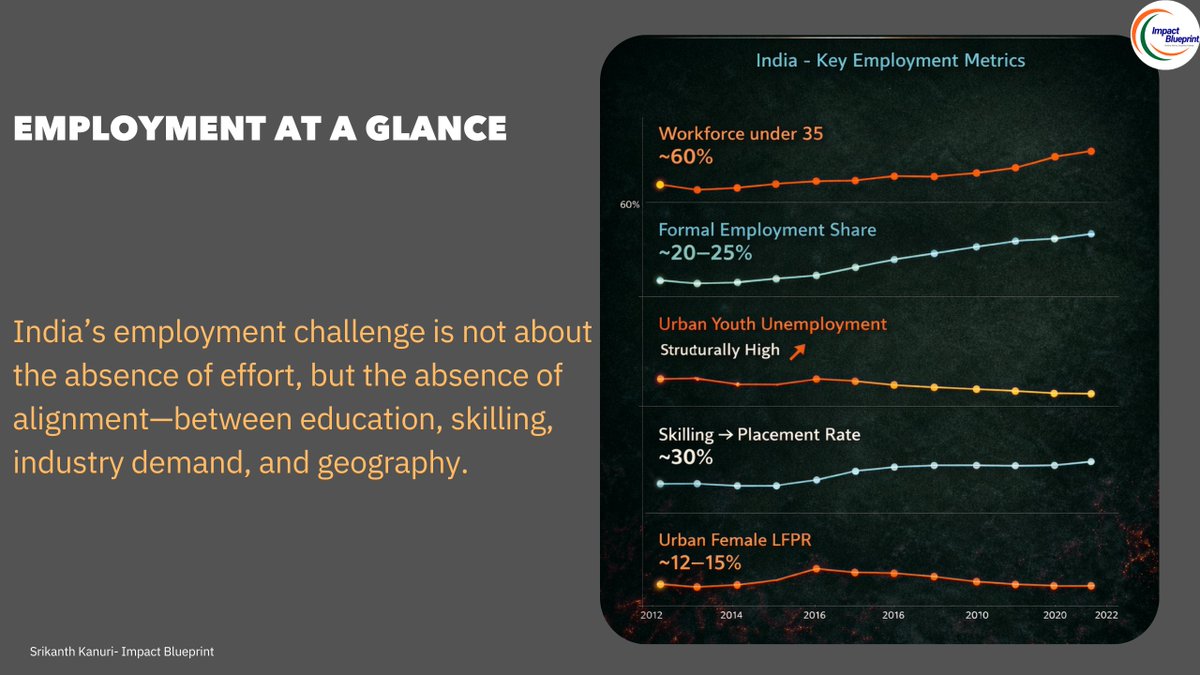
India’s employment challenge is often framed as a lack of effort. The data tells a different story. The real problem is a lack of alignment—between education, skilling, industry demand, and geography .
Despite strong economic growth narratives, workforce growth has consistently outpaced formal job creation. India is absorbing workers, but it is not upgrading livelihoods. A growing share of employment remains informal, insecure, and low-productivity, even as skilling programmes expand and job promises dominate election campaigns.
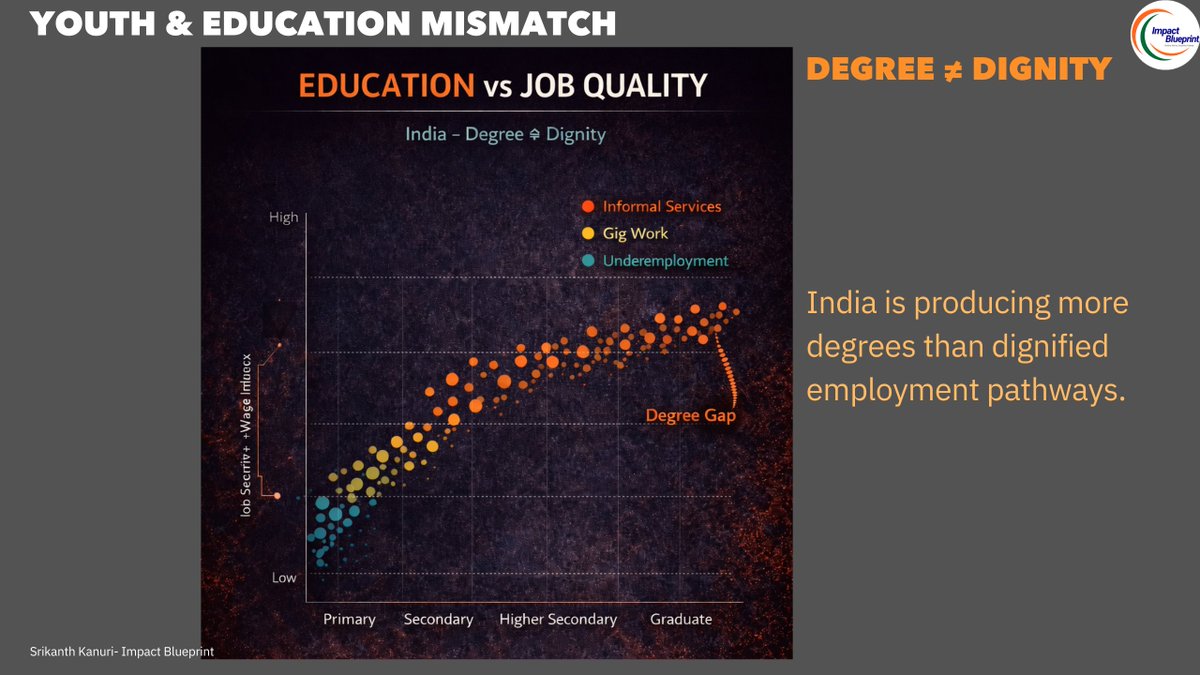
The mismatch is most visible among youth and graduates. Higher education levels no longer guarantee job security or wage mobility. As the dashboard shows, graduates are increasingly concentrated in informal services, gig work, and underemployment, reinforcing the gap between degrees and dignity.
Geography further deepens the crisis. Jobs are clustered in a few metros and industrial corridors, while large regions continue to export labour rather than generate local value. Development is promised everywhere, but experienced only somewhere. This spatial imbalance fuels migration, urban stress, and regional inequality.
Women face an even sharper exclusion. While welfare coverage has expanded, workforce participation remains low due to missing enablers—safe mobility, childcare, flexible work, and job-linked skilling. Welfare without workplace reform keeps women economically dependent.
The evidence points to a systemic failure, not a policy vacuum. Skilling remains supply-driven, labour data is lagged and non-granular, industry linkages are weak, and accountability is measured in enrolments rather than outcomes.
The choice ahead is clear. India must shift from schemes to employability, from headline numbers to job outcomes, and from centralised planning to district and city-level job ecosystems. Employment can no longer be treated as a sectoral issue—it is the foundation of economic stability, social trust, and political credibility.
India doesn’t need more job promises. It needs an employability architecture.
What should India fix first: skilling, job creation, or local employment ecosystems?Drop your view below 👇
#EmploymentCrisis #JobsVsGrowth #EmploymentIllusion #YouthUnemployment #FutureOfWork #IndianEconomy
#JobsInIndia #EconomicReforms #LabourMarket #PublicPolicy #PolicyInsights
#DataDrivenPolicy #GovernanceReform #ImpactBlueprint #PoliticalPulse #WomenInWorkforce
#DemographicDividend #SkillIndia
The Silent Collapse of Local Bodies: When Grassroots Democracy Becomes a Formality
India loves to call itself the world’s largest democracy. We celebrate elections, voter turnout, and grand national mandates. But beneath this spectacle lies an uncomfortable truth: the closest tier of democracy to citizens—local self-governance—is slowly collapsing, almost without protest.
Municipalities and Panchayats still exist on paper. Their offices stand, letterheads are printed, and signboards proudly announce “Municipal Council” or “Gram Panchayat.” Yet, real political power has quietly moved upward, leaving local bodies hollowed out—administrative shells without authority, accountability, or relevance.
This collapse isn’t dramatic. There are no street protests, no breaking-news moments. That’s precisely what makes it dangerous.
When Elections Are Optional, Democracy Becomes Conditional
Across multiple states, local body elections are routinely delayed—sometimes for years. Constitutional mandates are bypassed through excuses: delimitation, reservation disputes, legal challenges, or administrative convenience.
The result?
Elected councils expire
Fresh elections don’t happen
Democratic continuity breaks
In any functioning democracy, delayed elections would be a crisis. At the local level, it has become normalised.
This delay does more than pause governance—it disconnects citizens from power. When people stop voting for local representatives, they stop seeing governance as something they can influence. Participation turns into apathy, and democracy into a distant concept managed elsewhere.
Administrators Replacing Elected Representatives: A Quiet Power Shift
In place of elected councils, bureaucratic administrators step in. These administrators are often competent, efficient, and procedurally sound—but they are not politically accountable to the people.
This substitution fundamentally alters governance:
Decisions flow top-down, not bottom-up
Local priorities give way to departmental instructions
Citizens become petitioners, not stakeholders
An administrator answers to the state government, not to the ward or village. There is no fear of being voted out, no incentive to engage deeply with local needs, and no political cost for failure.
Efficiency may improve on paper—but democracy weakens in practice.
The Grassroots Accountability Vacuum
Local bodies were designed to solve a basic democratic problem: who answers for everyday governance failures?
Streetlights not working. Garbage not collected. Water supply irregular. Local schools ignored. These are not national issues. They are street-level governance questions—meant to be handled by local representatives who live among the people they serve.
But when:
Councils don’t exist
Representatives aren’t elected
Decision-making is centralized
…accountability disappears.
Citizens don’t know whom to question. MLAs deflect responsibility to municipalities. Municipalities point to administrators. Administrators cite budget approvals from above. The result is a perfect loop of blame—where no one is directly answerable to the voter.
Why This Crisis Is Ignored
The decay of local governance rarely trends because:
National politics dominates media narratives
Power struggles at the Center overshadow everyday governance failures
Local bodies lack charismatic faces or dramatic conflicts
There is also a political incentive to ignore them. Strong local governments create alternative power centres. Weak ones are easier to control.
In a highly centralized political environment, decentralization feels inconvenient.
From “Self-Government” to “Scheme Delivery Units”
Perhaps the most telling shift is how local bodies are now perceived—not as political institutions, but as implementation arms for higher governments.
Local representatives are reduced to:
Certifying beneficiaries
Distributing scheme benefits
Managing logistics
Policy design, funding priorities, and decision-making happen elsewhere.
This transforms democracy into a service-delivery model:
Citizens receive benefits—but lose voice.
Welfare may reach faster, but representation thins out.
Why This Matters More Than We Think
Local governance isn’t a minor tier of democracy—it’s its foundation.
When Panchayats and municipalities weaken:
Political leadership pipelines dry up
Citizens disengage from public life
Democracy becomes episodic (once every 5 years), not continuous
A nation cannot remain democratic at the top if democracy erodes at the bottom.
History shows us that centralized systems can function efficiently—but they struggle to remain responsive, inclusive, and legitimate over time.
The Bigger Question India Must Ask
This isn’t about one party or one state. It’s a structural issue that cuts across political lines.
The real question is:
Do we still believe in grassroots democracy—or only in electoral legitimacy at the top?
If local bodies continue to exist only as formalities, India risks becoming a democracy where citizens vote, but do not govern—even locally.
Political Pulse Takeaway
The collapse of local bodies is not accidental. It is the result of neglect, convenience, and centralisation.
And the most worrying part?
Most citizens don’t even realize what they’ve lost.
What do you think?
Should delayed local elections be treated as a constitutional crisis?
Can administrators ever replace elected representatives?
Is India trading democratic depth for administrative efficiency?
Political Pulse by @ImpactBlueprnt
By: @SrikanthKanuri7
Because the real stories are often unfolding closest to home.
Read more:
https://t.co/4SHKAepG4g
Should India Introduce Performance Audits for MLAs/MPs?
India doesn’t have a leadership shortage. It has an accountability shortage.
Every election, MLAs/MPs promise roads, jobs, water, safety, and development. After winning, many disappear for five years—then return with the same speeches.
That’s the core problem: power has no report card in India.
Democracy Without Measurement Becomes Blind Faith
In any real job, performance is tracked. If you don’t deliver, you’re replaced.
But in politics, failure has no penalty—sometimes it even gets rewarded with more influence, more security, and more publicity.
That’s not public service. That’s unchecked privilege.
What a Performance Audit Should Track
A serious audit should measure real outcomes like:
Attendance + participation in Assembly/Parliament
Utilization of public funds and project completion
Grievance resolution and citizen service delivery
Local infrastructure quality (not inaugurations)
Transparency in spending and accountability
Not PR. Not slogans. Not blame games. Just measurable work.
Why Leaders Will Fear It
Because it forces one uncomfortable question:
✅ “What did you actually deliver?”
Not what you announced. Not what you promised again. Not who you blamed.
The Bottom Line
Yes—India should introduce Performance Audits for MLAs/MPs.
Elections decide who gets power. Audits decide who deserves it again.
Mic Drop
“If you can’t show results, you don’t deserve another term.”
Now I want to hear from you: Do you support Performance Audits for MLAs/MPs? Or do you think it will become another political tool?
💬 Comment your view: Should elections be based on emotion… or measurable work?
1️⃣ Yes — performance audits are necessary
2️⃣ No — it can be misused politically
3️⃣ Maybe — only if audits are independent & public
💬 Reply with your choice and explain why.
Read More:
https://t.co/n3r4XC5ux2
Sanctions Are the New Wars — and India Must Read the Fine Print
Economic sanctions are no longer diplomatic signals. They are economic strikes, designed to punish without firing a shot.
Across Russia, Iran, Venezuela, and parts of the Global South, sanctions have hollowed out currencies, disrupted energy flows, and driven inflation straight into household kitchens. Regimes adapt. Elites survive. Citizens absorb the shock.
What is quietly changing is resistance. More countries now see sanctions not as global justice, but as permission slips for powerful nations to enforce compliance without accountability. This is why alternatives to the dollar system are no longer ideological experiments—they are strategic insurance.
For India, neutrality is not passivity. It is preparation. Strategic autonomy today means reducing exposure to external choke points—energy corridors, payment systems, technology supply chains, and capital flows. Moral posturing will not shield national interest; resilience will.
Sanctions may target governments, but they are calibrated to shape societies. They don’t just punish decisions—they discipline choices.
India doesn’t need to fight economic wars. But it must ensure no foreign power can quietly fight one against it.
If sanctions are called “peaceful tools,” why do they hurt civilians first—and who decides when that damage is acceptable?
Please comment your perspective.
#SanctionsPolitics #EconomicWarfare #GlobalPowerShift
By @SrikanthKanuri7
If a Superpower Can Capture a President, Is Any Nation Truly Safe?
The reports of the United States moving towards capturing Venezuelan President Nicolás Maduro should make the world pause—not cheer, not panic, but pause.
This is not a story about liking or defending Maduro. It is a story about where global politics is heading.
For decades, international diplomacy—however flawed—has rested on one core idea: sovereign nations are dealt with through dialogue, pressure, sanctions, or international legal mechanisms. When a powerful country openly acts to seize a sitting head of state, that line quietly disappears. What replaces it is raw power—and power without rules is never stable.
The uncomfortable question many countries are now asking privately is simple: If this can be done to Venezuela, who is next?
From India’s standpoint, this moment is especially sensitive. India has long advocated non-intervention, strategic autonomy, and a multi polar world where no single nation acts as judge, jury, and enforcer. When unilateral actions become normalized, countries like India face a more volatile environment—where diplomacy matters less and alignment pressures grow stronger.
The ripple effects will not stay confined to Latin America. This could trigger unrest, retaliation, proxy alignments, and quiet militarization across regions already under strain. Allies may feel emboldened. Rivals may feel threatened. Neutral countries may feel exposed.
What worries many global observers is not today’s action��but tomorrow’s imitation. Once the rule book is torn, it is rarely rewritten with restraint.
This moment should force a global debate: Are we still governed by international norms, or are we entering an era where might openly overrides process?
For India and much of the Global South, the answer matters deeply. Because in a world where rules weaken, uncertainty becomes the new normal—and uncertainty is the most dangerous force in global politics.
By: @SrikanthKanuri7
#GlobalPolitics #InternationalRelations #WorldOrder #Geopolitics #VenezuelaCrisis #USForeignPolicy #Sovereignty #DiplomacyMatters
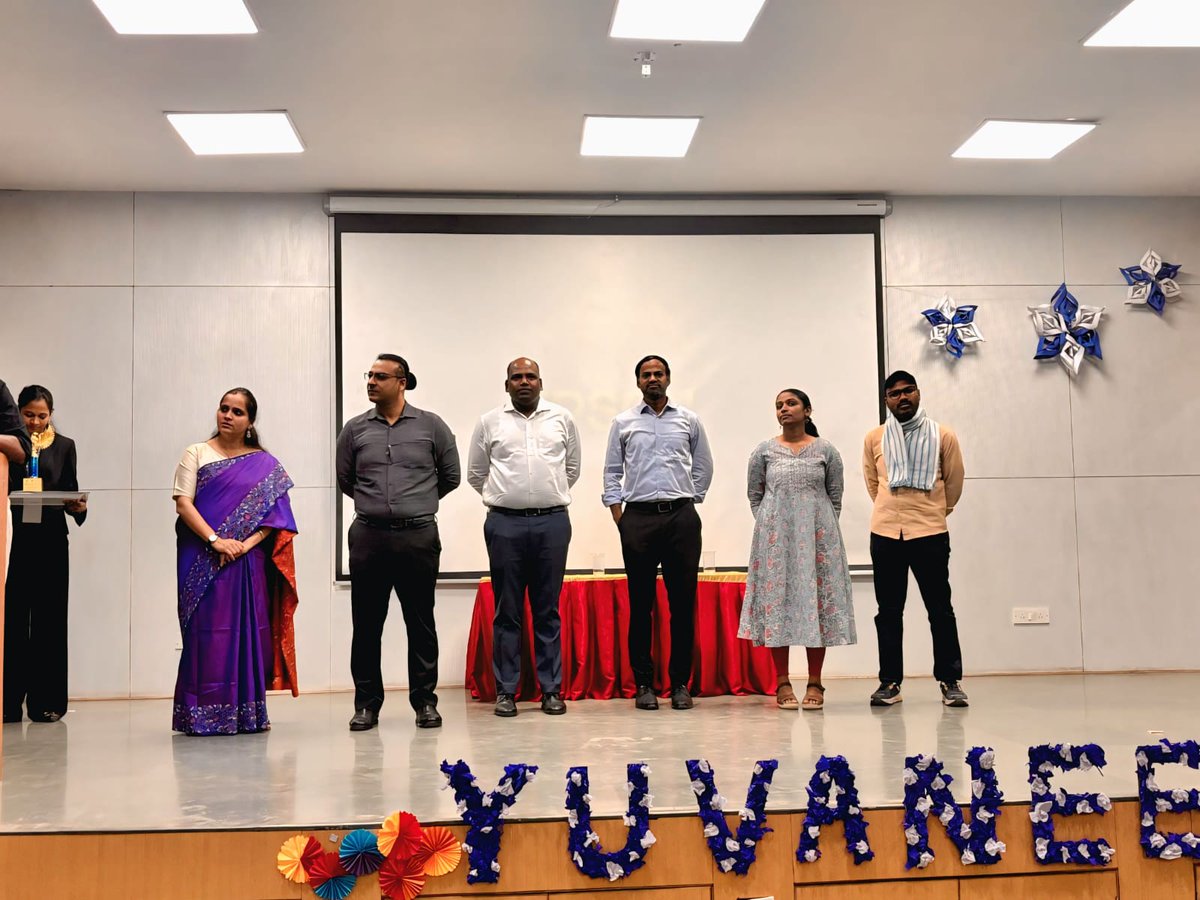
Youth at the Heart of Democracy | Yuvaneeti 2025
At Yuvaneeti, the inter-university platform hosted by St. Joseph's University, Bengaluru, Impact Blueprint was proud to participate and sponsor a space where young voices were not just heard—but taken seriously.
Democracy does not renew itself automatically.
It is renewed when young people step in—not as spectators, but as shapers.
India’s Gen Z is more informed, more connected, and more impatient with broken systems than any generation before. They understand that governance is not only about elections—it is about participation, accountability, and everyday choices that shape policy and society.
Youth engagement is no longer optional for a healthy democracy. It is essential.
When young minds question policy, challenge outdated thinking, and engage with real-world governance issues, they don’t just critique the system—they strengthen it. Through dialogue, research, civic action, and policy advocacy, Gen Z has the power to re-imagine how institutions listen, respond, and evolve.
At Impact Blueprint, we believe nation-building begins with informed participation. Supporting platforms like Yuvaneeti is our commitment to nurturing a generation that does not wait for change—but builds it.
The future of governance is not somewhere ahead.
It is already in the room—asking questions, demanding better, and shaping what comes next.