India is the absolute first to achieve this and every Indian should be extremely proud of how clever this is.
Let me explain what you are even looking at.
That video shows a freight train carrying shipping containers stacked two high, one box on top of another, running under live overhead electric wires.
Sounds simple. But it is not. No other country in the world has pulled this off. India is the only one.
Here is why it is so hard.
When you stack two containers on a wagon, the train becomes very tall. Around 7 metres. Normal electric train wires in India sit much lower, around 5.5 metres. So the two cannot share the same track. The train would smash straight into the wire.
That leaves you with a choice. Go electric and stack only one container. Or stack two containers and pull the train with a diesel engine.
The US, China, Canada and Australia all run double-stack trains. But they mostly do it with diesel, or on routes that were never electrified in the first place. Nobody bothered raising electric wires that high on old tracks.
India did both electric and double-stack together. That is the world first.
The reason India could do this is a decision from the early 2000s.
So, Indian Railways had a basic problem. Goods trains and passenger trains shared the same tracks. Passenger trains always get priority.
So freight trains crawled at 25 to 30 km/h. For a growing economy, moving goods that slowly is a major problem.
So we built separate tracks only for freight. No passenger trains allowed. These are the Dedicated Freight Corridors.
The government approved the project around 2006 and set up a company called DFCCIL to build two corridors.
The Western one runs from near Delhi to the port near Mumbai, around 1,500 km. The Eastern one runs from Punjab down to West Bengal, around 1,875 km.
Because they were building from zero, the engineers were not stuck with old bridges, old tunnels or old wire heights. They could decide the clearances themselves.
So they made a deliberate call to build the whole corridor tall enough for two stacked containers. And electrify it.
Then they had to solve two hard problems.
First, the wire. On a normal Indian line the wire hangs around 5.5 metres. On the freight corridor they raised it to about 7.5 metres. This is called high-rise OHE.
No railway in the world had run a regular freight wire that high before.
Second, the engine. If the wire is way up high, a normal loco cannot reach it. The arm on the roof that touches the wire, called the pantograph, would be too short.
So India needed a new locomotive. A taller reach. And enough power to drag thousands of tonnes.
This is why we built a new loco called the WAG-12.
It is a beast.
12,000 horsepower. Double the power of the old WAG-9 it replaced. It can haul trains over 6,000 tonnes, and up to 15,000 tonnes in some setups, at 100 km/h. That is roughly three times the old freight speed.
The WAG-12 has its own backstory. In November 2015, Indian Railways signed a deal worth about ₹19,604 crore, around 3.4 billion dollars, with the French company Alstom.
They built a new factory in Madhepura, Bihar. Indian Railways holds 26 percent, Alstom holds 74 percent. It was the largest foreign investment ever in Indian Railways.
Over time the factory reached close to 90 percent local manufacturing. So most of each loco is now made in India.
So, the government approved an infrastructure decision in the mid 2000s, then it got built over almost two decades by DFCCIL, Indian Railways and RDSO. The locomotive came through the Alstom joint venture.
The first double-stack train ran under high-rise wires in June 2020, from Palanpur and Botad in Gujarat. The corridor sections were opened in stages after that.
And finally, why only India can do this.
Three things stack up together.
One, broad gauge.
India runs on a wider track than most of the world, 1,676 mm. A wider track gives a bigger loading box. So India can run plain flat wagons with two containers on top. Many countries need special low well-cars to manage height, and those still do not fix the wire problem.
Two, the fresh corridor.
India built new track with no height limits baked in. Old networks in Europe and the US are full of low tunnels and bridges never meant for 7 metre trains. Rebuilding all of that is close to impossible and crazy expensive.
Three, the system.
The tall wire, the high-reach pantograph and the powerful WAG-12 were all designed to work together as one package. You cannot copy just one piece. You need the whole thing.
Put those three together and other railways simply cannot recreate it without rebuilding from scratch.
But the part I keep thinking about is that India approved this in 2006 and ran the first train in 2020.
Fourteen years. :)
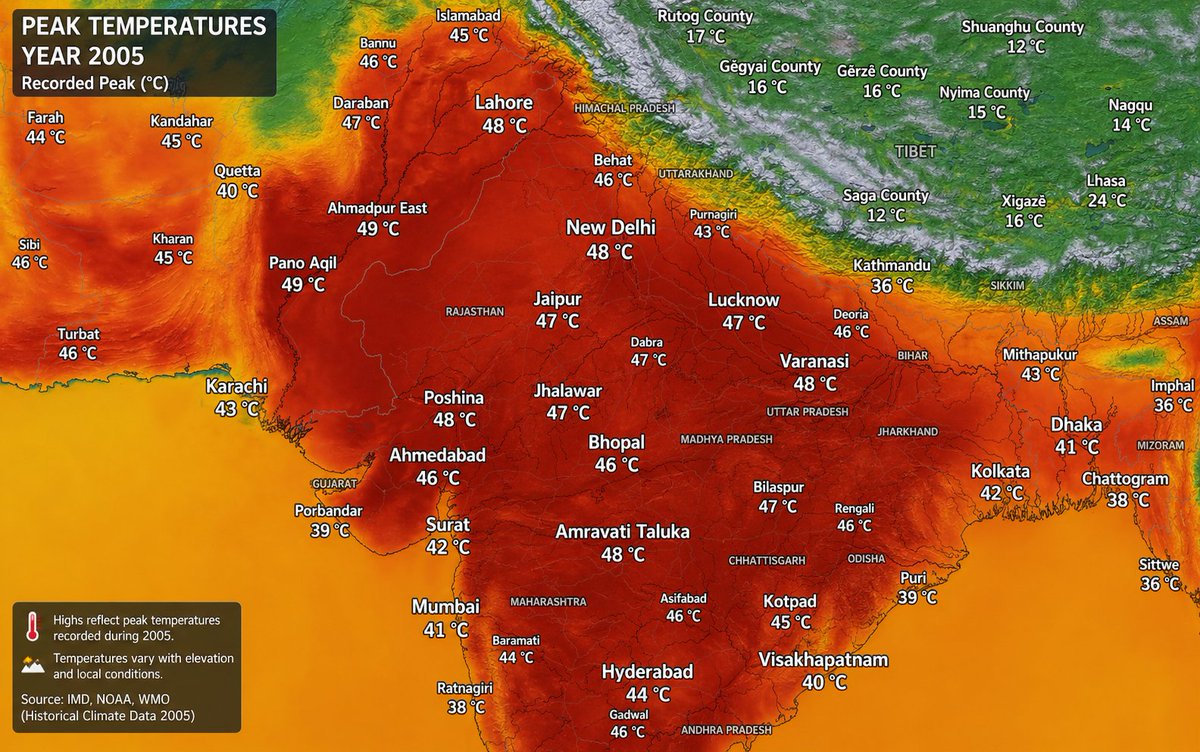
@KarunaGopal1 It's easy to brainwash Indians. Even ruling party's people are now getting brainwashed by perfectly packaged propaganda planted by Pakistani bots and parroted by the public for politics. Sad. Nobody posts like this in China or Europe when their cities touch 40+ year after year.
2005 when adani was not a big business men not even billionaire great Manmohan was pm when India has avg peak electricity of 14 hr pr day with only 40% people had electricity
She did not…
She murdered Innocent men just because they belonged to a Caste (Rapist did not belong to this Caste) She was raped by her own Caste Man
Threw a female baby so badly She is paralyzed to this day… She celebrated when this shit was murdered in Revenge…
Every single one of the points are a real problem.
But your understanding is broken, let me explain. :)
Norway has 55 lakh people. Total. That’s smaller than the population of Pune. Their entire country has fewer citizens than India’s 25 smallest cities individually. Norway also has 1.2 trillion dollars in sovereign wealth from oil reserves, accumulated over 50 years.
They have $250,000 per citizen sitting in the fund. India has roughly $3,400 per citizen in forex reserves.
Norway is what you get when a small population sits on top of one of the largest per-capita oil discoveries in human history.
The right comparison is other low-income, high-population, post-colonial democracies. Brazil. Indonesia. Nigeria. Bangladesh. Pakistan. Egypt. Mexico. South Africa. Vietnam. Philippines.
Compare on these and India isn’t doing badly. It’s doing better than most.
UPI is the world’s largest real-time payments system.
Aadhaar is the world’s largest biometric identity system.
We absorbed the global pandemic, the Ukraine war, the West Asia conflict, Trump’s tariffs, the Iran war, and a rupee fall without going into recession.
Most of those countries above did. Pakistan went to the IMF 24 times. Sri Lanka collapsed. Bangladesh is unstable. Egypt needed emergency Gulf bailouts. Argentina has 60% inflation. We stayed standing.
India is the only country in human history to add a trillion dollars of GDP every 18 months. We added our first trillion in 2007. Our second in 2017. Our third in 2024. Our fourth coming in 2026.
The problems you mentioned exist in every large, low-income, high-density country on earth.
Mexico City’s pollution is worse than Delhi’s.
Manila’s traffic is worse than Mumbai’s.
Lagos has worse road quality than Delhi.
Jakarta has worse air than Delhi.
Cairo has worse adulteration.
Karachi has more corruption.
Hanoi has higher pollution.
None of these countries are run by Modi. They’re all dealing with the same impossible math.
Industrialising a country of 145 crore people during a global energy transition, with limited natural resources, while keeping democracy intact, is the single hardest governance challenge in human history.
> China did it without democracy.
> South Korea did it with a population one-tenth our size.
> Japan did it with no major religious or linguistic diversity.
> Singapore did it with 50 lakh people total.
Nobody has done it at India’s scale, with our diversity, in democratic conditions.
So when someone asks “why hasn’t Modi built one city like Norway,” the answer is because building one Norway requires not having 144.5 crore other Indians to look after.
How on earth is that India convincing Dutch for supplying lithography machines is not a major news but that Melody toffee ? 😭
What a hell of negotiation it needed to pull this, lol.
This is literally access to one of the most strategically controlled technologies on Earth 💀
And there is more.
While India had the largest blackout in human history, the power minister was promoted to Home Minister!
GenZ has no idea how Dr. Singh, the world's greatest economist, ruled India.
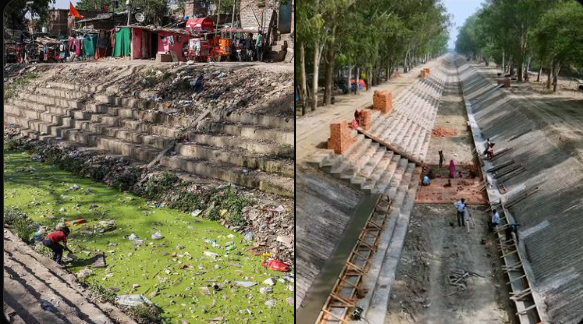
> I just found out that Munak Canal is literally one of Delhi’s main drinking water lifelines.
> Nearly 5 lakh metric tonnes of garbage had piled up along a 25 km stretch there over the years
> From july 2025, Rekha Gupta govt is cleaning it, talking about purification, roads, even solar covers over the canal.
So, what the hell was Kejriwal doing for 10yrs ?
Before cleaning: After cleaning:
So this is how they’re gaining so many followers.
This mvsIim guy commented on Cockroach Janta Party post saying, “I’ll take your follower count to 10 million tomorrow” and he literally explained in a reel on his profile how he does it, which is by buying bots. Lmao
They have 11M followers now, btw!
There was once a time in India when Opposition leaders understood the difference between opposing a government and humiliating India abroad. In 1994, PM P. V. Narasimha Rao sent Opposition leader Atal Bihari Vajpayee to represent India at the UN in Geneva on Kashmir because the nation came before party politics.
Today’s opposition has reduced itself to mocking India’s Prime Minister during diplomatic visits over trivialities for viral engagement and international applause. You may oppose Modi, his policies, or his politics, that is democracy. But turning every global engagement into an opportunity to sneer at India’s leadership reflects neither maturity nor statesmanship.
The tragedy is not ideological decline, but civilisational decline. Earlier generations of political rivals could stand united when Bharat’s image was at stake. Today, some seem more interested in embarrassing India internationally than strengthening India globally.
PM is traveling abroad to secure investments and ensure energy security in this period of economic gloom due to various global wars. It is one thing to know that, as a contender of PM post over the last 16 years, you don't have the intellectual capacity to understand this. However, I am intrigued to see your irritation towards promoting a reputed Indian brand (Parle). Is it because you don't want Indian brands to be showcased on the global stage? Or are you disgruntled by your intelligence (or lack of it), which has kept you puzzled over why melody is chocolaty?