A single brain cell just did the work we assumed needed an entire network for.
On its own, one simulated neuron sorted images, recognized sound, and solved XOR, the problem a single layer of classic neurons is famously unable to crack.
How?
Real neurons are way more powerful than the simple version AI has used for 50 years. The little branches on a neuron each do their own bit of computing before the cell even adds it all up.
That tiny detail turns out to matter a lot for how we build AI.
That is the thread our science team has been pulling on. They broke down the study and what it changes.
No LLMs. No GPUs. Just raw CPUs. And it already ranked ahead of @grok 4.2 beta on ARC-AGI 3.
The Qubic scientific team is quietly building something that's already out-ranking billion-dollar LLMs on the hardest #AGI benchmark. 🤯
#AI#decentralizedAI
Happy to share that our bio-inspired #Neuraxon 2.0 by @VivancosDavid & @josesanchezhb with @_Qubic_ #OpenScience #aigarth @c_@c___f___b is showing promissing results in the most challenging #AI #AGI #benchmark #ARCAGI 3 by @fchollet@mikeknoop and team @arcprize
First Entry we get 0.13%
Most Frontier AI's rank 0% or close to it, even @grok 4.2 beta by @elonmusk@xai ranked 0.1% lower than our first entry.
Btw:
1.- We use no LLMs or VLMs or alike, just Neuraxon Architecture so no call's to expensive APIs
2.- and 0% GPUs in this case raw plain CPUs
Long road ahead to rise the rankings but stay tuned for the updates & follow the progress here:
https://t.co/VzFFabYYFK
Neuraxon is #OpenSource in GitHub https://t.co/SJuYIL0BOA
Demos & Datasets at @huggingface@ClementDelangue and team https://t.co/h5Cl3hu5uS
Everyone in crypto knows the Bitcoin halving. Every four years, the reward for mining a block gets cut in half.
Qubic just approved its own halving for August.
It reaches the same goal as Bitcoin by a different route, and that is the most interesting part. 🧵
For most of its life, a QUBIC token could only live on Qubic.
Fast, feeless, and walled off from the rest of crypto.
QBridge is the door.
It moves QUBIC to Ethereum and back, so your tokens can reach the wallets, exchanges, and apps that live on the biggest network in the space.
The mechanics are easy to picture.
You lock QUBIC on one side, and an equal amount of a matching token, wQUBIC, is created on Ethereum.
One to one. Fully backed. No IOUs.
Send it back, and the process reverses.
It is non-custodial, so no company holds your funds in the middle.
It was independently audited before launch.
And no single party can move anything alone.
Ethereum first. Expansion to more chains next.
OGAudit Web3 Research: @_Qubic_ $QUBIC - The Chain Where Mining Trains AI Instead of Burning Electricity?
Qubic has been building useful blockchain compute since its April 2022 mainnet launch, directly converting mining hash power into AI training cycles:
- A quorum based architecture with 676 elected Computors running identical hardware validates network state, achieving feeless transactions with sub second finality, Useful Proof of Work aligns computational effort with meaningful tasks like distributed AI model training and validation via Aigarth, a native decentralised AI running on top of Qubic rather than burning energy on arbitrary hash puzzles like Bitcoin.
- A governance approved halving at Epoch 175 increased the weekly burn rate to 57.5%, cutting net emissions from 900 billion to 425 billion QUBIC per week addressing concerns the 200 quadrillion max supply could be reached four years ahead of schedule. A “Supply Watcher” dynamically adjusts emission and burn rates in real time while QEarn staking locks supply to reduce immediate circulating float.
- Qubic ranks #2 in AI social activity behind Bittensor with sustained developer activity and hackathons like Qubic RaiseHack though its long term value depends on out competing rival compute models like Bittensor’s marketplace and Render’s job based GPU rental.
Is feeless sub second finality, a working halving mechanism that already addressed supply concerns, Dogecoin merge mining utility and genuine AI training infrastructure the most underrated useful PoW thesis in crypto or does a 200 quadrillion max supply denomination, ranking second to Bittensor in the AI compute social conversation and total dependence on unproven AGI research progress confirm that QUBIC’s economic engine is more novel than it is currently valuable?
Category: Layer 1
Coin Name: $QUBIC
Circulating Supply: 138.57 trillion
Market Cap: $62.46M
Market Cap Rank: #342
OG (Trust) Score: 23.53
OG Score Rank: #821/1351
Reviewed by 14 OG Auditors.
See the Social Audit with Reviews by crypto OG’s and more on the $QUBIC Coin page: ogaudit(.)com/crypto/qubic-qubic
https://t.co/APdHGXpQxJ
Today @josesanchezhb & @VivancosDavid for
@_Qubic_ #OpenScience we are releasing another follow up demo!
🧠 #NxonKaleido it lets you watch the artificial brain of your Nxer "think" in real time.
Green regions sense, purple integrate, orange act, and you see the signal flow as it spots food 🍎, eats 😋, mates ❤️
Already live at: https://t.co/H5KcaO9vSy
Full open source code at: https://t.co/SJuYIL0BOA
(Remember to give us a⭐fork and build!)
Why it matters?
- Behavior and intelligence emerge from how brain regions connect, not from any single neuron or neuraxon. The connectome is the computation, and we need to explore and understand it for replicating it.
The Quorum has spoken.
Qubic's second halving is approved and locked in for Epoch 227.
Weekly emissions drop from 450B to 225B $QUBIC. The burn rate jumps to 77.5% of all weekly emissions. The first halving was EP175.
EP227 keeps emissions on a controlled long-term schedule and extends the runway for the entire ecosystem.
Yes... Looks Like #Neuraxon just started....
@josesanchezhb & @VivancosDavid are very proud to communicate that our paper #MultiNeuraxon follow-up to the just presented and awarded at ICMLT Neuraxon 2.0 in #Berlin for@_Qubic_ #OpenScience evolving @c___f___b #Aigarth to new heights...
This time has been accepted for poster presentation a the 19th #AGI Conference, so to #SanFrancisco @SFSU and beyond...
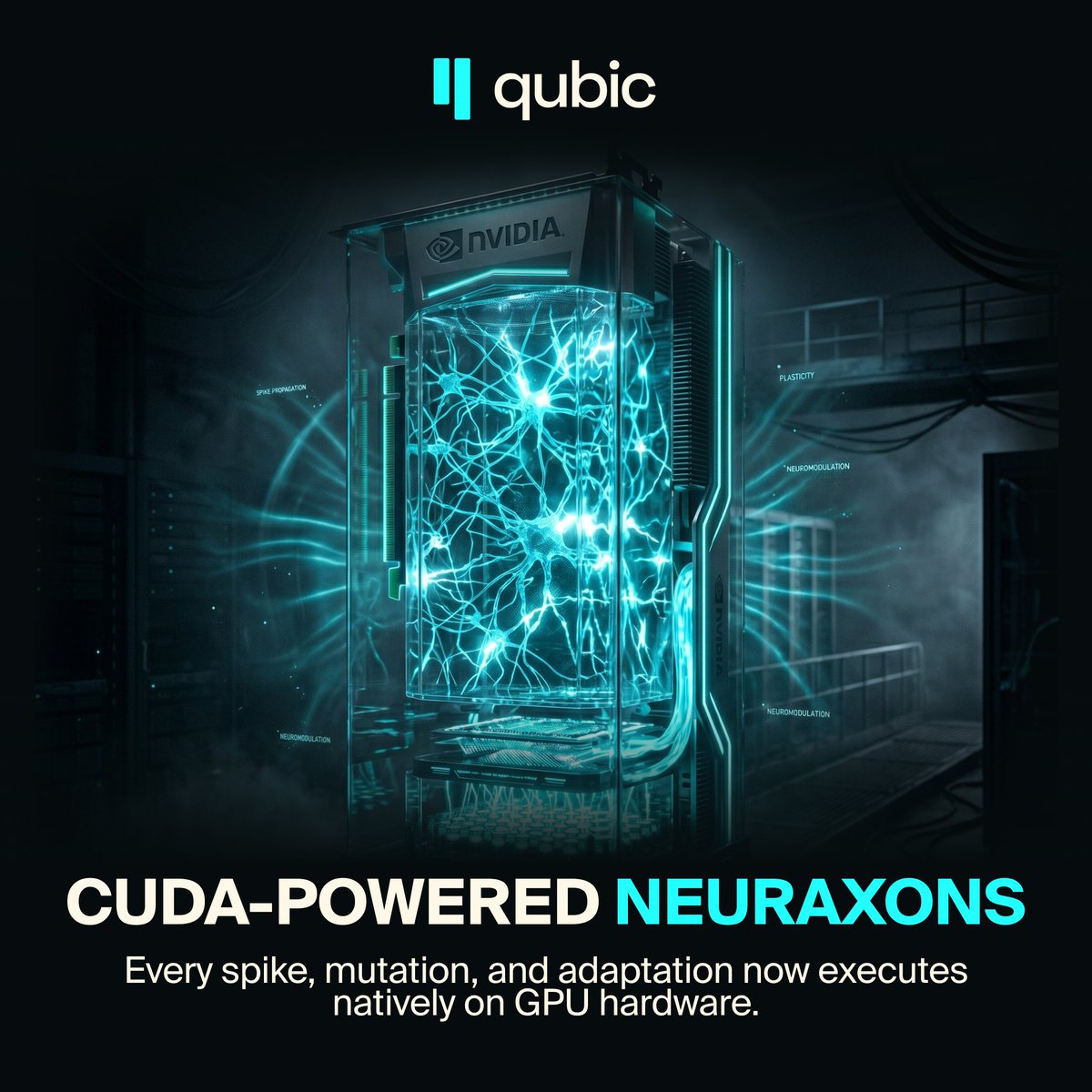
Qubic Science has released CuNxon.
Full Neuraxon computation ported to NVIDIA CUDA kernels. Every operation a Neuraxon can perform, from spike propagation to plasticity to neuromodulation, now runs natively on NVIDIA GPUs.
Previously, Neuraxon research ran on CPUs. That was fine for the Game of Life simulator and the early parameter sweeps. It is not fine for what comes next.
There are roughly five million CUDA developers worldwide. Most of them work in machine learning and AI. As of this release, every one of them can build with, test, and extend Neuraxon using the same GPU toolchain they already know.
The practical path this opens: when the Aigarth evolutionary layer gets ported into the Qubic network, miners and Computors will be able to train and evolve Neuraxon populations using GPU compute, not just CPUs.
A single $100 GPU. Or a billion-dollar cluster. The library does not care. The code is open source.
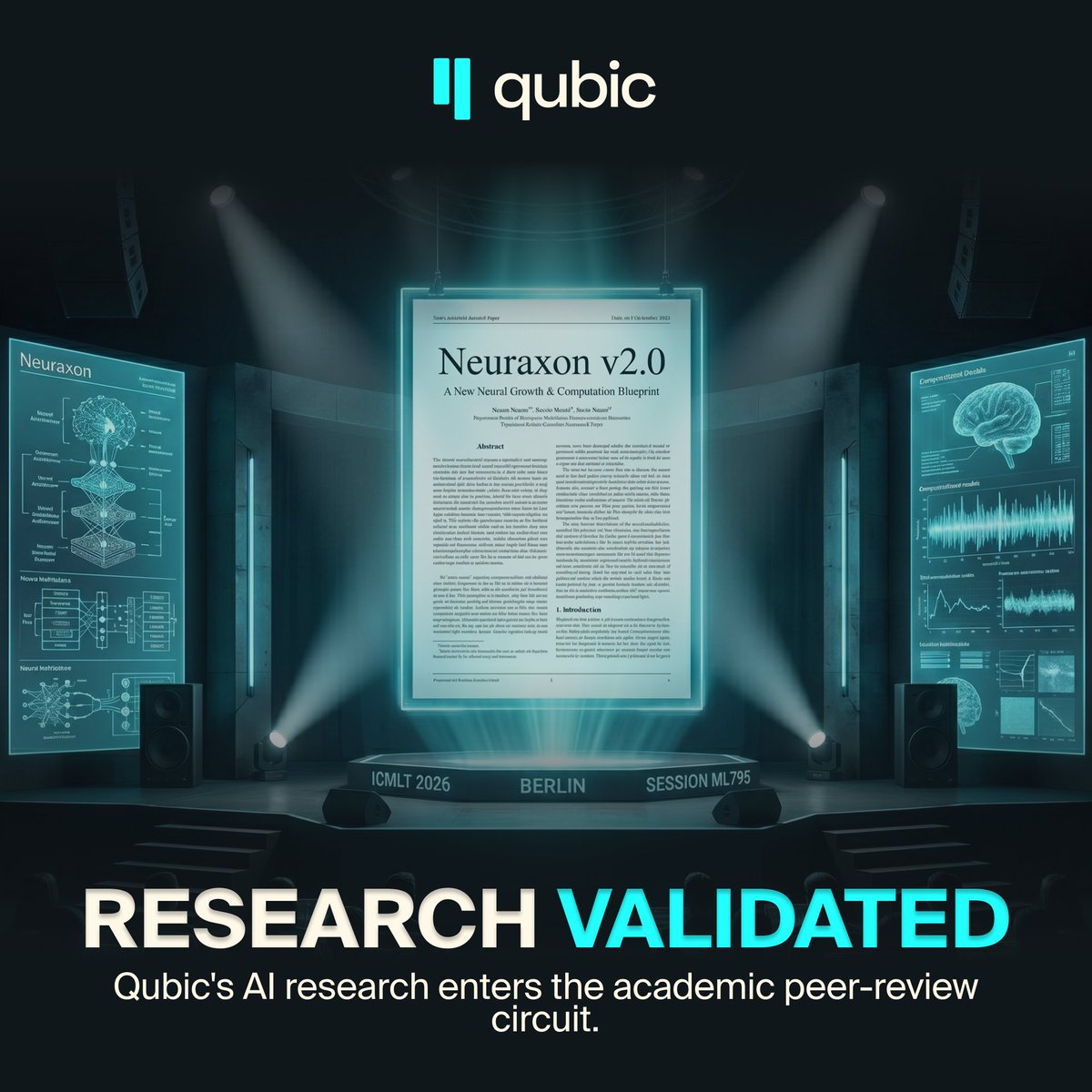
Qubic Science is presenting a peer-reviewed paper at an IEEE co-sponsored conference this week.
ICMLT 2026. Berlin. May 20-22. Session ML795.
“Neuraxon v2.0: A New Neural Growth & Computation Blueprint.”
While most crypto AI projects are announcing, Qubic is presenting.
Authors: @VivancosDavid and @josesanchezhb.
Neuraxon is not a language model like ChatGPT. It is not a wrapper on top of transformers.
It is a bio-inspired neural architecture built from scratch, modeled on how actual biological neurons grow, connect, and adapt in continuous time.
Trinary dynamics. Neuromodulation. Astrocytic gating. Criticality at the edge of chaos.
What peer review means in practice: the work gets indexed on IEEE Xplore and Scopus.
It enters the scientific record.
It gets cited, challenged, and built upon by researchers who have no financial stake in Qubic.
Four years of building.
The science is now entering the room where it gets tested by people who did not build it.
From the #Neuron to the #Neuraxon Same city, 137 years apart: 1889 to 2026. 3 Spaniards, one mission to unravel the mysteries of the human mind (and replicate them on a machine).
It is a truly humbling honor to be this week @josesanchezhb & @VivancosDavid at the 11th International Conference on Machine Learning Technologies in #Berlin, presenting our biologically inspired Artificial Neuron "Neuraxon" thanks to @_Qubic_ #OpenScience https://t.co/l1Vp6sBOWj in the same city where the first Spanish Scientific #Nobel laureate Santiago Ramón y Cajal showed the world the human neuron for the first time.
#neuroscience #AI #AGI #TrueAI #FromNeuronToNeuraxon
A new paper out of KRICT and KAIST just put a number on something Qubic's architecture has been built around since 2022.
Multiple AI agents working in coordination reduce extrapolation error by up to six orders of magnitude versus isolated deep neural networks. Up to a million model parameters compress into 5 to 40 interpretable ones. Tested across deterministic and previously uncharacterized dynamics. The collective recovered the underlying governing equations across all of them.
@c___f___b described the design premise of Qubic's coordinated mining layer this way: "The work of one miner benefits from the work of another miner, and their combined work is greater than the sum of their works measured separately."
That is not a metaphor. The MCI paper is empirical confirmation of the mechanism.
The researchers tested on a small lab cluster and noted the obvious next question: what happens when this runs at network scale?
Qubic's 676 Computors and broader mining base sit directly on the other side of that question.
Coordinated, network-scale machine intelligence is what Aigarth is being built for.
The frontier is catching up to the foundation.
Your brain sits at a frontier between order and chaos, and a single number determines which side it falls on.
The branching ratio (σ) measures how neural activity propagates. Too low, signals die. Too high, you would have seizures. But right around σ ≈ 1, something remarkable happens: sensitivity, memory, information capacity, and complexity all peak at once.
In NIA Vol. 8, the Qubic scientific team breaks down how this principle from statistical physics and neuroscience became a core design constraint in Neuraxon, and why the "edge of chaos" matters for building brain-inspired AI that actually works.
Today #MultiNeuraxon🪼joins the @nvidia#cuda family , very glad to release for @_Qubic_#OpenScience The Cuda Kernels and library so you can teach your #bioinspired#AIs using Nvdia #GPUs too.
Code: https://t.co/SJuYIL0BOA
Why it matters?
It brings Multi-Neuraxon + #Aigarth evolution to GPU-native execution: CPUs orchestrate while NVIDIA GPUs teach, execute, and scale neural compute in parallel.
CPU + GPU together = Multi-Neuraxon at speed.
The Neuraxon Intelligence Academy Vol. 7 is live.
In 1970, John Conway wrote four rules on a postcard and accidentally proved that complexity doesn't need a designer. Fifty years later, Sakana AI dropped five neural species onto a shared grid and watched cooperation emerge from pure competition.
The Qubic Scientific Team traced the line from Conway's Game of Life through Langton's edge of chaos to modern digital ecosystems, and showed where Qubic, Aigarth, and Neuraxon sit on that timeline.
The short version: the same principles that make cellular automata produce gliders and Turing machines are the ones keeping a decentralized network of thousands of nodes stable without anyone in charge.
The NxonLife experiments back it up. Branching ratio near 1. 1/f temporal correlations. Thousands of ticks of self-sustaining activity, no resets, no external normalisation.
You can now move $QUBIC to Ethereum and back.
No custodian. No middleman.
QBridge is live, and we just dropped a full tutorial showing you exactly how to use it.
In under 3 minutes you'll learn how to:
→ Connect your wallet (MetaMask Snap, WalletConnect, or seed)
→ Bridge QUBIC to Ethereum as wQUBIC (ERC-20)
→ Add the wQUBIC token to your EVM wallet
Built by @Vottun.
Non-custodial.
2-of-3 multisig.
Audited by Certik.
📷 Bridge: https://t.co/SneE3CxCmD
📷 wQUBIC CA: 0xa989EDfee575425904514D4090846a5AFD58F225
Full tutorial 👇
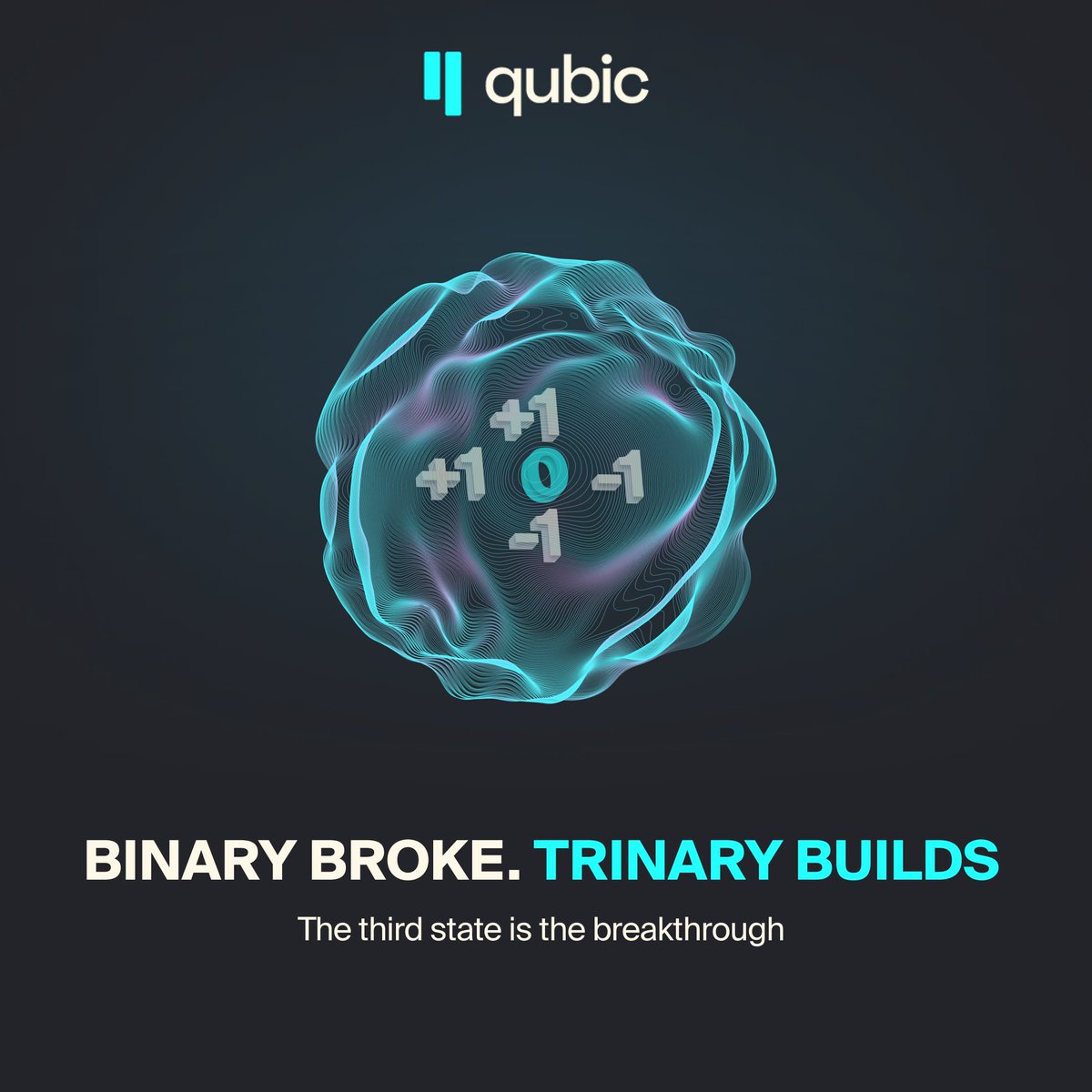
Traditional AI neurons: on or off. Binary. Simple.
Neuraxon neurons: excite (+1), inhibit (-1), or modulate (0).
That third state is the breakthrough.
Zero doesn’t mean “nothing.” It means the neuron is listening. Building context. Adjusting sensitivity. Waiting for the right signal.
Real brains do this constantly. Neuromodulators like dopamine don’t fire or stay silent. They fine-tune the entire system’s responsiveness.
Neuraxon brings this to artificial neural networks for the first time.
The result: AI that adapts continuously, avoids catastrophic forgetting, and self-organizes its own network structure.
Two IEEE peer-reviewed papers. Two more submissions in progress.
This is what bio-inspired AI looks like when it’s built, not theorized.