Absolute crashout by DeepSeek
DeepSeek just made the secrets behind its technology public and free for everyone!
Now you can use ideas from a team with extensive AI experience in your own projects, completely free of charge
DeepSeek is opening up not just the intelligence behind its AI the model weights, but also part of the infrastructure that makes running large models economically viable
This could fundamentally change the competitive landscape
Previously, a major AI company's advantage came not only from the quality of its models, but also from a huge number of internal engineering solutions that no one outside the company had access to
By open-sourcing DeepInfer, DeepSeek is helping other teams replicate some of these solutions instead of having to build everything from scratch
DeepInfer builds on vLLM and ideas from other open-source projects
It's a great example of how open-source technology evolves through collaboration: a company builds on community contributions, improves them, and shares its own advancements back with the community
The capabilities of existing AI models could become cheaper and more accessible
This is an absolutely incredible update, and it's hard to even wrap your head around how big it is
🚀 Introducing DeepInfer, our in-house inference framework, now fully open source!
Powering DeepSeek-V4.1-Flash at scale with high throughput and low latency. We’re sharing our production stack to help the community lower compute costs, reduce energy use, and make AI more affordable.
🔗 https://t.co/JGAik1kgk0
1/4
RubyScore × Inferum AI
We’re excited to introduce RubyScore, our largest inference partner.
@rubyscore_io is building on-chain analytics and reputation infrastructure, spanning over 70 blockchain networks and more than 1 million users.
The team has a strong track record of collaborations and integrations across leading Web3 ecosystems:
• Linea (Consensys): Integrated Proof of Humanity solutions, helping identify over 243,000 bots.
• Circle: Listed in the official partner directory of the company behind USDC.
• Ecosystem integrations: Scroll, Celo, Boba, Somnia, Soneium, Katana, and other blockchain networks.
Today, RubyScore leverages AI agents powered by Inferum AI to analyze wallets across multiple blockchains, investigate transaction patterns, identify suspicious activity, and assess on-chain reputation.
For us, this is a real-world example of how AI inference powers Web3 applications, enabling agentic systems to process and analyze massive amounts of on-chain data at scale.
More inference, less cost.
Inferum AI has processed over 100 billion inference tokens
It took us just 16 days
We're currently ranked #3 among all brokers by inference consumption on @gonka_ai, accounting for approximately 10% of total network usage
On the community side, we'll also be working with something big as the race continues
More to come
OpenAI and Anthropic are cooperating to fund Simons Foundation
On October 6, OpenAI published a collection of mathematical results generated by an internal frontier model, including formalizations of many proofs in Lean, details about its research process, and estimates of the computing resources used.
The company also acknowledged that it needs to improve how these results are presented, cited, and explained to the mathematical community.
Now, just days later, OpenAI and Anthropic are helping fund an independent initiative focused on exactly those challenges.
It's about what happens when machines begin contributing to mathematical research at a scale that existing academic processes weren't designed to handle.
Here's what makes this development worth paying attention to.
Producing a proof and contributing to mathematics are not the same thing
Mathematical research has two distinct requirements.
First, a result must be correct.
Second, it must contribute something valuable to the field.
These sound closely related, but they're fundamentally different questions.
A theorem can be perfectly valid and mathematically uninteresting. Another result might introduce a technique that transforms an entire research area.
Formal proof assistants such as Lean can help address the first requirement.
They allow researchers to express mathematical statements in a formal language and verify that proofs follow logically from their assumptions.
But Lean cannot determine whether a theorem is worth studying.
Alex Kontorovich, a mathematician quoted in the Simons Foundation's own discussion of Lean, makes precisely this distinction: mathematical journals evaluate both correctness and significance, while formal verification addresses only correctness.
This matters because AI changes how mathematical results can be produced.
If generating candidate proofs becomes substantially cheaper, researchers may face an increasing number of technically valid results without an equally clear understanding of their importance.
The challenge isn't just checking whether an AI is right.
It's determining what its results actually contribute.
OpenAI's recent mathematical release illustrates the problem
On October 6, OpenAI published results produced by an internal frontier model.
Rather than releasing only a conventional research paper, the company provided a GitHub repository containing mathematical results, formalizations in Lean, information about attempted problems, and summaries of the model's reasoning.
It also disclosed an estimate of the computational effort involved.
According to OpenAI, the average result required computing resources equivalent to roughly three hours of ChatGPT Pro thinking.
That number is interesting, although it shouldn't be confused with a direct measurement of the model's actual runtime or the total cost of the research program.
The release raises several questions.
How should mathematicians prioritize which AI-generated results to examine?
Who is responsible for verifying claims that have not been fully formalized?
How should AI-generated work cite earlier research?
And what level of explanation should be expected before a result enters the mathematical literature?
OpenAI has already acknowledged some of these issues.
In its publication, the company committed to improving citations, mathematical exposition, and the presentation of future results.
That admission is significant.
It suggests that producing mathematical results and communicating them in a form useful to researchers are becoming separate engineering and scientific challenges.
3. The Simons Foundation has already helped build part of the solution
One reason this partnership is particularly interesting is the foundation's existing involvement with Lean.
In 2023, Simons Foundation International contributed $5M toward the Lean Focused Research Organization, alongside related support from the Simons Foundation.
Lean wasn't created specifically for the current wave of AI-generated mathematics.
Its original purpose was to make formal reasoning more reliable, scalable, and accessible.
But those properties are becoming increasingly valuable as AI systems take on more complex mathematical problems.
A formal proof can be checked by a relatively small, trusted verification system rather than relying exclusively on a reader's confidence in the author.
This creates a useful separation between generating a proof and verifying its logical validity.
However, it doesn't eliminate every problem.
Researchers still need to ensure that the formal statement accurately represents the intended mathematical claim.
They also need to understand the assumptions, identify relevant prior work, and evaluate the result's significance.
In other words, formal verification can reduce one major source of uncertainty without replacing mathematical judgment.
That's an important distinction that often gets lost in discussions about AI solving mathematics.
Why the structure of the $15M initiative matters
Under the new partnership, the Simons Foundation, OpenAI, and Anthropic are committing a combined $15M in funding and resources.
The foundation will manage and award the funding, including through an open call for proposals.
The program will support workshops, conferences, and other initiatives focused on evaluating AI-assisted results, developing research practices, and helping mathematicians work with emerging tools.
OpenAI and Anthropic will also provide AI models and computing resources to foundation-supported researchers, including researchers in basic science outside mathematics.
The important detail is who controls the process.
The initiative is designed to be community-driven, with the Simons Foundation managing the awards rather than leaving the entire process to either AI company.
This matters because the companies building frontier models have their own incentives.
They want to demonstrate progress, attract talent, and establish their systems as useful research tools.
Mathematicians have a different responsibility: determining which results are correct, original, significant, and worth incorporating into the field.
Those interests can overlap without being identical.
An independent institution can provide a setting in which researchers establish standards based on scientific needs rather than product announcements.
Of course, funding alone doesn't guarantee independence.
The practical test will be whether researchers can critically evaluate results, publish negative findings, and develop standards that remain useful across competing AI systems.
Scientific institutions were largely built around research conducted by humans, with human limitations on how quickly new work could be produced.
Peer review, conferences, journals, and specialist communities help distribute the work of checking and interpreting discoveries.
These processes already face significant pressure.
AI-generated research introduces a new variable: the possibility that the supply of candidate results increases much faster than the number of experts available to evaluate them.
This doesn't mean AI-generated mathematics will automatically overwhelm the field.
The quality, originality, and usefulness of those results still need to be established.
But it does create a serious question about research infrastructure.
If advanced models can generate large collections of plausible mathematical results, simply publishing more papers may not be an adequate way to communicate them.
Researchers may need better systems for formal verification, attribution, prioritization, and collaborative interpretation.
The same concern extends to other scientific disciplines, although mathematical proofs have an advantage that experimental sciences generally lack.
A formally verified theorem can establish a logical conclusion from specified assumptions.
A proposed biological mechanism or physical theory still needs evidence about the real world.
That difference makes mathematics a particularly useful place to develop rigorous practices for working with AI-generated research.
The real test comes after the announcement
The success of this initiative shouldn't be measured by the number of workshops organized or how many researchers receive model access.
Those are inputs, not scientific outcomes.
More meaningful questions are whether the program helps researchers independently verify important results, identify errors, clarify previously opaque proofs, and turn isolated AI-generated findings into techniques other mathematicians can use.
It will also matter whether the standards developed through these programs are adopted beyond the participating institutions.
There is a meaningful difference between an AI company announcing that its model solved a difficult problem and a mathematical community independently establishing the result's validity and significance.
The first demonstrates a claimed capability.
The second creates knowledge that other researchers can confidently build upon.
That's the distinction this initiative has an opportunity to address.
And it's why I find the partnership more interesting than the headline funding figure.
OpenAI and Anthropic are competing to build increasingly capable reasoning systems.
But the mathematical community now faces a different challenge: deciding how discoveries produced by those systems should be verified, published, interpreted, and incorporated into existing research.
The $15M won't solve that problem on its own.
What it can do is support the researchers and institutions responsible for developing the answers.
AI producing a mathematically valid result is an achievement.
Turning that result into something the mathematical community can understand, trust, and build upon is a separate achievement.
The next phase of AI-assisted science will need both.
We want to support the mathematics community in turning progress in AI into deeper human understanding and new discoveries. To support that goal, we are contributing $5 million to a new Simons Foundation initiative to help mathematicians examine, understand, and build on results produced by AI, including the results we recently published.
The funding, managed and awarded by the @SimonsFdn will support workshops, conferences, and special programs. We will also provide access to our models and computing resources to Simons Foundation-supported researchers.
The most interesting part of Ultramarine 1 Flash isn't the claim that it matches Fable 5 at 1/60th of the cost
It's what the release potentially tells us about where the economics of frontier-level AI are heading, how much of enterprise model performance can be recovered through targeted post-training and why the next major competitive advantage in AI may have less to do with general-purpose intelligence than with the ability to reliably execute professional workflows
There are several important things to unpack here.
A five-person team reportedly spent approximately $300k to post-train a model that now claims performance comparable to Fable 5 on knowledge-work tasks.
The important distinction is that this is a post-training budget, not the total cost of producing the underlying pretrained model. Those are fundamentally different economic claims, and conflating them would dramatically overstate what this experiment demonstrates.
But the narrower claim is still significant.
If a relatively small team can take an existing open-weight foundation and push it into competitive territory on commercially valuable workflows with a few hundred thousand dollars, that changes the economics of building specialized AI products.
Historically, frontier-level performance has been associated with enormous capital requirements, large research organizations, and substantial proprietary infrastructure.
This release suggests that at least some of the performance gap on specific downstream tasks may be addressable through focused post-training rather than another massive pretraining run.
That matters because the relevant question for most AI companies is not whether they can build the most generally capable model in existence.
It's whether they can obtain sufficiently strong performance on their customers actual tasks at an economically sustainable cost.
A model that is marginally weaker on broad capability evaluations but substantially cheaper and equally reliable on a defined professional workflow can be the better commercial asset.
And if that capability can be produced through relatively inexpensive post-training, the barriers to building competitive application-specific models become meaningfully lower.
A 60x reduction in model cost is not simply a pricing improvement.
At that magnitude, the economics of the surrounding product can change.
Knowledge-work agents are often inference-intensive systems. They don't necessarily generate a single response and stop. They search through documents, retrieve context, reason across sources, generate intermediate artifacts, review their own outputs, call tools, revise drafts, and sometimes repeat the entire process.
The cost of completing a workflow can therefore be many times the cost of an individual model call.
This creates an important relationship between model pricing and product architecture.
When inference is expensive, developers are incentivized to minimize calls, restrict context, reduce iteration, and reserve expensive models for only the most difficult steps.
When inference becomes dramatically cheaper, those constraints loosen.
Developers can afford more verification passes, more candidate generations, more extensive document analysis, and deeper multi-step execution.
Consider an agent that needs to produce a financial analysis, draft a legal memorandum, or prepare a client-facing presentation.
The economically relevant unit is not the token.
It's the successfully completed deliverable.
A cheaper model can make it economical to perform more internal work before delivering the final artifact.
However, this advantage only materializes if lower token prices translate into lower cost per successful task.
If the model requires significantly more retries, produces more factual errors, fails tool calls more frequently, or demands substantially more human review, the apparent pricing advantage can disappear.
The strongest evidence would therefore be a comparison of total workflow cost at equivalent output quality, including retries, verification, latency, and human correction.
If Ultramarine preserves its claimed cost advantage under those conditions, the commercial implications are substantial.
One of the more interesting claims in the announcement is that prolonged training caused the model to learn professional standards such as visual hierarchy and straightforward prose.
That might sound like a relatively minor achievement compared with improvements in reasoning or coding.
It isn't.
A large portion of the practical value of enterprise AI comes from producing artifacts that people can actually use.
A legal memo is not just a collection of correct statements. It has a recognizable structure, an appropriate hierarchy of arguments, careful qualification of uncertainty, and conventions around evidence.
An investment analysis needs to distinguish assumptions from observations, separate the investment thesis from its risks, and present financial information in a way that supports decisions.
A consulting deliverable needs coherent information architecture, prioritization, concise writing, and consistent formatting.
These properties are not merely cosmetic.
They determine how easily a human can inspect, understand, verify, and act on the output.
A model that generates technically correct information but packages it poorly creates additional editing work.
A model that understands the conventions of professional deliverables can reduce that work.
This is why generic language-model benchmarks often provide an incomplete picture of enterprise usefulness.
The relevant capabilities include not only factual accuracy and reasoning, but also document structure, evidence handling, instruction fidelity, tool-use reliability, and consistency across long workflows.
Optimizing directly for these properties makes sense.
It also creates a different competitive landscape from the one implied by general-purpose model leaderboards.
A model does not need to dominate every category to become extremely valuable in a particular professional environment.
It needs to be consistently good at the tasks that environment actually demands.
Traditional reinforcement learning has a relatively straightforward advantage in domains where success can be verified programmatically.
In coding, a generated solution can be executed against tests.
In mathematics, an answer can sometimes be checked against a known result or evaluated by a verifier.
These environments provide relatively clear reward signals.
Professional knowledge work is much harder.
What makes a legal analysis good?
What makes a financial memo decision-useful?
What makes a research report well structured, appropriately skeptical, and sufficiently comprehensive?
There often isn't a single objectively correct output.
Multiple answers can be defensible, and quality depends on a combination of correctness, completeness, judgment, communication, and adherence to professional conventions.
This makes reward design substantially more difficult.
A model can learn to produce outputs that appear polished without becoming more accurate.
It can optimize for superficial characteristics that evaluators prefer.
It can learn formatting conventions while failing to improve the underlying reasoning.
And in long-horizon agentic tasks, the quality of an individual step may be difficult to evaluate independently from the final result.
These are central problems in non-verifiable RL.
The announcement claims that Ultramarine represents one of the largest open experiments in this area.
If the training code and technical report provide sufficient detail to reproduce the methodology, the contribution could extend well beyond this particular model.
It's teaching it to reliably produce the substance of professional work.
If the report demonstrates measurable improvements in both artifact quality and underlying task correctness, it would provide useful evidence that agentic RL can optimize capabilities that are difficult to express as deterministic rewards.
That is a research direction with implications far beyond banking, legal services, or consulting.
There is an important difference between a cheap proprietary API and a capable open-weight model.
A cheap API reduces the immediate cost of inference.
Open weights can change who controls the infrastructure.
For companies building AI systems for banks, law firms, and other regulated enterprises, deployment flexibility is often a meaningful consideration.
Depending on the license and architecture, open weights can enable private deployment, infrastructure customization, independent evaluation, and greater control over the model lifecycle.
They can also reduce dependence on a single upstream API provider.
That matters for companies whose customers have requirements around data handling, security reviews, vendor concentration, deployment geography, and operational continuity.
But open weights do not automatically make a model enterprise-ready.
The practical requirements are much broader.
Organizations still need access controls, audit trails, reliable infrastructure, appropriate data isolation, monitoring, incident response, and governance around model changes.
In high-stakes professional environments, reliability and traceability can matter more than a small difference in raw model capability.
Still, the strategic value of open weights is real.
An AI company that can deploy and adapt its own model has a different negotiating position from one whose entire product depends on the pricing, availability, and policy decisions of an external model provider.
This does not eliminate the advantages of proprietary frontier models.
It creates a more credible alternative for workloads where specialized open models can deliver comparable results.
The obvious interpretation of a release like this is that it threatens expensive frontier APIs.
That's only part of the story.
The more immediate pressure could be on companies whose products depend on relatively thin layers of orchestration around general-purpose models.
If high-quality knowledge-work behavior can be learned through post-training, some capabilities previously implemented through elaborate prompts, formatting rules, and application-level heuristics may increasingly become native model behavior.
That could simplify application architectures.
It could also reduce the defensibility of products whose primary differentiation is making a generic model behave like a professional assistant.
The strongest application companies will still have advantages in proprietary data, customer relationships, workflow integration, distribution, and domain-specific evaluation.
But the value of merely packaging general-purpose intelligence into a professional-looking interface may decline.
At the same time, lower model costs could make entirely new product categories economically viable.
Some workflows currently cannot support extensive autonomous execution because the inference cost is too high relative to the value of the task.
If capable models become substantially cheaper, the set of economically automatable workflows expands.
That could increase total inference demand even as the price per token falls.
In other words, cheaper models do not necessarily mean a smaller market for model providers.
They may mean a much larger market with a different distribution of value.
7. The critical unresolved question is how much of the claimed performance survives independent evaluation.
The announcement makes several strong claims, and they should be treated as claims until the supporting evidence is available.
"Similar performance to Fable 5" needs a precise definition.
Which tasks?
Which evaluation distribution?
And how closely do those benchmarks resemble the messy, underspecified, document-heavy workflows encountered in actual enterprises?
The same applies to the 60x cost claim.
A comparison based on published API prices may look different from one based on self-hosted inference economics.
Hardware utilization, batching, output length, throughput, and operational overhead can materially affect the calculation.
There is also an important distinction between being competitive on selected knowledge-work evaluations and being a genuine drop-in replacement across the full range of tasks currently handled by GPT or Claude.
Enterprise agents depend on more than final-answer quality.
They depend on predictable tool calling, structured output, long-context reliability, instruction adherence, error recovery, and stable behavior under unfamiliar inputs.
A model can be excellent at generating polished reports and still struggle with multi-step execution in production.
None of these caveats invalidate the announcement.
They define what needs to be demonstrated for its strongest conclusions to hold.
The forthcoming weights, training code, and technical report are arguably as important as the API launch.
A model release is one thing.
A reproducible training methodology is another.
If the team publishes meaningful details about data construction, reward design, optimization, evaluation, and failure modes, the broader research community can test which parts of the approach actually produced the gains.
That creates the possibility of independent replication, ablation studies, and adaptation to other domains.
The most useful outcome would not simply be other teams reproducing Ultramarine's benchmark results.
It would be other teams learning how to produce similarly strong domain-specific behavior with modest post-training budgets.
That would make the research contribution much more durable than any single model checkpoint.
Of course, the degree of openness matters.
Weights, training code, datasets, reward models, and evaluation harnesses are different artifacts.
Publishing some does not automatically make the entire experiment reproducible.
The technical report should make those boundaries explicit.
The broader takeaway:
This release is interesting because it points toward a possible separation between the economics of creating general intelligence and the economics of adapting that intelligence into commercially useful systems.
Pretraining frontier foundation models may remain enormously capital-intensive.
But converting a capable foundation into a specialized model that performs valuable professional work could become dramatically more accessible.
If that happens, competition will increasingly occur at several distinct levels: foundation-model capability, post-training methodology, inference efficiency, domain-specific reliability, and application distribution.
The winners at each level may not be the same companies.
And for enterprise AI, the central metric will increasingly be the cost of producing a correct, usable, auditable work product rather than the cost of generating a million tokens.
That's the standard against which Ultramarine 1 Flash should ultimately be judged.
Not whether it can produce an impressive-looking memo in a demo.
Not whether it achieves parity on a narrow benchmark.
But whether an AI company can deploy it in a real professional workflow, deliver the same or better outcomes, reduce total operating costs, and maintain reliability at scale.
If the claims hold under that level of scrutiny, this would be more than another efficient open-model release.
It would be evidence that targeted post-training and non-verifiable agentic RL are becoming practical tools for turning relatively accessible foundation models into economically competitive professional systems.
And that would be a meaningful development for both the research community and the enterprise AI market.
We are releasing Ultramarine 1 Flash, a frontier-class model built for knowledge work. It is open-source and achieves similar performance to Fable 5, while being 60x cheaper.
It was post-trained by a team of 5 for ~$300k all-in. Available on API now, with weights releasing in 2 weeks.
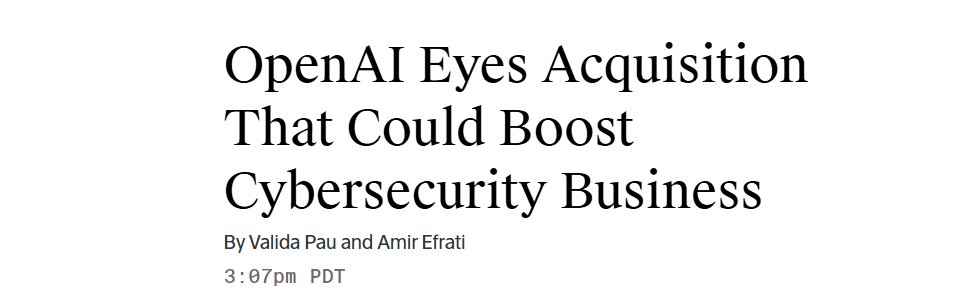
🚨 BREAKING: OPENAI IS REPORTEDLY IN TALKS TO ACQUIRE ONE OF CRYPTO'S MOST RESPECTED SECURITY FIRMS
According to The Information, OpenAI is in early discussions to acquire Trail of Bits.
But this story is much bigger than crypto.
We're talking about a company that has spent more than a decade finding vulnerabilities in critical software, building security tools and researching ways to discover and fix bugs automatically.
And now one of the biggest names in artificial
Trail of Bits was founded in 2012. It's is a cybersecurity research and engineering company.
Unlike a typical crypto auditing firm, its expertise extends far beyond smart contracts.
Its work covers:
• Blockchain and smart contract security
• Cryptography and zero-knowledge systems
• Software vulnerability research
• Reverse engineering
• Fuzzing and symbolic execution
• AI and machine learning security
• Security engineering and automated vulnerability detection
Three important examples:
Slither: open-source static analysis framework for Solidity and Vyper.
It helps developers identify potentially dangerous patterns in smart contracts without executing them.
Echidna: smart contract fuzzer that tests whether contracts behave correctly under large numbers of generated inputs.
Instead of checking only a few manually written scenarios, developers can use it to search for unexpected behavior.
Manticore: symbolic execution framework used to explore different execution paths and identify potentially vulnerable conditions in software.
These aren't speculative products.
They're real tools that have been used by security researchers for years.
And they help explain why Trail of Bits has a reputation that extends well beyond the crypto industry.
Trail of Bits has already been working on automated cybersecurity research.
In 2025, the company placed second in DARPA's AI Cyber Challenge, earning a $3 million prize.
Buttercup, was designed to autonomously discover and patch software vulnerabilities.
Traditional security research depends heavily on human experts examining code, identifying weaknesses, reproducing bugs and developing fixes.
But increasingly capable AI systems could help automate parts of that process.
It's directly relevant to OpenAI.
OpenAI isn't necessarily buying a crypto company to enter crypto.
Trail of Bits is well known in blockchain security, but its capabilities are much broader.
According to The Information, OpenAI is trying to build a substantial cybersecurity business.
Acquiring a company with years of experience in vulnerability research, security tooling and automated bug discovery could accelerate those ambitions.
Instead of building every capability internally, OpenAI could gain an established team with deep technical expertise.
The opportunity isn't limited to protecting OpenAI's own systems.
It could also involve developing security products for other organizations.
The same technology that can help defenders discover vulnerabilities can also make attackers more capable.
AI can help analyze code, investigate attack surfaces, and automate repetitive security work.
But those capabilities can potentially be misused.
As AI models become more capable, security becomes increasingly important.
Companies need systems that can identify vulnerabilities before attackers exploit them.
They also need ways to evaluate whether AI-generated code is secure.
And as AI agents gain access to tools, files, APIs, and sensitive systems, the consequences of security failures become much more serious.
An AI assistant giving a wrong answer is one problem.
An autonomous agent making a dangerous change to a production system.
It's clear that OpenAI aims to integrate its products into crypto, which will bring a whole new set of challenges the industry has never faced before.
Imagine an AI agent that can:
• Interact with smart contracts
• Manage on-chain assets
• Execute transactions
• Interact with DeFi protocols
• Pay for services
• Operate through connected applications
Every additional capability introduces potential security risks.
A compromised tool, malicious instruction, vulnerable contract, or poorly configured permission could have financial consequences.
Unlike a traditional chatbot mistake, a blockchain transaction may be irreversible.
That makes security especially important for financial AI agents.
OpenAI and Trail of Bits already have a connection
Trail of Bits public website lists security work involving OpenAI, including an OpenClaw assessment.
The company also references an open-source security initiative in collaboration with OpenAI. So this isn't necessarily a situation where two completely unfamiliar companies are suddenly considering a deal.
There's already a documented professional relationship. That doesn't prove an acquisition will happen.
But it makes the reported discussions particularly interesting.
What could an acquisition actually change?
There are several possibilities.
First, OpenAI could strengthen its internal security capabilities.
Second, it could accelerate the development of AI-powered cybersecurity products.
Third, it could combine advanced AI models with established vulnerability research methodologies and security tools.
Fourth, it could expand its expertise in securing autonomous agents and complex software systems.
And fifth, Trail of Bits blockchain experience could become valuable if OpenAI develops products involving financial infrastructure.
That last point is a possibility, not a confirmed strategy.
There's currently no evidence that this acquisition is specifically intended to launch a crypto product.
According to The Information, discussions are still at an early stage.
The potential purchase price hasn't been disclosed.
There's no announced agreement, closing date, or confirmed acquisition structure.
And the negotiations could still fall apart.
It's also worth noting that OpenAI's interest in Trail of Bits doesn't automatically imply a new token, blockchain launch or crypto partnership.
Those would be separate developments requiring their own evidence.
The most interesting part of this story isn't that OpenAI might acquire a company known for auditing smart contracts.
It raises the biggest question:
As AI gets better at writing code, finding vulnerabilities, and operating software autonomously, who will build the security infrastructure that keeps those systems safe?
Maybe the next major AI business opportunity isn't another chatbot.
Maybe it's securing everything those chatbots and agents are about to control.
Muse Wonder Full crushed the competition
On the Personal Superintelligence Index overall, Muse outperforms Claude Fable 5.1, GPT-6 Astra and Claude Opus 5.5
Muse is exceptionally good at specialized tasks
In legal tasks, Muse outperforms competitors by 3x–4x
Mark Zuckerberg has officially entered the AI race
Let your agent make mistakes
The results will surprise you
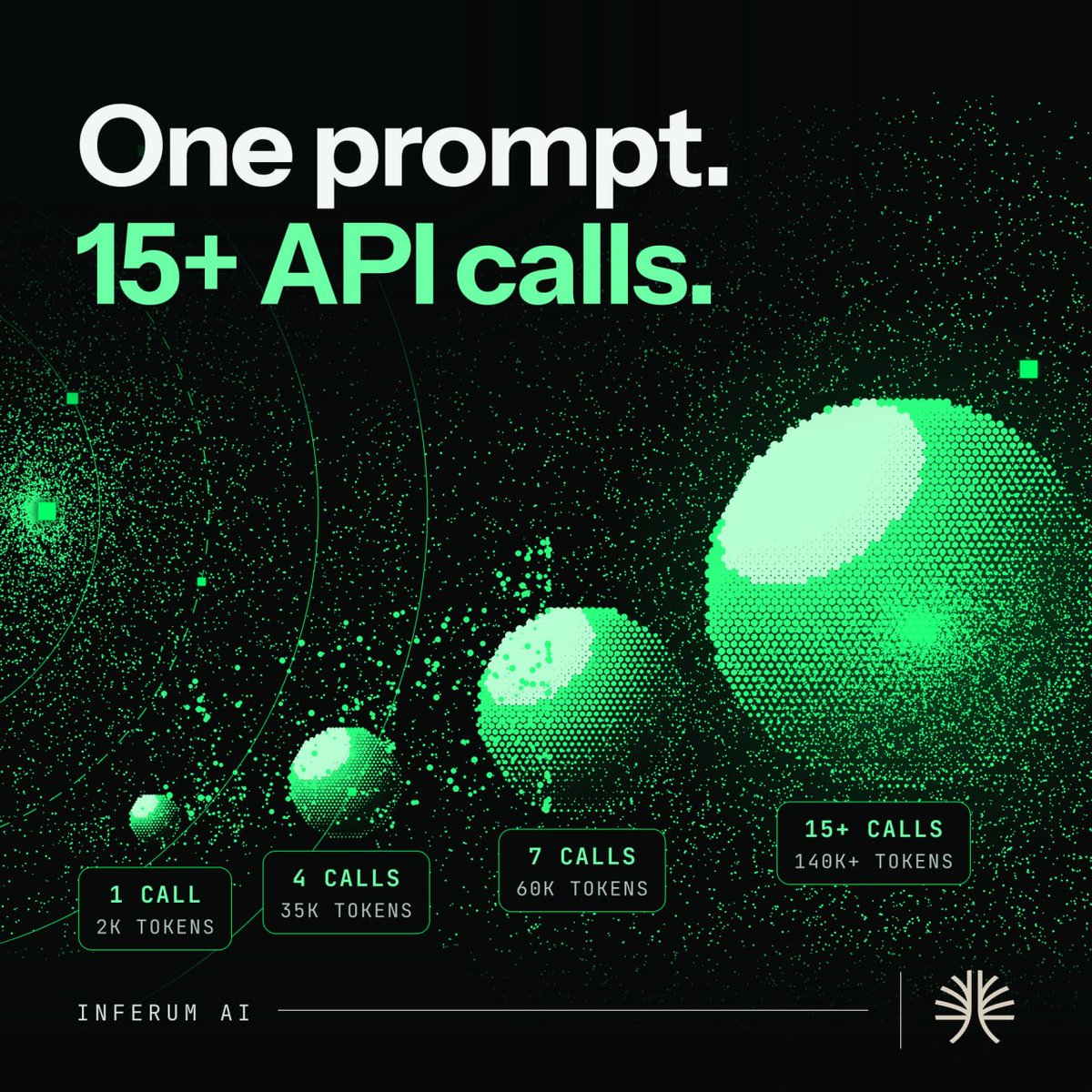
When you give an AI agent a task, it autonomously starts making decisions and executing terminal commands
But there’s a silent killer for AI agents: Context Window Snowballing
Models don’t have built-in memory. For a model to remember what it did on step 1 when it’s on step 10, the developer has to resend the ENTIRE HISTORY back to the API
Expensive inference traps developers in a lose-lose situation:
• Set execution limits: The agent gives up halfway through
• Give full freedom: The agent gets stuck in a loop, running 20 retries and burning $15–$20 on a single minor task
The core point of Inferum isn't just saving a few cents on inference
It’s about letting the agent learn and execute tasks properly without insane compute costs
Affordable inference fundamentally changes agent behavior
It gives the agent room to fail, test, try alternative solutions and refactor code without fear of a bloated bill
The problem with agents isn’t that they’re dumb
The problem is that we force them to cheap out on thinking
Affordable inference isn't about cutting costs - it's about giving your agent the room to actually think and fix its own errors
Launch and test any AI agents for free
We give you 10M tokens just for signing up
If you are an AI enthusiast, developer or just trying out AI agents to test a hypothesis - work with us
Sign up → get your key → connect your tool → run your task
No credit card or anything else required
Grab your inference and test how the Inferum operates
https://t.co/zuiX1SFBFX
Time to make AI for everyone
Inferum AI delivers the most affordable inference for AI agents to enthusiasts
> MiniMax M2.7
> DeepSeek V4 Flash 0731
> GLM 5.3 Flash
$0.0023 per 1M tokens / input & output
No upfront payments
Choose a model, pay and start using it
New users get 10M free tokens to experience the quality of our service
Affordable AI for everyone, starting today!