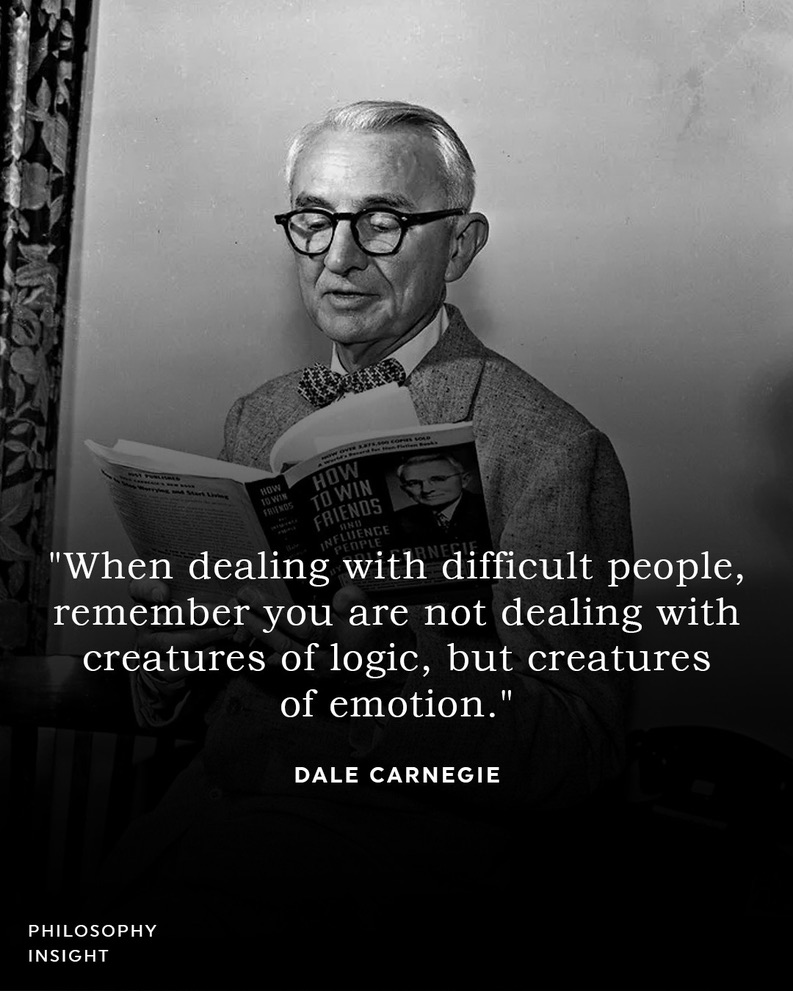
There’s far more information in a smile than a frown.
That’s why encouragement is a much more effective teaching device than punishment.
#howtowinfriendsandinfluencepeople
“Begin by emphasizing – and keep on emphasizing – the things on which you agree,” Carnegie wrote.
“Keep emphasizing, if possible, that you are both striving for the same end and that your only difference is one of method and not of purpose.”
Be empathetic.
Carnegie wrote that “the only way on earth to influence other people is to talk about what they want and show them how to get it.”
#howtowinfriendsandinfluencepeople
Praise others’ achievements.
“Abilities wither under criticism; they blossom under encouragement,” Carnegie wrote.
Be lavish with praise, but only in a genuine way, he advised.
Avoid criticizing, condemning, or complaining.
“Any fool can criticize, condemn, and complain – and most fools do,” Carnegie wrote.
“But it takes character and self-control to be understanding and forgiving.”
Shaw once remarked: If you teach a man anything, he will never learn.
Shaw was right.
Learning is an active process.
We learn by doing.
#howtowinfriendsandinfluencepeople
Criticism is futile because it puts a person on the defensive and usually makes him strive to justify himself.
Criticism is dangerous, because it wounds a person’s precious pride, hurts his sense of importance, and arouses resentment.
Why talk about what we want?
That is childish.
Absurd.
Of course, you are interested in what you want.
You are eternally interested in it.
But no one else is.
The rest of us are just like you: we are interested in what we want.
Everybody in the world is seeking happiness—and there is one sure way to find it.
That is by controlling your thoughts.
Happiness doesn’t depend on outward conditions.
It depends on inner conditions.