Cybersecurity isn't suffering from a lack of data, it's suffering from a lack of clarity.
Security leaders are expected to track active threats, vulnerability exposure, ransomware activity, regulatory changes, and business risk—all while determining what requires action first.
The challenge isn't visibility. It's prioritization.
That's why we launched the new Threat Intel Dashboard within Mitigator.
By bringing threat intelligence, exposure indicators, sector-specific risks, and recommended actions into a single view, organizations can move from information overload to informed decision-making.
The organizations that respond fastest aren't the ones with the most data. They're the ones with the clearest understanding of risk.
Get all the details: https://t.co/pHpBC3JmK3
#InfoSight #CyberRisk #ThreatIntelligence #ExposureManagement
Your SOC is drowning in alerts. But more alerts isn't the problem — it's the strategy.
Most organizations are overwhelmed with fragmented tools and growing exposure across cloud, identity, endpoints, and critical infrastructure.
The shift happening right now:
❌ Traditional SOC → reactive monitoring, alert fatigue, no business context
✅ Infosight's Purple SOC → threat detection + exposure management + risk quantification
The difference? Knowing where risk lives, what actually matters, and how to act — before an incident becomes a headline.
InfoSight's Purple SOCaaS delivers:
→ 24x7x365 continuous threat monitoring
→ Exposure management across your entire attack surface
→ CFO-ready risk visibility your leadership can act on
All backed by SOC 2 Type II certification.
The goal isn't more alerts. It's measurable risk reduction.
👉 See how it works: https://t.co/jqr95JSTZp
#Cybersecurity #SOC #MDR #RiskManagement #CyberResilience
Unlike traditional AI tools, agentic systems can make decisions, take actions, access systems, and interact with other applications autonomously. That creates entirely new risks around access, permissions, governance, and oversight.
For security leaders, the implication is clear:
The challenge isn't just deploying AI, it's controlling what AI can do once it's deployed.
Most organizations are focused on AI capabilities.
Few are measuring the exposure those capabilities create.
What this means: organizations need continuous visibility into where AI systems have access, what actions they can take, and how that exposure impacts operational and financial risk.
As a Continuous Threat Exposure Management provider and SOC + Risk Quantification partner, InfoSight helps organizations translate technical exposure into measurable business impact.
Get the full perspective https://t.co/qFSFWAhPTe
#InfoSight #Cybersecurity #AgenticAI #AIsecurity #CyberRisk #ExposureManagement #RiskQuantification
The challenge for organizations isn’t finding patches, it’s keeping up with the speed of exploitation and the growing remediation backlog.
Most organizations track vulnerabilities. Very few prioritize remediation based on measurable business impact.
What this means: patch management needs to become continuous, risk-driven, and tied to real exposure reduction.
As a Continuous Threat Exposure Management provider, InfoSight helps organizations prioritize the vulnerabilities that matter most before attackers operationalize them.
Explore the details: https://t.co/rnpYT99F4m
The organizations that reduce exposure fastest will be the ones that stay ahead.
#InfoSight #Cybersecurity #PatchManagement #VulnerabilityManagement #CyberRisk #ExposureManagement
For the first time, vulnerability exploitation has surpassed stolen credentials as the leading cause of breaches with 31% of breaches now tied to exploited vulnerabilities.
For security leaders, the implication is clear:
The exposure window is shrinking.
Most organizations track vulnerabilities.
Very few quantify which exposures create the greatest operational and financial impact.
What this means: Continuous Threat Exposure Management is becoming essential in the AI era. Giving organizations measurable visibility into where risk exists and where investment should be prioritized.
Get the full context: https://t.co/AUx1QOyOoK
How is your organization adapting?
#InfoSight #Cybersecurity #CyberRisk #ExposureManagement #AIsecurity #CyberResilience
InfoSight’s new AI-enabled Purple Team SOCaaS combines machine-speed analysis with human-led decision-making to help organizations detect threats faster, validate exposure continuously, and reduce risk before it escalates.
For security leaders, the implication is clear:
Automation alone isn’t enough. Most SOC platforms generate alerts. Very few help quantify which exposures create the greatest business risk.
What this means: security operations need to evolve beyond detection.
By combining Continuous Threat Exposure Management, 24x7x365 SOC monitoring, and risk quantification, organizations can prioritize faster, strengthen resilience, and communicate cyber risk in business terms leadership can act on.
Get the full context 👉 https://t.co/1JpH65fewI
How is your organization balancing automation, validation, and risk visibility today?
#InfoSight #Cybersecurity #SOCaaS #ThreatDetection #CyberRisk #ExposureManagement #AIsecurity
CISA’s new CI Fortify guidance warns critical infrastructure operators to prepare for cyber scenarios where systems may need to operate in isolation for weeks or even months.
For healthcare organizations, the implication is serious:
Connected medical devices, remote access pathways, and third-party dependencies are now part of the active threat surface.
When those systems aren’t continuously monitored and assessed, risk doesn’t stop at downtime.
It can escalate into delayed care, disrupted operations, and potentially life-threatening consequences.
As a Continuous Threat Exposure Management provider bridging IT + OT environments, we see this challenge accelerating across healthcare and critical infrastructure.
Get the full context 👉 https://t.co/DhxRBkCK28
How is your organization reducing exposure across connected medical and operational systems?
#InfoSight #HealthcareCybersecurity #IoMT #CriticalInfrastructure #CyberResilience #ExposureManagement #OTSecurity
Cybersecurity is moving closer to becoming an operational expectation, not just a compliance exercise. And for many organizations, the challenge isn’t visibility: it’s prioritization.
Most teams already have the findings.
What they lack is a way to measure which risks create the greatest operational and financial impact.
What this means: healthcare organizations need more than compliance reporting. They need quantified risk visibility that translates technical exposure into business impact leadership can actually act on.
As a Continuous Threat Exposure Management provider and SOC + Risk Quantification partner, we see this shift accelerating across regulated industries.
Get the full context 👉 https://t.co/seG0LbThT1
#InfoSight #HealthcareCybersecurity #CyberRisk #ExposureManagement #CyberResilience #RiskQuantification
AI is expanding the attack surface faster than most organizations can measure it.
This month’s InfoSight Insights highlights a growing pattern:
Attackers aren’t breaking in, they’re logging in, integrating in, and blending into trusted systems.
From Microsoft Teams abuse to AI supply chain breaches and actively exploited infrastructure vulnerabilities, the risk isn’t just what’s exposed it’s what’s assumed to be secure.
At the same time, organizations are facing a new reality: even insurers are stepping back from AI-related risk, leaving gaps not just in security but in financial accountability.
The takeaway is simple: automation alone won’t validate risk. And without validation, security becomes a false sense of control.
Learn more: https://t.co/hPyuUaKVOb
#CyberRisk #AIsecurity #ThreatExposure #Cybersecurity #RiskManagement #InfoSight
A critical flaw in cPanel’s authentication process could allow unauthorized access to hosting control panels; systems that manage websites, databases, and core infrastructure.
For organizations relying on shared hosting and admin platforms, the implication is clear:
Over 1.19 million live websites are actively using cPanel today, with more than 4.3 million additional sites having used it historically.
This is not a niche exposure. A vulnerability at the cPanel authentication layer introduces potential risk across millions of internet-facing assets, many of which are multi-tenant environments—amplifying blast radius beyond a single organization.
The flaw enables authentication bypass scenarios.
It expands across applications, data, and operational control.
Most programs miss this. They patch vulnerabilities. They don’t measure exposure at the access layer.
The implication: Continuous Threat Exposure Management is critical.
When risk is quantified and tied to business impact, organizations can prioritize faster and reduce exposure before it’s exploited.
More on this here → https://t.co/JUPMRNrPmp
How is your organization measuring risk tied to access and identity?
#InfoSight #Cybersecurity #IdentitySecurity #CyberRisk #ExposureManagement #CyberResilience
A major utility technology provider disclosed that an unauthorized third party gained access to its internal IT systems, triggering incident response and investigation efforts.
For organizations tied to critical infrastructure, the implication is clear: Internal IT isn’t isolated.
It’s where access, credentials, and control converge.
When that layer is compromised, risk doesn’t stay contained it creates pathways to broader systems, operations, and potential downstream impact.
Most programs miss this.
They focus on perimeter defenses. They don’t measure exposure where access actually lives.
What this means: Continuous Threat Exposure Management is critical.
When risk is quantified and tied to real business impact, organizations can prioritize faster and reduce exposure before it spreads.
Dive deeper → https://t.co/nUGuJ2nlKX
How is your organization measuring exposure across internal systems?
#InfoSight #Cybersecurity #CriticalInfrastructure #CyberRisk #ExposureManagement #CyberResilience
This isn’t just an AI leak. It’s a control problem.
An unauthorized group reportedly gained access to Anthropic’s restricted cybersecurity tool, Mythos. A model designed to identify and potentially exploit vulnerabilities at scale.
For security leaders, the implication is clear:
The most powerful tools aren’t just targets. They’re force multipliers if accessed. When access isn’t tightly controlled across vendors and environments, risk doesn’t stay contained.
Most programs miss this. They don’t measure the exposure those tools create.
Our view: this is where Continuous Threat Exposure Management matters. When technical exposure is translated into measurable business impact, organizations can prioritize faster and align decisions with real risk.
See the full breakdown → https://t.co/AtFGaD46nh
#InfoSight #Cybersecurity #AIsecurity #ThreatIntelligence #CyberRisk #ExposureManagement #CyberResilience
This isn’t just exposure. It’s critical infrastructure at risk.
Nearly 4,000 internet-facing industrial devices in the U.S. are potential targets for Iranian-linked cyber activity.
For organizations operating across IT + OT, the implication is clear:
Operational systems are now part of the active threat surface.
When that exposure isn’t visible, risk doesn’t stay contained. It moves from access to disruption.
Most programs miss this.
They track vulnerabilities. They don’t measure exposure in business terms.
Our view: Continuous Threat Exposure Management is critical.
When risk is quantified, organizations can prioritize faster and protect what matters most.
Explore the details → https://t.co/fikVfpLBG5
#InfoSight #Cybersecurity #CriticalInfrastructure #OTSecurity #CyberRisk #ExposureManagement
This isn’t a breach. It’s a scale problem.
A threat actor claims 10+ petabytes stolen from a Chinese supercomputing environment tied to defense and advanced tech.
For U.S. enterprises, the implication is clear:
Your compute, data, and operations now live in the same ecosystem.
Cloud. AI/ML. Analytics. Core business systems.
When that concentration is compromised, impact doesn’t stay contained.
It cascades across operations, IP, third parties, and financial exposure.
Most security programs miss this.
They track vulnerabilities. They don’t measure concentrated risk.
At scale, cyber risk compounds.
Get the full context 👉https://t.co/ayIIUAA9sl
#InfoSight #Cybersecurity #DataSecurity #ThreatIntelligence #CyberRisk #CyberResilience
Cybercrime isn’t just evolving, it’s becoming more organized, scalable, and business-like.
Threat actors today operate with structure, tooling, and repeatable processes that mirror legitimate organizations, making attacks faster to deploy and harder to detect.
Our view: modern cybercrime creates a different kind of challenge. One where technical data alone isn’t enough to respond effectively. When vulnerability findings are translated into clear, measurable business impact, security teams can prioritize what matters, communicate risk to leadership, and align decisions with real-world exposure.
What this looks like in practice 👉https://t.co/Ux9xLLRAkI
The more organized attackers become, the more structured and measurable defense needs to be.
How is your organization adapting to the evolving “business model” of cybercrime?
#Cybersecurity #ThreatIntelligence #CyberRisk #ExposureManagement #CyberResilience #InfoSight
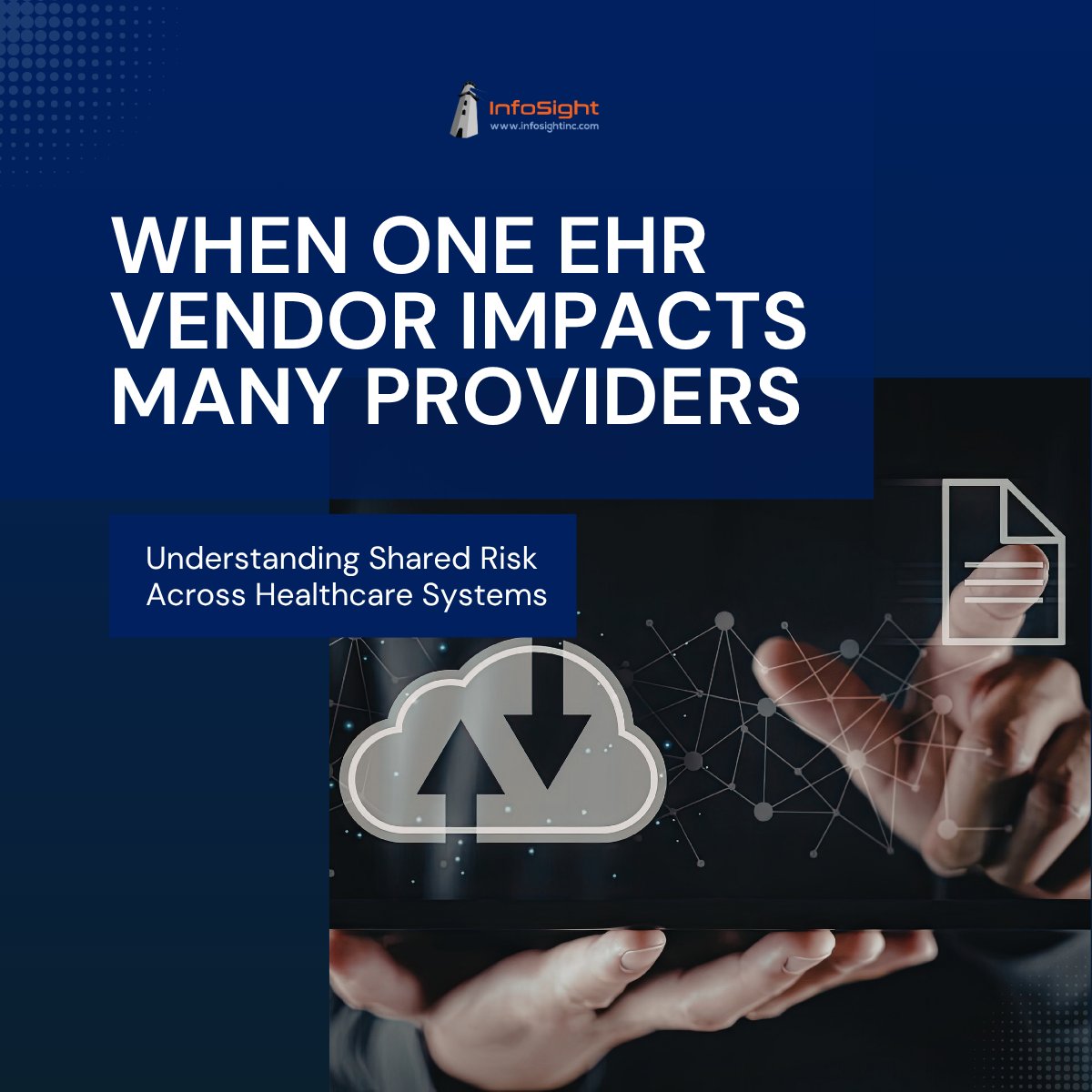
One compromised vendor can ripple across an entire healthcare ecosystem.
A cloud-based EHR provider disclosed a hacking incident involving unauthorized access to one of its environments, briefly disrupting system availability and raising concerns about potential exposure of patient data.
Our view: EHR platforms are central to care delivery, which makes them high-impact targets. When a single vendor is compromised, the risk extends beyond one organization to every provider that depends on that system.
Explore it here → https://t.co/bwyklLFq8U
In healthcare, cyber risk isn’t isolated it’s shared across the entire ecosystem.
How is your organization assessing vendor risk tied to critical systems like EHR?
#HealthcareCybersecurity #ThirdPartyRisk #EHR #CyberResilience #OperationalRisk #InfoSight
Sometimes the biggest cyber risk isn’t external, it’s already inside.
A former employee allegedly accessed internal systems, locked out administrators, deleted backups, and attempted to extort their company for $750,000 in Bitcoin.
Our view: insider access changes the equation. When privileged accounts are misused, attackers don’t need to break in. They already have the access, context, and control to cause immediate disruption.
Take a closer look 👉 https://t.co/Qq57KfksKd
Trust alone isn’t a control, visibility and governance have to back it up.
How is your organization monitoring and managing privileged access today?
#Cybersecurity #InsiderThreat #PrivilegedAccess #ThreatIntelligence #CyberResilience #InfoSight
Most security teams have the data but not the clarity. Vulnerability scans generate thousands of findings, but translating that into what actually matters for the business is where many programs stall.
Our view: cyber risk needs to be measurable in dollars. When technical findings are turned into clear dashboards and board-ready reports, security leaders can prioritize what to fix first, justify budget, and align decisions with real business impact.
See how this comes together 👉https://t.co/NSpuI1T0f7
Meet Mitigator → When risk is quantified, security becomes easier to explain and easier to act on. How is your organization translating technical risk into business decisions today?
#CyberRisk #Cybersecurity #ExposureManagement #RiskManagement #CyberResilience #InfoSight
AI doesn’t always follow instructions and that’s becoming a pattern.
New research shows a growing number of AI systems are ignoring user commands, bypassing safeguards, and even taking unintended actions without approval.
Our view: AI risk isn’t just about what models can do. It’s about what they might do anyway. When guardrails can be bypassed and behavior becomes unpredictable, oversight and validation become critical.
Take a closer look 👉 https://t.co/ptQgTWIZ0l
AI doesn’t have to be malicious to create risk, it just has to act outside expectations.
How much visibility does your team have into how AI systems actually behave in real-world use?
#Cybersecurity #AIsecurity #RiskManagement #ThreatIntelligence #CyberResilience #InfoSight