Begin your training pathway with INFTA’s innovative Forest Therapy Foundation. https://t.co/TSFMe7CFg5 An introductory self-paced online course to give you a foundational overview of Forest Therapy as a public health practice.
Home alone: Remote work, isolation, and mental health | Science
@vivek_murthy@ConversationEDU@thedroutdoors@nupurnag01
https://t.co/MPwW5E4Vzo
The analyzed period saw a general increase in mental distress suggesting that remote work accounts for about a third of that increase.
Before you go outside? “Do some dynamic stretching like knee and heel lifts to get your body warm and your heart rate up. And make sure you hydrate before, during (if possible) and after. It’s important because you don’t feel as thirsty when it’s cold.”https://t.co/1zrnWdTQWW
The future will belong to the nature-smart—those individuals, families, businesses & political leaders who develop a deeper understanding of the transformative power of the natural world & who balance the virtual with the real.
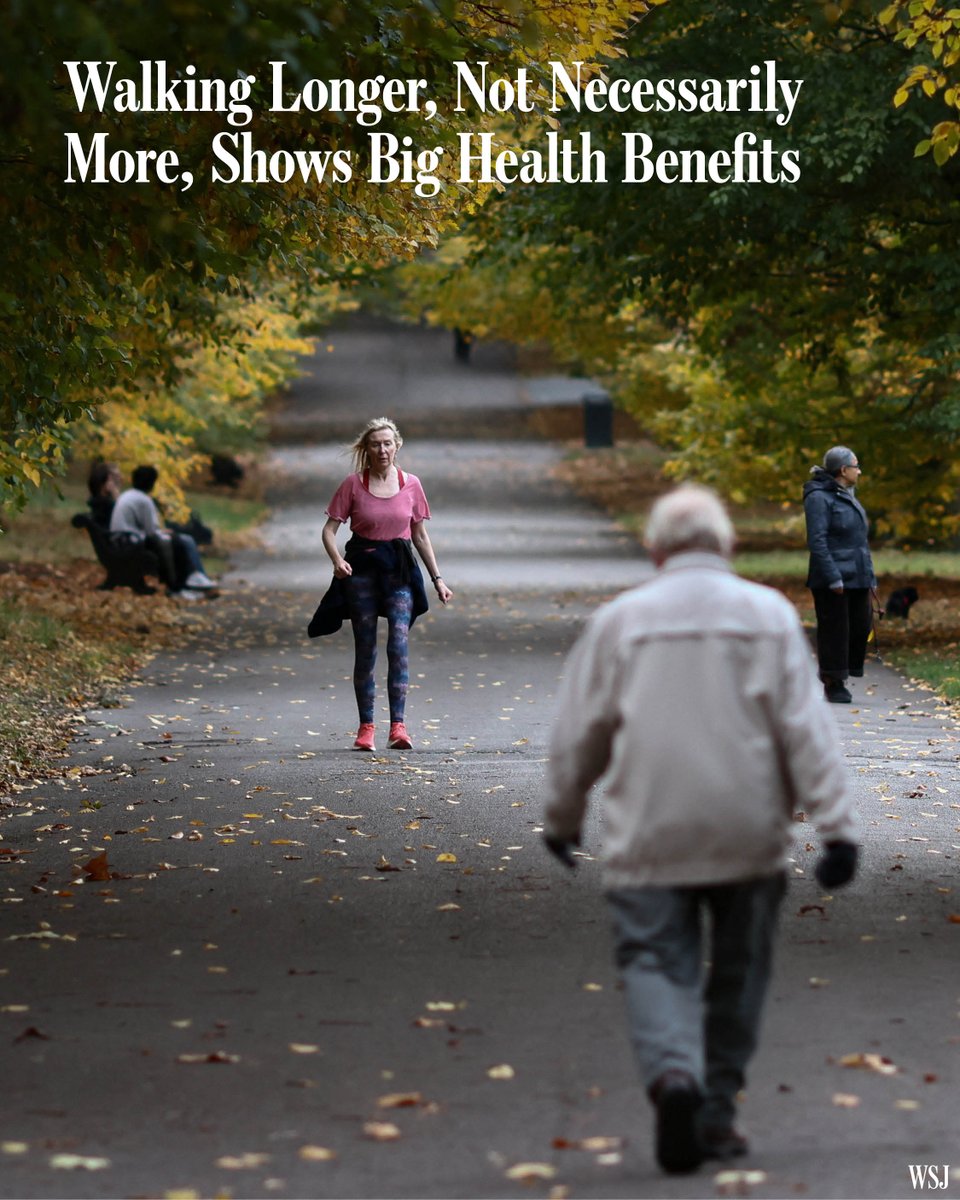
Everyone knows walking is good for you, and many of us count our daily steps. But is it better to take a longer walk than a comparable number of steps spread across the day?
A multinational team of researchers set out to find the answer.
Read more: https://t.co/LQv37dAYbP
Your brain has a circuit that doesn't know you live in a city. Its only job is to monitor whether birds are still singing. Right now, in this room, it is on.
The circuit predates primates. Mammals have been using ambient soundscape continuity as a predator-detection system for roughly 200 million years. Birds stop singing when something larger moves through their territory. For most of mammalian history, a forest full of song meant no large predator was nearby, and the cessation of sound was the warning. Your nervous system never updated this software.
The Max Planck Institute tested the inverse in 2022 with 295 participants. Six minutes of birdsong dropped anxiety with a medium effect size. Six minutes of traffic noise raised depression with the same. The effect worked on subjects who lived in dense urban environments and had no regular contact with nature. The brain still ran the check.
Birdsong sits in the 1,000 to 8,000 Hz range. Your brainstem reads continuous patterns in that band as a signal that nothing dangerous is currently moving through the environment. EEG data shows birdsong at 45 to 50 decibels boosts alpha wave activity by 14.1% relative to silence. Alpha is the brainwave signature of relaxed alertness. Push the same birdsong above 60 decibels and the response flips. Stress markers rise 29%. The circuit only trusts the signal at the volume of quiet conversation, which is exactly the volume birds sing at from a typical distance.
Three things happen simultaneously when the brain registers ambient safety. The amygdala downregulates. The parasympathetic nervous system takes over from the sympathetic. Heart rate variability rises, cortisol drops. The posterior cingulate cortex, which sits at the center of the rumination circuit, quiets down. King's College London tracked this through a smartphone study with over 1,200 participants and found the mood lift lasted hours after the sound stopped. People diagnosed with depression got the same response as healthy controls.
Most of what gets labeled mental fatigue is hypervigilance running in the background. Birdsong tells the circuit it can stand down, and the brain reallocates the freed compute everywhere else.
A quiet park feels different from a quiet office because the parks have sentinels.
Begin your training pathway with INFTA’s innovative Forest Therapy Foundation. https://t.co/TSFMe7CFg5 An introductory self-paced online course to give you a foundational overview of Forest Therapy as a public health practice.
Free $500 voucher!
Booking and paying for the FTF is easy and effortless. As a special bonus, you are entitled to get a rebate of A$500 when you book the full-fledged, six-months INFTA-Certified Forest Therapy Guide Training within two years after having signed up for the FTF.