Africa's Leading Trainer of NLP & Neurological Repatterning. Lifestyle Coach & Performance Consultant. Head Trainer/Consultant at @NLPwithIMI || +2348032005725
Only the truly WEALTHY feed THEIR MINDS when there is barely food to eat.
The POOR however, seek first to feed their TUMMIES ABOVE everything else.
@NLPwithIMI
WE PRAISE STRENGTH.
THEN PUNISH PEOPLE FOR NEEDING SUPPORT.
Nigeria, We Need To Talk.
Nigeria, We Need To Talk About Strength
We have some interesting definitions of strength in Nigeria.
The first son must carry it.
The first daughter must understand.
The father must not shake.
The mother must somehow find capacity from heaven.
The leader must know.
The pastor must hold everybody.
The imam must remain steady.
The founder must solve payroll and still smile for LinkedIn. 😂
Then when the person says:
“I need help.”
We start looking at them somehow.
But a society that celebrates responsibility without making room for support can quietly produce exhausted strong people.
Support doesn't automatically mean weakness.
And independence doesn't mean doing everything alone.
Sometimes mature strength sounds like:
“I need another perspective.”
“I don't know.”
“I need to rest.”
“I need training.”
“I need to change how I am doing this.”
“I need help.”
Perhaps one of the things we must redesign culturally is the belief that needing support cancels strength.
It doesn't.
Sometimes asking earlier prevents collapse later.
Nigeria, we need to talk.
Innocent Usar
Behavioural Architect
#NigeriaWeNeedToTalk #Nigeria #Leadership #MentalWellbeing #BehaviouralArchitecture #AfricanLeadership #SelfLeadership #EmotionalIntelligence #InnocentMINDS
INSIGHT IS NOT CHANGE
Insight can be beautiful.
It can also become another hiding place.
“I know why I do it.”
Good.
What changed?
“I understand my childhood.”
Important.
What response is different now?
“I know I have boundary issues.”
Okay.
Where did you communicate one?
“I know I procrastinate because I’m afraid.”
Fine.
What did fear meet differently this week?
Insight is not change.
Insight gives us information.
Change eventually gives us evidence.
I have had insights about myself that took years to become behaviour.
So this is not contempt for insight.
Far from it.
Understanding matters.
But we must not mistake naming the architecture for redesigning it.
Inside InnocentMINDS, the movement is:
UNDERSTAND. REDESIGN. TRANSFORM.
Not:
Understand.
Understand some more.
Explain beautifully.
Then repeat.
😂
Tonight ask yourself:
What is something about yourself you already understand very well...
but have not yet translated into behaviour?
That question may show you where the next work is.
You may not need another promise to “be disciplined.”
You may need to identify the exact moment your structure collapses.
What triggers it?
What wins immediately?
What must become easier?
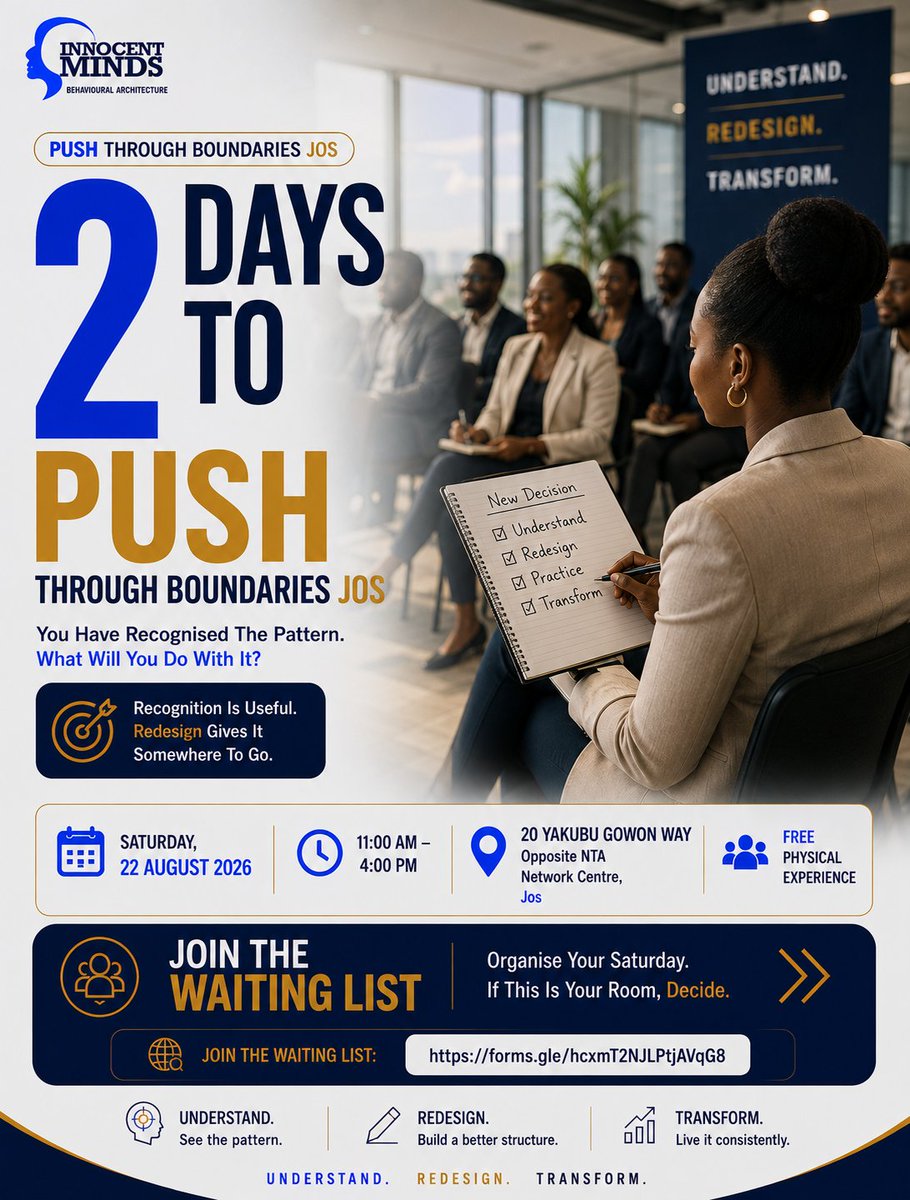
PUSH Jos is Saturday.
If the question is yours, come work with it.
If not, send it to one person whose next level needs better structure.
Delay Can Carry Information
Sometimes procrastination means:
“I am afraid.”
Sometimes:
“I am overwhelmed.”
Sometimes:
“I don't know the next step.”
And sometimes:
“I never actually chose this.”
Do not glorify delay.
Interrogate it.
The correct diagnosis changes the intervention.
Innocent Usar
Behavioural Architect
#BehaviouralArchitecture #PUSHThroughBoundaries
Your Next Level Needs More Than Mood
Mood says:
“I feel ready.”
Structure asks:
“What happens when you don't?”
That distinction matters in leadership, business, career and personal change.
A useful structure survives a bad day.
A weak one requires the perfect emotional state.
Build for ordinary Tuesday, not only inspired Monday.
Innocent Usar
Behavioural Architect
#BehaviouralArchitecture #PUSHThroughBoundaries
geria, We Need To Talk:
We Are Raising Children Who Apologise Without Understanding Repair
Nigeria, we need to talk.
We teach children...
“Say sorry.”
Good.
But what happens after “sorry”?
Do they understand:
what happened?
what impact their behaviour had?
what needs to change?
what repair looks like?
how trust is rebuilt?
how to behave differently next time?
A child can learn to say “sorry” simply because an adult wants the discomfort to end.
Then adulthood arrives.
“I said sorry now.”
As if the word itself completes accountability.
You can see this in relationships.
Teams.
Families.
Leadership.
Even public life.
Apology without repair can become another avoidance strategy.
A clean apology may include:
I understand what I did.
I understand some of its impact.
I am not demanding immediate forgiveness.
Here is what I will do differently.
Here is what I can repair.
And then:
evidence.
We need to stop teaching apology as a magic word that makes consequences disappear.
Repair is a behavioural skill.
Children should learn it.
Adults should practise it.
Leaders should model it.
Nigeria, we need to talk.
Innocent Usar
Behavioural Architect
#NigeriaWeNeedToTalk
#Parenting
#Accountability
#BehaviouralArchitecture
#Leadership
A Free Introduction Should Not Exist To Impress You With Terminology
It should help you notice something useful.
A pattern.
A sequence.
A response you have been repeating.
A possibility you had not seen.
NLP becomes useful when it helps you become more precise about experience.
What do you picture internally before anxiety rises?
What do you say to yourself?
What state follows?
What do you then do?
What result does that sequence keep producing?
That is far more valuable than simply knowing another impressive term.
Learn the language.
But use the language to understand life.
Then practise.
Innocent Usar
NLP Master Practitioner and Trainer
#NLP
#BehaviouralArchitecture
#Learning
#PersonalDevelopment
If you recognise the gap between what you know you are capable of and what you repeatedly do under pressure, PUSH Through Boundaries Jos is designed to help make that gap visible and workable.
The experience is for professionals, leaders, entrepreneurs, parents, young adults, creatives and thoughtful adults who want to understand a repeated limitation and begin practising a better response.
Saturday, 22 August 2026
11:00 AM–4:00 PM
Venue:
20 Yakubu Gowon Way, Jos
Entrance: FREE
Experience value: ₦50,000
Enrolment:
https://t.co/D485LMEUDC
WhatsApp:
+234 803 200 5725
Some Teachers Are Teaching From Burnout
Some people are teaching discipline from exhaustion.
Leading teams from exhaustion.
Parenting from exhaustion.
Building businesses from exhaustion.
Then what should be wisdom begins carrying irritation.
Correction becomes sharp.
Patience disappears.
Small mistakes feel enormous.
Everybody around the person thinks:
“They have changed.”
Sometimes what changed is capacity.
This does not excuse harmful behaviour.
It tells us something important about design.
If a leader repeatedly operates beyond capacity, the eventual problem will not stay private.
Exhaustion leaks.
Into tone.
Judgement.
Relationships.
Decision-making.
Delegation.
Creativity.
Even into the way we teach other people to live.
So before telling everyone around you to become tougher, ask:
When did I last actually recover?
Not distract myself.
Not collapse.
Recover.
There is no prize for becoming so useful that everybody benefits from you except you.
And there is no sustainable leadership architecture built entirely on depletion.
Innocent Usar
Executive Coach
#Leadership
#Burnout
#BehaviouralArchitecture
#Capacity
RECOVERY AND RETURN
Sometimes the best evidence that you rested well is not that you enjoyed the break.
It is what becomes available afterwards.
You can think again.
Speak again.
Make the decision.
Return to the unfinished work.
Have the conversation.
Or finally recognise that a particular return would no longer be healthy.
Recovery should increase choice.
Escape often keeps one old choice running automatically:
Stay away.
Delay.
Disappear.
Distract.
Call the postponement something nicer.
So do not ask only:
“Did I rest?”
Ask:
What did the rest restore?
There is a deeper explanation in this week’s Inside The Design episode. I have put the YouTube and Spotify links in the comment.
Innocent Usar
Trauma-Informed Healing Facilitator
#InsideTheDesign
#Recovery
#RestVsEscape
#BehaviouralArchitecture
Real Healing Leaves Evidence
One reason healing language can become dangerous is that it can make avoidance sound complete.
“I have moved on.”
“I have forgiven.”
“I am protecting my peace.”
“I don't owe anyone an explanation.”
“I am choosing myself.”
All of those statements can be healthy.
But none of them proves that the underlying pattern has changed.
Behavioural evidence might look different:
You can now have the conversation without collapsing.
You can say no without needing to punish.
You can remember the event without reorganising the whole day around it.
You can meet the person without becoming the old version of yourself.
You can make a decision without rehearsing how everybody may judge you.
You can rest and return.
You can take space without disappearing.
You can forgive without pretending there was no injury.
That is why I increasingly ask:
What has become possible that was not possible before?
That is a better question than:
“Do I feel healed?”
Feeling matters.
But evidence matters too.
Sometimes healing is not loud.
It appears in the cleaner decision.
The shorter explanation.
The conversation you no longer avoid.
The boundary that no longer needs anger to survive.
The trigger that still exists but no longer drives the vehicle.
This is the movement from insight to evidence.
Innocent Usar
Behavioural Architect
#BehaviouralArchitecture
#Healing
#SelfLeadership
#Evidence
MORE COURSES. SAME RESULTS?
One uncomfortable reality in personal development:
You can become very educated about change without changing much.
You know the terminology.
You can explain limiting beliefs.
You understand trauma language.
You know your attachment style.
You have attended coaching programmes.
You can describe your childhood.
You recognise your triggers.
You have highlighted twelve books.
But what happens when pressure arrives?
That is where evidence enters.
Do you still send the same angry message?
Do you still disappear when conflict begins?
Do you still postpone the difficult financial decision?
Do you still accept access you said you would stop giving?
Do you still over-explain when authority enters the room?
Do you still know exactly what to do and not do it?
Knowledge matters.
But knowledge is not change until it enters behaviour.
For leaders, coaches and professionals, this matters even more.
Because we can easily hide behind competence.
The person helping everybody else can remain unexamined.
The coach can become skilled at asking questions they never ask themselves.
The trainer can teach the process while quietly avoiding their own next step.
The leader can read ten books on delegation and still refuse to release control.
Do not despise learning.
Learn deeply.
Then demand evidence from the learning.
What changed in your calendar?
What changed in your language?
What changed in your boundaries?
What changed in your money?
What changed in your response when the old trigger appeared?
What changed in what you tolerate?
Insight is valuable.
Integration is the assignment.
Innocent Usar
Behavioural Architect
#BehaviouralArchitecture
#Leadership
#Learning
#PersonalDevelopment
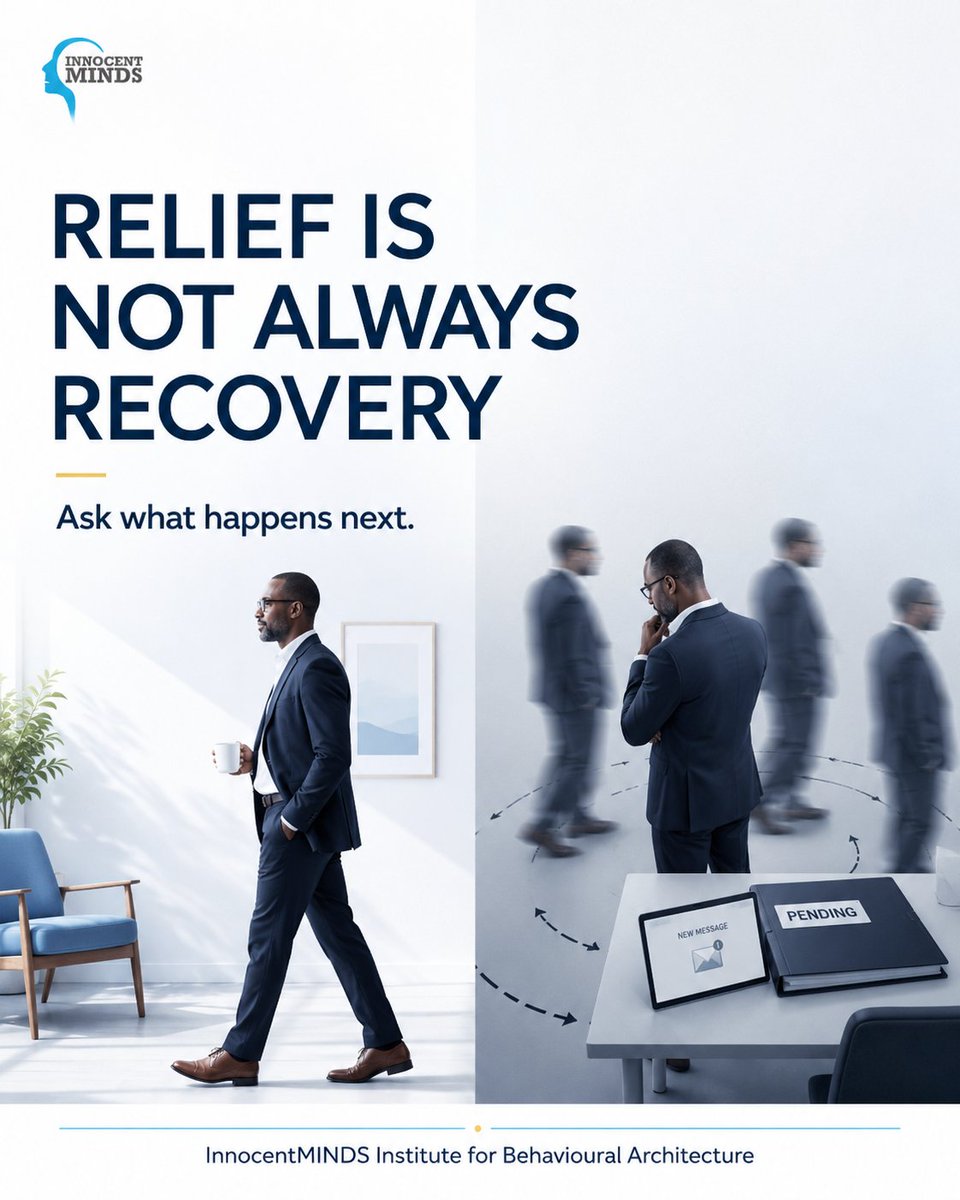
RELIEF IS NOT ALWAYS RECOVERY
One mistake leaders make is assuming that because something feels relieving, it must be healthy.
Not necessarily.
Relief tells you discomfort reduced.
It does not automatically tell you why.
You can feel relief because you slept after three brutal weeks.
Good.
You can also feel relief because you cancelled the conversation you were afraid to have.
Those are not the same behavioural event.
A founder says:
“I need space.”
Fine.
What does the space produce?
Better judgement?
Clearer decisions?
Less reactivity?
Or ten more days of organisational uncertainty?
A parent withdraws after feeling overwhelmed.
Did the pause help them return more regulated?
Or did everybody in the house learn to walk around their silence?
A professional postpones an important decision because they are “thinking.”
Did reflection create clarity?
Or did it simply make avoidance sound intelligent?
Behavioural Architecture does not ask only:
“How do you feel?”
It also asks:
What is the behaviour doing?
What does it protect?
What does it prevent?
What does it produce afterwards?
Rest can be deeply responsible.
Avoidance can feel incredibly relieving.
Learn the difference.
Your feelings matter.
So does the evidence.
Innocent Usar
Behavioural Architect
#Leadership
#BehaviouralArchitecture
#DecisionMaking
#SelfLeadership
RELIEF IS NOT ALWAYS RECOVERY
One mistake leaders make is assuming that because something feels relieving, it must be healthy.
Not necessarily.
Relief tells you discomfort reduced.
It does not automatically tell you why.
You can feel relief because you slept after three brutal weeks.
Good.
You can also feel relief because you cancelled the conversation you were afraid to have.
Those are not the same behavioural event.
A founder says:
“I need space.”
Fine.
What does the space produce?
Better judgement?
Clearer decisions?
Less reactivity?
Or ten more days of organisational uncertainty?
A parent withdraws after feeling overwhelmed.
Did the pause help them return more regulated?
Or did everybody in the house learn to walk around their silence?
A professional postpones an important decision because they are “thinking.”
Did reflection create clarity?
Or did it simply make avoidance sound intelligent?
Behavioural Architecture does not ask only:
“How do you feel?”
It also asks:
What is the behaviour doing?
What does it protect?
What does it prevent?
What does it produce afterwards?
Rest can be deeply responsible.
Avoidance can feel incredibly relieving.
Learn the difference.
Your feelings matter.
So does the evidence.
Innocent Usar
Behavioural Architect
#Leadership
#BehaviouralArchitecture
#DecisionMaking
#SelfLeadership
REST RESTORES. ESCAPE DELAYS
A lot of high-performing people don't know how to rest.
But there is another group we don't talk about enough.
People who know how to stop, disappear, postpone and disconnect, but call all of it “rest.”
Those are not necessarily the same thing.
Rest should not be judged by whether you stopped working.
Ask what the pause produced.
Did you sleep?
Did your body settle?
Did your thinking clear?
Did you regain capacity?
Could you return to the conversation with less reactivity?
Could you make the decision you had been postponing?
Could you resume the task with better energy?
That is evidence.
Escape often has a different signature.
You stop.
You feel temporary relief.
The thing remains unresolved.
Its emotional weight increases.
You need another distraction to avoid the discomfort created by the first avoidance.
Then you call the entire cycle “protecting my peace.”
For leaders, founders and people carrying responsibility, this distinction matters enormously.
A leader genuinely recovering can return with more capacity.
A leader repeatedly escaping leaves uncertainty for everyone else to carry.
A parent genuinely resting may return softer.
A parent emotionally disappearing leaves children trying to interpret silence.
A founder recovering can think more clearly.
A founder avoiding can turn one uncomfortable decision into six expensive consequences.
Rest is not the enemy of responsibility.
Proper rest supports responsibility.
This is why Behavioural Architecture looks beyond intention into evidence.
Don't merely ask:
“Do I deserve a break?”
Sometimes you absolutely do.
Also ask:
“What should this break restore, and what will my return look like?”
That question makes rest safer and avoidance harder to disguise.
Innocent Usar
Founder, InnocentMINDS Institute for Behavioural Architecture
#Leadership
#BehaviouralArchitecture
#RestVsEscape
#SelfLeadership
Being useful can become a hiding place.
That sounds unfair until you understand what it means.
There is nothing wrong with being useful.
Helping people is beautiful.
Providing is beautiful.
Being reliable is beautiful.
Leadership requires usefulness.
Parenting requires usefulness.
Business requires usefulness.
Community requires usefulness.
But something changes when being needed becomes one of the safest places you know how to exist.
Then every problem gives you a role.
Every emergency gives you purpose.
Every request gives you evidence that you matter.
And when nobody needs anything?
Silence.
That can be uncomfortable.
So you find another task.
Another person to rescue.
Another problem to fix.
Another meeting.
Another responsibility.
Another reason not to sit long enough to ask:
“What is happening inside me?”
This is why over-functioning can be deceptive.
From outside, it looks like excellence.
And sometimes it is.
But the same behaviour can carry very different meanings.
One person is working hard because the work genuinely requires it.
Another is working hard because there is a season to build.
Another is working hard because the system is poorly designed.
Another is working hard because stopping makes them feel irrelevant.
The behaviour alone does not tell you the architecture.
You have to ask:
What does usefulness protect?
What does it prove?
What would happen if somebody else handled the problem?
Can I receive help without immediately taking control back?
Do I know who I am outside the role people depend on me to play?
And perhaps most importantly:
When I say I need rest, am I genuinely depleted?
Or am I exhausted because I have built a life where being unnecessary feels unsafe?
The answer will not be the same for everyone.
Some people need sleep.
Some need delegation.
Some need systems.
Some need boundaries.
Some need to stop volunteering for jobs nobody assigned them.
And some need to examine why usefulness became one of the main places they learned to locate value.
The goal is not to become less useful.
The goal is to become whole enough that usefulness is something you give, not the only evidence that you matter.
#BehaviouralArchitecture #Leadership #Identity #Rest #InnocentMINDS
Private honesty is not public disgrace.
That distinction matters because many people keep protecting what is hurting them simply because they do not want to “wash dirty linen outside.”
But there are more options than:
Hide everything.
Or expose everything.
A family can protect privacy without protecting dysfunction.
A couple can respect confidentiality without pretending everything is fine.
A leader can protect institutional reputation without forcing employees to deny what is actually happening.
A strong person can remain dignified without performing strength every hour of every day.
You do not need to turn private pain into public content.
But somewhere, truth must become speakable.
A safe conversation.
A journal.
A trusted professional.
A diagnostic.
A learning room.
A private reflection.
Somewhere without the pressure to perform.
Because the longer appearance becomes more important than truth, the more likely the system is to organise itself around what nobody is allowed to say.
That happens in families.
Marriages.
Businesses.
Teams.
Faith communities.
Friendships.
And inside individuals.
The question is not only:
“What will people think if they know?”
Ask:
“What is this costing us because we refuse to know?”
There are homes that are organised but not intimate.
Leaders who are respected but emotionally exhausted.
Couples who function but no longer connect.
Families known for unity where nobody feels safe enough to disagree.
Professionals who look successful but have quietly disappeared inside the role.
The appearance may be real.
The pain may also be real.
Both can exist at the same time.
Behavioural Architecture asks us to look beyond the public story.
What is being protected?
What meaning is attached to the image?
What behaviour maintains the appearance?
What evidence says the system is healthy rather than simply functioning?
And what private change would become necessary if the truth were admitted?
You do not need public drama.
You need enough private honesty to stop doing public relations for what is quietly hurting you.
#BehaviouralArchitecture #PrivateHonesty #Relationships #Leadership #InnocentMINDS
We are back with week 5 of the online experience on Zoom tonight.
We are half-way through.
TO WHOM IT MAY CONCERN only!
No one does Neuro Linguistic Programming (NLP) in Nigeria and indeed across Africa like we have done at InnocentMINDS for 17 years
#NLPNigeria
#InnocentMINDS
#BehaviouralArchitecture
#TransformationalChangeWork
#NeuroLinguisticProgramming
A closed door does not automatically mean:
Try harder.
Explain longer.
Add another page.
Discount yourself.
Wait indefinitely.
Sometimes persistence is the right response.
But persistence without evidence can become expensive loyalty to a door that has already answered.
Before you knock again, ask:
What exactly is missing?
Is it information?
Skill?
Timing?
Resources?
A condition that can genuinely change?
Or is the real issue simply that the person, organisation or structure does not want what the outcome requires?
Then watch behaviour.
Words may remain polite, vague or hopeful.
Behaviour often becomes clearer.
Repeated postponement is information.
Repeated non-commitment is information.
Endless requests for concessions are information.
A refusal to take responsibility is information.
And if the evidence increasingly says that this particular door is closed, another important question appears:
What outcome was I actually trying to create through this door?
Because the door and the outcome are not always the same thing.
You may still want the partnership without this particular partner.
The career without this particular employer.
The impact without this particular institution.
The growth without this particular opportunity.
The relationship you hoped for may require accepting that one particular person cannot build it with you.
Redirection is not automatically failure.
Sometimes it is what happens when clarity finally becomes behaviour.
Persistence is useful.
Preparation is useful.
Negotiation is useful.
But so is knowing when to redirect your energy toward a route that can actually carry the outcome.
A closed door is information.
It does not have to become your identity.
#BehaviouralArchitecture #DecisionMaking #Clarity #BehaviouralEvidence #InnocentMINDS