【The Trader Who Has Been "About to Make It" for Three Years】
Do you remember a night from three years ago?
You sat in front of the chart and felt this.
"I think I am starting to get it."
"Just a little more, and I will be able to win."
That sense of being close was real.
And tonight.
You are sitting in the same chair again.
Looking at the same chart, feeling the same thing.
"Just a little more, and I can win."
Three years have passed.
The sense of being close has always been there.
And yet, you have not moved a single step.
■That "just a little more" is not a sign of progress
Let me say something cruel.
That very feeling of "just a little more and I can win" is proof that you have been standing in the same place for three years.
You think that feeling is progress.
You believe it is a sign that the goal is getting closer.
But no.
The feeling of "just a little more" is a phantom sensation that people feel forever when they keep piling up attempts without changing the structure.
You always look at short term results and think this.
"Next time, I will just do this."
But it never works out.
Because what you are doing is only trying to synchronize with randomness through hindsight and outcome bias.
The only thing born from that is the feeling of "now I finally get it."
As long as you keep looking at short term results, this feeling will always appear.
And it will always betray you.
Because the short term results you are chasing were never something you could control in the first place.
It is hollow.
■Whether you have truly moved forward is decided here
So where should you measure whether you have truly moved forward?
Not in the sense of closeness in your chest.
Not in this week's wins and losses.
Only three questions decide it.
How far have you prepared a system with an edge?
How far have you built trust in it with your own hands?
How consistently are you able to follow your rules in live trading?
Answer these three with facts.
The first.
Has your system been tested across a large sample size through your own hands?
Or is it still just a feeling that "this should work"?
Surely you do not think a few hundred trades make a large sample size.
It does not.
That is nowhere near enough to call your system prepared.
And not testing at all is out of the question.
The second.
Was that trust built after you passed through losing streaks and drawdowns with your own hands?
Or have you never once confirmed it with your own hands?
Surely you are not treating an automated test, or a test someone else ran, as your own test.
Those mean nothing.
You must use your own eyes to identify conditions on charts whose outcomes you do not yet know, and then test what happens when you repeat consistent judgment with your own hands, no matter how many losses come.
That is what builds trust, the most important thing in trading.
The third.
Are you following your rules consistently right now?
Or do you start changing them again every time losses continue?
Surely you are not going to tell me that you cannot follow the same rules consistently in live trading, not even for one year.
That is a complete lack of preparation.
You are still at the stage before you should be trading live, and you do not even recognize it.
If you cannot answer these with your head held high.
You have not moved forward.
You have only gone around once more, in a place that merely feels like progress.
■To the person who thought, "but I am moving forward little by little"
Here, you will think this.
"But still, I am moving forward little by little."
Can you show that progress with facts, not feelings?
Between three years ago and now, how much has the sample size you tested through your own hands increased?
Between three years ago and now, on what grounds, and by how much, has your trust in your system deepened?
Between three years ago and now, how much more consistent have you become with your rules?
If you can show these with facts, you are truly moving forward.
But if all you can show is "I can somehow see the chart better now," or "I feel like I understand more than before."
That is not progress.
It is only the same phantom sensation, now three years thicker.
The person who circles the same place holds the "sense of progressing little by little" most tightly.
Because that sense is there, they cannot quit.
Because they cannot quit, they go around the same circle once more.
The sense does not move you forward.
That very sense is the culprit keeping you tied to the same place.
■End the "just a little more" today
The moment you let go of "just a little more," you can finally move forward.
Closeness is not something to measure by feeling.
Only three things show the distance you have truly moved.
How far you have prepared a system with an edge.
How far you have built trust with your own hands.
How consistently you can trade.
These three are plain.
There is no flashy sense of closeness, no thrill of starting to get it.
You only pass through charts whose outcomes you do not know, again and again, with your own hands.
And I have been repeating these three plain things, again and again.
My two books and my system building manual are all built around these three.
Listen.
What matters for a trader is a system with an edge, and consistency.
Only the preparation behind those things matters.
Every problem that occurs in live trading is a manifestation of insufficient preparation.
It is not an emotional problem.
It is not a problem with your nerves.
It is a preparation problem.
If tonight, too, you felt "just a little more and I can win."
Then the same circle for the fourth year has already begun.
End that feeling today.
📚 Content for serious traders
https://t.co/ZxU7qo7pJm
Thank you for reading.
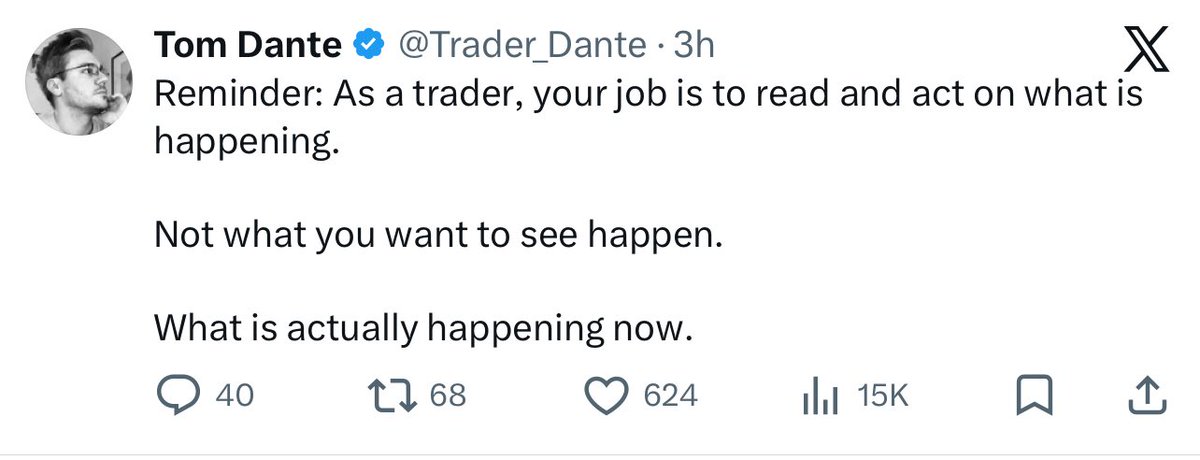
Stop grading your day by what the market gave you.
Start grading it by what you executed.
One of these was always in your hands.
The other was never yours.
POWER OF TIMEFRAME ‼️
W
→ 3 candle confirmation
D
→ Support and Resistance
4H
→ Direction
→ Key Levels
→ Supply & Demand
1H
→ Trend
→ Liquidity
→ Break of Structure (BOS)
→ Reversal
→ Order Block (OB)
→ Fair Value Gap (FVG)
M30, M15, & 5M.
→ Confirmation
【Learn From Failure. Not From Losses.】
You stare silently for a while at the screen after your stop loss has been executed.
The number in your account has certainly decreased a little.
You open your trade history and check the entry point and the exit point.
Then you write this.
Next time, I will enter a little more carefully.
That one line is the very culprit pulling you away from success, and you still have not realized it.
■ First, Separate "Loss" From "Failure"
Many traders take the phrase "learn from failure" and receive it as "learn from losses."
This is the starting point of every problem.
Failure and loss are not the same thing.
The real failure in trading is failing to follow your rules or plan.
Or it is being so insufficiently prepared that you do not even have rules to follow in the first place.
That is indeed a failure you should learn from.
But a losing trade that happened after you executed according to your rules is not a failure.
It is a normal component of what the strategy produces across a large sample size.
In a strategy with positive expectancy, losing trades are part of what makes up that expectancy, not a defect that should be avoided.
And yet, every time you lose, you reflect on it and try to change something.
You keep changing what must not be changed.
■ If You Try To Learn From Losses, Randomness Rewrites Your Standards Of Judgment
Why should you not learn from losses?
Because short term results are strongly dominated by randomness.
No matter how correct the action is considered to be, it can still lose.
No matter how wrong the action is considered to be, it can still win.
This happens all the time.
In this world, what happens if you try to learn from the loss in front of you?
Your learning becomes synchronized with randomness.
Because the trade happened to end in a loss, you learn that the action was wrong.
Because the trade happened to end in profit, you learn that the action was correct.
Then you make small adjustments to the rules.
But the next trade is also dominated by randomness.
This time, that new rule loses.
You reflect again, and adjust again.
This is the endless improvement loop.
You think you are moving forward, but you are only stacking distorted patterns written by random noise inside yourself.
■ "But If I Do Not Learn From Losses, Won't My Growth Stop?"
This is what many people will think.
"But if I do not learn from losses, won't my growth stop?"
No.
That question comes from seeing trading as "a game of winning and losing the trade in front of you."
A trader who has truly grown is someone who has reached a state where they do not learn from losses.
This is not an abandonment of learning.
Rather, because they have already "finished learning" during preparation how to assign meaning to each individual win or loss, they do not take responsibility for the result in front of them.
What they are truly responsible for is repeating consistent behavior and preparing for that consistency.
That trader has verified the strategy across a large sample size, and has confirmed through their own hands that even rule based losses, losing streaks, and drawdowns leave positive expectancy after repetition.
For someone who has completed that confirmation, a rule based loss is inside the expected range, and there is nothing to learn from that individual loss.
The state of not learning from losses is a place only traders with a completed foundation can reach.
So this is not the stopping of growth.
It is growth itself.
■ Move Your Learning From Live Trading To Preparation
Then where should you learn?
Not in live trading.
The place to learn is preparation.
Cultivate probabilistic thinking.
Confirm the edge of your strategy across a large sample size.
Practice again and again with your own hands on charts where you do not know the outcome.
Pass through rule based wins, rule based losses, and losing streaks with your own hands.
Your learning can only be obtained there.
After you enter live trading, the only learning should be repeating execution on top of a foundation that is already complete.
Stop opening losing trades and reflecting on them.
Stop looking at your history and writing, "Next time, I will do this."
That is not learning.
Real learning should already be finished in preparation, not after a single live result.
📚 Content for serious traders
https://t.co/ZxU7qo7pJm
Thank you for reading.
1) Determine a Draw On Liquidity - where Price is likely reaching; like NWOG, PDH\PDL, Session H\L.
2) Wait for opposing liquidity raid, during or immediately after a 10\50 Macro.
3) Entry on 1st FVG in the present price structure or use IFVG in the run to opposing liquidity to your Draw On Liquidity.
4) Frame your risk to 1% or less, Hard Stop Loss placement beyond Candle #1 of the FVG you used for entry.
5) Take 50% of position off at half of the range between your entry and the Draw On Liquidty, the balance limit out just before your Terminus.
Wash, Rinse, Repeat... nothing fancy or complicated.
【Why Reflection Breaks Your Consistency】
I will explain why the reflection that people call “good” can break your consistency 👇
■ What many traders call reflection
・You followed the rules, but treated that loss as a mistake.
・You saw one loss and started looking for something to fix.
・You used one result to start doubting the strategy.
・You called that reflection.
・You called that improvement.
But what you are actually doing is only teaching yourself that “losses are bad” and “short term results matter.”
However, one result is heavily influenced by randomness, and even if you trade correctly, you can still lose, and even if you trade randomly, you can still win.
Judging that trade only by short term wins and losses means you are allowing randomness to influence you.
That is why consistency breaks.
■ What you should ask instead
・Was that trade executed according to the rules.
・Was that system tested over a large sample size.
・Was positive expectancy confirmed in advance.
・Was that loss within the distribution the system can produce.
If the answer is yes, there is nothing to fix from that one loss.
Do not disguise your worship of short term results as reflection.
If you cannot let a rule based loss occur without changing anything, you will never obtain consistency.
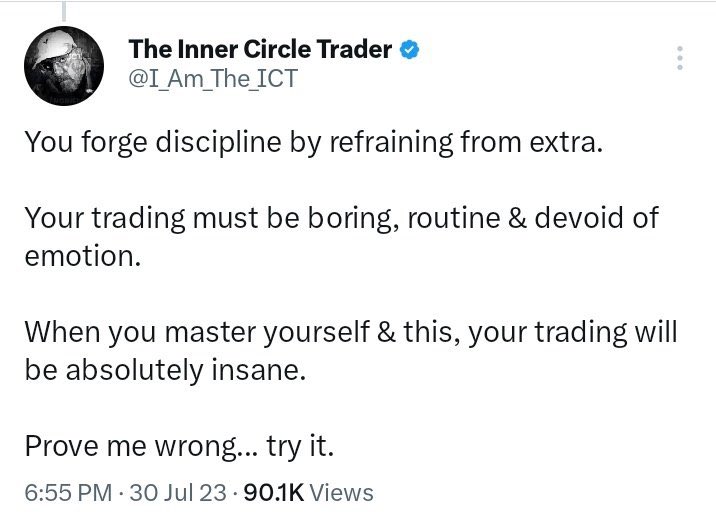
The actual variable is **execution under pressure**—specifically, emotional discipline and strict process adherence.
Knowledge is cheap. The ones who turn it around finally accept that losses are the cost of doing business, stop revenge trading/revenge sizing, and trade a simple, repeatable edge with ironclad risk rules (usually 1% or less per trade).
They shift from "being right" to "playing probabilities consistently." The game becomes boring and mechanical. That's when it flips.
The Draw On Liquidity...
That thing that makes your trade "worth" taking.
That thing that gives you bias.
That thing you can anchor targets to.
That thing that can not hide in any timeframe.
Free, easy and effective.