We will provide FREE thermal conductivity measurements of your gels at The Advanced Materials Show, Birmingham NEC, July 9 and 10, stand 1129. We need just a droplet of gel or grease to measure it!
#thermalconductivity#thermopaste#thermalgrease
https://t.co/LEkAFXVgFr
We will measure thermal conductivity of your samples for FREE at The Advanced Materials Show, NEC, Birmingham, July 9 and 10. Discs of 8 - 12 mm dia and 1 - 10 mm thick. Will post the timeslots later on. Follow us!
#thermalconductivity#composites
https://t.co/LEkAFXVgFr
ZrO2 thermal shock resistance R = 3 W/m. Steel has 1200 W/m. Oxides cannot be used for ultra-high-temperature thermal protection. You can see five different ceramics after ablation at 1800 °C. Only alumina cracked.
#thermalconductivity#thermalprotection
https://t.co/zs6h5uYyD0
FREE thermal conductivity measurements during The Advanced Materials Show at the Birmingham NEC on 9 and 10 July 2025. Just bring your samples to stand 1129! Follow us not to miss anything.
#thermalconductivity#composites#materialsscience
https://t.co/LEkAFXVgFr
@Inomorph is now part of The Advanced Materials Show and The Advanced Ceramics Show at the Birmingham NEC on 9 and 10 July 2025. We will be happy to meet you at a stand 1129!
#thermalconductivity#composites#materialsscience
https://t.co/LEkAFXVgFr
https://t.co/zs6h5uYyD0
It appears that the most plausible option for protecting systems in ultra-high-temperature applications is to utilise ceramics. But what thermal conductivity should they have?
#thermalconductivity#greenenergy#thermalprotection
https://t.co/zs6h5uYyD0
https://t.co/LEkAFXVgFr
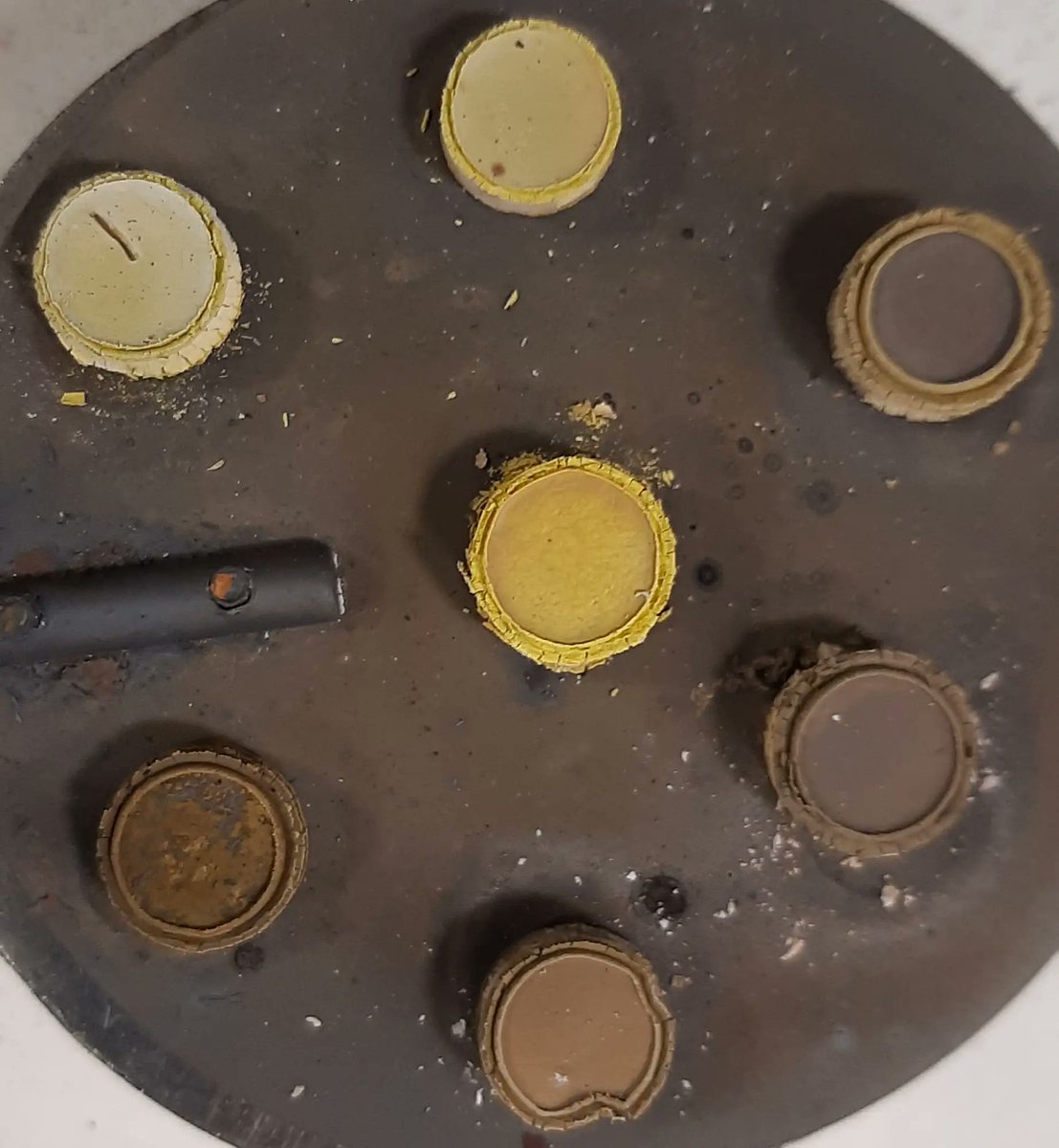
A photo of seven mirror-polished W-based samples after annealing at 1000 °C. So, no metal can be used for the thermal protection at 1800 °C.
#thermalconductivity#greenenergy#thermalprotection#solarpower
https://t.co/zs6h5uYyD0
https://t.co/LEkAFXVgFr
We measured the thermal conductivity coefficient of high-quality graphite with a density of 1.83 g/cm3. We used the InoTherm-S system. The value was k = 162 ± 4 W/mK. Enjoy the data.
#thermalconductivity#graphite#graphene
https://t.co/LEkAFXVgFr
Stainless steel (k = 15 W/mK) is used now for high-temperature heat exchangers. Our machinable UHTC has thermal conductivity of 70 W/mK and much better high-temperature stability!
#thermalconductivity#greenenergy#sustainability
https://t.co/LEkAFXVgFr
https://t.co/zs6h5uYyD0
You take tungsten with 1 wt.% of carbon (a) and mill it – your carbon inserts into W-based powder between W grains (b). Now, you can have non-porous tungsten at 1350 °C. But what about the thermal conductivity?
#tungsten#W#nanpocomposites#carbides
https://t.co/zs6h5uYyD0
The thermal conductivity of a raisin k = 0.3 ± 0.05 W/mK.
The Seebeck coefficient S = -500 μV/K. What can I say… Let us make green (or rather yellow) energy!
Will measure a dried cranberry next week.
#thermalconductivity#raisins#products
https://t.co/LEkAFXVgFr
We measured the thermal conductivity coefficient of a polypropylene sample at temperatures between 25 and 40 °C. It was k = 0.24 ±0.01 W/mK within the temperature interval.
#thermalconductivity#polypropylene#plastics
https://t.co/LEkAFXVgFr
We measured the thermal conductivity coefficient of a polycarbonate sample at temperatures between 25 and 75 °C. It was k = 0.21 ±0.005 W/mK within the temperature interval.
#thermalconductivity#polycarbonate#plastics
https://t.co/LEkAFXVgFr
We mixed TiC, ZrC, HfC, NbC, VC, TaC with B4C. We are going to press the mixture at 1900 °C. What will be the result? What do you think?
#ceramics#UHTC#nanpocomposites#highentropy
https://t.co/zs6h5uZ6sy
Carbon nanotubes inside TiB2-SiC matrix. The CNTs cannot survive at 1850 °C for more than 5 minutes☹. Fortunately, our reaction-hot-pressing route facilitates full densification of the ceramic matrix at 1800 °C for 3 min 😊
#ceramics#nanocomposites#CNT
https://t.co/zs6h5uZ6sy