The @InRO Substack is officially live! This is a labor of love by the estimable @CCassingham, so we hope you join us. Subscribe now for bi-weekly newsletters of curated writing from our amazing critics, as well as Substack-exclusive features and essays throughout the week! https://t.co/gdywB5JXtQ
I managed to see a movie outside of a festival this month. I really dug WICKER. Like their previous film SAVE YOURSELVES!, Fischer & Wilson look at how outside noise can creep in on a relationship's vulnerabilities. Very weird movie (positive).
For @InRO: https://t.co/mhXE2rjR7r
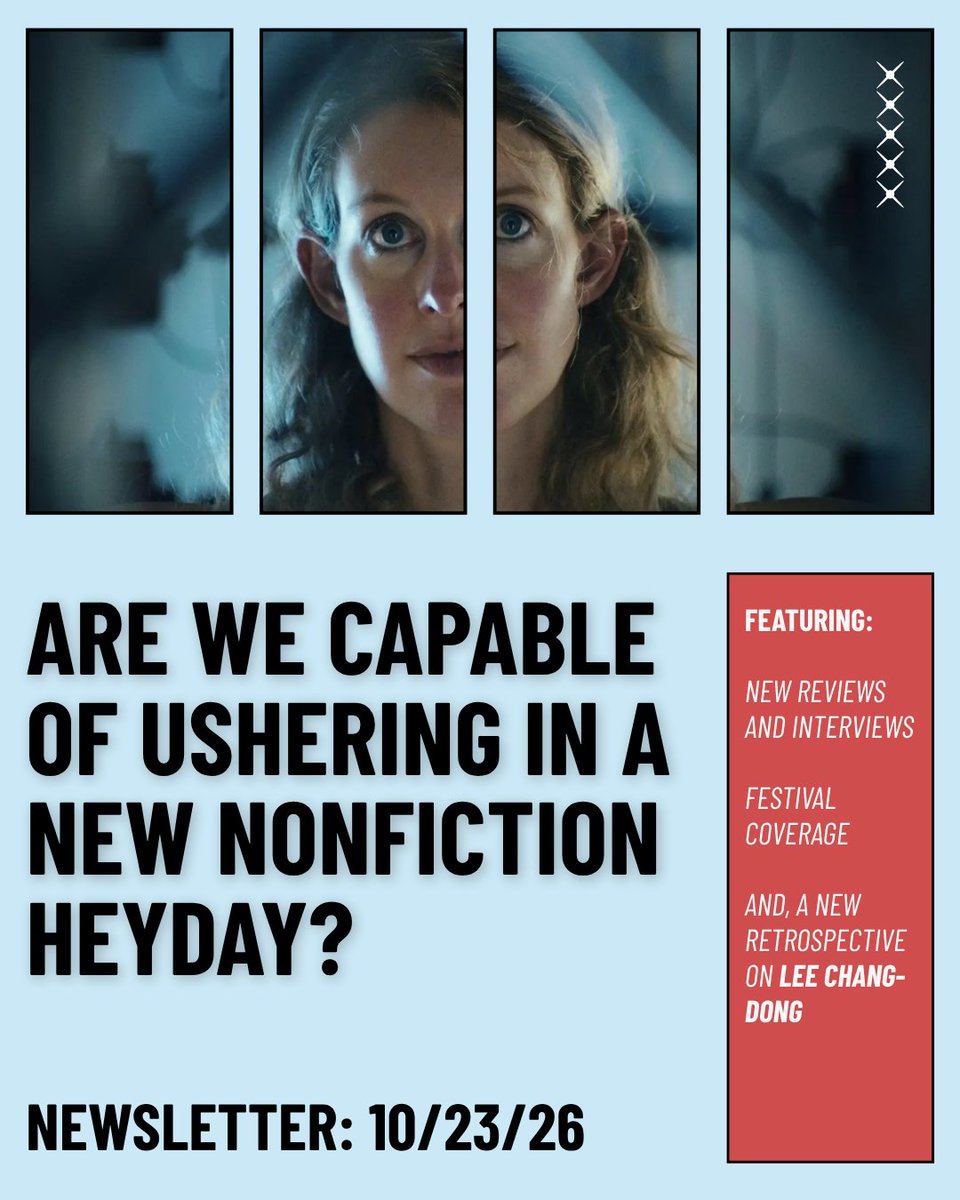
The latest @InRO newsletter has, as usual, new reviews, interviews, and festival coverage, plus: a special announcement of new retrospective essays on the films of Lee Chang-dong. https://t.co/srPqoyQ6kl
'meaning in Schanelec’s cinema is less something to be decoded than something to be felt. Her images are fields of experience before they are vessels of meaning; meaning settles later, through the contact between body, time, space, sound, and memory. This sensibility was already discernible in Schanelec’s earliest films and in her place within the first generation of the Berlin School. What linked her to Christian Petzold and Thomas Arslan was less a shared style than a common suspicion of some of cinema’s most entrenched habits: explanatory psychology, guiding music, editing that organizes the spectator’s gaze in advance, images whose meaning has effectively been determined before they have even been seen. Silence, pause, omission, and distance are not ends in themselves in this cinema; they are consequences of trust in the capacities of the image.' https://t.co/LeN5ipfboR
'ideology is the backbone of cinema. Or, at least that is what Jean-Luc Comolli and Paul Narboni posited nearly 60 years ago in their joint manifesto, “Cinema/Ideology/Criticism,” wherein the two critics brazenly wrote “every film is political.” Political, meaning a product of politics, of a political ideology, and hence, of a political system. Their words presupposed a link between apolitical and hyper-political as enmeshed, one and the same, insofar as they both reflect political ideology, but what of cinema now? What of contemporary political cinema? What of the “eat the rich” satire, which has proliferated endlessly, it seems, in the wake of Bong Joon Ho’s ultra-successful Parasite?' https://t.co/fH4TQMxCcK
'Halloween movies may be an oversaturated market, but for writer/director Ben Sottak’s feature-length debut, he’s looking to deliver a love letter to the holiday, backed with some haunting ambience and gory encounters. Small-scale, brisk, and unassuming, Hallowarrior nevertheless makes for a very satisfying watch, offering just the perfect amount of diverting entertainment for those who stumble upon in on streaming' https://t.co/TR61gjjKBV
'director James Nunn and frequent leading man Scott Adkins are back together again with One Last Shot, the (presumably) final entry in their elaborately staged, single-take tactical action trilogy. It’s difficult to convey just how hard these guys work: this is Nunn’s sixth film in three years, while Adkins has already starred in three films this year (with two more still on the way). For all the pleasures of the DTV genre, there’s a lot of effort going on in front of and behind the camera — this is blood, sweat, and tears cinema.' https://t.co/T7w5TdhCD0
'This shying away from the author’s true-to-life nastiness turns her into a kind of stock character, a curmudgeonly grandma type, and sinks any sense that the film intends to really grapple with Highsmith’s complexities. This lack of genuine darkness infects the narrative, too. Highsmith’s work is reduced to little more than big specs and social climbing. It’s an overall approach that strips the film of any real idiosyncrasy, leaving simply a genre experience in the wake, a hollow film that can only really observe, “Boy, aren’t thrillers good?” Well, unfortunately, not this one.' https://t.co/0K17Ifaz4S
'The social imagination is also murky on the details of what Cohen is attempting to do with this revival film. The original Channel 4/HBO series was certainly a product of the early aughts, replete with linguistic and cultural appropriation that he does, to be fair, tackle head-on in this reunion — Ali G acknowledges the systemic reckoning amplified by COVID and infuses the narrative with montages of TikTok influencers and other public figures comically issuing statements about this fictitious character’s racially misguided history. Had this thread been unraveled further, perhaps Who Iz I? could have achieved something worthwhile, but instead we’re given other threads. Too many threads.' https://t.co/dVpeCe5alv
'in Noah Segan’s slinky, elegiac neo-noir The Only Living Pickpocket in New York, Harry (John Turturro) is still plying his Bressonian trade in a world that’s left him behind. Living now in the Bronx after years in Manhattan, the pickpocket gets by on the old ways, selling his takes to his pawn shop-operating friend (Steve Buscemi) while taking care of his completely paralyzed wife at home. Harry’s relationship to technology is (nearly unbelievably) that of a caveman freshly chiseled out of the ice and thrust into the modern world; he doesn’t understand any of it and would rather not use anything newer than a flip phone. He’s the type of guy who would call a DVD a “tape.”' https://t.co/UINbTHlUu5
'Where do you start with a group as vast and with such a complex network of relationships? It’s like trying to carpet Escher’s staircase. Perhaps the way in is through one of the group’s outer members, one of the myriad figures that has at some point nestled in the Wu-Tang family tree, which is itself somewhere between a four-dimensional shape and a magic eye painting — an incomprehensible, ever-shifting landscape of changeable quality, infighting, and commercial double-crossing. It’s this approach that Joanna Natasegara takes with The Disciple: A Wu-Tang Fable, and it makes for patchy results.' https://t.co/D7vWSyGcBi
'Apatow’s justification for this approach is that Macdonald is such an enigmatic subject, in his winking, invulnerable insincerity, that there’s no way to truly comprehend, let alone relate, an honest interiority, so why try? Let him serve as his own unreliable narrator, and let the viewer draw their conclusions from the man in his own words — or so the director has said. So what you get is a fairly uninspired, paint-by-numbers “Best of Norm” clipshow not really befitting the brilliant subversive subject.' https://t.co/TVAFi5sGQE
'Director Georgia Oakley’s adaptation of Jane Austen is without doubt a cinematic one, sacrificing the narrative balance of novelistic form in favor of the newer medium. Oakley’s Sense and Sensibility prioritizes texture — that oftentimes ineffable literary quality — much more than Jane Austen herself does. Austen’s works prioritize the texture of life, the flavor found in human speech, the inner workings of family relationships, and the cast of character “types” one meets in genteel late-18th century English society. Cinematic texture begins with a different set of priorities.' https://t.co/FJVnBDHzMC
On our newest episode, Four Stars Special Correspondent Daniella Mazzio @DaniellaMazzio interviewed Kelly O'Sullivan and Alex Thompson, directors of Mouse (2026), which is screening tonight as part of the Chicago International Film Festival @chifilmfest: https://t.co/rXVGFRDYr8
To the extent these categories hold up usefully it’s as functional ones of how works ask to be engaged with. But even then the question doesn’t resolve itself into two categories called “narrative fiction” and “documentary film”
I'm excited to continue @InRO's coverage of the recent Long Live the Underground! program @MoMAFilm with an essay by Michael Sicinski on their strand of structural film from the 1970s. This was a pleasure to read and edit. Subscribe! https://t.co/Xef1UaV4wG