The institute is headed by Professor Thomas Werge, part of iPSYCH Initiative, and epicenter to biomedical psychiatric research in The Capital Region of Denmark.
Very happy that our paper on calculations and interpretations of polygenic risk scores (PRS) from direct-to-consumer (DTC) genetics is now published (https://t.co/4Or29mkh7W). A big thanks to my co-authors: @ollie_pain, Andrés Ingason, @thomas_werge, @cathrynlewis, @J9_Austin
I’m thrilled to share our NEW PREPRINT where we report some fascinating findings on the relationship between cognition and psychiatric disorders. I'll post a tweetorial on this first thing tomorrow. Meanwhile enjoy the paper 😊
https://t.co/vfvf0tblKs
It's finally here! Read our latest paper on how to estimate #heritability in the presence of #admixture, published in @HeredityJournal. https://t.co/VoUXQGciAx
We have posted two new positions one for a Postdoc and one for a Bioinformatician. Please share them in your network. The call for applications end at 19th of April.
1 https://t.co/z5QAcJDv9H
2
https://t.co/8iaYyNaFSZ
iPSYCH has a unique design that makes it stand out from rest of the biobanks in the world. It is a *random* sample of the entire Danish population. This is the only way you can avoid participation bias. I am happy to contribute to this fantastic team effort.
Enjoyed the two days visit to Roskilde for the #iPSYCH research forum meeting. Many interesting things are happening. Watch out for many fascinating preprints/pubs from iPSYCH in the upcoming year. Thanks to @lassefolkersen@yorgos_a and others at @InstBioPsych for organising.
More often we end users in #iPSYCH start our analysis from imputed data. Sometimes we overlook the efforts that go into generating this data. Andrew Schork from Sct Hans demonstrated to us clearly that it's a painful task that requires time, patience and importantly, brilliance.
Catherine, head of precision medicine division, Danish national genome center gave us an overview of their infrastructure. Given the registry practice in Denmark, in few years, DNGC might accomplish a lot more than that possible by similar initiatives in other places #iPSYCH
@m_nordentoft there is much need in mental disorders. Both in research and social work. But needs also overlap. E.g. we are reducing social stigma by the insight that mental disorders are multifactorial/genetic, not just how children are raised, i.e. blaming the parents #ipsych
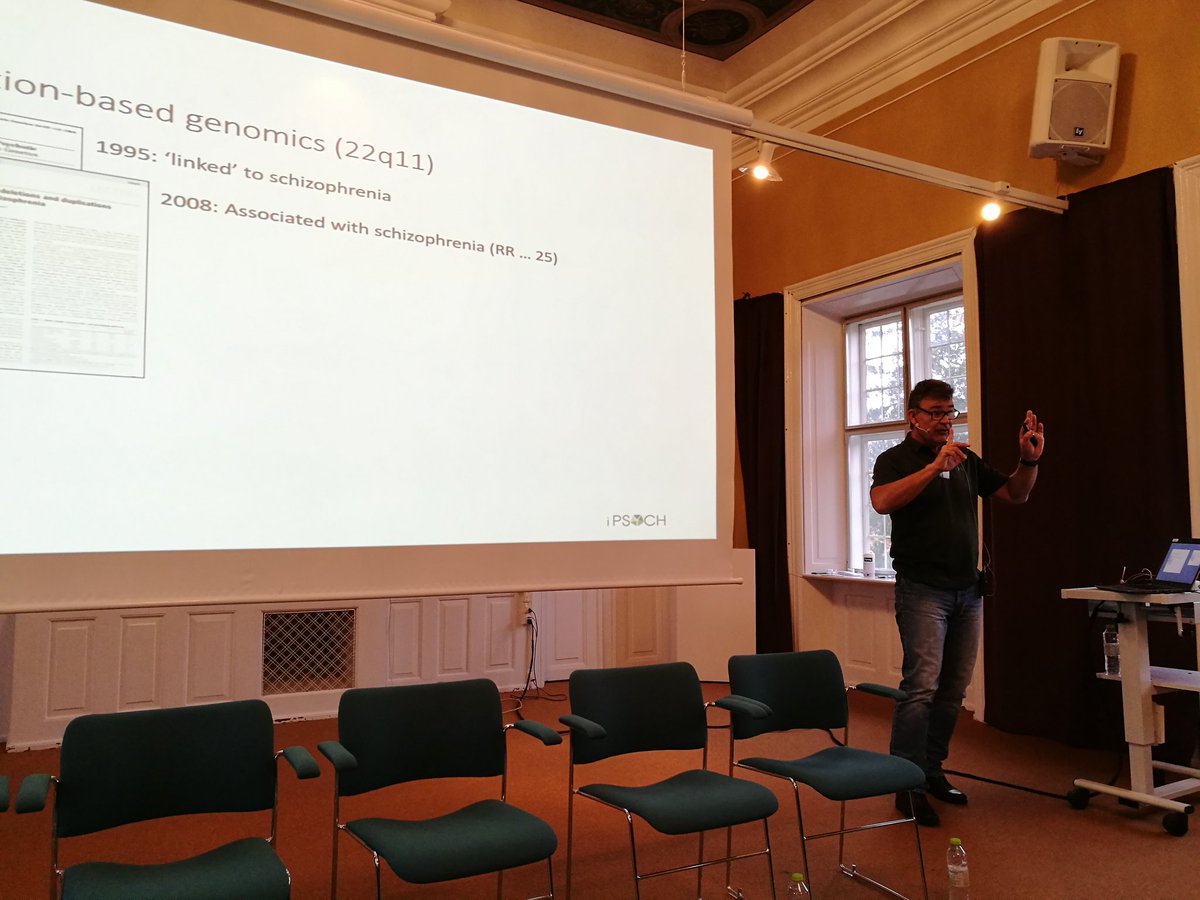
#iPSYCH provides a unique opportunity for unbiased risk estimates for psych disorders. Early estimates of risk for schizophrenia in 22q11 deletion carriers, 25x, 55x, were extremely biased. True estimate turned out to be mere 2x, says, Thomas Werge, one of the PIs of #iPSYCH
Bolette Pilegaard Graae from SIND on stigma and mental disorders: The labour market needs to work to become much more inclusive and able to find places for people with mental disorders #ipsych forum 2019 at Sankt Hans
@thomas_werge discussing why the combination of genetics and epidemiology is essential also in #PatientExperience. At the 2019 #ipsych forum meeting at Sankt Hans Hospital, Roskilde.
Absolutely great and envigorating ADHD session at #WCPG2019! Our field moves forward with huge steps. Large studies of common & rare genetic variants in people with/without ADHD, and for population ADHD symptoms. We might reach 100 loci in the coming year! @PGCgenetics@ISPGnet
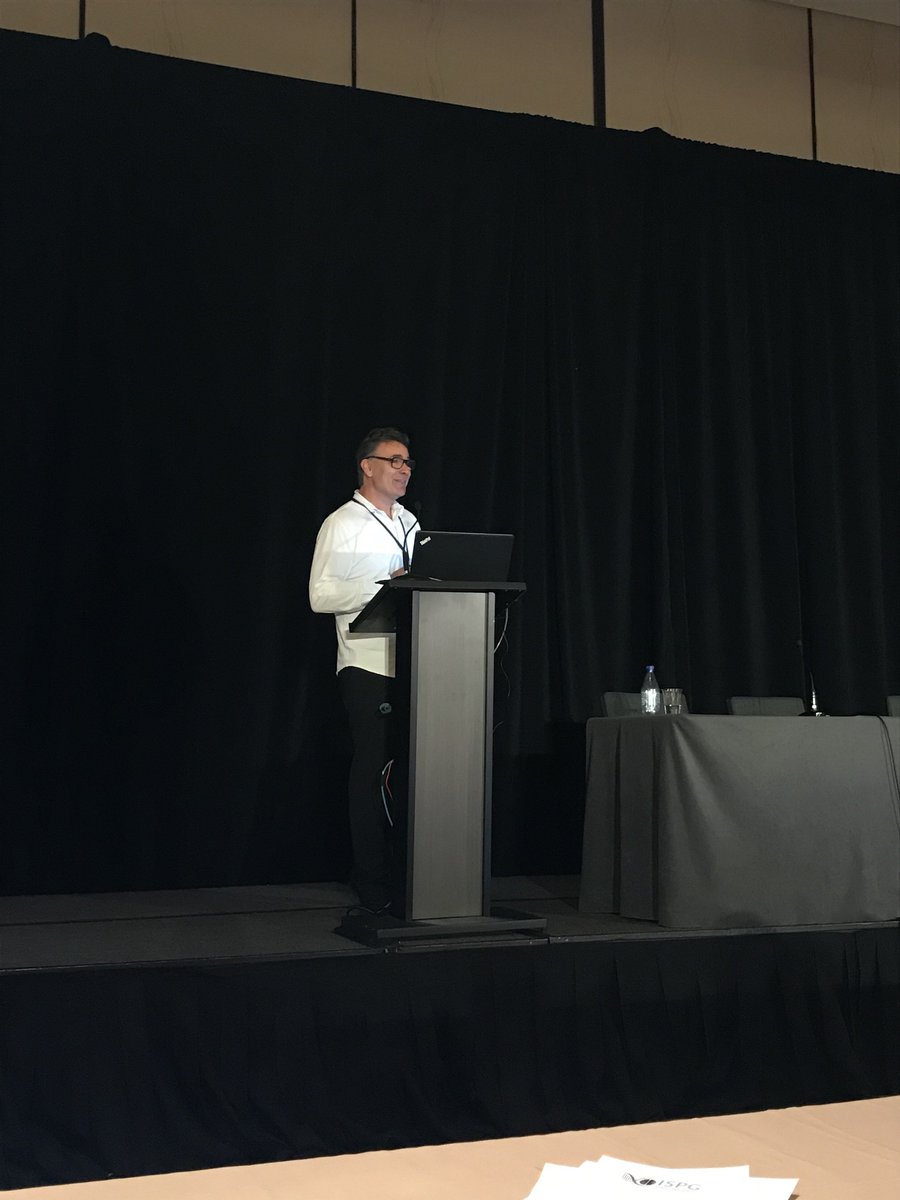
Werge: DK cohort ~10 mil individuals connected to all services & govt entities & registers & nationwide biobank of bloodspots at birth (PKU cards). #WCPG2019
Werge The Ideal: include all inhabitants, observed uniformly & continuously, egalitarian system. Piggyback on existing infrastructure in DK #WCPG2019
A. Schork speaking to a full room about ascertainment effect on SNP h2 estimates and PRS - if you sample from the extreme ends of a liability distribution you’ll overestimate SNP h2 #WCPG2019