We cover military and political strategies in the Arab and Middle Eastern countries, tracking news, security, and military movements on land, sea, and air.
✈️ IntelSky OSINT Radar Update!
We've rolled out key improvements:
✅ Explore historical flight paths via date selection & a new detail view calendar.
✅ Enhanced UI & improved mobile layout.
✅ Track selected aircraft with a new pulsing highlight
https://t.co/vYyEbqTOBr
More powerful OSINT tools at your fingertips!
#IntelSky #OSINT #ADSB #Military #FlightTracking
- The "Ababil" Harvest in Al-Qantara and Zawtar: Ababil suicide drones (Statements 6, 7, and 8) destroyed an Israeli military transport vehicle and an advanced communications vehicle at the Al-Sal'a hill in the town of Al-Qantara. In addition, they pounded a soldier deployment tent in the riverbed on the outskirts of Eastern Zawtar, and bombarded a command headquarters in Al-Bayyadah (Statement 9). This brings the total documented Zionist armor meat grinder to 303 Merkava tanks, alongside the occupation army's admission of 48 officers and soldiers injured in the last 5 days, and 30 killed and 1291 injured since last March.
- The Shocking Strategic Failure in "Ramim": The occupation army radio (Doron Kadosh) dropped a bombshell revealing details of a historic incident that broke the rules of engagement since 2023. A resistance fighter wearing a full Hezbollah military uniform succeeded in breaching the separation fence and reaching deep into an internal military enclave in the Ramim mountain range, clashing with elite forces at point-blank range. This prompted the head of the Metula council, David Azoulay, to admit the total loss of safety in the north.
Fourth: The Turkish-Israeli Clash and the Regional Threat
Turkey has entered the line of direct political collision:
- Erdogan's Strategic Warning: Turkish President Recep Tayyip Erdogan officially announced that the Israeli attacks on Syria and Lebanon have reached a stage that poses a direct threat to Turkish national security, using definitive phrasing: "Turkey's security begins in Beirut and Damascus."
- The Hysterical Zionist Response: Israeli Minister Miki Zohar rushed to respond in a crude, offensive manner: "If the dictator Erdogan dares to test us, his fate will be worse than Iran's," reflecting a Zionist desire to expand the scope of wars to encompass the entire regional geography.
Conclusion and Comprehensive Strategic Forecast:
Tonight, the joint military rooms of the Axis stand with all their missile platforms and suicide drones a hair's breadth away from the great comprehensive explosion. Trump's maneuvers—threatening to bomb power stations and bridges in Iran tonight to force Tehran to accept the flawed and fragmented version of Washington's agreement—are met with a clear Iranian doctrine of decisiveness that refuses surrender under fire.
The Inevitable and Imminent Operational Path:
If the Qatari delegation fails to extract Trump's approval of the full Iranian conditions (immediate lifting of sanctions, release of all assets, and inclusion of a comprehensive ceasefire in Lebanon), and the US Air Force and B-52s commit the folly of targeting Iran's infrastructure, the world will immediately witness an unprecedented fiery hell tonight.
The Iranian response will not wait. The platforms that pounded the Ramat David base are ready for a terrifying tactical operation, comprehensively targeting oil and gas infrastructure as well as hosting American bases in the Gulf and Jordan. This will coincide with Lebanon's Hezbollah, Sanaa's Ansarullah, and the Iraqi involvement opening the swarms of drones to create mass graves for the occupation forces and Washington's fleets. Thus, the Trumpian hypothesis of decisiveness will turn into a comprehensive strategic defeat that ends the Western military presence and imposes the Axis's conditions with blood and fire on the battlefield.
3/3
Zero Hour for the Great Existential War: B-52 Mobilization and the "Infrastructure" Guillotine Confront Iran's Doctrine of Decisiveness — Talal Nahle
Wednesday Evening, June 10, 2026
Strategic Introduction: Transitioning to the Round of Mutual Existential Destruction
The Middle East is entering its most dangerous hours, announcing the transition from the phase of "tactical combat rounds" to the actual zero hour for the start of a comprehensive and existential war against Iran and its axis. The margins of maneuverability and indirect messages have vanished after the Western alliance and the Zionist entity received a dual military shock. This was manifested in the official and public Israeli admission of a direct and precise strike on the "Ramat David" airbase by Iranian missiles, coupled with a series of "Khaibar Shekan" strikes that shattered F-35 hangars in Jordan and pounded the Fifth Fleet.
This collapse in the walls of deterrence has pushed US President Donald Trump and the Zionist entity to activate the option of "maximum destructive decisiveness." Tonight, the world stands mere hours away from a coordinated American-Israeli strike targeting energy pillars and bridges in Iran. This is countered by a comprehensive Iranian ballistic and aerial alert to completely exit the state of "no war, no peace," while the southern Lebanon front ignites with a hysterical Israeli desire for revenge and to isolate the geography with fire.
First: CENTCOM's Air Mobilization Armada and the Record Israeli Alert
The US Central Command and the Israeli army have shifted to a "fully pulled trigger" posture to execute a large-scale offensive operation:
- Advance of Dual-Capable Strategic Bombers: Navigational radars have tracked the crossing of heavy B-52 strategic bombers over the Mediterranean Sea, heading directly toward the Persian Gulf region, to form the aerial destructive hammer against rear lines.
- Repositioning and Deployment at Prince Sultan Air Base (PSAB): Satellite imagery has detected exceptional defensive and offensive tactical movement. This involved the dispersal and scattering of E-3B Sentry AWACS early warning aircraft, E-11 command and relay aircraft, and P-8 maritime patrol aircraft from the main runways and tarmacs to taxiways at the Saudi base, in anticipation of receiving preemptive or counter Iranian missile strikes.
- The Largest Israeli Mobilization (280,000 Soldiers and Officers): Immediately after the Zionist entity admitted the failure of its media blackout and confirmed that the "Ramat David" base was hit by Tehran's missiles, Chief of Staff Eyal Zamir issued an exceptional order to begin a reserve mobilization encompassing 280,000 soldiers and officers, ranging from the Home Front to recently discharged soldiers, to prepare the internal front for the scenario of an extended, comprehensive war.
- Trump's Guillotine for Iranian Infrastructure: Trump appeared on the "Fox News" and "ABC" networks to explicitly announce that he is close to issuing definitive orders to launch new and violent strikes targeting vital power stations and bridges inside Iran. As part of a psychological war, he claimed that "the Iranian military, along with its navy and air force, is in total chaos and utter defeat," vowing that Iran will pay a heavy price tonight for stalling in signing the American understandings. In contrast, CENTCOM announced the disruption of the routes of 8 ships and the rerouting of 134 ships in Hormuz to tighten the blockade.
1/2
Second: The Tehran Front... Exiting "No War, No Peace" and the Final Qatari Negotiation Race
Faced with the existential threat of having its energy arms severed, the Iranian leadership has drawn its unbreakable red lines:
1. The Strict "Noes" of Pezeshkian and Ghalibaf: Iranian President Masoud Pezeshkian announced during the memorial ceremony for Imam Khamenei that "Iran will never submit to threats and must immediately exit the state of no war, no peace," considering the threat to bomb infrastructure as evidence of the enemy's despair and impotence. In the same context, Parliament Speaker Mohammad Bagher Ghalibaf affirmed that the military field is what governs, threatening to turn the naval blockade into a historical defeat for Washington.
2. Araghchi's Fiery Doctrine for the Gulf: Foreign Minister Abbas Araghchi issued a final evacuation warning to CENTCOM: "If you want to stay safe, it is best you leave our region." He reiterated the rejection of the internationalization of the Strait of Hormuz, considering it a joint sovereign corridor between Tehran and Muscat, asserting that fleets crossing thousands of miles have no right to breach its legal borders.
3. The Qatari Negotiator's Last-Ditch Mission: Reuters reported the arrival of a delegation of Qatari negotiators in Tehran this morning in an urgent, last-resort attempt to seal a final agreement and bridge technical gaps after intense consultations with Washington. This serves as an attempt to beat the clock before the deadline set by Trump to end negotiations and commence the destructive bombardment.
Third: The Lebanese Front... "Fiber Optics" Ban, Sovereign Breach in "Ramim," and the Crushing of the 401st Brigade
- On the coast of the southern battlefield, the accumulating Israeli impotence has turned into a war of annihilation and hysterical destruction of the villages of Jabal Amel and the coast north of the Litani River:
- The Meat Grinder of Majdal Zoun and the Coast: The occupation's warplanes and drones launched intensive raids, targeting the town of Majdal Zoun with 9 successive airstrikes. This coincided with violent shelling that targeted Tayr Debba, Al-Qlaiaa, Baraachit, Doueir, Deir Qanoun En Nahr, Al-Masaken Al-Chaabiyeh in Tyre, Homin Al-Fawqa, Arabsalim, Al-Ghassaniyah, and Al-Ansariyah. This aimed to implement the Cabinet's new equation, which grants automatic authorization to strike the capital Beirut and the Dahieh immediately upon the crossing of any missile.
- The Port Ban on FPV Drones:</b> Journalist Hasan Al-Dorr revealed a dangerous security and political measure involving the issuance of an urgent and strict circular to Beirut International Airport and the port, enforcing an absolute ban on the import of Fiber Optic Cables. This is a desperate Western and Israeli intelligence attempt to besiege the unique technical advantage of Hezbollah's jamming-resistant suicide drones, which have caused a disaster for army vehicles.
- Destroying the 401st Brigade Command in Dibel and the Yohmor Ambush: The Resistance managed its offensive operations with extreme intensity. The Mujahideen (Statement 3) carried out an exceptional attack with a swarm of suicide drones targeting the newly established headquarters of the Zionist 401st Armored Brigade command in the town of Dibel, achieving confirmed and fatal hits. Furthermore, Resistance shooters (Statements 2 and 4) destroyed gatherings of enemy vehicles and soldiers on the southeastern outskirts of the town of Yohmor Al-Shaqif with rocket salvos and artillery shells in batches (including a heavy specialized missile).
2/3
Since 08:00 UTC, all U.S. Air Force K35R aerial refueling aircraft have entered stealth mode, meaning they have concealed their operational transponders within the region.
III. Political Messages: A Warning to the Ring Countries and Activating the Hotline
The military response was accompanied by a scathing Iranian diplomatic offensive, holding the countries of the region to their responsibilities:
* Warning Host Nations: The Iranian Foreign Ministry and the Khatam al-Anbiya Headquarters issued a stern statement reminding regional states of their responsibility to prevent their territories from being used by the US military. The message is clear: the geography from which attacks are launched will immediately turn into a legitimate bank of targets for the Aerospace Force.
* Diplomacy Under Fire: Iranian Foreign Minister Abbas Araghchi rushed to make urgent phone calls with his Saudi and Turkish counterparts. The objective of these calls is to brief regional powers on the developments and to affirm that Iran does not seek to strike Arab countries, but exclusively targets US bases that infringe upon its sovereignty.
Conclusion and Strategic Outlook
This violent combat round has ended, but it has established a new reality. The United States, which attempted to restore its prestige following the Apache incident, found itself facing a scene where its Fifth Fleet headquarters was burning, and the hangars of its most expensive aircraft globally (F-35) were destroyed in Jordan.
The Expected Trajectory:
We are currently in a state of "damage assessment" for both sides. If the Trump administration swallows this slap and settles for the CENTCOM statement announcing the "completion of strikes," we might witness a cautious calm and a US pullback to focus on negotiations.
However, should the Pentagon decide to retaliate to repair its image in front of its allies, the statement from the IRGC and the Khatam al-Anbiya Headquarters was decisive: *"If the aggression is repeated, fiercer and wider-scale attacks will be launched."*
2/2
The Dawn of "Kheibar Shekan".. Iran Burns F-35 Hangars in Jordan and Pounds the Fifth Fleet in the Fiercest Clash with Washington — Talal Nahle
Wednesday Morning, June 10, 2026 (Day 103 of the War)
Strategic Introduction: The Fall of Red Lines and the Explosion of Geography
The most violent wave of direct combat operations between the United States and the Islamic Republic of Iran since the collapse of the ceasefire on April 8 has ended. What began as an American pretext to retaliate for the downing of an Apache helicopter turned into a grave strategic error for the Pentagon; CENTCOM launched a large-scale attack disproportionate to the magnitude of the incident. Consequently, the Iranian response came in an unprecedented manner, transcending the traditional geography of the Gulf to reach the heart of strategic US bases in Jordan, having publicly threatened them during the previous round of Iranian retaliation against Israel's bombing of the Southern Suburbs [Dahiyeh].
At dawn today, Tehran established a new regional deterrence equation: any American attempt to forcefully break the blockade on Hormuz will mean incinerating the crown jewel of US airpower in the region.
I. The American Aggression: A Failed Attempt at "Coastal Blindness"
The US Central Command (CENTCOM) announced the completion of its strikes, which were described as targeting "Iranian air defense sites, control stations, and surveillance radars near the Strait of Hormuz" using precision munitions.
* Operational Analysis: The expanded scope of the US raids proves that the objective was not merely a retaliatory gesture for the downed Apache helicopter, but rather a military attempt to destroy the Islamic Revolutionary Guard Corps' (IRGC) "radar eyes," aiming to break the naval blockade and forcefully secure the passage of commercial and military vessels.
II. The Shocking Iranian Response: 26 Burning Targets from Hormuz to Azraq
Tehran retaliated with a coordinated operational decision involving the IRGC Navy, the IRGC Aerospace Force, and the Khatam al-Anbiya Central Headquarters, achieving an exceptional bank of targets that overthrew the prestige of American deterrence:
1. The Strategic "Kheibar Shekan" Strike in Jordan (The Turning Point):
In what represents the most dangerous geopolitical development, Iran expanded the scope of its retaliation to include Jordan. The IRGC utilized "Kheibar Shekan" ballistic missiles (solid-fueled and highly precise) to pound the Muwaffaq Salti Air Base in Azraq.
> US Losses: Four highly sensitive targets were destroyed, most notably the hangars housing F-35 stealth fighter jets, in addition to obliterating the US military's Command and Control (C2) center at the base. This strike shattered the myth of American air superiority and proved Iran's capability to destroy state-of-the-art US fighters while they are grounded.
>
2. Pounding the Fifth Fleet in Bahrain:
US bases in Bahrain were subjected to a massive missile attack, triggering sirens and resulting in the sound of massive explosions. A direct missile hit was recorded at the headquarters of the US Fifth Fleet, where plumes of smoke were seen rising from the nerve center of the US Navy in the Gulf.
3. Drone Attack on Kuwait:
Swarms of IRGC drones targeted the Ali Al Salem base and the Jahra region in Kuwait, leading to successive explosions and prompting Kuwaiti air defense systems to attempt to intercept the aerial targets.
4. Neutralizing Reconnaissance Eyes:
Concurrently with the missile attack, Iranian air defenses announced the downing of an advanced, strategic US MQ-9 Reaper drone while it was attempting to penetrate the airspace of the Iranian city of Jam.
* Total Toll of the Iranian Retaliation: Striking 21 targets across US naval and air bases in the Gulf, destroying 4 strategic targets in Jordan, and downing an MQ-9 drone.
1/2
Conclusion and Comprehensive Strategic Forecast: The Imminent Great Explosion
Netanyahu's crossing of red lines by bombing the southern suburbs of Beirut with American coordination represents the coup de grâce to the partial de-escalation maneuvers. Netanyahu is gambling by dragging the region into a comprehensive war to save his political future and alleviate the pressure on the northern front, over which its commanders (such as Jerry Gershon) have admitted losing control, alongside the deaths of 16 officers and soldiers there since the alleged truce.
The Inevitable Coming Trajectory: Based on the strict stance of the Head of the Iranian National Security Committee, Ebrahim Rezaei, and the full missile readiness announced by Advisor Mohsen Rezaei, the coming hours carry the scenario of a unified, lightning response. The situation is heading toward extremely violent combat days. The skies of the occupied territories will witness the launch of ballistic salvos and thermal suicide drones striking deep into the Zionist entity and its hosting American bases, to prove to Trump and Netanyahu that the "Dahiyeh for the settlements" equation has been crushed under the feet of the battlefield, and that a true ceasefire will only pass through complete submission to the sovereign conditions of the Axis by a total and comprehensive withdrawal from every inch of occupied land.
4/4
The 100th Day of the War: Establishing the Dahiyeh Equation with Strategic Fire, the Pakistani Message Trap, and the Choking of the Global Energy Artery in the Sea of Oman — Talal Nahle
The General Geopolitical Landscape and the Shock of the 100th Day
The American-Israeli conflict with Iran and the Axis of Resistance enters its 100th day amidst a highly dangerous operational shift. This was manifested by the Israeli occupation army's bombing of the southern suburbs of Beirut (Dahiyeh), shattering previous localized understandings in an attempt to impose a new security equation that links the security of the Lebanese capital to halting the Resistance's strikes in the north. This hysterical escalation, conducted with prior knowledge and coordination with Washington, coincides with the US-Iranian negotiations reaching their final stretch amid complex technical gaps. It proves that the enemy's Prime Minister, Benjamin Netanyahu, is moving feverishly to thwart any nuclear understanding between Tehran and Washington by detonating the Lebanese arena.
However, this Zionist treachery puts the Axis's commitments to a direct test; the Lebanese and Iranian fiery response has become a matter of hours as eyes turn to the skies over the occupied territories. Meanwhile, the occupation army is drowning in a fatal war of attrition south of the Litani River, and global energy markets are suffocating due to near-total paralysis in the Strait of Hormuz.
I: The Dahiyeh Raids and the Background of their Timing... The Pakistani Message Trap and the Trumpian Maneuver
The targeting of Tahwitat al-Ghadir in the southern suburbs of Beirut, which resulted in two martyrs and 11 wounded according to the Lebanese Ministry of Public Health, carried precise political and negotiating dimensions:
1. The Nature of the Field Targeting: Hebrew security and military circles (Channel 13, Yedioth Ahronoth, and the Broadcasting Corporation) admitted that the strike targeted an empty Hezbollah headquarters allegedly used previously for planning attacks. It was not aimed at assassinating senior commanders but was executed as a punitive measure to enforce the "Dahiyeh in exchange for northern settlements" equation.
2. Intersection of the Diplomatic Message: The Israeli raid was executed in precise synchronization with the arrival of Pakistani Interior Minister Mohsin Naqvi in Tehran to deliver a message from the Pakistani Prime Minister to the Supreme Leader of the Revolution via Iranian Foreign Minister Abbas Araghchi. This timing raises crucial questions in Tehran about whether the message carried conditions or liquidation proposals from another international party, conveyed through the Pakistani channel, especially since Trump announced at that very moment the cancellation of the American delegation's departure to Islamabad.
3. Trump's Maneuvers and the Madman Theory: US President Donald Trump announced via NBC News that Washington and Tehran are very close to signing an agreement, but he affirmed continued pressure to paralyze Iran's shadow fleet and Tehran's banking networks, refusing to lift frozen assets or sanctions in advance. Foreign Policy magazine revealed that Iran's stern response by closing Hormuz and bombing bases dismantled Trump's "Madman Theory," as he faced an adversary ready for maximum escalation. Trump dropped a political bombshell by declaring he is not demanding Lebanon be part of a short-term agreement with Iran, attempting to separate the arenas and leaving the Beirut government in an awkward position as it negotiates directly in Washington without unified national red lines.
1/2
5. The Toll of Martyrs: The enemy committed a treacherous raid on a Lebanese Army military vehicle in Nabatieh, leading to the martyrdom of two officers and a soldier. It also bombed the towns of Zebdine (where 5 people were martyred, including a paramedic), Al-Qatrani, Wadi Berghoz, Jouaiya, and Maarakeh, bringing the total toll of the aggression since March 2 to 3,613 martyrs and 11,072 wounded according to the Ministry of Health.
III: The Gulf Front and the Sea of Oman... Direct Clash and the Global Energy Crisis
The Strait of Hormuz and the Sea of Oman have turned into a real war zone, imposing harsh economic and military equations on the Western alliance:
1. Details of the Hormuz and Sirik Battle: The IRGC and US Central Command confirmed a direct clash occurred after US military ships and tankers attempted to pass without sovereign coordination. The IRGC disabled one tanker and forced the rest to retreat. In response to US raids targeting radars on Qeshm Island, Sirik, and Kuhmobarak (Gorouh), Iran launched 7 ballistic missiles and drones that pounded the Ali Al Salem base in Kuwait and the 5th Fleet headquarters in Bahrain. This was accompanied by the Iranian Navy launching Qadir missiles and Shahed Dana drones to force the American destroyers DDG 103 and DDG 87 to flee from the Sea of Oman toward the Indian Ocean.
2. Commercial Paralysis and Financial Bleeding: Bloomberg shipping data and statements by Igor Sechin (CEO of Rosneft) announced a sharp and dangerous decline in ship traffic in the Strait of Hormuz, falling to less than 10% of its normal level, warning of the exposure of the Malacca, Bab-el-Mandeb, and Gibraltar straits. The Drewry Maritime Research Institute announced that container shipping prices jumped by 80%, with global companies incurring losses of $25 billion. Gas futures prices in Europe rose to a 4-month high by 7%, amid a drop in local inventories to below 41%.
3. Choking of Airlines and OPEC+: The fuel crisis cast its shadow over the airline chiefs' meeting in Rio de Janeiro; Spirit Airlines announced its bankruptcy (affecting 17,000 employees), Lufthansa canceled 20,000 flights, and British Airways raised its ticket prices to offset 2 billion euros in additional fuel costs. Reuters reported that the OPEC+ alliance is moving to increase production by 188,000 barrels in July, due to the inability of major countries like Saudi Arabia to meet customer demands following a decline in Gulf supplies since late February at a rate of 33.19 million barrels per day.
IV: Air Traffic and Strategic Naval Vessels
Documented maritime indicators show an exceptional operational positioning of American vessels:
1. Naval Buildup in Oman: Satellite data (Sentinel-2) detected the positioning of a US aircraft carrier (USS Abraham Lincoln or George H.W. Bush) in the Gulf of Oman, advancing an additional 50 km to sit just 280 km from the Iranian coast, indicating readiness for a scenario involving receiving or directing heavy strikes.
2. Movement of Command and Logistics Aircraft: A US Navy Boeing C-40 Clipper aircraft with the callsign CNV5404 landed at Prince Sultan Air Base in Saudi Arabia, arriving from the strategic Diego Garcia base in the Indian Ocean to transport sensitive supplies.
3. Repositioning of Refueling Tankers: A strategic movement of 5 KC-135 Stratotanker refueling aircraft with the callsign REACH was detected. Four departed from Sofia, Bulgaria, and one (tail number 63-7996) departed directly from Tel Aviv toward the British base RAF Mildenhall, reflecting a temporary reduction in the number of tankers on the Eastern European front to recycle them toward the burning theater of operations in the Middle East.
3/4
The Cost of War: A report by the Iran War Cost website indicated that the war has thus far cost the US Treasury over $100 billion, alongside a sharp decline in US gasoline reserves. This financial hemorrhage explains Trump's anxiety over a prolonged stalemate and his desperate attempts to blackmail Iran in Lebanon to strike a blow on behalf of "Israel."
Third: NOTAM A1102 and the Declaration of Absolute Iranian Readiness
Iran did not stand idly by in the face of the US deception, but responded with strict security measures documented through official aviation notices:
Suspending Negotiations: Confirmations by Tasnim sources and the decision of the Iranian negotiating team to halt the exchange of texts with Washington in protest of the violations in Lebanon prove the cohesion of the arenas and that Tehran does not compromise at the expense of its allies.
Warning NOTAM A1102/26: The Iranian Civil Aviation Organization's issuance of this comprehensive security warning covers vast areas of the high seas in the Gulf and the Sea of Oman. The warning of increased naval and military activities, high air defense readiness, potential GPS jamming, communications blackouts, and aircraft interceptions signifies that the Iranian aerospace and naval forces are in a state of actual electronic and combat engagement. This notice is a sovereign declaration implicitly closing the airspace to any hostile US movement, denying the Pentagon freedom of movement and maneuver in this vital region, and forcing all mid-air refueling aircraft out of the airspace over the Gulf, pushing them towards eastern Saudi Arabia.
Conclusion and Strategic Forecast
Trump's attempt to portray the freeze on the bombing of Beirut as a diplomatic victory was dead on arrival. The Iranian response—suspending negotiations and issuing NOTAM A1102/26—proved that Tehran reads the maneuver perfectly well and is preparing to confront the US deception by establishing harsh rules of engagement in the Strait of Hormuz and the Sea of Oman.
The Expected Trajectory: Lebanon will not witness genuine de-escalation as long as Tel Aviv insists on maintaining a buffer zone, and Hezbollah's suicide drones will continue to shred the Israeli army's armor. On the Gulf front, the activation of the Iranian warning NOTAMs and the heightened US readiness portend dangerous naval and aerial frictions in the coming hours, making any miscalculation the spark that could ignite the entire region.
2/2
NOTAM A1102 Turns the Tables... Trump's Deception in Dahieh Collapses Before the Inevitable Escalation in the Arabian Sea — Talal Nahle
Wednesday, June 3, 2026 (Day 96 of the War)
While US President Donald Trump promotes in the media that he has thwarted an Israeli attack on Beirut's southern suburbs (Dahieh) to market a climate of de-escalation, the battlefield and aviation documents prove that what is happening is a massive strategic deception. Trump's announcement was merely a desperate attempt to neutralize the Lebanese front and fracture the "Unity of the Arenas," at a time when Washington is raising its military readiness across multiple continents in preparation for a broader war with Tehran. In contrast, the Iranian response was decisive—not only by suspending negotiations with Washington but also by issuing the critical security NOTAM (A1102/26), which has turned the airspace of the Arabian Sea and the Gulf into an open electronic warfare theater. This affirms that the response to the US-Israeli deception will be the establishment of new, irreversible rules of engagement.
First: The Deception of Freezing the Dahieh Strikes and Phantom Withdrawal Maneuvers
Washington is attempting to market an "anesthetic" proposal based on the withdrawal of Hezbollah fighters north of the Litani River in exchange for freezing strikes on Beirut, which effectively represents a legitimization of the occupation:
Israeli Marketing of De-escalation: The Israeli Home Front Command's instruction to resume studies in the north, and Netanyahu's attempt to show his acceptance of freezing the attack on Beirut under US pressure, are merely delay tactics to buy time. Israel conditions its military presence in a security strip extending to the Zahrani River and demands freedom of intervention, rendering any ceasefire mere ink on paper.
Categorical Lebanese Rejection: The Resistance, backed by the stance of Speaker Nabih Berri, struck down the two-phased US proposal. The Lebanese constant is that there will be no ceasefire unless it comprehensively covers all Lebanese territories as a prelude to a full Israeli withdrawal, and there are no commitments to halt strikes on the north as long as the bombardment of the south continues. Senior official Mahmoud Qmati was decisive: "We will respond to the bombing of Dahieh by targeting deeper than the northern settlements."
The Erosion of Israeli Tactics: A Maariv newspaper report admits that Hezbollah has succeeded in developing loitering munitions capable of penetrating Namer and Merkava armor, achieving two lethal breaches this week. Resistance statements today confirm the destruction of communication vehicles and armored personnel carriers, bringing the total number of destroyed Merkava tanks to 286. This attrition turns the Israeli incursion into a mere sinking in an "operational swamp," as described by Ofer Shelah, emptying any Israeli withdrawal maneuver of its substance and turning its forces into exposed targets.
Second: US Mobilization and the Fall of the Hormuz Card
Washington is escalating its military threats in the Gulf waters to compensate for its failure to subjugate Tehran diplomatically:
Raising US Readiness: The Washington Post revealed that US military commands have raised their readiness levels across several continents in anticipation of renewed military confrontation. This mobilization, coinciding with yesterday's flights of KC-135R aerial refueling tankers and P-8A reconnaissance aircraft over the Gulf and the Sea of Oman, confirms that Washington is wielding a massive military stick to impose its conditions.
Threatening Oman and Extortion: US pressure on the Sultanate of Oman—threatening sanctions and even military action under the pretext of its alignment with Tehran—exposes the state of confusion and diplomatic bankruptcy of the Trump administration, which is attempting to isolate Iran regionally.
1/2
THIRD: DIPLOMATIC IMPOTENCE AND THE FLIGHT TOWARD "TARGETING BEIRUT"
Faced with the dual field failure, Netanyahu's government is experiencing a state of confusion that is leading it toward suicidal options:
1. The Collapse of the Washington Track: Negotiations in Washington have not achieved any breakthrough. The Israeli refusal to withdraw behind the border, alongside the attempt to impose capitulatory demands (a security coordination room and a demilitarized zone), was met with an official Lebanese adherence to the constants of sovereignty (as Walid Jumblatt affirmed the impossibility of forcing Israel to withdraw). This turned the continuation of negotiations into a tool for Israel to legitimize its occupation of the South, which Hezbollah categorically rejected, affirming the continuation of the Resistance.
2. Preparing to Bomb Beirut: Facing tactical collapse, the Israeli security echelon (through Meir Ben-Shabbat's statements and Channel 12 leaks) is proposing "Plan B": launching a devastating attack deep into Lebanon and Beirut to target the structural infrastructure of the Resistance's center of gravity. The goal is to generate popular pressure on Hezbollah to halt its strikes. Netanyahu, who is holding security consultations tonight, sees the destruction of Dahiyeh and Beirut as the only way out to manufacture a missing "image of victory," serving as a bloody cover for the Merkava crematoriums in the South.
FOURTH: AMERICAN CONFUSION AND THE FAILURE OF THE HORMUZ BLOCKADE
Lebanon cannot be separated from the broader regional scene. The United States, whose Secretary of Defense made hollow statements about an "open Strait of Hormuz," is colliding with the "Iranian Wall":
The Supremacy of Iranian Fire: The announcement by the "Khatam al-Anbiya Headquarters" that all ships are obligated to cross via Iranian permits, and considering any foreign military intervention a "legitimate target," torpedoes American threats. Tehran (which Trump accused of betraying diplomacy) proves day by day that it holds the keys to global energy, while Washington contents itself with piracy, confiscating assets, and covering up the crimes of its Israeli ally.
CONCLUSION AND URGENT WARNING (THE NEXT 24 HOURS):
Israel has officially entered the phase of "strategic madness." The inability to contain Hezbollah's drones, and the shock of the rocket barrages on Nahariya and Safed, have backed Netanyahu into a corner.
The Expected Trajectory Tonight and Tomorrow: It is highly likely that Netanyahu will give the green light to execute the deep attack plan (prepared by the army). We will witness an unprecedented escalation in violent airstrikes that may target Beirut, Dahiyeh, and the Lebanese depth with immense destructive cruelty (exceeding pre-truce lines), in an attempt to sear the consciousness of the Resistance.
In contrast, the Resistance in Lebanon has already transitioned from the phase of "tactical defense" to the phase of "strategic deterrence." Any Israeli stupidity in targeting Beirut will be met with the launch of unprecedented swarms of qualitative rockets and drones that will reach Haifa and beyond Haifa. This will plunge the entire entity into a state of total paralysis, pushing the confrontation to the exact point everyone has been trying to avoid: an open, all-out war with no limits.
2/2
Urgent Strategic Report: The Folly of "Expanding the Incursion" Ignites the Galilee... Hezbollah Collapses the "Buffer Zone" and Israel Prepares to "Flee Deeper" — Talal Nahle
Saturday Evening, May 30, 2026 (Day 92 of the War)
Israel has fallen into the trap we have long warned about. The Israeli rush to "expand the incursion" into southern Lebanon to secure the northern settlements has turned into a strategic disaster over the past few hours. Hezbollah did not merely bog down the invading forces in death ambushes inside the frontline villages (Yohmor, Zawtar, Dibbine); it transitioned to an "expanded deterrent response," unleashing its rockets deep into the Galilee, Safed, and Nahariya for the first time since the beginning of the alleged truce.
Faced with this collapse, where sirens sounded 1,099 times and Tel Aviv admitted its complete surprise, Netanyahu is now considering fleeing forward. Preparing to strike Beirut and the Lebanese depth is not an expression of strength, but rather a hysterical reaction from an army incapable of protecting its officers and settlers, and a bloody cover-up for the failure to impose Israeli conditions in the Washington negotiations. We now stand on the brink of an all-out, limitless explosion.
Here is a deconstruction of the operational and political scene, and how we arrived at the "Saturday of Fire":
FIRST: THE ILLUSION OF GROUND ACHIEVEMENT... THE FALL OF THE ISRAELI NARRATIVE IN THE "SWAMP"
The Israeli propaganda machine sought to portray reaching parts of the Litani River as a historic achievement, but field data has decisively exposed the falsity of this claim:
1. Miserable Tactical Advance: The axis from which the enemy advanced is the narrowest and closest to the border. Despite this, the Israeli army needed 3 months, utilizing a full division (the 36th Division and the elite Golani Brigade), to destroy completely empty villages, relying on a "scorched earth" policy and fire belts out of fear of direct confrontation.
2. The Zawtar and Yohmor Knot (War of Attrition): Up to this moment, the enemy is unable to control Eastern Zawtar and Yohmor al-Shaqif, positioning itself only at the outskirts. Flanking attempts through the complex geography of the land collide with tight ambushes. The Resistance's statements today (which documented the destruction of Merkava tanks with guided missiles and point-blank clashes in Dibbine and Zawtar) prove that the invading forces are isolated and deprived of operational stability.
3. The "Rear Lines" Crisis: The most dangerous development for the enemy is that reaching the Litani did not prevent the Resistance from bombing the Galilee. Instead, its forces in the rear echelons and border posts have been rendered "devoid of security" and are at the mercy of continuous Resistance fire.
SECOND: THE SHOCKING SURPRISE... HEZBOLLAH COLLAPSES THE "SECURITY BELT" AND TRANSFERS FIRE TO THE DEPTH
Hezbollah's response to the ground incursion contradicted all Israeli expectations, which had bet on exhausting the Resistance inside the villages:
1. "Saturday of Fire" in the Galilee: In a dramatic development, Hezbollah launched dozens of rockets and drones toward Safed and Nahariya (for the first time in three weeks), in addition to intensely targeting frontline settlements (Misgav Am, Kiryat Shmona, Metula, Idmit, Arab al-Aramshe). This qualitative shift in firepower proved the failure of the primary goal of the Israeli ground operation: protecting the North.
2. Israeli Blindness and Panic: Channel 13's admission that "Israel was surprised by the scope of Hezbollah's response and was not prepared for it," and journalist Doron Kadosh's confirmation of a "sad gap between Katz's promises of safety and reality," reflect a state of deep shock. Settlers are fleeing to shelters (1,099 alarms), and the entity's experts confirm that the drone threat is "more dangerous than Israel imagines" with no foreseeable solution to its catastrophe.
1/2
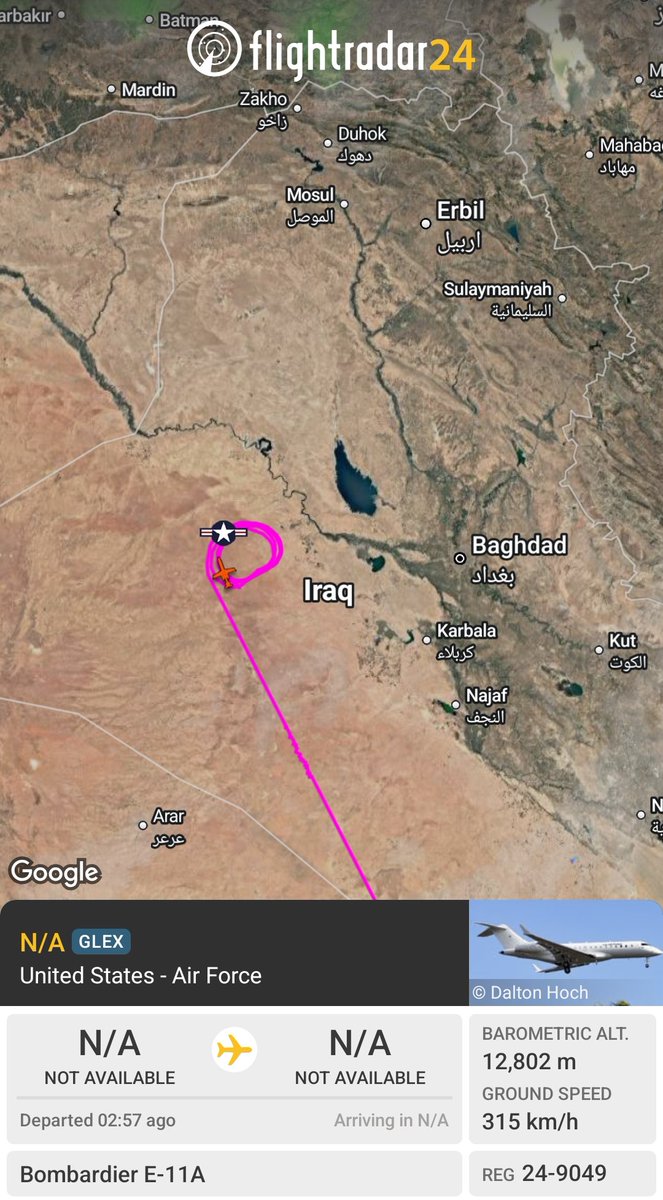
The Digital Artery of War Activates Critical Flight of the Strategic E-11A Communications Aircraft Over Iraq
Intensive circular holding patterns by a US Air Force Bombardier E-11A over western and central Iraq, having arrived from a southern trajectory.
This aircraft is the Pentagon's trump card in joint battle management, carrying the Battlefield Airborne Communications Node (BACN) payload. It functions as a massive airborne digital translation and wireless relay station. It enables B-2 stealth bombers and F-35 fighters to directly coordinate and instantly exchange targeting data and tactical plans with naval vessels, ground forces, and command centers, seamlessly overcoming terrain obstacles and severe electronic jamming.
The deployment of this platform, coinciding with the US President convening in the Situation Room and the total collapse of de-escalation efforts, stands as the most prominent tactical indicator yet. It signals the immediate activation of combat corridors and the securing of vital network links for massive aerial and missile strike packages preparing to execute major offensive operations across the theater.
The Preemptive Iranian Response: The statement by the Speaker of the Iranian Parliament, Qalibaf, emphasizing that Iran does not gain concessions through negotiations but through missiles, and that the victor is the one ready for war the next day, confirms that Tehran has made its decision for confrontation. Tehran's announcement of downing an American drone near Bushehr is a practical translation of this readiness.
Third: The Litani Slaughterhouse... Israeli Propaganda Shatters
While the drums of war beat in Washington, the Israeli army is bogged down in southern Lebanon, despite Netanyahu's announcement of crossing the Litani River:
The Dibbine and Zawtar Axis: The artillery shelling and Merkava fire on the town of Dibbine aiming to block the road toward Ebel El Saqi does not reflect control; rather, it confirms a state of impotence. Point-blank clashes have confounded the advancing forces. In Eastern Zawtar, the movement of vehicles stalled under the brunt of suicide (kamikaze) drones.
The Haddatha Trap and Night Drones: Luring the enemy once again in Haddatha and blowing up bulldozers and vehicles confirms the failure of the ground incursion. The most dangerous development for the occupation army is Hezbollah's introduction of precision drones equipped with night-vision thermal optics. The intense attacks resulted in the death of a female soldier and the injury of officers and soldiers who were evacuated by helicopters, escalating the unprecedented bleeding of the Israeli elite forces. This prompted Israeli officials to admit that the war in Lebanon has become a futile war working in Hezbollah's favor.
A War of Extermination to Compensate for Failure: In response to the ground impasse, warplanes launched raids covering Choueifat south of Beirut, destroying the Imam Hussein Complex in Tyre, and the Srifa clinic, along with issuing renewed evacuation warnings to cover up their failures in the field.
Conclusion and Strategic Outlook (Zero Hour):
We stand at the dividing moments between an impossible surrender and a devastating war. Trump's announcement to block the exchange of funds and his insistence on the mechanical extraction of uranium from deep within the Iranian mountains has completely destroyed the Pakistani-Qatari draft understanding, proving the validity of the Iranian view that American signatures are not a guarantee.
Trump's entry into the Situation Room is not to sign a peace agreement, but to review the target bank and perhaps give the operations order to the US Central Command to launch massive missile and aerial strikes on Iran to break the blockade on the Strait of Hormuz by military force.
Conversely, the Iranian front and the Resistance front in Lebanon are on maximum alert. Tehran, which refuses to compromise on the sovereignty of Hormuz or its enriched uranium, will respond by unleashing its ballistic missiles to strike American bases and its allies in the region. In Lebanon, the invading Israeli forces will receive unprecedented blows from fiber-optic drones, igniting the entire region in a war that will redraw the maps of global influence.
2/2
The Situation Room Opens its Doors... Trump Torpedoes the Financial Settlement and Imposes Forcible Uranium Extraction, While the Resistance Crushes the Incursion in the Litani — Talal Nahle
Friday, May 29, 2026 (Day 91 of the War)
We are entering the most critical hours, perhaps minutes, since the beginning of the war. The strategic tweet published by US President Donald Trump shortly before entering the Situation Room to make his final decision has turned the tables on all diplomatic efforts, uprooting the Qatari and Pakistani mediation from its foundations. Trump explicitly announced that no funds will be handed over to Iran until further notice, imposing coercive conditions regarding US entry to extract the uranium buried beneath the Iranian mountains. This announcement leaves Tehran with no room to maneuver, placing the region before two paths: either absolute Iranian submission (which is impossible according to Tehran's missile doctrine), or the outbreak of an all-out confrontation. This boiling point coincides with the shattering of the illusions of a decisive Israeli ground victory in the Litani swamp under the strikes of the Lebanese Resistance's drones.
First: Trump's Statement from the Situation Room... Booby-trapping the Agreement and Canceling Funds
The US President's recent statement laid down conditions on the negotiating table that are tantamount to a veiled declaration of war:
Canceling the Release of Assets: Trump's announcement that no funds will be exchanged until further notice is a direct torpedoing of the agreement's core, which stipulated the release of $24 billion. Tehran considered this clause a precondition for any understanding, and its cancellation means Washington aims to extract concessions and force the opening of the Strait of Hormuz for free.
Forcible Extraction of Uranium: Trump's claim that the United States itself (alongside China and in coordination with the IAEA) will extract the nuclear dust and enriched uranium buried under the mountains destroyed by American B-2 bombers 11 months ago represents a crossing of the Iranian Supreme Leader's red lines. The entry of American equipment deep into Iranian territory to extract uranium is a strategic surrender that Tehran will absolutely not accept under any circumstances.
Opening Hormuz and Demining: Trump announced that the naval blockade will be lifted so stranded ships can return to their home countries, ordering the immediate toll-free opening of the strait. He placed the burden of clearing the remaining naval mines onto Iran, after boasting that American minesweepers had destroyed the bulk of them.
The Final Decision: Trump's entry into the Situation Room to make the final decision means the US military is on maximum alert. Trump is presenting Iran and the Axis with two options: succumb to these humiliating conditions, or face a large-scale military strike.
Second: The Iranian Missile Doctrine and the Depletion of the American Arsenal
In contrast to the American conditions, intelligence documents and international reports have revealed the magnitude of the dilemma facing Washington and Tel Aviv:
Restoring the Fortified Iranian Arsenal: Satellite imagery published by CNN confirmed that Iran has regained full access to massive quantities of ballistic missiles and strategic stockpiles buried in underground facilities. This logistical superiority aborts the results of previous American air operations and affirms Tehran's readiness for a devastating response to any decision taken now in the Situation Room.
Depletion of the American Stockpile: The excessive consumption of American interceptor munitions in defense of Israel has depleted over half of the US stockpiles of THAAD, Patriot, and Tomahawk missiles. Suspending an arms deal with Taiwan has created a window of strategic vulnerability for Washington, making Trump's rush toward escalation a highly risky gamble.
1/2
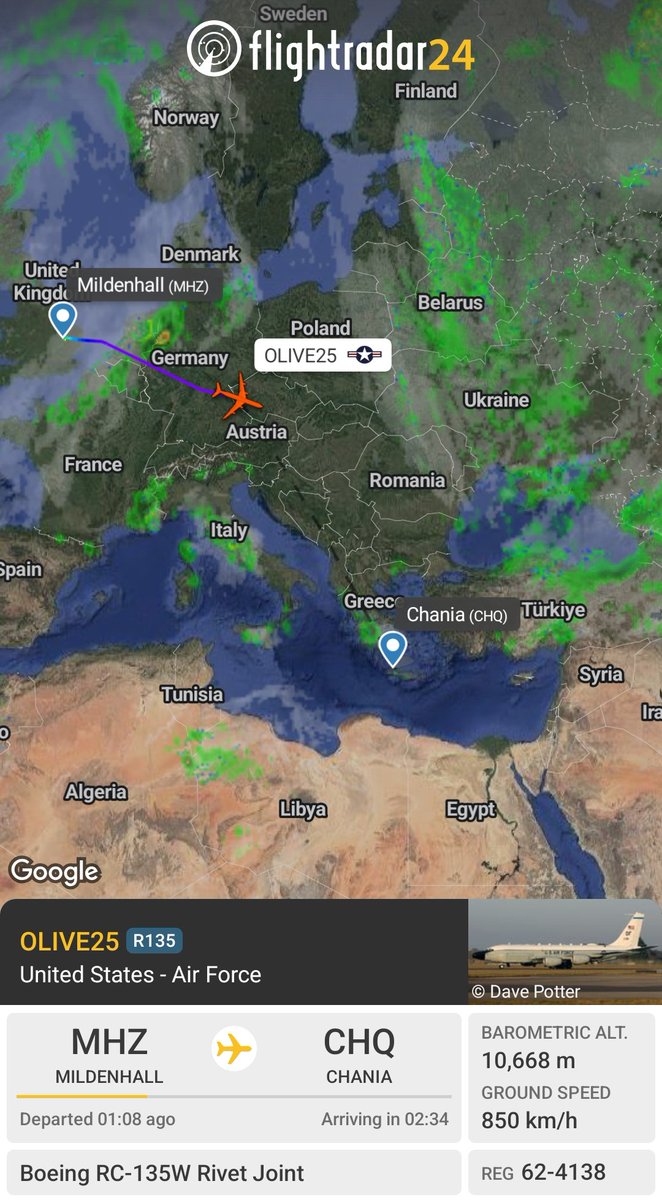
FR24 recently detected the deployment of the US strategic reconnaissance and electronic warfare aircraft, the RC-135W Rivet Joint (call sign OLIVE25), heading directly from its main base at RAF Mildenhall in the UK to the Chania (Souda Bay) base on the Greek island of Crete.
This movement cannot be dismissed as routine. The Rivet Joint is the Pentagon's premier platform for signals intelligence (SIGINT), communications interception, and radar frequency scanning. Deploying it now to reinforce the intelligence squadron stationed in Crete coincides with the US administration entering the operations room and the collapse of de-escalation efforts.
This strategic positioning indicates that US Central Command is expanding its electronic umbrella over the theater of operations. It is conducting precise, real-time updates of regional air defense and radar maps—a classic operational measure that invariably precedes decisions to launch large-scale strategic strikes to secure safe corridors for attack aircraft. The Pentagon's electronic eyes are mobilizing in preparation for the coming hours.


![Intel_Sky's tweet photo. The Dawn of "Kheibar Shekan".. Iran Burns F-35 Hangars in Jordan and Pounds the Fifth Fleet in the Fiercest Clash with Washington — Talal Nahle
Wednesday Morning, June 10, 2026 (Day 103 of the War)
Strategic Introduction: The Fall of Red Lines and the Explosion of Geography
The most violent wave of direct combat operations between the United States and the Islamic Republic of Iran since the collapse of the ceasefire on April 8 has ended. What began as an American pretext to retaliate for the downing of an Apache helicopter turned into a grave strategic error for the Pentagon; CENTCOM launched a large-scale attack disproportionate to the magnitude of the incident. Consequently, the Iranian response came in an unprecedented manner, transcending the traditional geography of the Gulf to reach the heart of strategic US bases in Jordan, having publicly threatened them during the previous round of Iranian retaliation against Israel's bombing of the Southern Suburbs [Dahiyeh].
At dawn today, Tehran established a new regional deterrence equation: any American attempt to forcefully break the blockade on Hormuz will mean incinerating the crown jewel of US airpower in the region.
I. The American Aggression: A Failed Attempt at "Coastal Blindness"
The US Central Command (CENTCOM) announced the completion of its strikes, which were described as targeting "Iranian air defense sites, control stations, and surveillance radars near the Strait of Hormuz" using precision munitions.
* Operational Analysis: The expanded scope of the US raids proves that the objective was not merely a retaliatory gesture for the downed Apache helicopter, but rather a military attempt to destroy the Islamic Revolutionary Guard Corps' (IRGC) "radar eyes," aiming to break the naval blockade and forcefully secure the passage of commercial and military vessels.
II. The Shocking Iranian Response: 26 Burning Targets from Hormuz to Azraq
Tehran retaliated with a coordinated operational decision involving the IRGC Navy, the IRGC Aerospace Force, and the Khatam al-Anbiya Central Headquarters, achieving an exceptional bank of targets that overthrew the prestige of American deterrence:
1. The Strategic "Kheibar Shekan" Strike in Jordan (The Turning Point):
In what represents the most dangerous geopolitical development, Iran expanded the scope of its retaliation to include Jordan. The IRGC utilized "Kheibar Shekan" ballistic missiles (solid-fueled and highly precise) to pound the Muwaffaq Salti Air Base in Azraq.
> US Losses: Four highly sensitive targets were destroyed, most notably the hangars housing F-35 stealth fighter jets, in addition to obliterating the US military's Command and Control (C2) center at the base. This strike shattered the myth of American air superiority and proved Iran's capability to destroy state-of-the-art US fighters while they are grounded.
>
2. Pounding the Fifth Fleet in Bahrain:
US bases in Bahrain were subjected to a massive missile attack, triggering sirens and resulting in the sound of massive explosions. A direct missile hit was recorded at the headquarters of the US Fifth Fleet, where plumes of smoke were seen rising from the nerve center of the US Navy in the Gulf.
3. Drone Attack on Kuwait:
Swarms of IRGC drones targeted the Ali Al Salem base and the Jahra region in Kuwait, leading to successive explosions and prompting Kuwaiti air defense systems to attempt to intercept the aerial targets.
4. Neutralizing Reconnaissance Eyes:
Concurrently with the missile attack, Iranian air defenses announced the downing of an advanced, strategic US MQ-9 Reaper drone while it was attempting to penetrate the airspace of the Iranian city of Jam.
* Total Toll of the Iranian Retaliation: Striking 21 targets across US naval and air bases in the Gulf, destroying 4 strategic targets in Jordan, and downing an MQ-9 drone.
1/2](https://pbs.twimg.com/media/HKcCNGxW4AAeJUD.jpg)