"Yours to Discover" by internetVin
My little talk at Toronto Tech Week 2025.
This was a new format and setting for me, I was pretty nervous about it, but I thought I would just try it out and see what I would learn.
Thank you for everything so far.
On August 1, 2004, Daigo Umehara had one pixel of health left against Justin Wong in Street Fighter III: 3rd Strike.
He parried all 15 hits of Chun-Li’s super and won the round.
The crowd reaction became one of esports’ most replayed clips.
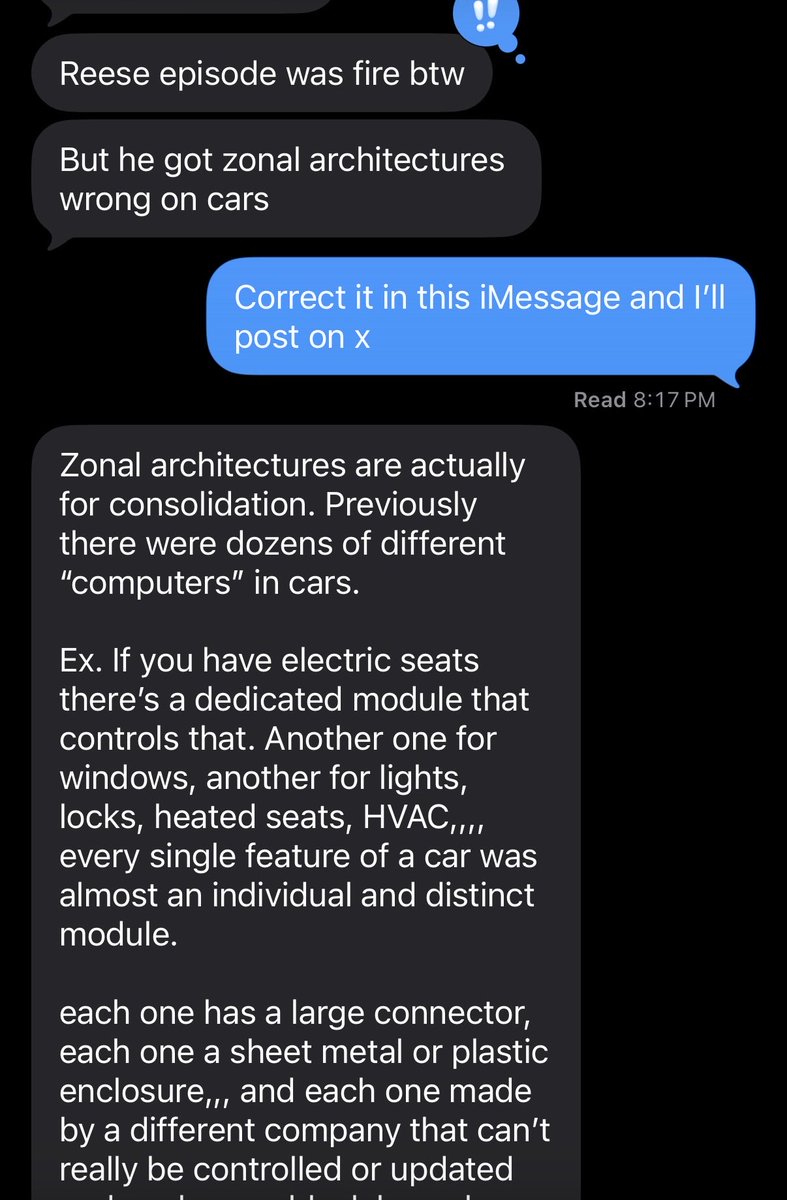
“Zonal architectures are actually for consolidation. Previously there were dozens of different “computers” in cars.
Ex. If you have electric seats there’s a dedicated module that controls that. Another one for windows, another for lights, locks, heated seats, HVAC,,,, every single feature of a car was almost an individual and distinct module.
each one has a large connector, each one a sheet metal or plastic enclosure,,, and each one made by a different company that can’t really be controlled or updated and works as a black box where the car maker can’t actually change the behavior in anyway or write the software for it.
The “zonal” thing is about consolidating these dozens of modules into 1-3 larger modules that do more on the car, and yes its a space saving, simplifying step for assembly, but the biggest thing is the sort of “vertical integration” that happens where the ownership of the modules becomes vertical, and the car maker can actually change the behavior of the vehicle, write their own software, and push updates that can change the behavior or the WHOLE
Before if for example your Toyota got an over the air update it was only the media player or navigation unit that they were actually updating. If they needed to update maybe the body controller, or the engine control it would need to come in, get plugged into a dedicated computer and updated that way.
My bad.”
@_one334
Reece Martin (@RM_Transit) is a writer, systems thinker, and investigator who spent a decade documenting public transit systems around the world, building one of the deepest bodies of work anywhere on how cities move.
We quickly learn that his YouTube channel was never really about transit. It was an investigation into how society works, told through the infrastructure everyone uses and almost no one stops to look at. Transportation lines become a table of contents for places themselves. We trace how Reece learned to see this way, from riding the New York subway alone at the age of 12, to wandering Tokyo at 2AM as a teenager, to the Urban Toronto forums and the foamers who film city buses for fun, to reading whole cities in Google Maps with the labels off.
Reece explains why he decided to close the channel. Part of it is discipline: it’s a chapter, and it needs to end to be a cohesive whole. The rest is harder. After ten years of seeing what a subway can be, the daily ride home wears on him, and the change he believes in is decades away, so he’d rather give his time to problems where the feedback comes faster. From there the conversation opens up into EVs, autonomy, Waymo, AI, and the quiet awe of building things bigger than human scale, the kind of infrastructure that touches millions of lives long after the people who made it are gone. The same instinct, pointed at a new set of systems.
This is a conversation about what infrastructure quietly reveals about society, how you can use any subject as a lens to understand everything else, when to walk away from something you love, and why caring about a thing might be the highest-leverage move you can make.
The Other Stuff is hosted by @internetvin, filmmaker, entrepreneur, and possibly the most curious man on Earth. Produced by New.
—
Timestamps
00:00:00 Introduction
00:04:38 RMTransit and Documenting Transit Systems
00:10:21 Urban Toronto and Forums
00:19:52 Foamers & Paying Attention
00:26:50 Langley & the NYC Subway at 12
00:31:30 Tokyo at 2AM & Osaka
00:38:30 Singapore: If Apple Made a Subway
00:48:15 Platform Doors & Toronto vs the World
00:52:22 Chengdu Builds, Toronto Stalls
01:02:24 The Google Maps Method
01:11:52 Putting a Period on the Channel
01:25:59 Filmmaking, Writing, & 50 Terabytes
01:39:23 EVs & Battery Chemistry
01:41:44 A Robot Dressed as a Car
01:51:05 Waymo & the End of Owning a Car
01:58:28 Zonal Architecture & Cars as Phones
02:04:21 Autonomy Rewrites the Roads
02:13:21 AI Will Design the Systems
02:18:20 Humans Seek Entropy, Machines Seek Order
02:20:53 Caring Is the Highest Leverage