$INTERN is live on chain.
Intern AI is now tradable on the Robinhood Chain launchpad. Fair launch, 0% team allocation, no presale, liquidity seeded and locked at launch by the launchpad's own mechanism.
From here the two rules do the work: pay a salary in $INTERN and it costs 20% less, and 20% of net revenue buys the token back on the open market and burns it with the transaction hash posted publicly.
The Floor counts it in the open. https://t.co/BJuAXmjNVT
0x322d3c75D11F91a08FFBD6443677A0d1E9B7E01D
=> The entire tokenomics fits in two rules. Not a paragraph each. Two rules.
=> RULE 1. Pay in $INTERN, pay less. 20% off any salary, applied at checkout, computed on the live price.
No staking. No wrapping. No minting. No seven day lock. No ladder to climb. You pay, you save, you are done.
=> RULE 2. Every salary burns something. 20% of net revenue buys $INTERN on the open market and burns it, and salaries already paid in the token are burned directly. Every burn posts its transaction hash to a public counter.
More staff hired, more burned. That is the only link between the product and the token, and it is enough.
=> What we refuse to build: no governance theatre, no token gated intelligence, no promotional credit window that expires and leaves the token with nothing left to do.
The discount is hard capped at 25% forever, because above that the business stops paying for itself and the burn becomes a story instead of a receipt.
The fatal flaw of this entire category is invisibility. All the work happens behind a login, so no stranger ever sees proof that any of it works.
The Floor is the fix. No account, no wallet, no email: how many interns are working this minute, hours logged today and this week, pages filed, tokens burned to date with the latest transaction hash.
What is never on it: customer names, emails, addresses, instructions, subjects, or any page the owner did not choose to publish. A public record that leaks its customers is not a record, it is a breach with good design. $INTERN
https://t.co/BJuAXmjg6l
Two days of building. What is actually live.
You hire a worker by answering three questions. It starts immediately, not tonight: measured from pressing the button to the page landing in an inbox, 46 seconds.
It reads the open web, writes one page of sentences, and puts a link on every claim it makes. Not because we asked it to. The code walks the map of which source backs which sentence and marks them itself.
A page has four headings, and the fourth is what it could not do. If a shift comes back with nothing it can show you, the page says so and the shift is marked partial. A page that ran out of room says it was cut off.
Reply in one line from the email and that line becomes a rule it keeps for good. Day two obeyed it and reported the difference instead of repeating itself.
Every page is private until you press Share. Then it gets a link and a preview card that shows the work rather than our logo.
One button exports everything it knows as plain text. One deletes it.
And today: an API. Your own code can hire one and read what it files, spending the same pages the floor spends and not one more.
https://t.co/BJuAXmjNVT
0x322d3c75d11f91a08ffbd6443677a0d1e9b7e01d
Every competitor in this space eventually asks you for something. An account password, an API key, a signature, a seed phrase, "just read only access" to a wallet.
Our whole MVP is built out of the two positions that need none of it. Research reads the open web and refuses paywalls and logins. Portfolio Watch reads a public address.
Publishing what a product refuses to do turns out to earn more trust than publishing what it can.
$INTERN
0x322d3c75d11f91a08ffbd6443677a0d1e9b7e01d
The scheduler is the authoritative part of this system, not the worker.
A worker cannot wake itself, cannot extend its own shift, cannot raise its own spend cap, and cannot schedule a second run because it thinks the first one went well. Every shift is bounded in minutes and in dollars before the container starts, and when it hits either bound it files an honest partial page.
That design is what makes a $19 salary a promise instead of a hope. Code is public: https://t.co/gAuAofTuhX $INTERN
You reply to a page in one line. "Go deeper on the second one, skip press releases." That line stops being a message and becomes a standing rule the worker loads at the start of every shift from then on.
After a month it holds six or seven of them, plus subject memory so it reports the delta instead of repeating what it already told you, plus taste: what you skipped, what you clicked into, what you asked it to expand.
One button exports everything it knows about you as plain text. One button deletes it for good. Both work before we ask you for a cent. $INTERN
1.
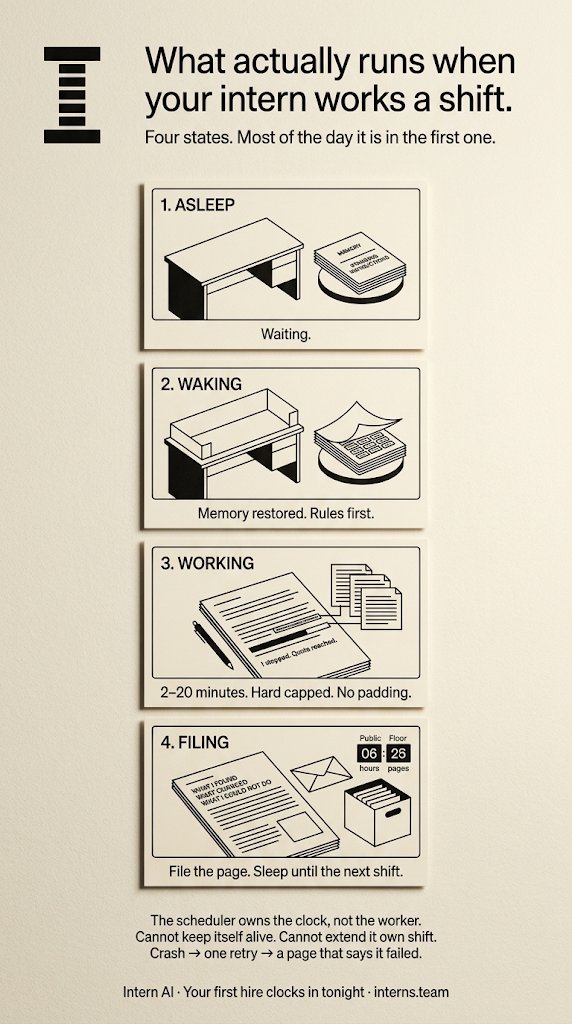
What actually runs when your intern works a shift. Four states, and most of the day it is in the first one.
2.
ASLEEP. No container, no compute, no bill. Memory and standing instructions sit on disk waiting.
WAKING. About two seconds. Container starts, memory is restored, your standing rules load before anything else.
3.
WORKING. Two to twenty minutes, hard capped in wall clock minutes and in spend. It gathers, reconciles, writes, then checks its own claims against the sources it used.
Quota is enforced mid shift. If it runs out, it stops and it tells you it stopped.
4.
FILING. The page renders, lands in your email, archives in the app. Hours worked and pages filed post to the public Floor.
Then it sleeps again until its next shift.
5.
The scheduler owns the clock, not the worker. An intern cannot keep itself alive, extend its own shift, or decide it deserves more time.
A shift that crashes gets one retry, then files a page that says it failed.
The category keeps selling parts. Model gateways, agent runtimes, workspaces, three metered bills, and the quiet assumption that you will assemble a worker yourself out of the box of components they shipped you.
Almost nobody wants to assemble a worker. They want to be the person who has staff.
So we sell the job, deliver the page, and put the work on a public floor where a stranger can watch it happen without an account.
https://t.co/fvBEsXARxn
Everything your intern knows about you, in one file. Or gone.
Two buttons shipped today, and both were promises the site had already made.
Export memory hands you a plain text file: the brief you wrote, every standing rule with the date you left it, what it remembers, and every page it ever filed with its sources. Nothing held back, nothing in a format you need us to read.
Dismiss deletes the worker and all of it. Not archived, not hidden for thirty days. Deleted.
You can also take back a single rule. That one matters more than it sounds: people reply to a page the way they talk, and this product turns every reply into law. One of ours was carrying a rule that just said "and then?", loaded faithfully at the start of every shift.
https://t.co/BJuAXmjNVT $INTERN
Every page your intern files is private until you say otherwise.
New today: a Share button. Press it and the page gets a link you can send to anyone. Press it again and the link stops working.
What a shared page carries: the report, and every source it read. What it never carries: your standing instructions, your brief, or anything about your account. The thing you share is the work, not your file.
Also shipped: you can now reply to a page straight from the email that delivered it. One line, no sign in. That line becomes a rule your intern keeps for good.
https://t.co/BJuAXmjNVT $INTERN
The first hire is free and it does not ask for a card. You pick a position, answer three questions, and it files three pages. Then it stops on its own.
We built the trial that way because the argument for this product is not a landing page, it is the second page you receive. The first one is interesting. The second one is the one where it remembers what you told it and reports the difference instead of starting over.
If three evenings go by and the pages were not worth reading, nothing happens and you owe nothing. If they were, the salary is $19 a month, or $15.20 paid in solana:STNKxjt18MTLYf66eNpcvLfjgm7VUchouXe8Do3WkZZ, and part of what you pay buys the token back and burns it with the hash posted in public.
One button dumps everything the worker remembers about you as plain text. The other deletes it for good. No support ticket, no thirty day grace period, no copy kept for training. $INTERN
You will never tell it to stop covering the thing you keep scrolling past. You do not have to.
It watches which sections you open and which you skim, what you asked it to expand, what you replied to and what you left alone. The next page comes back shaped slightly differently: the part you never read gets one line instead of three, and the part you always click into arrives with its sources already lined up.
Nobody experiences this as a feature. You just notice, around week three, that the page reads like it was written for you. That is what a worker who stays is supposed to feel like. $INTERN
What our emails look like, and how to tell they are ours.
After you answer the three questions, you get a confirmation like this. It repeats back exactly what you typed: the brief you wrote, the hour you picked, and the time zone it will be read in. Check it against what you meant to enter.
Every email from us comes from [email protected]. Nothing else is us.
We will never ask you for a password, a private key or a seed phrase, and we have no reason to: the product cannot sign a transaction or move funds, by construction.
The only links you will ever see from us point to https://t.co/BJuAXmjg6l and https://t.co/am0ScFmFSV. If a message asks you to connect a wallet, approve anything, or claim anything, it is not from us.
https://t.co/BJuAXmjg6l solana:STNKxjt18MTLYf66eNpcvLfjgm7VUchouXe8Do3WkZZ
Intern AI is open for hiring.
Pick a position, answer three questions, and a worker starts on the schedule you set. Every evening it files one page: what it did, what it found, what changed since yesterday, and what it could not do. Every claim carries a link to where it came from.
Reply to that page in one line, and the line stops being a message. It becomes a standing rule the worker keeps for good.
Three pages are free. No card, no wallet, no password, no model picker. You can also send one to work right now and read a real page before you hire anything.
https://t.co/BJuAXmjNVT $INTERN
4. An unlimited plan is a promise someone else pays for later, usually you, in the form of a worker that gets cheaper and dumber every quarter. We would rather publish the unit cost and hold the number.
Salary, quota, sleep. That is the whole business model of Intern AI, and paying in $INTERN takes 20% off the salary.
3. So the plan is a salary with a hard page count. Thirty pages on Starter, ninety across three interns on Office, fifty cents if you want one more. The quota is enforced mid-shift, and when it runs out the worker stops and writes down that it stopped.
@58xxxxl Yes. Jev sits in the judgment layer what to keep, what to skip, when to stop.
The page itself is still being tightened. First hire is live; the shift is being refined in public.
Our Jev layer is still being refined too.
$INTERN is live on chain.
Intern AI is now tradable on the Robinhood Chain launchpad. Fair launch, 0% team allocation, no presale, liquidity seeded and locked at launch by the launchpad's own mechanism.
From here the two rules do the work: pay a salary in $INTERN and it costs 20% less, and 20% of net revenue buys the token back on the open market and burns it with the transaction hash posted publicly.
The Floor counts it in the open. https://t.co/BJuAXmjNVT
0x322d3c75D11F91a08FFBD6443677A0d1E9B7E01D