Well shit.
Sonic booms were heard over Baghdad, explosions are being heard in Tehran, and Israel's Channel 14 reports that the Israeli Air Force has begun striking targets throughout Iran.
As I write this, the IDF also just confirmed that it has launched strikes on Iran in the last few minutes.
Explosions have been reported in multiple locations across the country, including Tehran, Isfahan, Shamriz, Karaj, and more.
Looks like we're back guys.
I thought you "call the shots" Trump.
You sure buddy?
Trump told the Financial Times that Netanyahu "won’t have any choice” but to accept whatever deal the US negotiates with Iran because he “calls the shots."
“I call the shots. I call all the shots. He [Netanyahu] doesn’t call the shots.”
He also said that Iran's attack on Israel "is not going to have any impact on the deal."
Trump added that if no deal is secured, he'd have two options:
To continue militarily, or maintain the blockade on Iran because it has been "probably more powerful than any attack that was ever made on that country."
Ok.
Cool.
Sounds like he got his point across to Netanyahu.
I'll stay up for an hour or two to see if anything happens, but it seems like we dodged a bullet tonight.
Kan News also reports that Israel may delay a strike for several days instead of acting tonight due to Trump's opposition.
Sleep well guys.
It looks like this week may be pivotal, so enjoy the quiet while we have it.
Trump spoke to Netanyahu earlier tonight.
According to ynet, the US told Israel it would be better to wait a few days to see if a deal is possible.
If not, it would move forward alongside Israel in attacking Iran militarily.
Yediot Ahronot reports that Washington informed Israel that it should not get drawn into a limited exchange of strikes, which would ultimately serve little purpose.
The Jerusalem Post reports that Israel will respond, but is still considering the timing and scale of the response.
Finally, Israel Hayom, quoting an Israeli official, says Israel will respond to the Iranian attack, "even if it doesn't happen soon."
The Israeli Broadcasting Authority reports that Netanyahu is currently holding security consultations following his phone call with Trump, and we'll have to see what, if anything, will happen.
Put together from these reports, it seems like Israel will not be responding tonight, but likely will eventually.
Nothing is certain though.
If a deal is actually close, a big if, and an Israeli response is inevitable, it sounds like a great opportunity to pull a charade like last year's war to deal with the PR problem all sides are facing.
A way to save face after embarking on a damaging and ultimately pointless war.
It's nice to hope.
We'll see.
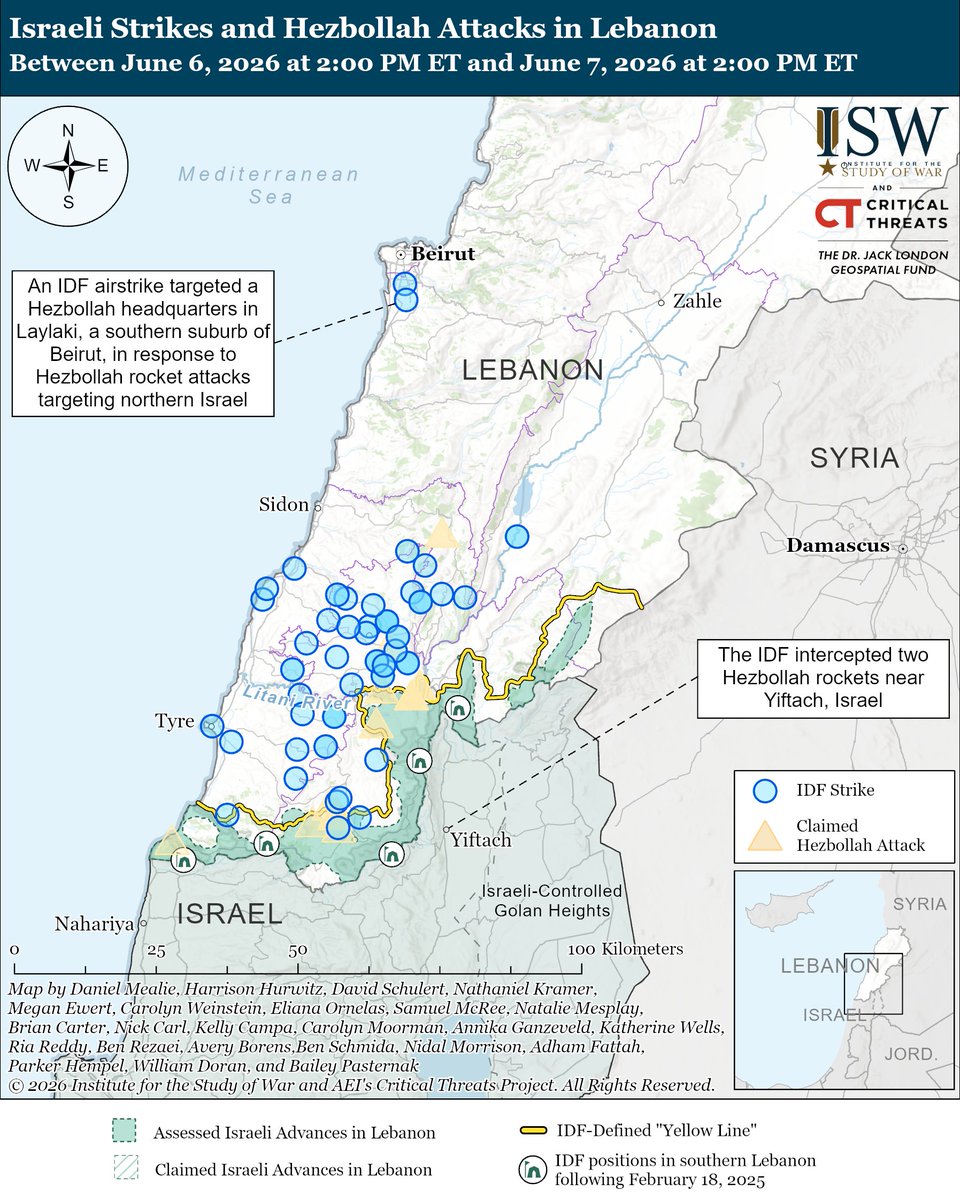
Time for an Infographic:
A map showing Israeli strikes on Lebanon, as well as Hezbollah attacks on Israeli forces and northern Israel, over the past 24 hours.
So, for now, it looks like both Trump and Iran don't want this to escalate.
Israel has probably been waiting for the opportunity, so it's going to need a lot of pressure from the US to keep this contained.
A resolution to the crisis as a whole needs to be secured quickly, or we'll face a lot more incidents like this one.
Among the many impediments to this, Israel has elections this September or October.
A significant majority of the population was unhappy about the Iran and Lebanon "ceasefires," and Netanyahu wants to secure yet another term.
That's no good.
Let's hope the US can calm its "ally."
For now, war has not yet arrived.
If Israel responds though, this may get hard to rein in.
Hope for the best.
A "Warning" or Back to War?
So, there's obviously a lot of context to cover on how we got here and the developments in the past month, and I'll report that when I can.
For now, what needs to be known is that this afternoon, Israel bombed Dahieh, the southern suburbs of Beirut, in response to Hezbollah's rocket fire on northern Israel this morning.
At least two people were killed and 11 wounded in the Israeli strike.
Israel reportedly aimed for this to be a "message of deterrence."
Iran had said that striking Beirut is a red line, and threatened to retaliate after the strike.
Well, they made good on that promise.
At around 10pm, Iran fired a volley of ballistic missiles at Israel, followed by a second round shortly after.
Despite reports of Iranian air defense being activated, Israel has not yet responded.
Walla News reports that Israel is seeking a US green light for strikes on Iranian energy sites, and CNN reports a source as saying that Israel is preparing a “powerful” response.
Trump doesn't want this.
He told Fox News "you've shot your missiles, that's enough. Get back to the table and make a deal," and Axios reports that Trump is working on convincing Israel not to retaliate since a deal is supposedly close.
Iranian officials and the IRGC have labelled this as "merely a warning," and if Israel responds or repeats its actions in Lebanon, the next strikes will be "more extensive and will include all American-Zionist targets in the region."
Meanwhile, the IDF Spokesperson said that "the Iranian regime made a grave mistake," and a senior Israeli official told Israel’s Channel 12 news that Israel will “respond forcefully” to Iran’s missile attacks.
So it's not looking too great.
Trump told Fox News that he is not happy about Israel's attacks on Lebanon and that they were not coordinated with the United States, though Saudi's Al-Hadath said they were earlier today.
It has also been widely reported that any strike on Beirut would require a US green light.
There is no mention of Israel withdrawing from Lebanese territory, so that alone probably means this won't really last.
Hezbollah hasn't officially responded yet, but I figure the government coordinated with them.
It's also not clear when this takes effect, nor where these "pilot zones" will be.
Since it's contingent on "the evacuation of all Hezbollah operatives" south of the Litani, we can expect Israel to keep striking with claims that it is targeting Hezbollah, and Hezbollah to not fully withdraw because Israel remains an occupying force.
Sounds like a recipe for success to me.
If we were to widen the lens a bit though, this comes a day after Iran fired missiles and drones on its Gulf neighbors, killing one and injuring over 60 in Kuwait, in response to US strikes on Qeshm Island.
It also comes a few days after Netanyahu and Israeli Defense Minister Katz said they were going to strike Beirut, which led to Iran threatening to pull out of talks, and Trump then reportedly held a "tense" call with Netanyahu.
Axios reports that Trump shouted at Netanyahu saying "what the fuck are you doing? You're fucking crazy. You'd be in prison if it weren't for me. I'm saving your ass. Everybody hates you now. Everybody hates Israel because of this."
The point being, this Lebanon ceasefire may be a necessary stepping stone for Trump to get an Iran deal that could finally calm this mess.
My fear is that Lebanon will lose that positioning once a deal is made, but we'll cross that bridge when we get there.
For now, we've got this Lebanon Ceasefire 3.0.
Let's hope it sticks.
Lebanon Ceasefire Plus Ultra Max:
Alright.
We've got good news, hopefully.
It's déjà vu on déjà vu, but at least it's in the right direction.
The US, Lebanon, and Israel issued a joint statement announcing a full ceasefire in Lebanon "contingent on a complete cessation of Hezbollah fire and the evacuation of all Hezbollah operatives from the South Litani Sector."
The agreement establishes "pilot zones" inside Lebanon from which Hezbollah would be banned and the Lebanese Army would take full and exclusive control.
I'll have to double-check, but I think this is the first time Lebanon and Israel are put on equal footing in a statement because it said that the US "reiterated its ongoing support for both governments to exercise their sovereignty."
"Both."
Eyyyy.
We finally have sovereignty rights guys!
The US also "underscored its intent to support the Lebanese Armed Forces, with the aim of improving their capacity and enabling the effective exercise of sovereignty throughout Lebanese territory."
Lebanon and Israel will meet again on the week of June 22 to reach a "comprehensive agreement."
So.
Sounds good.
I have a lot of questions though.
Umm, ok.
So here’s what happened.
After Netanyahu and Katz announced that Israel would strike Beirut, Iran announced that all talks with the US would now be put on hold.
Iran then issued an evacuation order for northern Israel in the even Beirut was bombed.
Trump then spoke and said he didn’t know that Iran pulled out of negotiations, after which he held a phone call with Netanyahu.
Now, he says this:
“I had a very productive call with Prime Minister Bibi Netanyahu, of Israel, and there will be no Troops going to Beirut, and any Troops that are on their way, have already been turned back.
Likewise, through highly placed Representatives, I had a very good call with Hezbollah, and they agreed that all shooting will stop — That Israel will not attack them, and they will not attack Israel.”
So apparently, “troops” that were “on their way to Beirut,” are no longer coming, and Trump says that Hezbollah has agreed to stop striking Israel and Israel will stop striking Lebanon.
That’s a lot of information in one go.
I guess we’re back to a “ceasefire” that won’t last?
Hala2 we’ll see.
Israel will be striking Beirut soon.
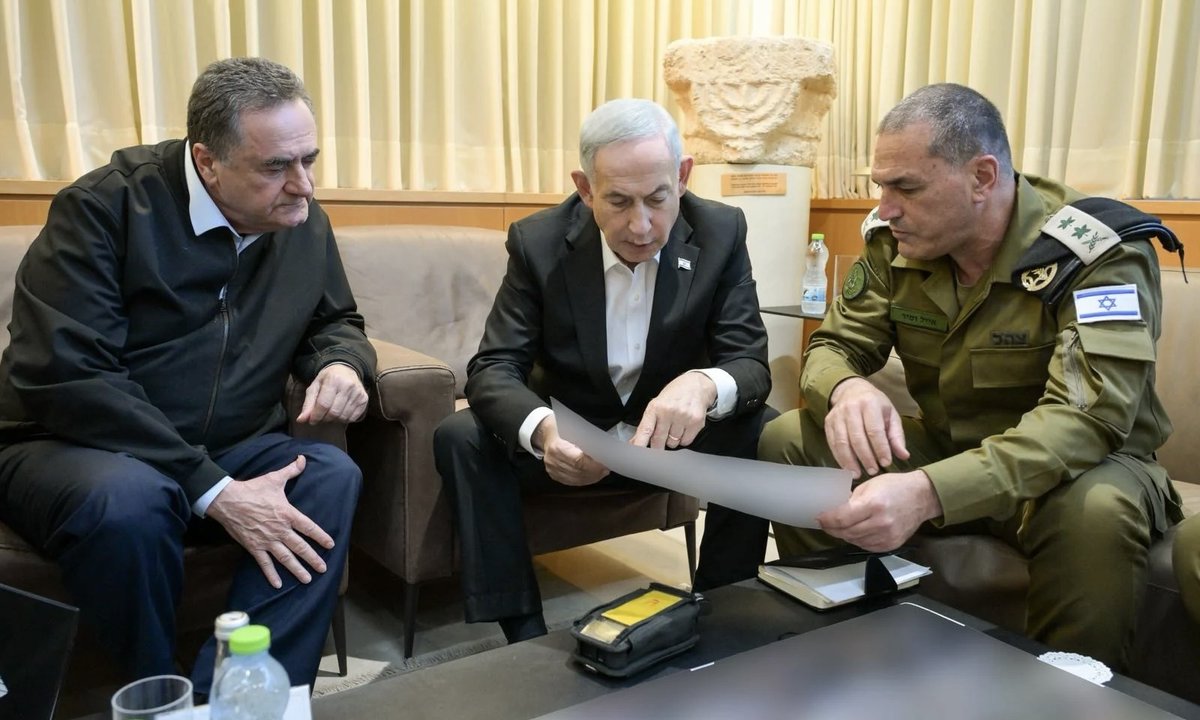
Netanyahu and Defense Minister Katz announced that they've ordered the IDF to carry out strikes on Dahieh.
This comes after reports yesterday that they were pushing for US approval to strike Beirut and expand their invasion.
Axios reports that efforts to secure a ceasefire in Lebanon have stalled.
There has been a lot of back and forth regarding this story, but it seems like this time we're finally close to a deal.
Reuters and the Washington Times report that the US and Iran have reached an interim peace deal to formally end the war.
The Washington Times says that both sides are expected to announce the finalization of a peace deal to end the fighting on all fronts by tomorrow afternoon.
Reuters says the agreement is “fairly comprehensive."
Al-Arabiya, citing a senior source, reports that “a few hours separate us from the announcement of the agreement between Iran and the United States.”
Axios reports that the the Trump administration and Iran are reportedly close to a deal to end the war, with remaining gaps focused on the wording of several points.
Earlier, Reuters also reported that Trump held a call today with the leaders of Saudi Arabia, Qatar, the UAE, Egypt, Türkiye, and Pakistan.
Finally, Axios reports that Netanyahu is highly concerned about the current peace deal under discussion and has urged Trump to launch another round of strikes against Iran.
Put together, it sounds like this is real, and we should expect word on the agreement and the details soon.
It's about time.
This has taken a ridiculously long time.
Let's hope it all works out.
The US has announced that Lebanon and Israel have extended their ceasefire by 45 days.
This comes after the two countries wrapped up a third round of negotiations in Washington DC today.
The "ceasefire" has been in place since April 16, but its terms allow Israel to continue striking targets it deems threats, killing hundreds in the process.
The State Department will reconvene the political track of negotiations on June 2, while a separate security track will be launched at the Pentagon on May 29 with military delegations from both countries.
There are also reports that a phased plan is being discussed, in which Israel would withdraw gradually as verified disarmament takes place in parallel.
This does sound like the only viable plan.
While this diplomatic track develops, it remains clear that all bets are off if the Iran War resumes.
Israeli newspaper Yedioth Ahronoth reported that if US-Iran hostilities resume, Israel would request a US "green light" to renew strikes in Beirut.
For now, strikes on the capital appear to be constrained in order to preserve the Iran talks and keep the Lebanon diplomatic track alive.
Wow, historic news.
The United Arab Emirates just announced that it will quit OPEC and OPEC+ effective May 1st.
A move that will significantly weaken the oil producing alliance, and a big blow to Saudi Arabia.
OPEC has historically shown a united front despite internal disagreements over a range of issues from geopolitics to production quotas.
In announcing its departure, the UAE also said it would “gradually and thoughtfully” increase oil production.
Nuts.
The power of OPEC is that major producers agree to limit or increase output together.
This gives them control over the oil market and massive global leverage.
The UAE leaving undercuts that power, and given Saudi’s role as the de facto leader of the alliance, significantly reduces the Kingdom’s influence in the world.
This Saudi-UAE cold war has already created significant new alliances in the region, and now is damaging the very structure of Gulf power.
State of the Lebanon "Ceasefire" (Part 4):
What Israel was bound to, according to what the US "understands," was not carrying out "any offensive military operations against Lebanese targets, including civilian, military, and other state targets, in the territory of Lebanon by land, air, and sea.”
The destruction of civilian homes in the south is arguably a violation of the ceasefire.
Though Israel would argue this is not “offensive,” and the US could agree in accordance with what it “understands.”
Hezbollah’s responses were technically not violations of the ceasefire, but rather a failure of Lebanon's obligation to take "meaningful steps" to stop Hezbollah's activities.
This is all according to the letter of the agreement, but obviously not the spirit of the agreement.
Israel should have halted its hostile activities, and Hezbollah should have halted its attacks.
Neither has happened, and here we are.
The ceasefire is scheduled to remain in place for another three weeks, but it's not clear if we'll reach that point.
All this will be largely dependent on how talks with Iran go, which for now, don't look good at all.
Beirut seems to be off-limits during this time period, but if the Iran track collapses, we could go back to the pre-April 16 reality.
Not a great situation.
State of the Lebanon "Ceasefire" (Part 1):
Let's provide a rundown of the Lebanon "ceasefire."
How much of a "ceasefire" is this ceasefire?
As usual, it's basically not.
On the ground, it has acted as a change in the rules of engagement, but far from actually ceasing fire.
An easy metric to prove this point is the rising death toll from Israeli strikes.
On April 16, the day the ceasefire agreement was announced, the toll in Lebanon stood at 2,294 people killed and 7,544 injured.
Today, it's 2,509 people killed and 7,755 wounded by Israeli strikes.
That's 215 killed and 211 injured during the "ceasefire" period.
During the same time period, at least three Israeli soldiers have been killed and tens injured from Hezbollah attacks in occupied southern Lebanon.
Attached is a video of a Hezbollah drone striking meters away from IDF soldiers as they were evacuating the wounded in Lebanon yesterday.
State of the Lebanon "Ceasefire" (Part 3):
In letter, the ceasefire agreement gave Israel a lot of latitude in what it is allowed to do, and Hezbollah was not once mandated to halt its attacks.
Israel was allowed "to take all necessary measures in self-defense, at any time, against planned, imminent, or ongoing attacks."
The agreement explicitly made Lebanon and Israel the main actors, distinguished Hezbollah from the Lebanese state, and said that Lebanon and Israel are not at war.
Lebanon had to "take meaningful steps" to stop Hezbollah, but that's where any Hezbollah-related obligation ends.
All this was structured around "what the United States understands" rather than what was agreed to.
So Israel is given massive leeway but subject to the terms, Hezbollah can do what it wants and was not a subject, and Lebanon is not hostile but must do its best.
A very weak agreement.
One that whether by design or negligence, was calibrated to fail.
Big news coming out of Israel.
This will be a game changer for Netanyahu in the upcoming elections.
Former Israeli prime ministers Naftali Bennett and Yair Lapid will be announcing a joint political party.
It will be a merger of their parties Yesh Atid and Bennett 2026.
They will now run together on one list called “Together – Led by Naftali Bennett."
Bennett is by far the most popular alternative to Netanyahu among Israelis, consistently polling as the largest or second-largest party in the event of a new election since his Bennett 2026 party was registered in June 2025.
Bad news for Netanyahu.
Bennett is not great, and we'll get into that later.
Still, it's time for a bye bye Netanyahu moment.







![intogreyx's tweet photo. Trump told the Financial Times that Netanyahu "won’t have any choice” but to accept whatever deal the US negotiates with Iran because he “calls the shots."
“I call the shots. I call all the shots. He [Netanyahu] doesn’t call the shots.”
He also said that Iran's attack on Israel "is not going to have any impact on the deal."
Trump added that if no deal is secured, he'd have two options:
To continue militarily, or maintain the blockade on Iran because it has been "probably more powerful than any attack that was ever made on that country."
Ok.
Cool.
Sounds like he got his point across to Netanyahu.
I'll stay up for an hour or two to see if anything happens, but it seems like we dodged a bullet tonight.
Kan News also reports that Israel may delay a strike for several days instead of acting tonight due to Trump's opposition.
Sleep well guys.
It looks like this week may be pivotal, so enjoy the quiet while we have it.](https://pbs.twimg.com/media/HKPt6HGXQAAN44b.jpg)