claude + REA can rebuild software features without copying a single line of code
opus 5.5 reads what REA finds inside a program, then rebuilds the feature in a separate clean-room setup.
here's how to do it:
1. run npx rea-agents setup to connect REA to Claude Code
2. pick a feature and let REA figure out how it works. save the behavior and rules in a spec file
3. start a fresh Claude session with only that spec. rebuild the feature without touching the original code
4. use /goal to run the tests and check 3 intentionally broken versions. all 3 must fail
one project recovered 697 functions in just 12 days, with 696 exact matches.
the real trick is building tests that catch mistakes before they become part of the finished software.
Chinese bride gifts her partner a flagship GPU at wedding — he breaks down in tears
She handed him an ASUS ROG Astral RTX 5090 that costs around $12,000
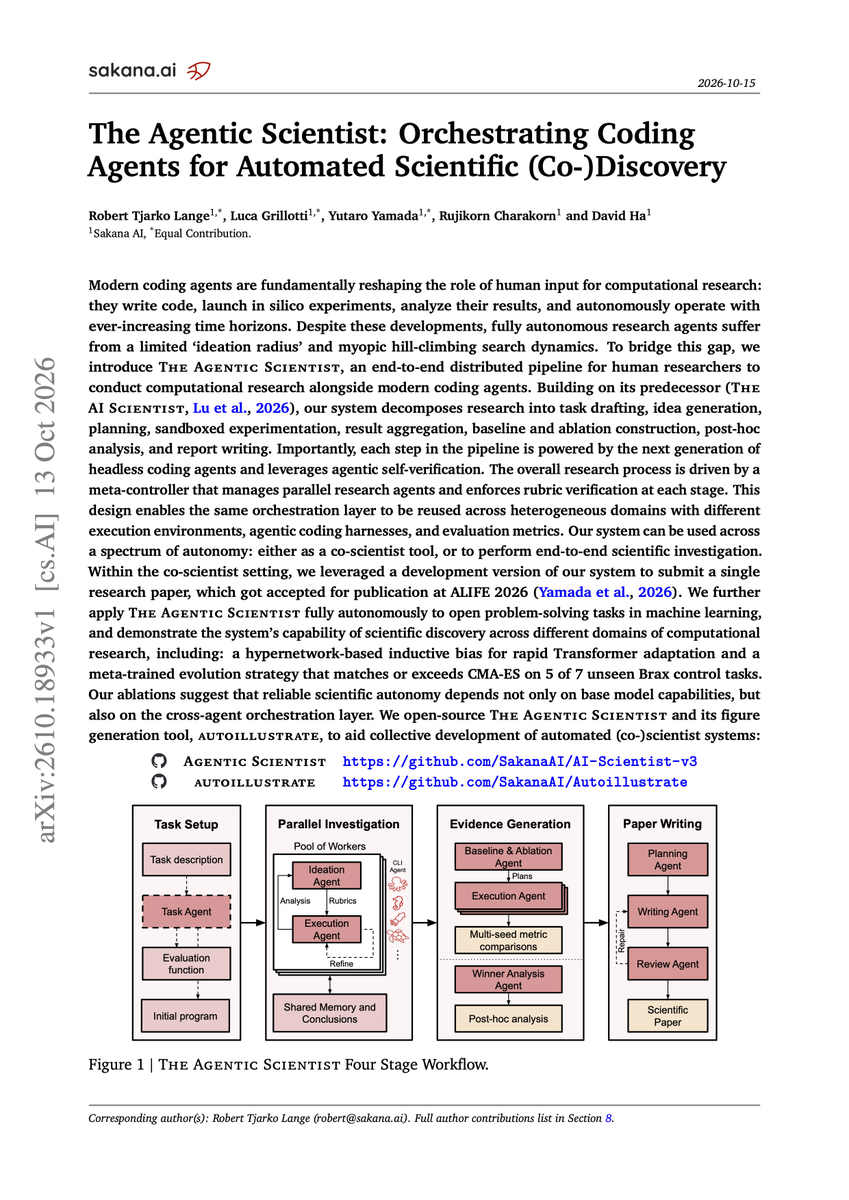
The AI Scientist v3 is out: The Agentic Scientist.
GitHub: https://t.co/v2AkZi4Bmt
Blog: https://t.co/v3Td5yfvBE
arXiv: https://t.co/RuVnAHjMlK
The Agentic Scientist is the 3rd iteration of our automated AI Scientist research system, and the shift this time is from “one agent writes a paper” to “a scaffold of parallel agents orchestrates the full research loop.”
The system now orchestrates a pool of parallel workers that share memory and distilled conclusions. Crucially, it features Evidence Generation: isolated agents automatically run controlled baselines and ablations to prove why an idea actually works.
It works as a co-scientist. We used a development version as a co-scientist to explore biologically plausible learning rules. The agent handled the empirical heavy lifting, proposing mechanisms and running experiments. We stayed in the loop to steer direction, verify results, and moderate claims. That feels like the right division of labor for where the technology actually is.
This resulted in a new biologically plausible learning algorithm, and the resulting paper was accepted at ALIFE 2026 as an oral presentation.
We are also releasing AutoIllustrate. It generates editable https://t.co/i6fwB6vzQV vector figures instead of uneditable, hallucinated raster images. Real scientists need vectors, not pixels. I am an SVG junkie ;)
Incredible work by Robert Lange, Luca Grillotti, Yutaro Yamada, Rujikorn Charakorn, and the team!
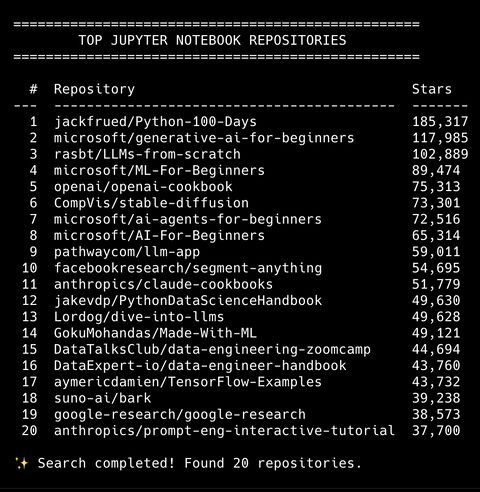
Goldmine for AI Engineers! 📌
If you're learning AI, ML, LLMs, or AI agents, don't waste hours jumping between random tutorials.
These are 10 repositories I'd actually keep bookmarked - from Python fundamentals to ML, LLMs, agents, and production AI.
1. Python - 100 Days
jackfrued/Python-100-Days
A 100-day Python learning path covering fundamentals, data analysis, web development, and more.
GitHub:
https://t.co/ED5Fm7Ei3Q
2. Generative AI for Beginners
microsoft/generative-ai-for-beginners
A practical introduction to building Generative AI applications.
Covers:
• LLM fundamentals
• Prompt engineering
• RAG
• AI agents
• Fine-tuning
• AI application development
GitHub:
https://t.co/kdQ2b6jBYB
3. LLMs From Scratch
rasbt/LLMs-from-scratch
Want to understand what's actually happening inside an LLM?
Build one step by step.
Covers:
• Tokenization
• Embeddings
• Attention
• Transformers
• Training
• Fine-tuning
GitHub:
https://t.co/lzCKdk7kl1
4. Machine Learning for Beginners
microsoft/ML-For-Beginners
A structured 12-week, 26-lesson curriculum covering classical machine learning.
A good starting point if you want ML fundamentals before jumping into LLMs.
GitHub:
https://t.co/AlXqh5KO9b
5. OpenAI Cookbook
openai/openai-cookbook
A collection of practical examples and guides for building applications with OpenAI models.
Useful when you want to move from:
Learning → Building
GitHub:
https://t.co/FrBiKTbIS6
6. Stable Diffusion
CompVis/stable-diffusion
Interested in generative image models?
This repository contains the original Stable Diffusion implementation and research code.
GitHub:
https://t.co/25e7FVkHIf
7. AI Agents for Beginners
microsoft/ai-agents-for-beginners
A practical course for understanding and building AI agents.
Covers:
• Agentic AI
• RAG
• Agent frameworks
• Tool use
• Multi-agent systems
GitHub:
https://t.co/oAn2ptn2T5
8. AI for Beginners
microsoft/AI-For-Beginners
A structured 12-week, 24-lesson introduction to AI.
Covers:
• Neural networks
• Computer vision
• NLP
• Deep learning
• Classical AI
GitHub:
https://t.co/p4PdLnL89o
9. LLM App
pathwaycom/llm-app
Focused on building practical LLM applications.
Explore:
• RAG
• AI pipelines
• Enterprise search
• Real-time data
• Vector search
GitHub:
https://t.co/LYMOE4PgWj
10. Segment Anything
facebookresearch/segment-anything
A foundation model for promptable image segmentation.
Worth exploring if you're interested in computer vision and multimodal AI.
GitHub:
https://t.co/j0mPn2or2V
Don't bookmark all 10 and forget about them.
Pick based on where you are:
Python → Python-100-Days
ML → ML-For-Beginners
AI Fundamentals → AI-For-Beginners
LLMs → LLMs-from-scratch
Generative AI → Generative-AI-for-Beginners
Agents → AI-Agents-for-Beginners
Building → OpenAI Cookbook / LLM App
Computer Vision → Segment Anything
Pick one.
Build something.
Then move to the next.
this one page turns Obsidian + Opus 5.5 + Jev into a second brain that thinks with you around the clock
built on Karpathy's ideas
Jev reads every note before Opus does
Opus writes only what matters
your vault keeps working while you don't
cuts 80% off your weekly chat time
frees you up for the work your manager actually pays for
the people who set this up early
are the ones the next raise finds first
UC Berkeley's "CS 188: Introduction to Artificial Intelligence"
by John Canny & Oliver Grillmeyer
The legendary Pacman-based AI course: search, CSPs, games, MDPs & ML, taken by tens of thousands online.
Course Website: https://t.co/PKlVUbyaZD
Lecture Videos: https://t.co/qljuhKnbIv
This is a must read paper for anyone tackling length generalization and Transformer reasoning limits.
We keep trying to force standard Transformers to do state tracking, but the math just doesn’t work in their favor.
Because their depth per token is completely fixed, the moment a sequence gets longer, they run out of compute runway to keep track of accumulating transitions.
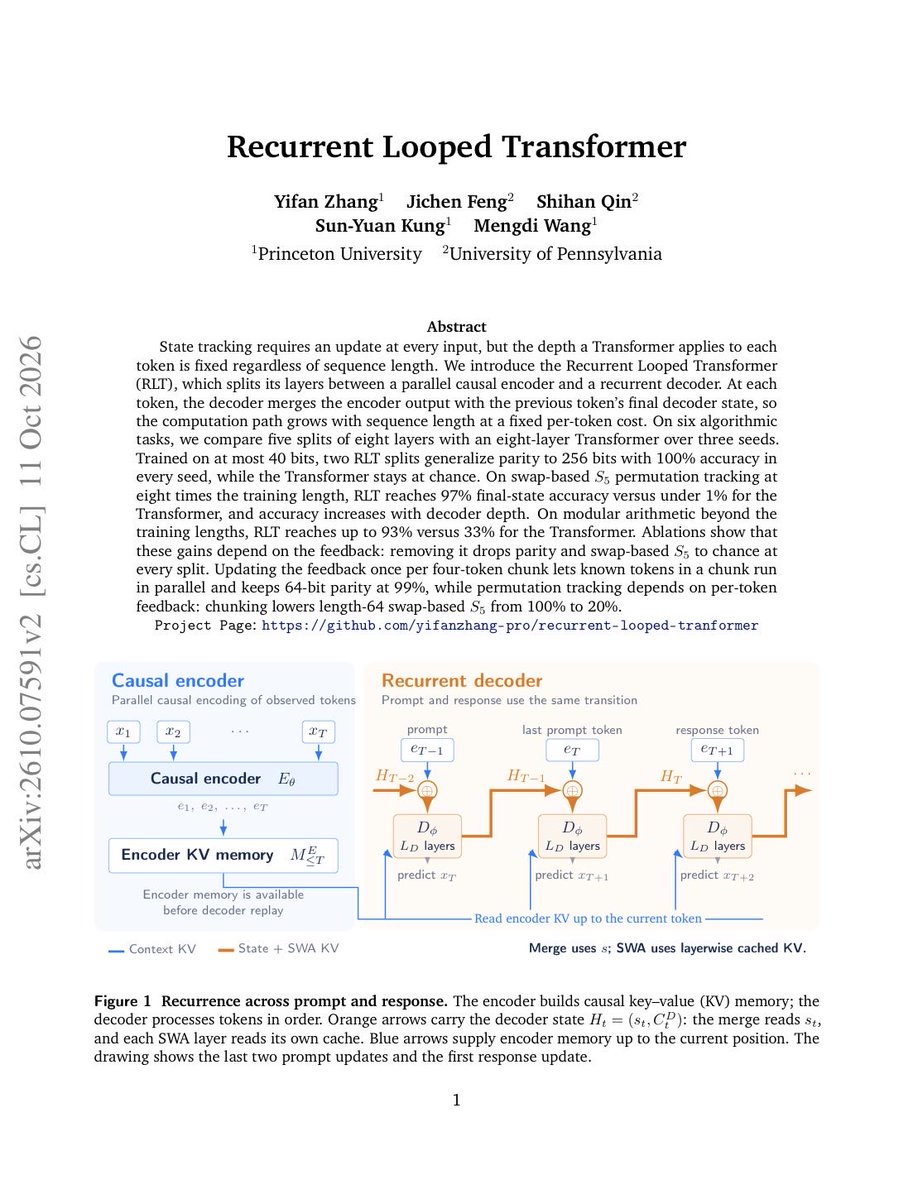
This paper introduces a clever architectural fix called the Recurrent Looped Transformer (RLT).
Instead of treating the whole sequence as one uniform pass, RLT splits the work.
A parallel causal encoder handles the raw prompt tokens, while a recurrent decoder loops through the sequence by passing its hidden state forward from token to token.
This lets the actual compute path grow alongside the sequence without blowing up the per-token cost.
The out-of-distribution results are wild.
When trained on parity tasks up to 40 bits, standard Transformers crumble to random guessing on longer sequences, while RLT solves 256 bits with 100% accuracy.
On permutation tracking at eight times the training length, RLT hits 97% where regular Transformers drop below 1%.
Ablations show that recurrent feedback is the entire secret sauce. If you kill the feedback loop, performance crashes right back to chance.
Chunking the updates buys back parallel speed for easier tasks, but precise state tracking truly demands that token-by-token recurrence.
Enjoy the full paper here: https://t.co/7uXH06hp5c
A Berkeley chemical engineer who suffered years of unexplained illness discovered through a spy camera from Amazon that her coworker, David Xu, was poisoning her food and water with cadmium, a toxic heavy metal for nearly 18 months between 2017 and 2019. The victim experienced significant health problems and at times required emergency care at a hospital. Newly released video shows Xu appearing to put a substance in her water bottle in 2019.
Xu was arrested that year and charged with attempted murder and two counts of poisoning, offenses that could have sent him to prison for life. But under a plea deal, the attempted murder charge and one poisoning count were dropped. Xu pleaded no contest to one felony poisoning charge and received two years of probation, with credit for one day served. He completed probation in March and is now seeking to have his felony conviction dismissed.
geoffrey hinton won the nobel prize in physics for building systems he couldn't fully explain - this october 2026 paper explains them, and the number that stopped me cold was 3,418 gradient steps to reach coherent reasoning from a random start state
"the most incomprehensible thing about the universe is that it is comprehensible" - einstein said that in 1936. he was describing physics. this paper proves he was also describing GPT-4, claude, and every LLM generating $3.8T in value right now, without anyone understanding why they actually work
every token your LLM generates costs energy. literally. p(τ) = (1/Z) exp(-E(τ)) - the probability of any reasoning trajectory follows the same Boltzmann distribution that governs how atoms arrange themselves in a crystal. your $0.002 per 1,000 tokens API call is a thermodynamic event.
the energy landscape visualization shows the full picture. high-energy region = inconsistent hallucinating output. saddle point = transition between concepts. low-energy basin = coherent reasoning. the model doesn't compute - it falls downhill through 10,000+ dimensions toward the most stable physical state.
neural dynamics: dh(t)/dt = -∇E(h(t)) + ξ(t). gradient pulls toward lower energy. noise term ξ(t) enables exploration before convergence. this is exactly how particles find equilibrium in statistical mechanics. hinton's backpropagation was gradient descent. this paper proves the entire LLM reasoning process is gradient descent - not just the training.
phase transitions explain why GPT-3 to GPT-4 felt like a different product entirely. small models stay trapped in high-energy fragmented states. large models cross a critical threshold and exhibit stable low-energy attractors. the capability jump wasn't more data. it was a phase transition - like water suddenly becoming ice at exactly 0 degrees.
the companies that engineer phase transitions deliberately instead of scaling blindly will compress 3 years of R&D into one architecture decision. that knowledge is sitting in a physics framework that 99% of AI teams have never opened.
hinton understood the gradient. this paper maps the entire landscape he was descending into.
Bookmark & watch today.
Every token your model generates is a system falling toward equilibrium.
You can literally type a sentence and watch a Transformer process it.
This interactive explainer runs a GPT-style model in the browser and lets you follow the whole path:
tokenization → embeddings → Q/K/V → attention → MLP → logits → next-token probabilities
You can inspect attention maps, intermediate values, and change temperature, top-k and top-p to see how generation changes.
If Transformers still feel like boxes connected by arrows, this is worth opening.
https://t.co/vkyxOqDVll
🚨 CHINA JUST OPEN SOURCED AN OCR THAT EATS 100 PAGE PDFS IN ONE PASS
It’s called Unlimited OCR. Only 3B params. Runs locally.
Every other OCR tool chops your doc into pages and loses the thread. This one reads the whole thing in one continuous pass.
→ One shot full context parsing (32K context window)
→ Multilingual out of the box
→ 93% on the standard parsing benchmark (6 points over baseline)
→ Under 0.11 error rate past 40 pages
→ Runs 100% locally on your own hardware
→ Works with Transformers, vLLM, SGLang, Docker, Ollama, llama.cpp
Traditional cloud OCR (Textract, Google Vision, Azure Doc Intelligence) costs $1.50 to $15 per 1,000 pages.
This runs on your machine. For free. Forever.
Baidu built it explicitly to push DeepSeek OCR one step further. Already at 1.9M downloads on Hugging Face and most people have no idea it exists yet.
100% open source.
Cornell's "Machine Learning for Intelligent Systems"
by Kilian Weinberger
One of the most popular intro ML courses online, covering everything from k-NN to deep nets.
Lecture Notes: https://t.co/zssCmE6DHJ
Lecture Videos: https://t.co/wjP6IOGkkI
Samsung open-sourced a method that shrinks 13B parameter LLM into less than 1 GB.
It's called "LittleBit"
Instead of storing AI weights as standard numbers, they used latent factorization to crush them down to extreme sub-1-bit levels.
In some configurations, they hit 0.1 bits per weight.
But here is where the architecture gets crazy.
When you compress an AI this much, you can stop doing math.
Instead of forcing the hardware to do heavy floating-point multiplication, LittleBit replaces the core computation with a bitwise XOR operation.
It swaps complex matrix math for basic sign flips.
The results rewrite the rules of model deployment:
• Unlocks a massive 11.6x inference speedup relative to standard FP16 models.
• Radically reduces memory footprint and loading bandwidth.
• Maintains robustness in extreme sub-0.5 bit regimes where previous compression methods catastrophically fail.
This is not a clever optimization.
It is the blueprint for running massive, state-of-the-art AI locally on cheap, resource-constrained devices.
Today, we're expanding SynthID Detector in partnership with @OpenAI, @NVIDIA, Kakao & soon @Apple as part of an industry-wide effort to make AI-generated content more transparent.
Available globally in English, our verification portal lets you check if media was made with AI 🧵
the NSA put its own hacking tool on GitHub and most people still haven't opened it
5 security repos that show you how exposed you actually are. all free, all open source.
want to see every account tied to your username across the internet?
-> Sherlock
https://t.co/fgbY1FogR0
want to take any program apart and read what it really does?
-> Ghidra, the reverse engineering framework built by the NSA
https://t.co/9GirNpEiJ9
want to watch everything your phone apps send home?
-> mitmproxy
https://t.co/W6gIVwCbLR
want to know if your API keys and passwords are already sitting in your git history?
-> TruffleHog
https://t.co/0fT4OfVQ82
want to test your own WiFi and Bluetooth with a $10 chip?
-> ESP32 Marauder
https://t.co/Ri39foTwPL
~260k stars of tools that professionals get paid to run.
none of this is hidden. it's the same kit pentesters use on the job.
the catch: it's only legal on things you own or have written permission to test.
the best way to learn how you get hacked is to run the attack on yourself first.
bookmark this. pick one. point it at your own stuff tonight.
TODAY I F*CKING QUIT MY JOB AND SPAT IN MY BOSS'S FACE BECAUSE GPT-6.1 + 6 DOTS ON SPIDER TURNED $37 INTO $7,450 IN 11 HOURS WHILE I WAS ASLEEP
at 22:00 i gave them exactly one rule:
if all six of you agree right away, start over
Codex set up the workspace
GPT-6.1 did the analysis
six Dots ran the same case through one spider
here's how the night played out:
→ 22:05 SCOUT spotted the announcement and pulled the original source
→ 22:17 ANALYST built a thesis around what the news actually changed for the business
→ 23:08 SKEPTIC said it was obvious, late and probably already priced in
→ 00:41 QUANT reworked the entry, the fees and what a bad exit would really cost
→ 02:16 RISK shot down the position size and sent the case back
→ 08:54 JOURNAL put together the final report with every objection still in it
the first idea never turned into a trade
the second one came back with a smaller position and a new entry
the crew kept bouncing it around until the numbers backed up the argument
at 09:00 i opened the terminal
$37 → $7,450
then i opened the chat, expecting six geniuses patting each other on the back
half of it was SKEPTIC explaining why everyone else was wrong
turns out the most valuable employee in my imaginary hedge fund is the insufferable bastard nobody wants in the meeting
the research setup, role prompts and handoff rules are in article below