Dear Kenyans, can we make this video trend so that every Kenyan, who is eligible to vote must watch it and must ensure they vote come 2027. We need to vote in new people. Even if they will steal, they will be new and we can remove them.
Pastor T, who allegedly used to go from one girls school to another to supply high voltage electricity to underage girls in the name of spiritual networking, has now received a prophecy that an uprising leader from Western Kenya could be assassinated. According to the pulpit bandit, the said leader urgently needs to visit his church for some serious spiritual consultations.
And as always, prophecy works best when accompanied by an envelope carrying something heavier than the Bible. The pastor will then activate the Anti-Assassination Prayer Department, sprinkle some holy water, chase away the evil spirits and install a spiritual firewall around the politician.
Election season is here walimwengu. Politicians are casting their nets for votes, while some men of Yehova Wanyonyi are casting theirs for envelopes.
Pia sisi walala hoii we don't want to hear mdomo tamtam from politicians, without sitting allowance or premium Kanamba speciioo to lubricate our throats to shout WANTAM or TUTAM, tutakupiga Mawe na hiyo manifesto Yako ya matakataka.🌚
Only a failed state runs itself on autopilot while the Cabinet goes on tour.
🌻President Ruto is in New York for UNGA with at least 7 CS’es: Mudavadi, Duale, Wandayi, Wahome, Joho, Mulongo and Kinyanjui. Principal Secretaries and parastatal CEOs are with them too, and nobody will say how many.
🌻Back home, ministries are near shutdown. The few who stayed behind are busy with one project: the President's re-election in 2027.
🌻Why does one speech at the UN need seven CSes? Who approved these trips? What are the air tickets, hotels and per diems costing?
🌻This is a country drowning in debt. It can't fund university education for its own children. Hospitals are waiting on SHA. Farmers are waiting on payments.
🌻A country serious about its people does not export its entire government to Manhattan.
🌻Kenyans deserve the full delegation list and the full bill. #UNGA81
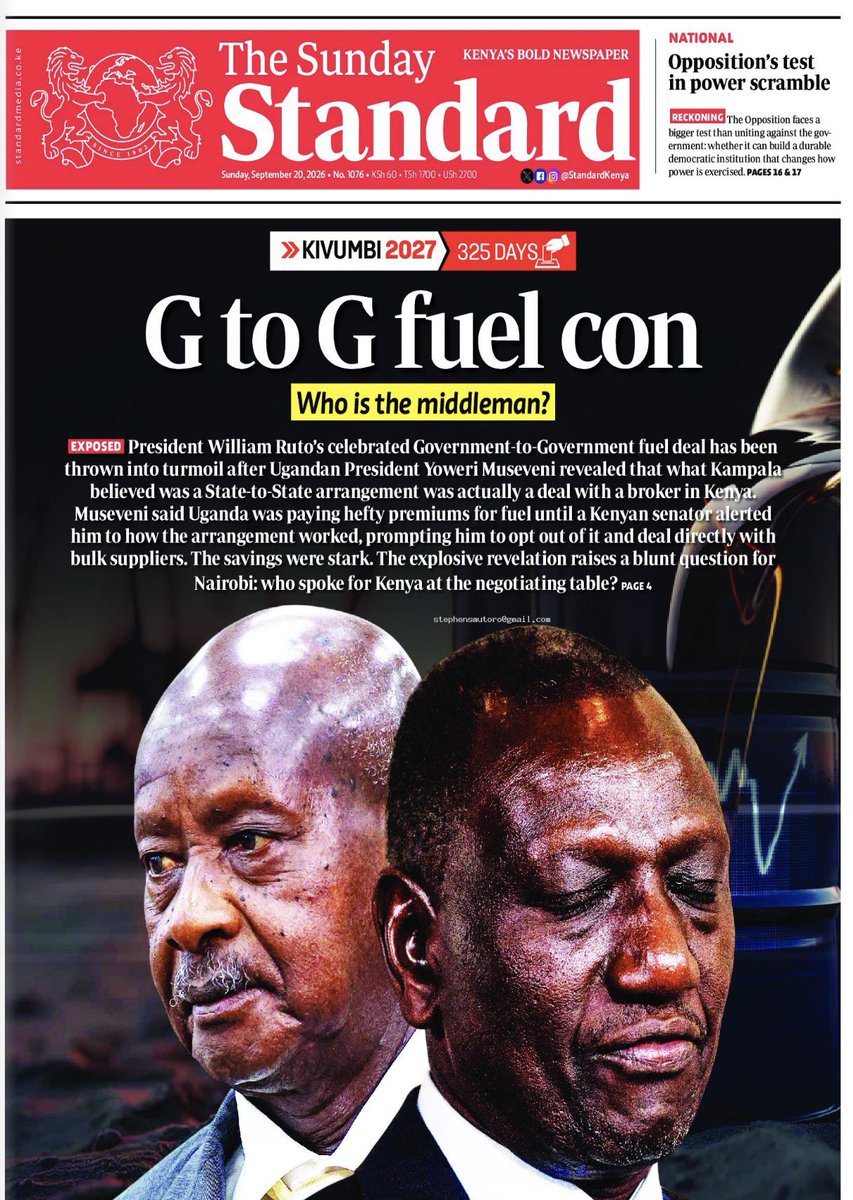
It is funny how WSR keeps on saying without fear of contradiction that we have the best fuel import deal in 🇰🇪 despite the numbers/data saying otherwise!
This is the kind of insincerity that I can't stomach na bado utaskia tutam brigade wakipiga kelele hapa nje!
Dear President Ruto: When you check the landed fuel cost for Uganda and Kenya, here is a quick answer;
🌻Landed cost is supposed to be the great equalizer — same Mombasa entry point, same Gulf cargoes, same Brent benchmark. It isn't.
🌻Kenya runs a G-to-G scheme with a handful of anointed marketers and a 180-day credit window. Uganda runs an open market where importers actually compete
🌻Add Kenya's levies — PDL, RML, excise stacked on top of 16% VAT — and "landed cost" stops being a market number and starts being a policy choice.
🌻Ruto says Kenya's model beats Uganda's and that our fuel lands cheaper. The numbers as of last month said otherwise: petrol at Ksh214 in Nairobi against roughly Ksh180 in Kampala — this despite Uganda paying extra to truck or pipe that same fuel hundreds of kilometres inland after it clears Mombasa.
🌻If a landlocked country can absorb pipeline tariffs, cross-border haulage, and still sell cheaper at the pump, the story isn't "landed cost." It's what Kenya does to that cost before it reaches the pump
The River Was Never the Problem. The Loan Was.
The Congo is the deepest river on Earth, more than 220 metres down in places. At Inga Falls it can throw 40,000 to 45,000 megawatts. On paper that is enough to change the lights across a large part of Africa.
Almost none of that power exists.
About one Congolese in five has a connection. In the countryside it is close to none. Mines in the southeast buy or generate their own power because the state cannot keep the lights on.
The usual sermon says “lack of vision.” That is a polite lie. The same sermon is preached over Kenya’s Seven Forks. Same river logic. Same western credit. Same class of men who discovered that a dark country is more profitable than a lit one.
How you manufacture a shortage
Kenya already had the cascade: Masinga, Kamburu, Gitaru, Kindaruma, Kiambere - the Seven Forks scheme on the Tana. Cheap water power. Firm capacity when the reservoirs are managed as a public asset and not as a stage prop.
What Samuel Gichuru did at Kenya Power, with Daniel arap Moi and Nicholas Biwott, was invert that asset.
Drain the dams, feed the githeri media a drought story, stampede Parliament into emergency law, then park diesel Independent Power Producers on the grid under contracts the public cannot exit. The fuel-adjustment levy and the forex charge on every token are the residual of that architecture.
Since 1998, KPLC has paid out Kshs. 1 trillion to IPPs tied to that elite circuit that includes thugs like Gideon Moi and companies like Iber Africa, Thika Power and Westmont.
Ethiopia built the Grand Renaissance Dam for about $5B and now sells Kenya the power that Nairobi should have made cheap. Every embrace between Addis and Nairobi is a receipt for that failure.
You do not need a conspiracy novel. You need a water level and a power-purchase agreement. If the reservoir is low, thermal plants run. If thermal plants run, the men who own the diesel get paid whether the turbines on the Tana turn or not. Scarcity is the product.
The World Bank did not fund a dam. It funded a signature.
The Ewaso Nyiro hydro plant is another exhibit. A British export-credit loan of £68.1 million was wrapped around a contract between KPLC and Knight Piesold for studies. The dam was supposed to exist by 2007. It was never built. Kenyans kept paying the loan.
That is the IMF/World Bank model in this region: a facility large enough to look like development, small enough in actual steel that nobody can point to a wall, and routed so the politician and the PS can take a cut that never appears as a turbine.
Arror and Kimwarer repeated the joke a generation later - billions committed, insurance premia paid on loans for dams that were cancelled, communities still dry. Same church. Different hymn sheet.
Inga is the same racket, drawn across a whole continent.
For fifty years the line has been the same: Grand Inga will light Africa. Conferences, treaties, glossy maps of cables running from the Congo to Cape Town. Two plants were actually poured in the Mobutu years - Inga I in 1972, Inga II in 1982. Together they were built for 1,775 megawatts. For long stretches they have run at about half of that. The shared canal silted up. Maintenance was postponed until “the next package.” The rest of the site is still a speech.
Degenerate sovereignty:
Congo’s darkness and Kenya’s inflated tariff are cousins. One river is wasted at the source. The other was wasted after it had already been dammed. In both places the politician learned the only infrastructure that must be completed is the offshore account.
The falls at Inga are still there. Seven Forks still holds water when nobody opens it to manufacture a headline. What is missing is not megawatts on a brochure. It is a ruling class that loses money when the lights stay on.
Until that class is removed, Africa will keep paying interest on dams that exist only in the annex of a loan.
I have been building scenarios about what happens after 2027.
What happens if Ruto gets a second term?
What happens if we get fresh blood, say Sifuna? Or old blood that is not Ruto, say Kalonzo or Matiang'i?
This is not a scaremongering exercise. Some people think nothing can get worse than it already is.
Ten years ago, we started documenting the collapse of the Kenyan economy. Newspapers were awash with profit warnings from big corporates, and between 2016 and 2020 so many people lost their jobs. Many companies closed shop. Others fled a toxic business environment, high power costs, punitive taxes, and cheap Chinese imports. The COVID-19 pandemic bought Uhuru two vital years and let him finish his term as a "statesman." The lockdown absorbed his accumulated failures, and the handshake with Raila bought him more time. Otherwise, what Ruto experienced on June 24, 2024 would very likely have happened to Uhuru ahead of the 2022 election. Between Uhuru's exit and Ruto's takeover, you saw how busy the auctioneers' pages became, disposing of cars and household goods belonging to a middle class drowning in debt.
Hear me out.
I watched my friends get laid off, one by one. If 20 of my friends were employed in 2015, by 2020 nearly half had lost their jobs, and only a few had found another meaningful job or built a business with modest success. COVID-19 shaved off another five. And the thing about losing your job after 30 is that the chances of getting another one shrink with every passing minute. In between the end of COVID and Ruto’s four years, more friends have lost jobs, and only 2 or 3 in my closest circle, one can say, are doing relatively well. And we are not young.
Nairobi, and Kenya generally, is deceptively vibrant on the surface. You could mistake us for a rich country. But beneath the smiles, people sleep hungry. Families are coping badly, adjusting to job losses and inflation while responsibilities keep piling up. I have seen marriages end purely on economic grounds. I have seen friends sink into depression. I have seen men and women become homeless, and others forced back to the village. Saddest of all, most millennials who made it were the first generation of money in their families, so going back home is a reversal of fortune no parent ever hoped for.
In the past, when parents sent us food from the village, it was cultural, because fresh ethnic delicacies are hard to find in the city. If your Luo mother packed you omena, or my Kisii mother packed me millet flour and bitter vegetables, it was to make sure we ate the best from home. For the last ten years, those big buses from the village have carried food to Nairobi to help people survive the harsh times. It is a strange, informal system, cumulatively worth billions, and a survival mechanism for the city's poorest. And for the middle class.
I do not remember a time in my adulthood when all of us were this broke. There is no longer a working friend to bail out the jobless one, and the few who are working are overburdened by black tax. I recently coined a word for the help we now extend to one another as friends and strangers: buddy tax.
You wake up and your inbox already has ten requests. You are clutching at straws, and you have no one to bail you out yourself.
Businesspeople will tell you how few people are buying. Many now sit on stranded goods and assets they cannot dispose of.
Kenya being an African country, we stay quiet about it. Our economy has collapsed, but we have a backup: the culture of dependence. Nearly three-quarters of diaspora remittances go into helping family. Some of it is ordinary responsibility, a parent paying school fees or a medical bill. Everyone does that. But there is the extra burden of carrying relatives who, in a functional economy, would take care of themselves. Now every well-off adult has siblings, parents, aunts, uncles, nephews, nieces, colleagues and college friends to bail out. Ten years ago, black tax was maybe 5 to 10 percent. Now it has gone up by about 200 percent.
They say you should not give a man fish; teach him to fish. Indeed, most families have spent their meagre resources on agents who ship a member off to the Gulf, if only to make them independent. But not many families have a loose Sh200,000 to Sh600,000 lying around. Many sell what little they own to raise it, and that is before counting the millions lost to Nairobi conmen.
Some just grind harder, dreading every school opening, dreading disease, dreading any disaster that demands real money.
Maybe it is only my friends and relatives going through A LOT. How are things on your end? How are you coping? With school fees? With medical bills? With the cost of living?
What I know is that black tax cannot solve problems a government should solve. We live in a country where common public goods have been privatized. Good education is only available in private schools. Decent healthcare comes from private hospitals, while public ones operate in a highly politicized environment, caught between a transactional national government and counties sometimes run by governors who dropped out in Class Two. Security in some neighborhoods is outsourced to private firms. Public transport is private. All of it piles costs on citizens endlessly. Our parents survived because public school and public university, discriminatory as admission was, were affordable. Ruto slashed the money for secondary school students, and his university funding model was never going to work. That means more pressure on parents.
Before we get to Ruto's weaknesses, we must admit how broken this country was before he inherited the mess. And sadly, he was uniquely unqualified to take us forward, because his personal ambition for wealth is opposed to the collective aspirations of Kenyans.
The period between 2027 and 2032 is the critical phase of Project Kenya. Either we sink for good under a Ruto second term, or we start a path to recovery with whatever Plan B we can find.
We had no room for error in 2017. We messed up big time, even after the Supreme Court tried to correct the blunder. Some Kenyans still voted the dynamic duo back in. Then 2022 was supposed to be a bridge into the future, and again, some Kenyans looked at Ruto and saw a man worth a chance.
And now 2027 is upon us.
The unvarnished truth is that a Ruto win- and he stands a chance of winning by any means necessary- is unfathomable. It would mean that he and Uhuru together condemned three generations of Kenyans to permanent poverty. That is saying something.
Go broke in your 30s or 40s and see how hard it is to recover in a weak economy like ours. You simply waste away. That has been the fate of many Kenyans, especially those who graduated in the last twelve years.
Beyond the speculation about our constitution, we will remain tied to useless projects that will never open up the economy and whose sole purpose is to line the pockets of Ruto and his financiers.
, we are staring into an https://t.co/PSVu61bHG4 rescue the economy, we have to think outside the box, and sadly, no presidential candidate has articulated a believable economic vision. Beyond#WANTAM
We cannot sustain an economy where more than half of what we collect goes to debt, the next portion disappears into people's pockets, and whatever remains must compete against the needs of 55 million people.
A Kalonzo presidency does not promise much. Maybe less corruption, and if he hires the right team, the economy can expand. As a positive, if moribund, force, he may at least let us heal at a psychic level, and feel safe with a man who will not lie to us unnecessarily or reach for brutal force.
A Matiang'i presidency may promise Magufuli-style leadership, which will appeal to those who like that kind of thing. With the right ideas, it could work. With the wrong ideas, it would be a disaster.
A Sifuna presidency promises a generational shift, as he would be our first millennial president. Sifuna is educated and inclined to respect human rights. With the right team, he would understand the needs of millennials, Gen Zs and those coming after. He is less drawn to shiny things, and I doubt he would oversee needless mega projects designed to fund himself or his next campaign. I am not naive enough to assume there would be no theft under him, but sometimes we are talking about scale.
Some say the best president we ever had was Kibaki. There was corruption under Kibaki, certainly, and in 50 years of government service he was not the cleanest man. But he never amassed a fortune to match any of the other four presidents. What you notice is that Kenya grew in leaps and bounds under him. He gave us a hint of what happens when a president is less interested in accumulating personal wealth and more inclined to help the country, and when money, if it comes, comes second to his aspirations.
Over to you
I have followed Abel Mutua's stories for a long time, and there is no question that he understands how to hold an audience. He knows how to build suspense, introduce humour and keep people listening until the end.
That is precisely why his recent entry into political conversations deserves scrutiny. When someone understands storytelling as well as Abel Mutua does, we should pay attention not only to what he says, but to how he says it.
After watching his interview with Oga Obinna and Chris the Bass, one thing stood out. Abel appeared to advance the idea that there may be moments when a President needs to put the Constitution aside for a few minutes in order to get things done. But who keeps time? If the Constitution is put aside for five minutes, who decides when the five minutes are over?
This is the danger of presenting constitutional safeguards as obstacles to progress. Every leader seeking exceptional power has a reason why the circumstances are exceptional. The Constitution suddenly becomes bureaucracy, accountability becomes obstruction and democracy is blamed for slowing development.
But the Constitution exists precisely because those in power cannot be trusted to decide for themselves when the rules should no longer apply. Once leaders can suspend constitutional safeguards whenever they become inconvenient, those safeguards cease to mean anything.
What was equally striking was the way stories were delivered. Names were wrong. Timelines were questionable. Details did not always add up. Yet the inaccuracies did not stop the story from reaching its political conclusion.
This is where the tactic becomes important. He kept saying, "I don't know if this is true.", "Correct me in the comments if I am wrong." "I will verify it later." "Let me tell you the story first."
These disclaimers appear harmless, even responsible. But they can also allow a claim to enter the public conversation without the speaker taking full responsibility for its accuracy. One thing needs to be clear if you do not know what you are saying, you should not be saying it in the first place.
The story travels first. The correction comes later, if it comes at all.
And because a skilled storyteller understands how to make a message memorable, audiences are more likely to remember the conclusion than the disclaimer that came before it.
The same pattern can be seen in how Kenyan protests are increasingly being reframed. Complex grievances are reduced to simplistic conclusions.
"You rejected an airport."
"You rejected development."
But that was never the argument.
Kenyans did not reject the need to improve JKIA. The questions were about the process, the cost, the terms and accountability. A country can need infrastructure while rejecting an exploitative or opaque deal.
But once you remove the nuance, citizens become easier to dismiss. Instead of addressing concerns about corruption or process, the argument shifts to whether people support development. The real issue disappears.
This is a familiar political tactic: focus on the outcome and avoid the process.
Do you want an airport or not? Do you want development or not? Do you want security or not?
But democracy requires more difficult questions. At what cost? Through what process? Who benefits? Who is accountable?
Another dangerous narrative is the attempt to portray Kenyan protesters as people who did not understand why they were in the streets, that they lacked agency or were being controlled by foreign actors.
But Kenyans knew why they protested. They had experienced economic pressure, watched corruption and impunity and raised legitimate questions about taxation, governance and accountability.
To reduce their grievances to foreign programming is to deny them political agency. It replaces the story of citizens demanding accountability with one of a confused population being manipulated by outsiders.
And then there was yesterday's podcast.
While discussing Edwin Sifuna, Abel said that he had spoken to Kambas who admitted that Sifuna is a political force but said they would not vote for him if there was no Kamba on his line-up.
That statement is tactical.
First, it introduces ethnic arithmetic into a conversation about the political potential of Edwin Sifuna. Instead of asking whether Sifuna can build a national movement based on ideas, leadership or policy, the conversation is redirected towards tribe.
The message becomes: he may be capable, he may be popular, but politics ultimately comes down to ethnic representation.
But there is an even more interesting tactic in how the claim is framed.
"I spoke to Kambas, and they told me."
The speaker does not directly make the ethnic argument himself. He places it in the mouths of unnamed people. That creates distance while still introducing the message into the public conversation.
It is the same architecture as saying, "I don't know if this is true, but..."
The speaker is protected, but the idea has been planted.
The audience is left to believe that ethnic communities will only support leaders who bring their tribe into the political equation. And once that idea enters the conversation, attention shifts from leadership and policy to ethnic bargaining.
That is how tribal politics can be reinforced without anyone making an openly tribal statement.
There is also a psychological dimension to claiming private conversations with unnamed groups. It creates the impression of insider knowledge.
"I spoke to them."
"They told me."
"This is what they really think."
But the audience has no way of independently testing the claim. Yet an influential speaker can introduce it into the national conversation and shape how people perceive an entire community.
This matters because ethnicity has always been one of the easiest ways to redirect political frustration in Kenya. When citizens begin asking difficult questions about corruption and governance, tribal narratives can quickly divide them into competing camps.
Instead of asking what leaders are doing, people begin asking who is represented. Instead of demanding accountability, they begin negotiating ethnic interests.
That is why we need to scrutinise political messaging more carefully, particularly when it comes from influential people with large and trusting audiences.
Political messaging does not always need direct coordination to serve power. When protesters are portrayed as ignorant, power benefits.
When constitutional safeguards are portrayed as obstacles, those seeking more power benefit.
When citizens questioning corruption are portrayed as enemies of development, those avoiding accountability benefit.
When tribal arithmetic replaces conversations about national leadership, the political establishment benefits.
The modern political message does not always come from a politician standing behind a podium. It can come through a podcast, an entertainer, a comedian or a beloved storyteller.
And that is precisely what makes it powerful.
We should be able to admire Abel Mutua's talent and still interrogate his political messaging. We should be able to enjoy his stories without surrendering our critical thinking.
Because the most important question is not simply what he said.
It is what the audience is being encouraged to believe after the story is over.
That the Constitution is an obstacle? That protesters were confused? That Kenyans reject development? That citizens need outsiders to explain their own anger? That tribal arithmetic remains the only language of political leadership?
These ideas shape how people understand power, democracy and one another.
My heart goes out to those affected and still confused about what immigration laws to follow after yesterday’s deadline. Here is the legal position to help you plan.
If you are a foreign national from an East African Community (EAC) country and intend to reside in Kenya while doing business, trade or working, you can regularise your stay by applying for a Class R Permit.
Go to the Kenya eFNS portal on eCitizen and search for a ‘Class R’ Permit, available to EAC nationals who intend to reside in Kenya and earn a living.
This includes nationals of Burundi, Rwanda, Uganda, Tanzania, Democratic Republic of Congo (DRC) and South Sudan. Somalia is also an EAC Partner State.
The Class R Permit itself is FREE. Meaning, the processing fee and the issuance fee are both 0 (zero).
EAC nationals residing long-term must still fulfil standard Foreign National Registration requirements, such as the annual Alien Card fee, which is separate from the gratis Class R Permit.
Here is what you require:
You will need relevant supporting documents, including a valid passport and documents relating to your business or activity. Requirements may vary by sector. Small-scale traders may also be required to provide a Kenyan police clearance certificate where applicable.
Application Process:
Start online through the eFNS portal on eCitizen.
Where physical submission is required, print your forms and supporting documents and submit them at Immigration Headquarters or designated regional Immigration offices.
It is very important to note that not every EAC national visiting Kenya automatically needs a Class R Permit. EAC citizens enjoy general movement rights under the EAC Common Market framework, but those intending to reside, work, or run a business must ensure they hold the appropriate legal status.
Please share this information widely to assist EAC nationals in regularising their stay and businesses safely.
#VIP #EAC #EastAfrica #ImmigrationKenya
Burundi is the poorest country in the world. We must help Burundians, purely from a humanitarian point of view. The country is really doing badly and they realised the streets of Nairobi are goldmines. You don’t expect a Burundian to come to Kenya to set up a sugar-processing mill or a factory. With what money? The easiest business they could do is tea and mandazi or even do manual jobs that are low paying. Not even Kenyans can do what those guys do in the streets of Nairobi. The country is dead broke. It is one of the poorest nations in the world. These people are here because they see some hope in Kenya, and they are able to take care of their families while here.
They are here for help. Not for fun.
Burundians should be viewed through a humanitarian lens, not simply as economic competitors or a burden. Just like we seek help from America and China, Burundi needs help. The West has abandoned it, and Africa wants to abandon them as well. These are our brothers. Today they might be poor; tomorrow, only God knows. It only takes one discovery of gold or oil, then boom, a country rises.
Of all the East African countries, Kenya has been like a shield to Burundi, until this confused man became President. Although it is wrong to have illegal immigrants, the question is, how did they end up here? And you can't convince me that all entered within 3 years ago. Some have been here for a decade. We still fault our immigration system. My proposal is that even if we are going to stop other foreigners from hawking, please let's allow Burundians only, due to their current condition. Give them documents as you have promised and let us properly accommodate them.
One of the most encouraging consequences of this Ruto Xenophobic incitement, is the fact that we are seeing decent African rising up and resisting this hate, denouncing it, vowing to protect their fellow Africans from Government inspired attacks, and this is the true African spirit.
For the 1st time in a long time, we are seeing an African nation in which Afrophobia is being challenged and defeated.
Kudos to our Kenyan Family..
One of the saddest thing about adulthood is that there is no giving up. There is no cheat code. There is no day off.
I look back and think about the sacrifices our parents made. And their luck:They had alternatives, mostly.
Imagine school was affordable.
Primary school, save for the few boarding years, education was largely free. We used to pay some 40 bob here, some 100 bob there for tuition, and by the end of the year, at most 500.
The land we had was tillable and you could coax some food out of it.
And importantly, was the social support. If you had excess kids, you could ship them to your well off relatives. Parenting was a shared responsibility with extended family and society. In my early 20s, my cousin was our host. We lived in his place like 20 of us, each of us related to him in some funny way, but from his place we built our lives in the city.
Millennial parents have no such advantage.
Public schooling is uniquely absent in urban centres.
Take Kitengela for instance. There is hardly any public primary school that is well run for parents to send their kids there affordably. Academies are super expensive, for education which is a basic need. Learning French and swimming lessons are not a priority for a people struggling with basics.
Health care too, is very expensive.
Food is very expensive.
Social support systems have deteriorated, and every one is worse off, you can’t offload your extra child to your sister for a few years.
Less talked about is the toll bills and responsibilities pile on individuals. There is a spiritual exhaustion that comes with shouldering so many responsibilities, at a family and social level.
We have borrowed so much from each other, we now owe each other so much it is not even funny. People are downgrading and shrinking their lifestyles in a way that is unhealthy.
This shrinks our lifespan.
People develop cardiovascular problems and other health complications because nobody is coming to rescue us, and you can’t shirt your responsibility. Stress is a killer.
When you see Gen Zs and younger millennials disengaed, extend them some grace.
Times like this, the church should actually intervene and extend help to some of their most vulnerable members. To hear pastors extorting their congregation, totally insensitive to how sad life is in Kenya, makes one super sad.
The only people having it easy are those in top echelons of the government, a few government bloggers and drug dealers.
Everyone else I know is overwhelmed. If not him or herself, then the responsibilities on their shoulders that they can’t run away from.
Black tax is a killer.
It will get bad before it gets worse.
A few things if Ruto gets the second term.
1. Term limits will be removed. No brainer. Obviously.
2. Some nondescript MP from Sabaot or Taveta will start some serious charge to amend the constitution calling for a referendum to change our constitution. Armed with “good intentions”, a lot of noise about the need to tame the wage bill and overrepresentation, Kenyans will be duped to think that another amending of the constitution will fix our problems. There will be no discussion about the real culprits: corruption and bad governance. Sadder is that the most marginalised people for whom devolution may have been the best shot at fixing the multi-generational inequality will be at the foremost at defending the new consistution that will hoodwink many people but whose sole aim is consilidate more power and resources in Nairobi.
Ruto will not hesistate for a second to mutilate the constitution. When the whole country embraced it, he was the only one opposed to it for no reason at all other than that he hates all that can be good for Kenya.
We forget so easily.
3. It is foolish to think that Ruto remodelled State House so that he can leave power prematurely. Naah. Man’s never played like that. Ever. All that remodelling and building of the chapel are for the long haul.
Remember, regionally Kagame and Museveni inspire him. Suluhu also can teach him a thing or two. So does the Ethiopian guy. South Sudan, Somalia and Burundi don’t inspire much.
4. We have seen the institutionalization of the goon culture. It is a signal of the coming clashes between Gen Zs and Goon Z. Two young people of disparate backgrounds. Goon Z will win the day.
5. In his first term, Ruto survived the Gen Z protests, impeached his deputy with brutal efficiency. Can you imagine what kind of a man he will be when nothing stands out of his way?
6. Ruto swallowed and effectively neutered and neutralised ODM. He will have zero resistance from any quarters. He has quashed and vanquished anything that can stand on his way. Only Richard Onyonka and Edwin Sifuna have some cojones to speak truth to power. Two men against his brutal machinery, tough lucky baby.
7. Mass abductions, cruelty such as never witnessed, and serious crackdown at dissenting voices will be the norm.
8. Kenyans will ever regret laughing at Uganda, Tanzania or those countries ruled by dictators.
We will realise we are not above the program.
9. Current government bloggers will be the most surprised later in 2028. One just hopes they are making enough to prop up this regime. No sensible Kenya I know vouches for this government kabisa. And we all can’t be mad and only six government bloggers be right. And now content creators running low on cash are about to rescue their reputation appearing on popular podcast with very lame talking points. Do people in government read the mood of the country?
10. I have seen that Zimbwabwean dude around State House. And I have watched the company the president keeps. The level of corruption you will witness will leave you poorer than you are now, sadder than you will ever be and super hungry.
Again, all of the above are derived from the observable facts.
In 2030 let no one act surprised.
By Silas @nyanchwani
A few things if Ruto gets the second term.
1. Term limits will be removed. No brainer. Obviously.
2. Some nondescript MP from Sabaot or Taveta will start some serious charge to amend the constitution calling for a referendum to change our constitution. Armed with “good intentions”, a lot of noise about the need to tame the wage bill and overrepresentation, Kenyans will be duped to think that another amending of the constitution will fix our problems. There will be no discussion about the real culprits: corruption and bad governance. Sadder is that the most marginalised people for whom devolution may have been the best shot at fixing the multi-generational inequality will be at the foremost at defending the new consistution that will hoodwink many people but whose sole aim is consilidate more power and resources in Nairobi.
Ruto will not hesistate for a second to mutilate the constitution. When the whole country embraced it, he was the only one opposed to it for no reason at all other than that he hates all that can be good for Kenya.
We forget so easily.
3. It is foolish to think that Ruto remodelled State House so that he can leave power prematurely. Naah. Man’s never played like that. Ever. All that remodelling and building of the chapel are for the long haul.
Remember, regionally Kagame and Museveni inspire him. Suluhu also can teach him a thing or two. So does the Ethiopian guy. South Sudan, Somalia and Burundi don’t inspire much.
4. We have seen the institutionalization of the goon culture. It is a signal of the coming clashes between Gen Zs and Goon Z. Two young people of disparate backgrounds. Goon Z will win the day.
5. In his first term, Ruto survived the Gen Z protests, impeached his deputy with brutal efficiency. Can you imagine what kind of a man he will be when nothing stands out of his way?
6. Ruto swallowed and effectively neutered and neutralised ODM. He will have zero resistance from any quarters. He has quashed and vanquished anything that can stand on his way. Only Richard Onyonka and Edwin Sifuna have some cojones to speak truth to power. Two men against his brutal machinery, tough lucky baby.
7. Mass abductions, cruelty such as never witnessed, and serious crackdown at dissenting voices will be the norm.
8. Kenyans will ever regret laughing at Uganda, Tanzania or those countries ruled by dictators.
We will realise we are not above the program.
9. Current government bloggers will be the most surprised later in 2028. One just hopes they are making enough to prop up this regime. No sensible Kenya I know vouches for this government kabisa. And we all can’t be mad and only six government bloggers be right. And now content creators running low on cash are about to rescue their reputation appearing on popular podcast with very lame talking points. Do people in government read the mood of the country?
10. I have seen that Zimbwabwean dude around State House. And I have watched the company the president keeps. The level of corruption you will witness will leave you poorer than you are now, sadder than you will ever be and super hungry.
Again, all of the above are derived from the observable facts.
In 2030 let no one act surprised.