Nonprofit organization dedicated to the promotion of excellence in research and the dissemination of research findings in the field of human milk and lactation.
🤱 Mothers in Vientiane want to exclusively breastfeed but face barriers like C-sections, work challenges, formula convenience, low milk supply concerns, and inconsistent health advice.
https://t.co/pjhNfQKHSy
🍼 Breast milk sugars (HMOs) vary based on genetics and birth conditions. In a multi-ethnic Asian cohort, ~70% of mothers were “secretors” (linked to FUT2 genetics 🧬), shaping key HMOs like 2’-FL. Preterm birth also altered early milk composition.
https://t.co/v7QzWhMJbo
🤱 Many newborns need supplementation in their first days of life.
This study found that mothers who chose donor human milk over formula felt less stress, better mental well-being, and more peace of mind while establishing breastfeeding 💛
https://t.co/p3je4zMUGE
#Trainee#ISRHML
⏰ Friendly reminder: Today is the LAST day to submit your abstract!If you've been on the fence, consider this your sign. Submit now and secure your spot, we'd love to have you join us. 🙌
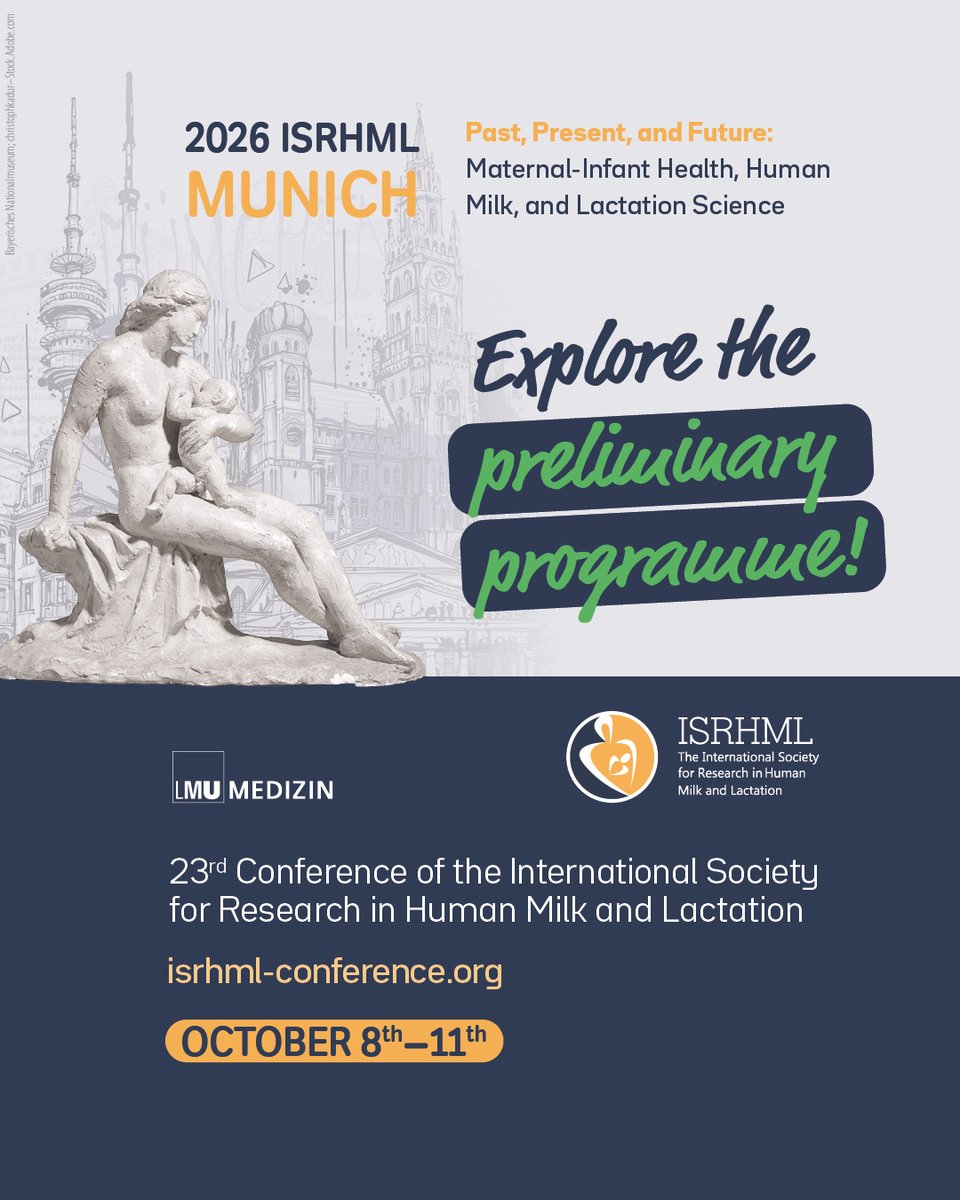
📢 First highlights of the 23rd ISRHML Congress are here!
Join leading experts in human milk & lactation science for keynote talks and latest research in clinical, analytical & translational fields.
📲 Explore & register: https://t.co/3K5PXu7eSp
#ISRHML2026#HumanMilkScience
New findings suggest EPA, DHA & AA may protect fetal neurodevelopment from methylmercury exposure ✨
Maternal diet rich in anti-inflammatory fats = potential cognitive protection 👶💙
#Nutrition#Neuroscience#MaternalHealth#TraineeThursday#ISRHML
https://t.co/AidrfXMQbI
Mohamed MA, Nejad SK, Ma H, Al-Shami A, Banks M, Soleimani A, Ong V, Ramos DV, Mousavi MPS. Safer breastfeeding with a wearable sensor for monitoring maternal acetaminophen transfer through breast milk. Device. 2025 Aug 15;3(8):100774. doi: 10.1016/j.device.2025.100774.
💡 NEW TECH ALERT: Scientists at USC developed a smart lactation pad that monitors breast milk in real time — detecting medication levels like acetaminophen so parents can make safer feeding decisions.
Maternal vitamins A & D ↓, vitamin E ↑ during pregnancy 🤰 in overweight/obese individuals. Despite common vit D deficiency & macrosomia 👶, no link with birth weight found 📊 More research needed
#TraineeThursday#ISRHML
https://t.co/y2rU4ZbgJd
New WHO-led agenda 🌍 identifies top research priorities for childhood wasting & nutritional oedema 👶. Focus: improving delivery & effectiveness of interventions, not just discovery 📊
#GlobalHealth#TraineeThursday#ISRHML
https://t.co/X9GXHE73Pb
HMO profiles 🍼 vary by lactation stage & delivery mode. In a China 🇨🇳 cohort, C-section ↓ several HMOs, while higher LSTb linked to ↓ infant eczema 👶. More research needed 📊
#TraineeThursday#ISRHML
https://t.co/0YVmDiUrhr
Breastfeeding 🤱 in Lao PDR 🇱🇦 remains low. Our study shows maternal health 💪, occupation 💼 & prenatal intention 💭 influence breastfeeding at 30 days postpartum. More research needed 📊
#TraineeThursday#ISRHML
https://t.co/UuoccfBU4A
📢 First highlights of the 23rd ISRHML Congress are here!
Join leading experts in human milk & lactation science for keynote talks and latest research in clinical, analytical & translational fields.
📲 Explore & register: https://t.co/3K5PXu7eSp
#ISRHML2026#HumanMilkScience
Low-SES mothers of color had 90% lower odds of breastfeeding at discharge vs. high-SES white mothers — and stress, social support & employment didn't explain the gap. Race + SES together drive breastfeeding inequity. Systemic change is needed. 🤱
https://t.co/tTwNn6HL09
Mothers with gestational diabetes have higher levels of specific sugars (HMOs) in their breast milk — and one is linked to faster infant growth in the first 6 months. 🍼🧬
https://t.co/ZFJKRXvPAb
Scientists have developed a faster, scalable way to isolate protective nanoparticles from donor human milk potentially turning them into life-saving supplements for preterm infants at risk of NEC. 4x more efficient. Half the time. Huge implications. 🍼🔬
https://t.co/3hL3rvo2GM
Reifsnider E, Spencer B, Hill RR, Connors LM, Spatz D, Louis-Jacques A, Groer M. Breastfeeding history is associated with women's health: Evidence and implications for practice and policy. Nurs Outlook. 2026 Jan-Feb;74(1):102656. doi: 10.1016/j.outlook.2025.102656.
The recent publication from Reifsnider and colleagues (2026) outline the implications of breastfeeding history on women's health. To learn more see the citation below
Carrasco-López MJ, Antón-Solanas I, Benito-Ruiz E, Barrio-Forné N, Navas-Ferrer C, Ramón-Arbúes E, Subirón-Valera AB. Underpinnings of breastfeeding motivation: A systematic review. Midwifery. 2025 Sep;148:104475. doi: 10.1016/j.midw.2025.104475. Epub 2025 Jun 18