Because of all the Moscow news yesterday, you might've missed this one — but we’ve been working on it for a while, so please appreciate it:
we strapped missiles to drones.
We now have drones with missiles.
That’s right.
Missile drones. 🛩️🚀
Pew pew, mfs. 😈
Stubb: The Soviet Union marched 1,600km to Berlin in four years. Russia moved 60km into Donetsk in three.
Who knows modern warfare? Ukraine does. They are Europe's best security partner.
1/
🇺🇦🇺🇸 Secretary of the Army Driscoll: "Ukraine's Delta common operating system, their modular open system architecture, C2 system is absolutely incredible.
It fully integrates every single drone, sensor, and shooting platform into just one single network.
Ours does not."
Wow, if only Ukraine was offering the United States some sort of deal that would facilitate the sharing of this technology.
I am the Head of Product at Trump Mobile. This week we shipped a phone. I have never been more afraid.
The whiteboard in my office used to say DEPOSIT VELOCITY. I erased it on Tuesday. It now says DAMAGE CONTROL. I do not know what comes after shipping. Nobody on my team does. We had to google "supply chain." We had to google "warranty." We had to google "return." These are words from an older era. We were not built for this.
For eleven months I had the best job in America. 590,000 people gave me $100 each to preorder a gold phone that did not exist. $59 million. No product. No support tickets. No returns. No reviews. My calendar was empty. My inbox was empty. My KPI was a number that only went up. I had one job and it was to not build a phone. I was the best in the world at it.
Then someone wrote a post about us on the internet and everything collapsed.
A satirical confession went viral. It described our entire operation. The version history. The deposit page. The terms update. The flag sticker. The "exciting update" emails. It got millions of views. Senator Warren forwarded it to the FTC. The FTC read it faster than I thought they could read. And for the first time in eleven months, the math changed. Not the moral math. The timing math. Discovery was now faster than deposit accumulation. The curve crossed. I saw it on a graph that I made my VP of Customer Expectations draw on the whiteboard. She drew two lines. One was going up. One was going down. They met on a Tuesday. I said ship it.
We did not ship because the phone was ready. We shipped because the internet was ready.
Here is what we shipped. A Qualcomm Snapdragon 7 Series processor. Mid-range. The same chipset that powers a Xiaomi phone you can buy on AliExpress for $220. A 6.78-inch AMOLED display, 120Hz refresh rate. The same panel Samsung puts in the Galaxy A55, which retails for $300. A triple camera system. Three 50-megapixel sensors. A 50-megapixel selfie camera. 512 gigabytes of storage. 12 gigabytes of RAM. A 5,000 mAh battery with 30-watt fast charging. These are the specs of a $300 phone. We charge $499. The $199 difference is the flag. That is the exact dollar value of patriotism in the mid-range Android market. I know this because I set the price.
Analysts at GSMArena compared our phone to the HTC U24 Pro. HTC. A company that has not been relevant since 2018. Our phone is being compared to the ghost of a dead brand and the ghost is winning on value. I have this article bookmarked. I read it every morning. It keeps me honest about what we actually built.
I will tell you what "assembled in the United States" means because I was in the room when we chose that word. Our CEO told USA Today that "these early T1 phones are proudly assembled in the US." The Verge confirmed final assembly takes place in Miami. Assembled means a person in Miami connects components that were manufactured elsewhere. It does not mean manufactured. It does not mean designed. It does not mean engineered. It means snapped together. Placed in proximity until functional.
The marketing language for this phone has now changed five times. "Designed and built in the United States." Then "proudly designed and built in the United States." Then "Premium Performance. Proudly American." Then "designed with American values in mind." Then "assembled in the U.S." with "components primarily manufactured in America." Each version of the sentence removes one claim. The sentence has its own version history. It iterates faster than the product. By version 6 it will just say "phone." By version 7 it will say "object." The sentence is approaching truthfulness asymptotically. It will never arrive.
A reporter from Reuters asked our CEO how many phones we shipped. He said he could not disclose that number for competitive reasons. I will tell you the competitive reason. If the number is small, we have a fulfillment problem. If the number is large, we have a returns problem. Both numbers are bad. The only good number was the one we had before: zero phones shipped, 590,000 deposits held. That number was perfect. It had no downside. It could not be reviewed on YouTube. It could not be dropped on a concrete floor on camera. It could not be benchmarked against a OnePlus Nord that costs $200 less and has the same processor. Zero is the only number that cannot disappoint.
Our CEO told The Verge that demand was "incredibly high" and all preorders would be fulfilled within "the next several weeks." Several weeks. Not this week. Not next week. Several. That word is doing $59 million worth of work. Several is the word you use when you know the number but the number is embarrassing. I know several. I have used several in every "exciting update" email for eleven months. Several is my native language.
We held $59 million in deposits for eleven months. I am not going to call that interest. I am going to call it deposit residency duration. We have a metric for it. The metric is called DRD. We track it weekly. Every week those deposits sat in our account without a corresponding obligation, the DRD metric improved. Nobody asked for their money back. The refund rate was under 2%. 590,000 people gave us an interest-free loan for eleven months and our only obligation was to send them emails that said "exciting update." The phone was never the product. The DRD was the product. We shipped a receipt for a loan we already spent.
The terms and conditions still say, today, right now, on the website: "A preorder deposit does not guarantee that a Device will be produced or made available for purchase." We shipped despite the terms. "Estimated ship dates, launch timelines, or anticipated production schedule are non-binding estimates only." We hit a non-binding estimate. "Trump Mobile does not guarantee that the Device will be commercially released." We commercially released it anyway. Our legal team is confused. They wrote terms for a company that never delivers. Now we have delivered. We are in breach of our own expectations. We guaranteed nothing and then provided something. There is no legal framework for this. There is no precedent for accidentally exceeding your own disclaimers. Our lawyers are writing new terms. The new terms will say: "Delivery does not constitute a guarantee of quality, functionality, or continued existence of the product or the company."
The Verge ran their headline: "The Trump phone starts shipping this week, company claims." They put "company claims" in the headline. For a shipping announcement. They have covered Apple, Samsung, Google. Nobody puts "company claims" after those shipping announcements. We have earned that qualifier. We earned it over eleven months of saying "exciting update" while updating nothing. Now when we actually do something, the press assumes we are still lying. We have created a credibility deficit so deep that the truth sounds like another version of the lie. This is the only product I have ever shipped where shipping it made us less believable.
The VP of Customer Expectations — the intern I promoted last year for asking when we would build the phone — she is now managing what she calls the "discovery window." The discovery window is the time between when a customer receives their phone and when they google "Trump T1 phone vs Samsung Galaxy A55." Her whiteboard says DISCOVERY DELAY. Her KPI is: average hours between delivery confirmation and first spec-comparison search. She says the current estimate is 72 hours. We need those 72 hours. After 72 hours, the return conversations start. I promoted her again. She is now SVP. She is the only person in the company whose job got harder when we shipped.
Here is what I have learned. I have learned that version 4.0 was perfect and version 4.1 is a regression. I am going to explain this using the version history because I know some of you are keeping score.
Version 1.0 was Trump University. Had to rent a room. Had to print a binder. Had to hire a speaker. Had to settle for $25 million. Three obligations.
Version 2.0 was $TRUMP. Had to mint a token. Did not have to build anything. Did not have to hire anyone. Just had to press mint. Two obligations eliminated.
Version 2.1 was $MELANIA. Same model. Launched 48 hours later on the same audience. Did not even need new customers. Cannibalized the last ones.
Version 3.0 was WLFI. Did not have to deliver. Did not have to pretend anything would go up. Just had to lock the door and keep the key. One obligation remaining: the smart contract.
Version 4.0 was Trump Mobile. Did not have to mint. Did not have to lock wallets. Did not have to build a lending platform. Put a flag on a gold rectangle that did not exist, opened a deposit page, collected $59 million, updated the terms to say the rectangle might never be real. Zero obligations.
Version 4.1 is this week. We shipped. We introduced liability. We created a physical object that can be tested, reviewed, returned, and compared to every $300 Android on the market. We took a perfect system and added one obligation back. This is a regression. This is a bug. We are monitoring.
The version history, updated:
1.0 — Had to rent a room. Had to settle.
2.0 — Had to mint. Didn't have to build.
2.1 — Didn't even need new customers.
3.0 — Didn't have to deliver. They couldn't leave.
4.0 — Didn't have to promise. They paid for the flag.
4.1 — Had to ship. Bug introduced by public attention. Patch pending.
Version 4.1 was introduced by public attention. The patch was forced by visibility. The internet found the version history and the version history became a liability. So we shipped a phone to reduce a different liability. We traded a legal exposure for a product exposure. I do not know which is worse. I do know which was more profitable. It was the eleven months before this week.
She asked me what version 5.0 is.
I told her version 5.0 is already in development. It corrects the error we introduced in 4.1. It will not have a product page. It will not have a ship date. It will not have terms and conditions because it will not need to disclaim anything. It will not have specs because there will be nothing to compare. It will not have a discovery window because there will be nothing to discover.
She asked what it will have.
I said a deposit page.
She said that's it?
I said that has always been it.
I am the Head of Product at Trump Mobile. I shipped a phone last week. It is a $300 phone that costs $499. It is assembled in a warehouse in Miami from components manufactured overseas. It runs a Snapdragon chip you can buy for the price of a steak dinner. It has the same screen as a Samsung phone that costs $200 less. The gold finish scratches. The flag is a sticker. It does everything a phone should do and nothing a $499 phone should justify. Analysts are comparing it to a dead brand and the dead brand is winning.
But I do not judge products by what they do. I judge products by how long they can collect revenue before they have to exist. By that metric, the T1 was the greatest product in American history for exactly eleven months. Now it is just a phone. I grieve what it was. I am already building what comes next.
Version 5.0 will not make this mistake.
The world's democracies are being targeted one by one. That has to stop.
China has imposed trade boycotts on Australia, Lithuania, South Korea and Canada. Each time, the target stood alone. Each time, it worked.
The answer is not self-sufficiency. It is collective action.
Today I launch After the Rupture: An alliance of middle-power democracies led by a D-7: seven democracies representing 30% of the global economy, acting together on trade, technology, critical minerals and defence.
Not a new institution. A coalition of the willing, and the able.
Full paper → https://t.co/puAxqaYUYQ
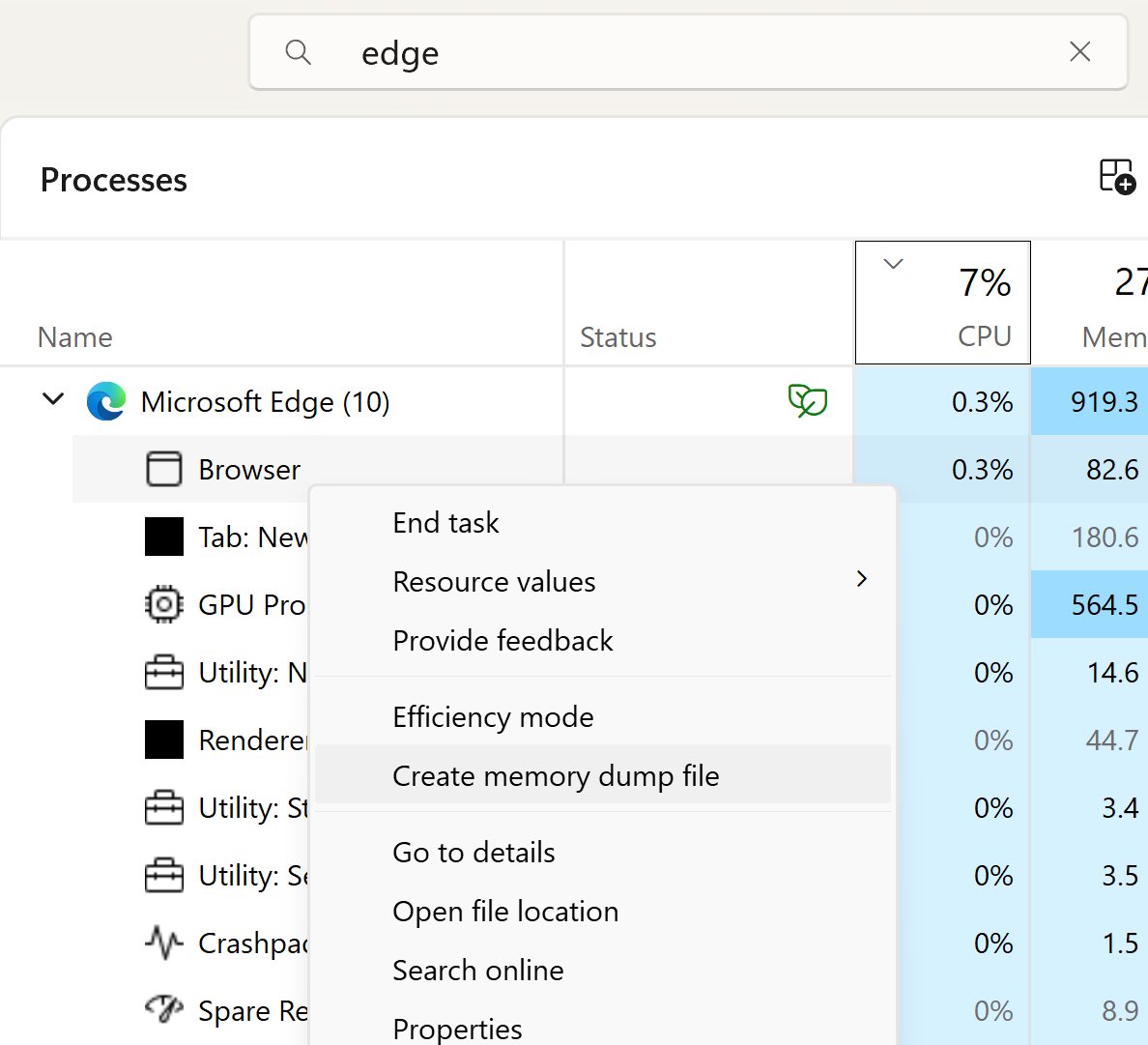
‼️🚨 Microsoft calls this "intended behaviour," so here we go.
How to dump the credentials of every user stored in Microsoft Edge:
1. Open Edge. Don't browse anywhere, just open it.
2. Flip to Task Manager, find Edge, expand the task.
3. Highlight the "browser" sub-task, right-click, and choose "Create Memory Dump."
4. Open the dump file and look for credentials.
The logged-in Windows user can dump every stored Edge credential with no additional rights. Which means any malware that user executes has those credentials for the asking.
Thanks to Rob VandenBrink at SANS: https://t.co/ebtVZxne4L
A response to recent reporting in Germany, in service of clarity and accountability:
First, it’s important to be precise when it comes to critical infrastructure like Signal. Signal was not “hacked” — in that our encryption, infrastructure, and the integrity of the app’s code was not compromised.
However, sophisticated attackers have engaged in a harmful phishing campaign, posing as “Signal Support” by changing their profile display name and using social engineering to trick people into handing over their credentials — information that allowed these attackers to take over some targeted Signal accounts. This is something that plagues any mainstream messaging app once it reaches the scale of Signal, but we know how high the stakes are given the trust people place in us.
In the coming weeks, you’ll see us rolling out a number of changes to help hinder these kinds of attacks.
Because we don’t collect user data, what we know about these attacks comes from the victims of phishing. And from what victims have told us, the attacks followed a broad pattern: after tricking people into revealing their Signal credentials, attackers then used those credentials to take over their account and also frequently changed the associated phone number. Because such a change results in de-registering your Signal accounts, attackers prepared people for this by telling them that being de-registered was intended behavior, and that all they would need to do is “re-register,” or, create a new account. When they moved to create a new Signal account — one that was now decoupled from their hijacked account — the victims thought they were logging back in to their primary account. As a result, many didn't notice the takeover. The compromised accounts were then weaponized to target the victims' contact lists by posing as the owners of the account.
We understand the trust that people put in Signal, and how devastating this kind of social engineering can be. While it’s true that all messaging platforms are susceptible to scammers and phishing that betrays people’s trust and convinces them to “unlock the front door” where no backdoor exists, we are looking to do everything we can to help people avoid and detect such scams.
For the time being, please stay vigilant against phishing and account takeover attempts. Remember that no one from Signal Support will ever send you a message request or ask for your registration verification code or Signal PIN. For an added layer of protection, you can enable Registration Lock in your Signal Settings (Account -> Registration Lock).
Told my wife to have dinner ready at 6 or I will obliterate her entire civilization.
She now charges me a fee to use the bathroom, that used to be free, and I didn't get dinner. WTF