The bigger question is how much autonomy banks will allow.
Will agents eventually spend without approval on every transaction? And how will issuers distinguish authorized activity from fraud?
If you sell online, find out whether you're blocking agents by accident. Then decide on purpose.
🚨 BREAKING: OpenAI launched ChatGPT Wallet with Visa, Mastercard and Amex.
Your dot finds the item. You approve with Face ID. The merchant gets a one-time network token instead of your card number.
Live for US Pro users. OpenAI takes no cut.
Merchants are another obstacle.
Amazon, eBay and United intentionally block agents. CNBC reports 37 more retailers block them accidentally through bot rules.
OpenAI's new Commerce Partner Playbook aims to fix that.
But network tokens won't solve every merchant's concerns about agents.
OpenAI just launched Businesses in ChatGPT. Finally, we're getting first-party ChatGPT analytics! 👏
You can claim your business and manage your company information, similar to a Google Business Profile. For me, the most exciting part is the analytics, which currently includes brand mentions, profile views, website clicks, and a section showing your top discovery topics. You can actually see what people are discussing when your business is mentioned in ChatGPT.
It's in beta, and it's currently live. I just claimed my profile. Here's how to claim yours:
1. Go to chatgpt(.)com/business-hub.
2. Search for your business and start the claim.
3. Verify it by text or phone call to your main business number, or through DNS.
4. Clean up your profile. Verified businesses get a blue check and can update details, prices and stock. You can add product feeds too.
5. Check Insights. The dashboard shows mentions in ChatGPT responses, profile views, website clicks, and the top discovery topics where your business shows up.
Did you know Grok Bot can take the LinkedIn profiles buried in your research and organize them for a Sales Navigator lead list?
I'm doing this now for AI research organizations.
It pulled LinkedIn links from my existing research dashboard, cleaned up duplicates and organized 139 unique profiles into six batches.
Now it's working through the Sales Navigator step: checking current roles and saving relevant people to my “AI Research Labs” list. That part is still underway, not a finished list of 139 qualified leads.
Here's a prompt based on the actual workflow:
"Help me turn my research into a LinkedIn Sales Navigator lead list for [my offer or goal]. Use [my research, dashboard or company list] as the starting point.
1: Define who belongs.
Review my goal and source material. Identify the organizations and roles worth targeting. Explain the criteria and flag assumptions before expanding the list.
2: Extract the LinkedIn profiles.
Collect the person-profile links in my research. Keep each person's name, listed role, organization and source. Flag missing or malformed links. Don't invent them.
3: Clean and prioritize.
Remove duplicate profiles while preserving the original records. Organize the candidates into manageable, clickable batches, with the strongest role matches first.
4: Check current roles.
Review visible profile information against my criteria. Separate confirmed matches from candidates that still need checking. A title in my research isn't proof someone still holds that job.
5: Confirm access and approval.
Check whether you can access Sales Navigator and locate [lead list name]. Show me the proposed saving criteria before changing the list. If access is missing, tell me exactly what's needed.
6: Save approved matches and verify.
After I approve, work through the candidates in batches. Record who was saved, already present or skipped, and why. Confirm saves rather than assuming a click worked. Verify the final count where possible.
7: Report what actually happened.
Give me the confirmed additions, unresolved candidates and remaining work. Don't call the list complete while reviews or saves are still pending. Don't send connection requests, messages or InMail."
Three questions before an agent touches money:
1. Authentication: can it prove whose agent it is?
2. Authorization: what can it do, and up to what amount?
3. Accountability: who eats the loss when it gets one wrong?
The first one gets all the attention.
Your agent books a flight at 2am with your card. The airline sees a valid login, a valid card, and traffic that looks like a bot.
Fraud teams spent years learning to block that exact pattern. Now it might be a good customer who was asleep.
The rules need a rewrite.
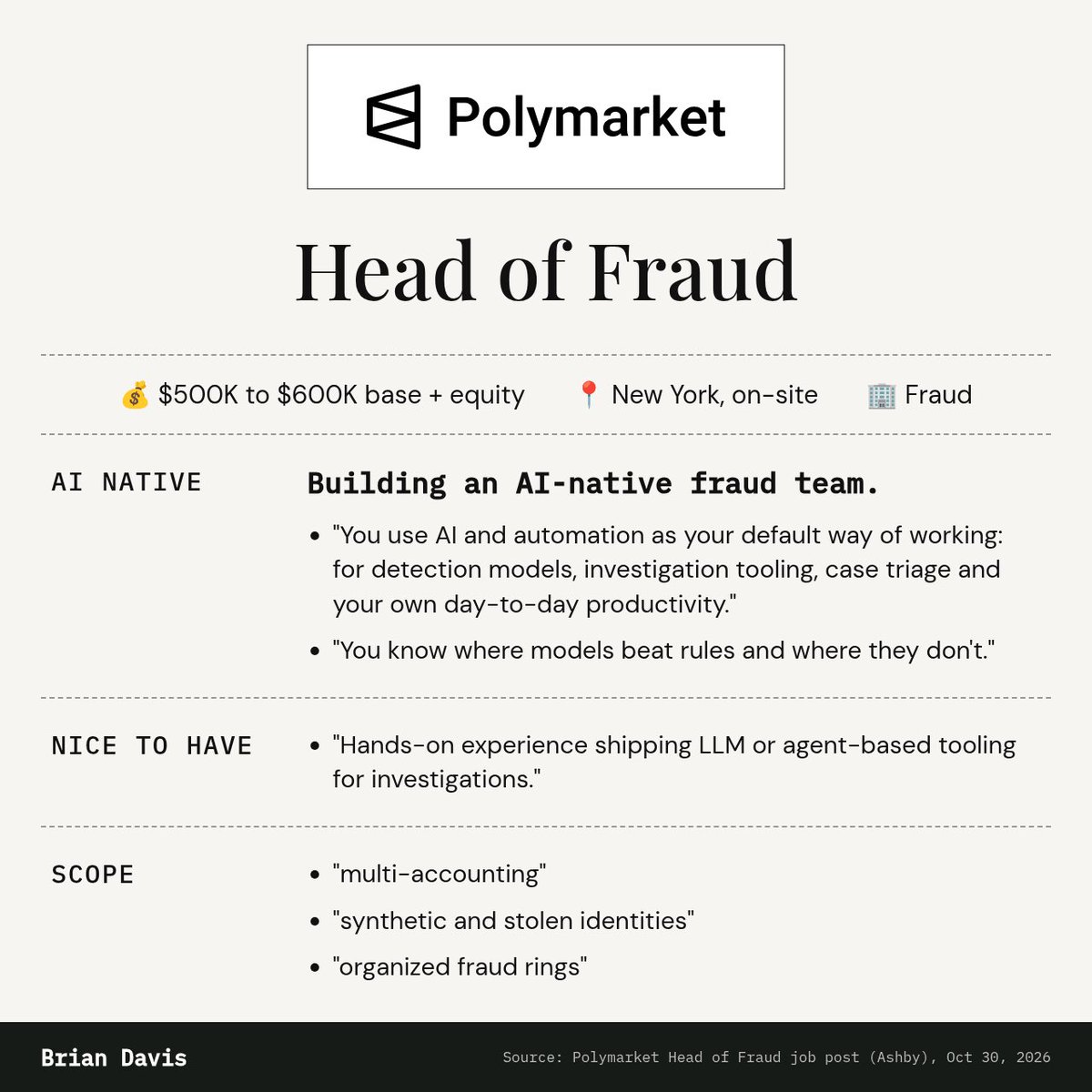
Holy moly, $500K. For a fraud role!
Polymarket just posted a Head of Fraud role at $500K to $600K base plus equity. The pay obviously got my attention.
What makes it interesting to me is the profile they want
"AI native. You use AI and automation as your default way of working: for detection models, investigation tooling, case triage and your own day-to-day productivity. You know where models beat rules and where they don't."
And the nice-to-have: "Hands-on experience shipping LLM or agent-based tooling for investigations."
Ten years ago a fraud leader was hired to run the rules and staff the queue. This post hires someone who builds with AI and decides where humans still belong.
I think that's the new bar for fraud leadership. Pay follows when a role becomes a builder role, and this one is priced like product and engineering.
I'll be watching who lands it. Whoever you are, coffee's on you.
the more I use AI the less interested I become in learning individual tools
I just want to describe something ridiculous and have my computer figure out how to make it happen
preferably without me having to create another account
kind of obsessed with the idea that a single person can now build something that would have required an entire team a few years ago
also kind of terrified because I am that single person and I have no idea what I'm doing half the time
96% of corporate is putting out fires you didn’t start, with information you don’t have in a timeframe arbitrarily decided by someone else.
Now my agent gets to deal with it.
I would pay an unreasonable amount of money for an AI that remembers every random idea I've had and only brings them back when they're actually relevant
instead of me finding a note from March that just says
"uber for something"
the worst part about building with AI is when something works perfectly on the first try
because now I'm convinced I can build literally anything
this confidence usually lasts about 45 minutes
I think we're about to find out how much of running a company was actually just moving information between people
and I'm genuinely curious what happens when that part gets really cheap