This is my first hybrid‑AI movie, ADO ITE five months of hard work and lots of spent credits 😊 and it’s finally finished. Am a big fan of Marvel and Disney, my dream is to tell African stories with world‑class VFX and real‑life actors.”
@arojinle1 Yeah, I didn’t say he wasn’t. Talking about “ economic crash” and “inflation” that’s human thing, so he’s anthropomorphizing them in the process of anthropologising them
Your concerns are very valid as a man regarding the prostate exam using the finger, however as a doctor it will be negligence of professional duty of care for me to endorse your anxieties and say “if you want to die as a warrior”, then so be it. Contrary to recent delusional deranged opinions on this app, no competent trained doctor should ever reinforce your fears and help amplify your anxieties as a patient because they don’t want to offend your feelings with the truth. So pls my brother permit me to help address your concerns (which are valid) but hopefully I can disabuse your mind of your fears.
Now to the issues you raise:
There are machines that can investigate the prostate. The MRI that you mentioned is actually used to also scan the prostate. So if you absolutely do not want a finger going into your anus, you can have a prostate MRI scan done which can adequately help in understanding any medical problems that your prostate may have.
Specifically regarding the prostate exam, The reason medical doctors insert a finger into your anus to check your prostate is because this is the only way for us in a clinic setting to reach your prostate and feel for the prostate to have a rough idea of what is going wrong if you have signs and symptoms of a prostate disease. If there was another way to do this exam, I promise you doctors will opt for it. Putting your fingers into someone’s anus is not exactly fun for the doctor, or for the patient. But then again, the job of a doctor is to do whatever it requires, even if it is inconvenient, to assess your problem and present a solution.
For instance when we use a finger to feel the prostate through the anus, we can know if it is enlarged, if it is hard, if it is firm, if it is rough, if it is painful or if it bleeds when touched.
Now depending on what we find or elicit from that examination, it can help us distinguish specifically what kind of prostate disease you have- whether this is prostate infection, prostate cancer or just harmless prostate enlargement.
Some men urinate many times a day, see blood in their urine, have to strain before they can urinate, they urinate many times at night, they have to rush once they need to urinate, they notice poor flow when to urinate, or sometimes dribbling of urine at end of urination. Some or all of these symptoms if you have any of it as a man may mean prostate disease. The specific type of prostate disease will depend on other questions and the exam the doctor does for you. But if anyone reading this has any of these symptoms, pls see your doctor. Or if you know any man who has these symptoms, pls tell them to see a doctor as soon as they can.
There are ways to make the finger exam less uncomfortable. The doctor should make sure they wear good gloves, use a good amount of lubricant and be very gentle. This way the whole procedure is almost pain-free. A finger exam in the anus to check the prostate should never be painful in ideal circumstances. It may be inconvenient or uncomfortable but it should never be painful or distressing. Once it gets painful then the procedure should be stopped.
Anyway I hope this little writeup has been helpful and I hope this has reassured you, and allayed your fears and anxieties regarding the prostate exam. I think all men over 40 who have any urine problems should ensure they have a prostate exam done, please. It’s a simple painless procedure that can save your life.
Prostate cancer is one of the highest killers of men worldwide and also in Nigeria. Please don’t choose to “die as a warrior” because you are scared of a finger going into your anus to find out early if there’s a problem with your prostate. Early diagnosis of prostate cancer saves lives.
Please I beg you all, kindly educate and encourage someone around you:
Thanks 🙏🏿 and please if you are a man or you have a man you care about, please retweet and share this with them.
BREAKING - Dozens arrested in Paris as day of protests begins across France
Protesters across France called for street demonstrations against rising living costs, joining high school students' grievances over education conditions
Dear Uchenna,
Thank you for your feedback. I most certainly do not hate Igbo people. I love Igbos. Don't you see how handsome and beautiful Igbos are? Who in their right mind would detest a people of such pulchritude, especially when combined with industriousness? Igbos are a major asset to the Black Race.
I hate no one. My life's purpose is to promote peaceful religious and regional coexistence. And if you talk in terms of my charitable activities, no Nigerian ethnicity has benefited from my philanthropy as much as the Igbo. And why would I give my daughter an Igbo name if I hate Igbos?
Since childhood, I have been wearing these clothes. My first birthday photo, taken when I was presented to my grandmother's sister in Ode-Itsekiri (Ale Iwere), was in Aso Oke.
My parents were conscious people who believed in Africa and Nigeria. And the reason I wear a lot of Northern clothes (not Awusa, as you put it) is that my father, though from Delta State, more or less became a Northerner, and the apple does not fall far from the tree.
I made a vow to wear only authentically made-in-Nigeria clothes made entirely from Nigerian fabric.
Agbada made from Aṣọ òfi (AKA Aṣọ òkè) fits that mould. Babanriga made from Kaduna textiles also represents that consciousness.
Even the Kemije that my people, the Itsekiri, wear, I don't wear it. The reason is that it is not authentically Itsekiri culture. It is a British sailor's uniform that we copied. Even the fabric is not of Sub-Saharan African origin.
The reason the Izon (Ijaw) call a Kemije Etibo is because it was sold for eight bo (also sometimes spelt Beau or Bow) by the European sailors. A bo is an old form of currency.
Much as I love the Igbo people, Isi-Agu is not authentically Nigerian. It has nothing to do with Nigeria.
Please fact-check me: Isi-agu originated as a colonial-era upholstery material for chairs and curtains. It is still used today in the poorer parts of the world.
At one point, I even wanted to wear Akwete cloth to be more pan-Nigerian. But then, I found out that Akwete cloth is actually of Ijebu origin. Please fact-check me.
You can read about it in the British historian John Gillow's 2003 book, African Textiles: Colour and Creativity Across a Continent.
The Ijebu have been trading with the Ijaw for centuries. Many prominent Ijaws are actually Ijebu. For example, former Bayelsa Governor and now NDC National Leader, Seriake Dickson, is actually an Ijebu man. He is from the Awujale's palace. His family went to trade in Izon land 200 years ago and never returned. Please fact-check me.
For hundreds of years, the Ijebu sold a fabric known as Aṣọ Olona to the Ijaws. The Izon (Ijaw) renamed it Ikaki. Only in the 19th Century did the Ijaws in Ndoki resell Ikaki fabric to Igbo women from a village called Akwete.
Those women began making a version of Ikaki, which the Igbos called Akwete cloth.
Google it or use an AI you trust. Akwete is a replica of Aṣọ Olona, and Aṣọ Olona was influenced by Aṣọ Ofi, which the Ijebu bought from the Oyo Empire.
The word Aṣọ òkè is of Ijebu origin, meaning that they went òkè (upcountry) to buy the Aṣọ, hence Aṣọ òkè.
Thanks again, Uchenna, and may God bless you.
Bemigho Reno Omokri
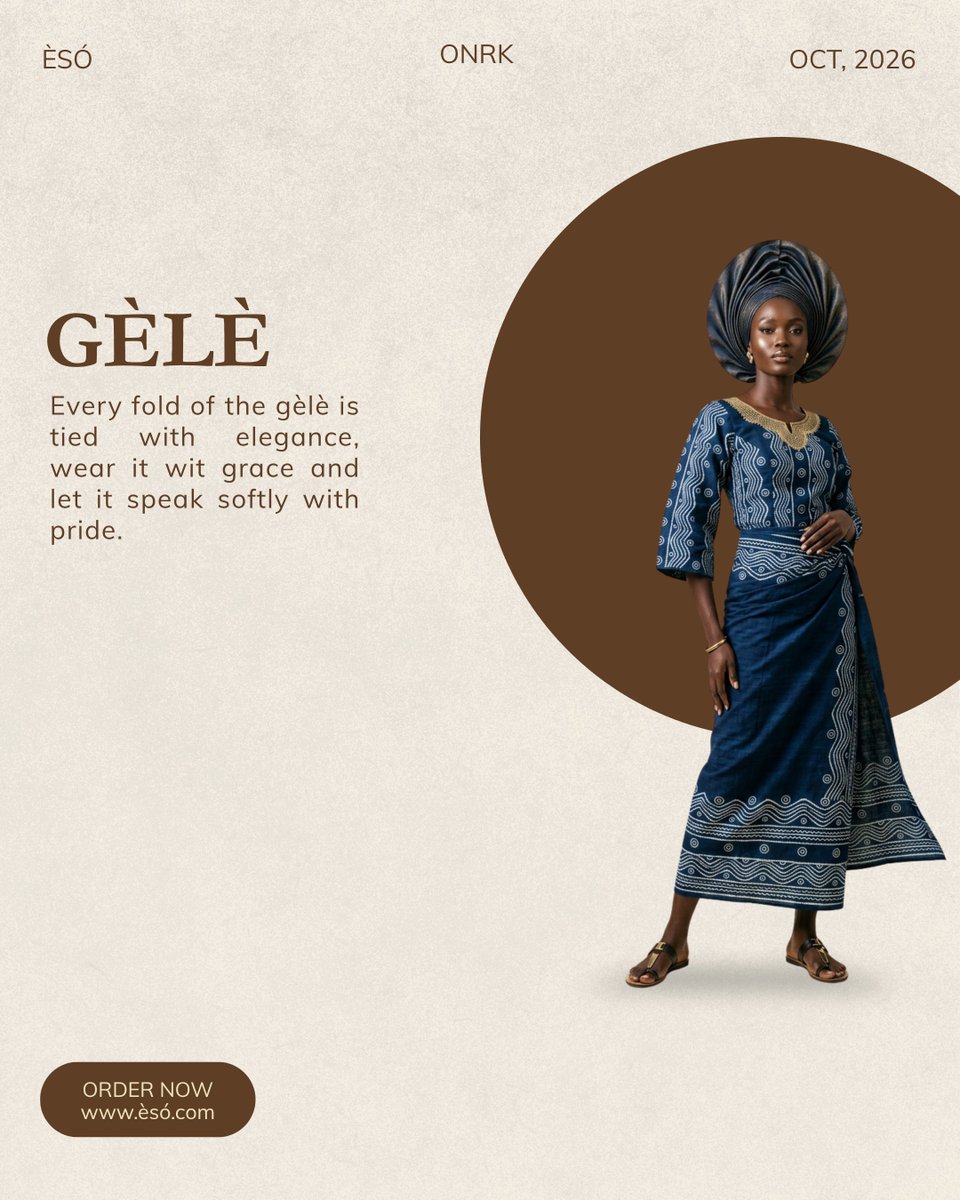
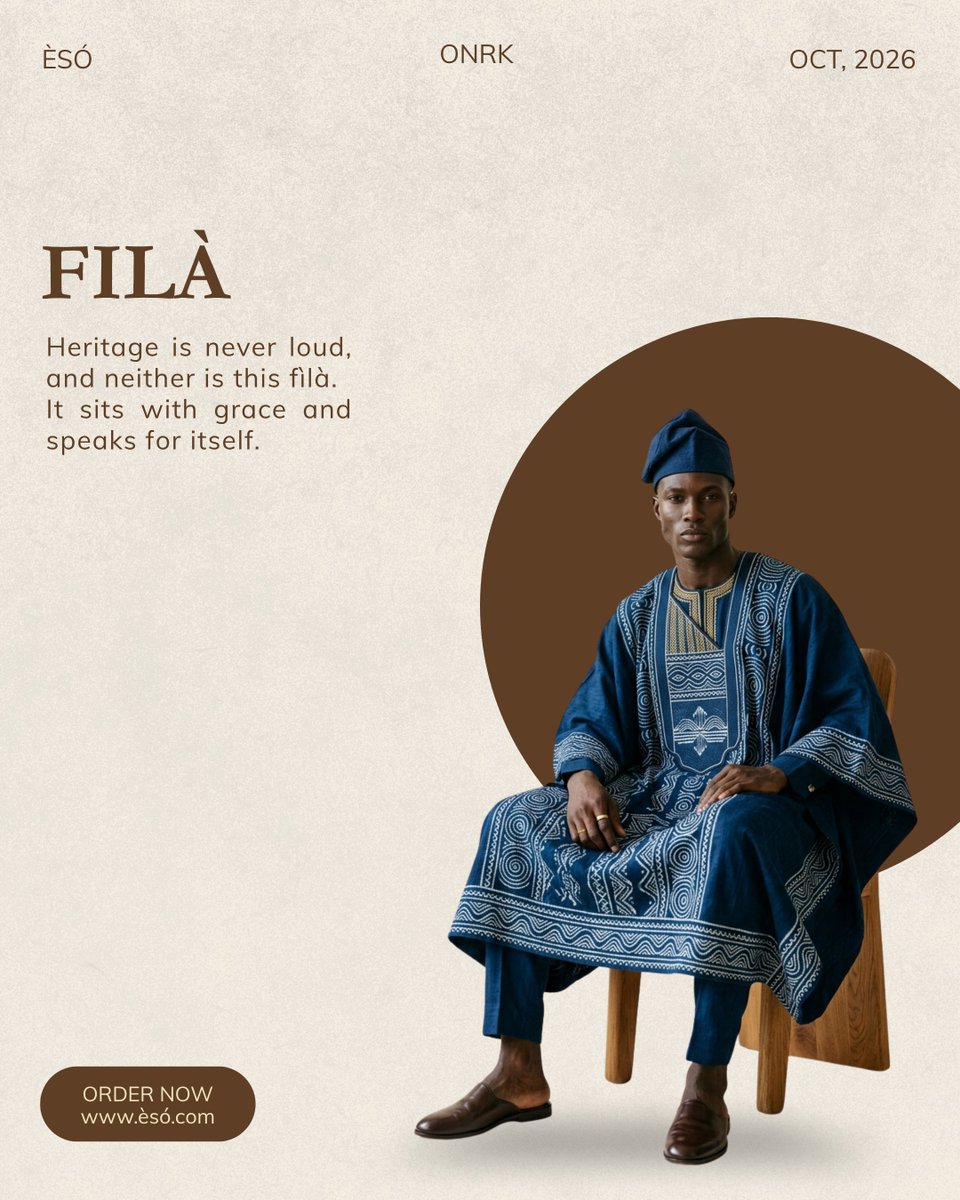
Inspired by the Japanese Design style, I designed a campaign poster series for a luxury clothing brand, ÈSÓ. The edition is called Adire, which shows the heritage and beauty of the Yoruba culture.