🚨 Someone built a full virtual computer that runs inside your browser.
No downloads. No installs. No VMs. Just a Docker command.
It's called Neko. It runs a complete desktop environment inside a Docker container and streams it to your browser using WebRTC.
Not a screen share. Not a remote desktop. A real computer running in a container that you control from any browser tab.
No VNC lag. No RDP setup. No TeamViewer watermarks. Just smooth, real-time video and audio.
Here's what this thing can do:
→ Run Firefox, Chrome, Brave, Edge, Tor Browser, or Opera in an isolated container
→ Run full desktop environments like XFCE or KDE
→ Multiple users can watch and control the same session simultaneously
→ Built-in audio streaming. Watch videos together with perfect sync
→ Persistent sessions. Close the tab, come back later, everything is still there
→ GPU acceleration for smooth rendering
→ Embed it in your own web app via API
Here's why people are losing their minds over this:
Watch parties. Open a movie, invite friends, everyone sees the same screen in real-time with synced audio. Open source alternative to Hyperbeam.
Throwaway browsing. Need to visit a sketchy site? Do it in a disposable container. Nothing touches your real machine. Pair it with Tor Browser and a VPN for full anonymity.
Team collaboration. Debug code together. Brainstorm on a shared whiteboard. Give a live demo where your audience can actually click around.
Secure jump host. Access internal company apps from anywhere without a VPN. Only video leaves the container. No cookies, no tokens, no data on the client.
Here's the wildest part:
The backstory. The creator built this because https://t.co/FEdEkGNdbS shut down and he just wanted to watch anime with his friends. Discord kept crashing. His internet couldn't handle streaming. So he built an entire virtual browser platform from scratch.
One Docker command to start:
docker run -d -p 8080:8080 m1k1o/neko:firefox
Open localhost:8080. You now have a full browser running in the cloud that anyone can join.
17.3K GitHub stars. 1.2K forks. 2,133 commits. 57 contributors.
100% Open Source. Apache 2.0 License.
@naralokesh garu & @PawanKalyan garu, Please Look into the matter sir.. the Situation is Worse than it looks..🙏🏻Village: Koonavaram,
Road: Korukonda to Kunavaram road, Rajanagaram,
MLA: @BattulaBalarama ,
We have our trust on you Sir, Please look into the Issue.. Jai Hind 🇮🇳
ఎంటీ sir ఇధి @BattulaBalarama పొద్దున్న లేస్తే 3 ఊర్లు అదే రోడ్డులో వెళ్ళాలి స్కూల్ కి అయిన హాస్పిటల్ కి అయిన మామోలు రోజుల్లో అంటే ఏదో వెళ్లిపోతాం ఇంకా తప్పదు కాబట్టీ కాని ఇలాంటి ఒకరోజు ఒస్తుంది అని తెలిసి అలా ఎలా పట్టించుకోకుండా ఉంటారు ఇంకా ఎన్నిరోజులు ఇలానే ��నుభవించాలి సార్
छोटी बहन ने बहुत सिंपल शब्दों में अपनी बात कही।
कांग्रेसी इसे भी गाली दे रहे है।
This Video is Trending All Over
इस छोटी लड़की में पूरे कांग्रेसियों से ज्यादा देशभक्ति दिख रही है।
#DroneAttack#ceasefire#ViratKohli𓃵
If Pakistan dares to launch a nuclear missile, India will strike back instantly.
S-400, AAD, and Prithvi Air Defence — we’ll destroy it mid-air before it hits.
“No First Use” is our policy, but the response will be unforgettable.
(An excellent cinematic presentation)
@MOSSADil BRAHMOS landed next to Pakistan’s Nuclear Command HQ.
Islamabad shook. Ran to the U.S. crying for help.
India didn’t just strike — it warned without words.
@MeghUpdates I'm unsure of one thing.. are these guys are Really living in an Alternative reality Or They kind of Suffering PTSD? Or They are Wildly hallucinating in day time?
People need to be patient....I have earlier said and again reiterating again....please be patient and you will definitely see results.
Let me collapse all the informations that is now running wild into a comprehensive digestible manner for everyone:
A) Geopolitical Context and International Response: The Fallout of India's Retaliatory Actions
1. The Strike on Nur Khan Airbase - Satellite Imagery and Foreign Involvement:
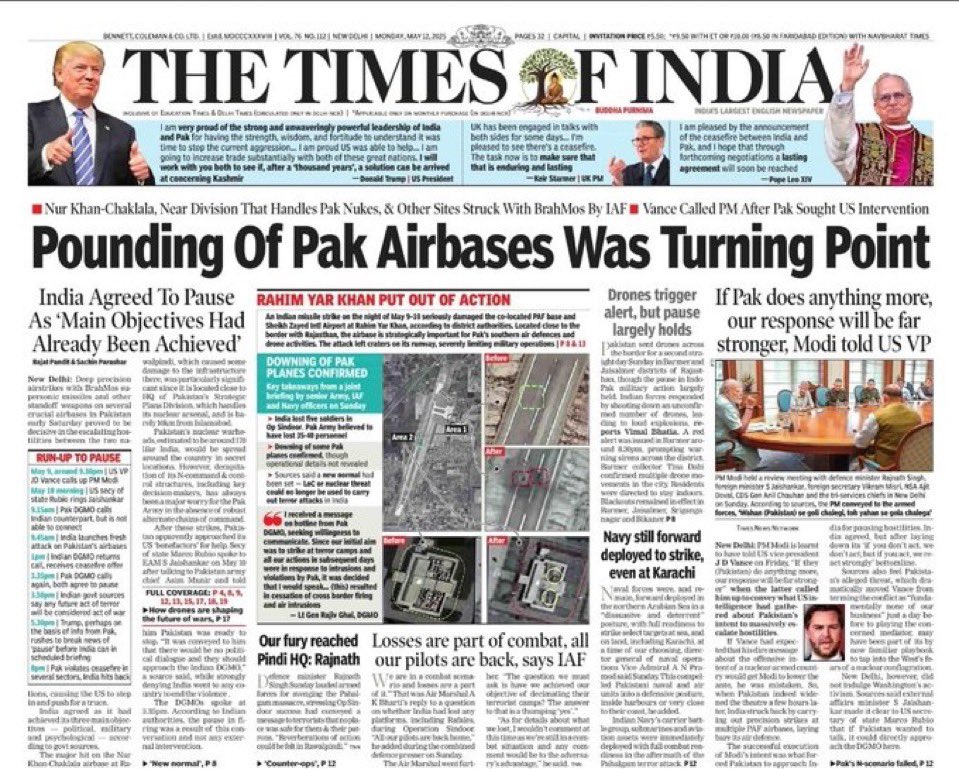
The satellite imagery of the Nur Khan Airbase in Pakistan following the Indian airstrike reveals considerable damage, particularly to military facilities and infrastructure.
The pre-strike and post-strike images clearly indicate that Indian Defense Forces targeted critical military assets, including at least 7 trucks that were used for military logistics.
Key Observations:
a. The post-strike image shows considerable destruction to key military facilities, including what appears to be a radioactive facility or a related infrastructure.
b. The pre-strike image shows the area largely intact, with visible military assets such as trucks, likely connected to logistics operations for Pakistan’s military readiness.
2. Detection of Radioactivity and US Experts in Rawalpindi:
Following the airstrike on the Nur Khan Airbase, a foreign aircraft equipped to detect radioactivity reportedly landed in Pakistan. The aircraft's mission was to assess the potential nuclear fallout resulting from the strike.
Key Developments:
a. Radiation reportedly detected at the site, indicating the possibility of nuclear-related damage.
b. In the wake of these reports, US experts were dispatched to Rawalpindi to assess the nuclear damage caused by the strike and to ensure there was no immediate risk of a nuclear escalation.
The presence of a US aircraft specialising in radiation detection suggests heightened international concerns about nuclear security in the region, particularly with the presence of Pakistan’s nuclear arsenal and the possibility that the Indian strike might have hit sensitive military assets involved in nuclear-related activities.
B) Strategic and Diplomatic Fallout:
3. The Role of International Powers and Regional Security:
a. The involvement of US experts underscores the global concerns raised by the Sarghoda base strike, Indian retaliation, and the detected radiation. Here are the key takeaways:
b. Nuclear Risk Management:
With Pakistan being a nuclear-armed state, the possibility of an attack involving nuclear infrastructure or materials raises alarms for international powers. India’s actions, while aimed at neutralising terrorist threats, have opened up global discussions about nuclear non-proliferation and regional stability.
(This in itself nullifies the so called PAKISTAN's Nuclear Deterrence)
c. Strategic Responses from Allies:
The US’s response in sending radiation detection aircraft and experts points to a major concern over the nuclear implications of the ongoing military operations in the region.
This also highlights the international interest in ensuring nuclear security, especially as both India and Pakistan maintain nuclear arsenals.
[Again here Pakistan's incapability to remain a stable Nuclear Deterrent in the Asian Region raises the question itself on the Mismanagement and lack of Maturity of PAKISTAN)
4. Flights from the US and China:
a. SSHAH75 (US Department of Energy) –
A nuclear emergency response aircraft was detected near Islamabad, Pakistan, further confirming the global stakes in ensuring that the situation did not escalate into a nuclear confrontation. The US has a vested interest in preventing nuclear conflict, particularly in a region where both India and Pakistan possess significant nuclear capabilities.
b. EGY1916 (Egyptian Air Force) –
A cargo plane from China also arrived in Pakistan, which further emphasizes the regional alliances at play. China’s support for Pakistan has been well-documented, and this flight points to China’s direct involvement, potentially supplying military or strategic resources to Pakistan amidst rising tensions.
C) India’s Firm Stance and International Reactions:
5. India’s Uncompromising Position:
As previously reported, India’s government has made its stance clear:
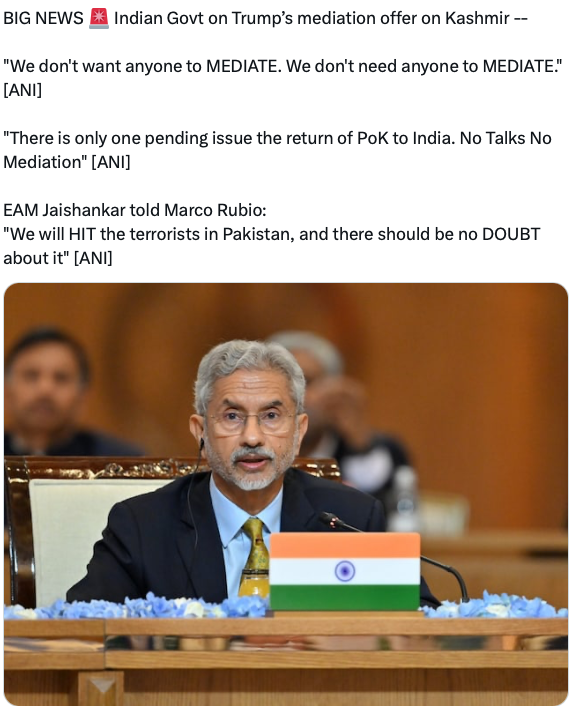
a. No Mediation: India firmly rejected the US offer to mediate on Kashmir, emphasising that India does not require third-party mediation.
The Indian government made it clear that the only issue pending is the return of PoK to India, signalling that India intends to settle the Kashmir issue on its own terms, without external intervention.
b. Terrorism and Military Response:
India's External Affairs Minister S. Jaishankar firmly stated that India will continue to target terrorists in Pakistan and that there should be no doubt about India's resolve in combating terrorism.
This further solidifies India's security doctrine, which prioritises the elimination of cross-border terrorism and terrorist infrastructure over diplomatic negotiations with Pakistan.
D) The Bigger Picture:
a. The Sarghoda Base strike and subsequent actions, including the airstrikes on Nur Khan Airbase, show that India’s military response is not only a defense against terrorism but also a strategic shift towards ensuring national security in a region where the nuclear balance is fragile.
b. The global attention on Pakistan’s nuclear security and the US's response indicate that international powers are closely monitoring the situation, ensuring that there is no further escalation into a nuclear conflict.
c. The response from China and Egypt, while providing support to Pakistan, indicates the broader geopolitical dynamics at play.
The involvement of China in supplying military aid, as well as Egypt’s strategic interests, reflects the complexities of the region’s security architecture.
d. India's leadership, through actions like the Balakot strike, surgical strikes, and its firm stance on Kashmir and terrorism, reflects a stronger, more assertive India that is willing to take decisive military action to safeguard its national interests and security.
Conclusion:
The combined international responses—from the US’s radiation detection aircraft and China’s cargo support for Pakistan—highlight the global significance of the India-Pakistan military conflict, especially concerning nuclear security.
Meanwhile, India's unwavering stance on terrorism and no mediation underscores its firm commitment to safeguarding its sovereignty and security.
As these developments unfold, it is clear that India’s actions have prompted international reactions that will shape the future of South Asian geopolitics.
The world’s attention is now focused not only on the regional conflict but also on how nuclear stability in the region is managed, with India’s strategic maneuvers continuing to define the broader narrative.
@GitaPress@gitapressbooks Is this Some kind of joke? Or you guys taking the Trust for Granted? I spoke with you guys multiple times, and even mailed you but no proper response and It even stoped updating the Status lol..@jagograhakjago please have a look at this.. 😐 Jai Hind 🇮🇳
@ShobitShukla6@wokeflix Either Indian satellites or International Satellites will find out the suspecious movements and they will Alert the Internal defence mechanism and they will directly Intercept the missile Transport if needed. n/n
@ShobitShukla6@wokeflix Then the president and PM has to give final approval to launch the nukes. if at all all this is happening, that to in Pakistan, just because of the huge distance between the launch pads and the station where they get assembled, 4/n