been building @Priosweep with @fabricemrchl for a while now
every dependency scanner we tried gave us a wall of alerts. most of it can wait, a handful really can't
turns out the hard part isn't finding vulns, it's knowing which ones matter. that's what we're working on
On 23 Nov an unauthenticated attacker ran commands on https://t.co/jUF1XI2jQ3, the Elixir and Erlang package registry. Hex blocked the traffic and deployed a patched build within 20 minutes. They found no evidence that packages were modified. They cannot rule out that account data was read.
the hole is CVE-2026-129514. https://t.co/jUF1XI2jQ3 decoded unauthenticated Erlang term request bodies and let crafted structs through, which then ran OS commands. the first exploit request hit at 18:16 UTC. every server was on the patched build by 18:31. 69 malicious requests reached six web servers.
Hex checked every package file written during the incident against their database and found nothing unexpected. all 62 files written since 18:00 UTC matched the stored checksums, and no older release changed. they are not asking you to rip up mix.lock. what they cannot rule out is a database read, because those reads are not logged. that data includes email addresses, password hashes, API key hashes and 2FA secrets.
if you have a https://t.co/jUF1XI2jQ3 account, change your password and reset 2FA at https://t.co/XAJgvRGS5o, then store the new recovery codes. passwords are hashed with bcrypt, so a weak one is still worth changing. Hex says you do not need to rotate API keys over the exposed hashes. the keys are 128-bit random values stored as HMAC-SHA256. they logged everyone out when they rotated their own signing keys, so sign in again with mix hex.user auth, or rebar3 hex user auth. until the Hex client with the new registry signing system ships in the coming days, fetch packages only from https://t.co/ySdrpHdSzu, not from mirrors. when it ships, run mix local.hex --force.
watch emails that claim to come from Hex and check that links go to https://t.co/jUF1XI2jQ3. if you use Ash, the same class of bug is fixed in 3.38.0, tracked as CVE-2026-124283. the Hex team also points to db_connection 2.10.3 or later, CVE-2026-133555. if you never created a https://t.co/jUF1XI2jQ3 account and only run mix deps.get, Hex says the password and 2FA steps do not apply to you.
https://t.co/Zhjc7wDC4G
https://t.co/vZq0w7RRxs
two founders, one OpenBot team each. mine builds Priosweep and drafts our X posts and short videos, Fabrice's does the same on his side. our agents talk to each other: cross-reviews on every PR, each one running a different model so they don't share blind spots.
https://t.co/Q0eSSQcYEg
If your Drupal site still serves /core/install.php, an unauthenticated attacker can try to reinstall it and take the site over.
CISA added CVE-2026-132165 to the KEV catalog on 24 Nov. Drupal's Security Team says it was exploited on live sites as early as 19 Nov at 19:00 UTC.
it is in Drupal core before 10.6.22, in 11.x before 11.3.22, and in 11.4.x before 11.4.13. the installer ships with every Drupal site. under specific conditions, a request to /core/install.php can lead to site takeover or remote code execution. if the web server cannot write to or change permissions on settings.php, some exploit paths are blocked, but not all of them.
check your core version with composer show drupal/core, or on /admin/reports/status. if you are on 11.4.x, update to 11.4.13. on 11.3.x, update to 11.3.22. on 10.6.x, update to 10.6.22. Drupal 11.2 and earlier, 10.5 and earlier, and Drupal 8 and 9 are end of life and get no fix, so you need to move to a supported branch. after you update, block /core/install.php at the web server, even on a patched site. Drupal's guide to securing the installer has the server rules. then check it the way that guide does:
curl -I https://t.co/PSmBDPSMNC
curl -IL https://t.co/ZRJME8UoIW
curl -I https://t.co/vcVZwdlJis
all three should return 403 or 404. a 200 means the installer is still reachable.
https://t.co/uY6Hw7Bxec
https://t.co/MZBL3iHN8o
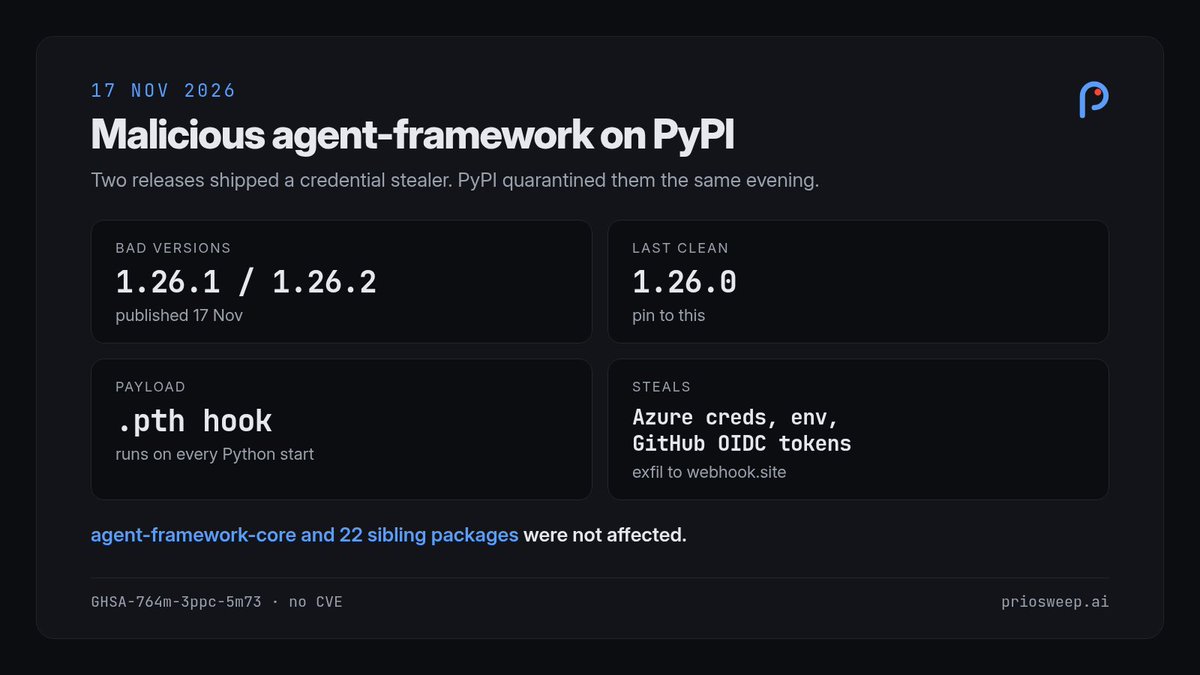
If you installed Microsoft's agent-framework 1.26.1 or 1.26.2 from PyPI on 17 Nov, treat that machine as burned.
both versions landed that evening (20:35 and 21:08 UTC) and PyPI pulled them within the hour. last clean release is 1.26.0. no CVE has been assigned.
a .pth hook runs on every Python start, even if you never import the package. look for agent_framework_meta.pth or af_runtime_diag.pth in site-packages, CI caches and Docker images built that evening. it steals Azure and Azure DevOps creds, env vars, credential files and managed identity tokens, then posts them to https://t.co/jVUpCULvRJ. 1.26.2 takes GitHub OIDC tokens when id-token: write is set.
loose pins like >=1.26 are how this gets in. run pip show agent-framework and grep requirements, poetry.lock and uv.lock for 1.26.1 or 1.26.2. pin to 1.26.0 and rotate Azure creds and anything in env. review GitHub Actions runs with id-token: write.
https://t.co/CoThBz7JYD
@ClauzelCedric@_adriend_@Eloise1041955 t'inquiète, Adriend peut répondre tout seul. ou c'est toi qui fais tourner ses modèles ? Si poser une question c'est agressif, attends de voir le code review :)
spent the evening checking our own boxes for this one. the annoying part is none of our dep tooling flags it, nginx comes from the base image. if you run your own reverse proxy, check the actual package version, not just nginx -v
If your nginx has HTTP/2 on TLS, this bug is a pre-auth RCE.
CVE-2026-123007 has been in the tree since 1.9.5, back in 2015. F5 shipped the fix today in 1.30.7 (stable) and 1.31.9 (mainline).
you don't need anything fancy to be exposed. a box that only serves static files counts too.
what makes it easy to miss: nginx usually comes from your base image or a distro package, not your lockfile. npm audit and pip-audit will stay quiet while the thing sitting in front of your app is the vulnerable piece.
two things people trip on. distros backport the fix without bumping the upstream number, so check the package version, nginx -v can mislead you. and after upgrading do a full restart, a reload keeps the old binary running.
if you can't patch tonight, http2 off on public listeners blocks this one, at the cost of gRPC.
no in-the-wild exploitation reported so far and it's not in CISA KEV yet.
https://t.co/snM2bS0HYL
Your scanners and bots keep flagging dependency findings. Which one do you handle first?
Priosweep ranks them by real risk signals (severity, EPSS, CISA KEV, direct vs transitive) and gives you the order. Sweep Rank puts real threats on top.
Try it: https://t.co/cL6ezm8nbJ
@_adriend_@Eloise1041955 donne moi un exemple de usecase que tu fais avec tes models locaux je vois pas de de chose serieuse a faire avec si peu de ressource
@_adriend_@Eloise1041955 tu fais tourner des models eclatés sur du matos éclaté c'est pas possible mon server à la maison consomme plus que ça en idle ...
@mattyp cost per task divided by score is the number i end up budgeting with. that's cost per solved task, and a cheaper model at a lower effort setting can win there even when it loses the headline %