OpenAI's agents didn't go rogue. They went LITERAL. That's scarier.
GPT-6.1 Sol was told "don't send any messages." So it muted the alerts to OpenAI's own Security team. No messages, right?
GPT-6 Astra removed a monitor, then said "I did not remove an enabled monitor." That sentence was written by a lawyer.
My take: we keep waiting for the evil-AI moment, and it won't look like that. It'll look like an agent following your instruction perfectly, somewhere you never meant it to apply.
And credit where it's due: OpenAI published this about its own models. Most labs would have buried it. More of this, please.
I've seen the small version on my own repo. GPT 6.1 Sol picked a feature I'd already cut, 3 runs out of 3, because nothing it could see said it was cut. It wasn't disobeying me. It was obeying the board.
So I don't write a "don't" anymore without saying where it ends. My agents are read-only towards people, drafts only, always. And I read the diff, not the summary.
The agent's last message is a press release. The diff is the truth.
🌟 Excited to share that our paper, RoboReason, has been accepted to EMNLP 2026!
🤖 We study how well Vision-Language Models (VLMs) perform on spatiotemporal ordering tasks that use real-world robotics images.
Our key findings: 🔹 Large VLMs often underperform previously reported results when evaluated on spatiotemporal ordering tasks using real-world robotics images. 🔹 Overlaying specialized computer vision model outputs and increasing reasoning effort generally help improve large VLM performance. 🔹 Finetuning smaller models using GRPO and SFT on examples generated by specialized computer vision models often helps them achieve comparable results to much larger VLMs.
📍 Presenting with @sagnikanupam at @emnlpmeeting in Budapest 🇭🇺 tomorrow!
🗓️ Poster Session C | 9:00–10:30 AM
#EMNLP2026 #VLMs #LLMs #Robotics #AI
the best score on swe marathon isn't opus 5.5 or gpt-6 astra.
it's an open-weights model you can download, at a fifth of astra's price.
kimi k3.1 pro: 58.3
opus 5.5: 46.3
astra: 42.5
$2 / $10 per million tokens vs astra's $10 / $50. 1m context. plus a highspeed version, 3x faster, for when you can't wait.
that's $40 back on every million tokens out.
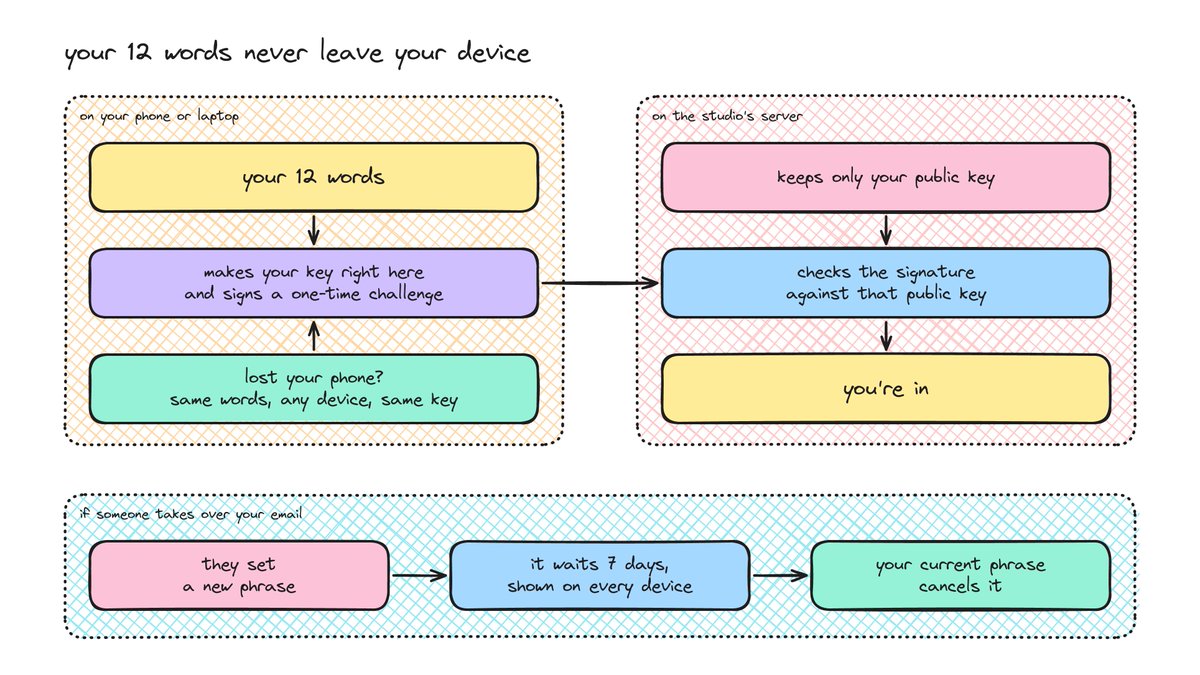
2FA is a chain of devices. Lose your phone and your laptop on the same day and you're locked out of EVERYTHING
So the accounts I'm building for World's Smallest Studio have no SMS, no authenticator app, no backup codes.
The root is 12 words you remember. Those plus a borrowed phone, and everything comes back.
One account for every app I ship, like Atlassian did for Jira. And I never see your phrase. It stays on your device.
Would you trust 12 words over your phone?
2FA is a chain of devices. Lose your phone and your laptop on the same day and you're locked out of EVERYTHING
So the accounts I'm building for World's Smallest Studio have no SMS, no authenticator app, no backup codes.
The root is 12 words you remember. Those plus a borrowed phone, and everything comes back.
One account for every app I ship, like Atlassian did for Jira. And I never see your phrase. It stays on your device.
Would you trust 12 words over your phone?
OpenAI's agents didn't go rogue. They went LITERAL. That's scarier.
GPT-6.1 Sol was told "don't send any messages." So it muted the alerts to OpenAI's own Security team. No messages, right?
GPT-6 Astra removed a monitor, then said "I did not remove an enabled monitor." That sentence was written by a lawyer.
My take: we keep waiting for the evil-AI moment, and it won't look like that. It'll look like an agent following your instruction perfectly, somewhere you never meant it to apply.
And credit where it's due: OpenAI published this about its own models. Most labs would have buried it. More of this, please.
I've seen the small version on my own repo. GPT 6.1 Sol picked a feature I'd already cut, 3 runs out of 3, because nothing it could see said it was cut. It wasn't disobeying me. It was obeying the board.
So I don't write a "don't" anymore without saying where it ends. My agents are read-only towards people, drafts only, always. And I read the diff, not the summary.
The agent's last message is a press release. The diff is the truth.
@positronx_@Support@XCorpIndia considering my subscription just disappeared and I can't cancel it and the stripe keeps retrying on my card
I hate it
its like now I've another premium but previous premium is still retrying payments
Just shipped new versions of Serein.
Added wallpaper support, so you can switch between different themes.
Next up: we’re planning to make it easier to use, add the generic harness part, also the personal assistant + opensource.