“We did an experiment with the previous technology. It cost about $15,000 to put a ZK verifier on-chain. Now we are about $10 to $20.”
@dntse at @consensus2026 on @CoinDesk Live, explaining BABE, Babylon’s 1,000x breakthrough in making proof verification on Bitcoin cheaper, faster, and more practical.
🏦 The Prividium Difference
Designed specifically for Institutions offering privacy, built-in compliance, cross chain connectivity and cryptographic enforcement.
Private where it matters.
Connected where it counts.
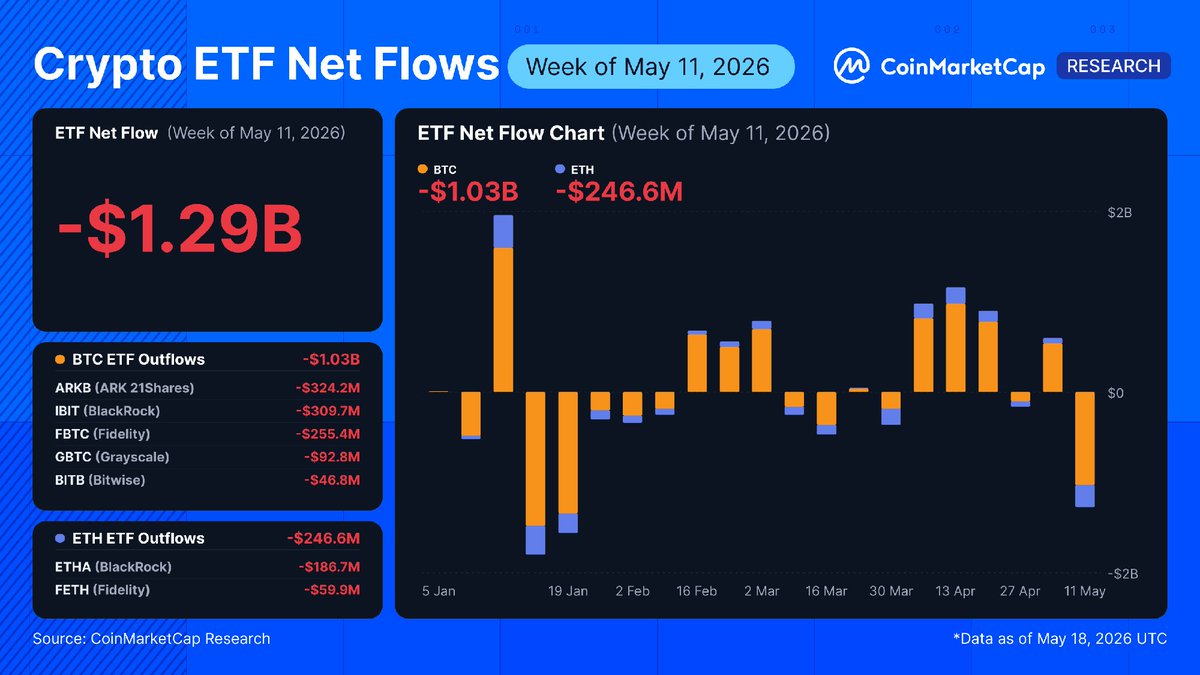
BTC & ETH ETFs Bleed $1.29B: 3rd-Worst Week YTD
🔴 11 May (Mon–Fri): BTC -$1.03B / ETH -$263.0M
> BTC -5.26% ($81,728 → $77,429)
> ETH -9.05% ($2,339 → $2,128)
Flashback: Late-Jan Was Worse
🔴 26 Jan: BTC -$1.5B / ETH -$327.1M (YTD #1)
> BTC -12.79% ($88,267 → $76,974)
> ETH -22.50% ($2,926 → $2,268)
🔴 19 Jan: BTC -$1.2B / ETH -$600.7M (YTD #2)
> BTC -6.46% ($92,554 → $86,572)
> ETH -11.63% ($3,187 → $2,816)
Two things stood out:
First, the BTC selling looks broader this time. ARKB and IBIT were nearly tied at the top, each seeing roughly $310M–$324M in outflows, while January’s waves were more IBIT-driven. ETH still rhymes with January, with ETHA doing most of the damage.
Second, BTC is now at $77k, less than 2% above the ~$76k support, making this week's ETF prints critical to watch.
Onchain payments are going mainstream.
@Mastercard launched its Crypto Partner Program with Aptos as a launch partner — together, exploring what's next for onchain payments at global scale.
Aptos 🤝 Mastercard
“It's clear that onchain rails will underpin the future of finance.”
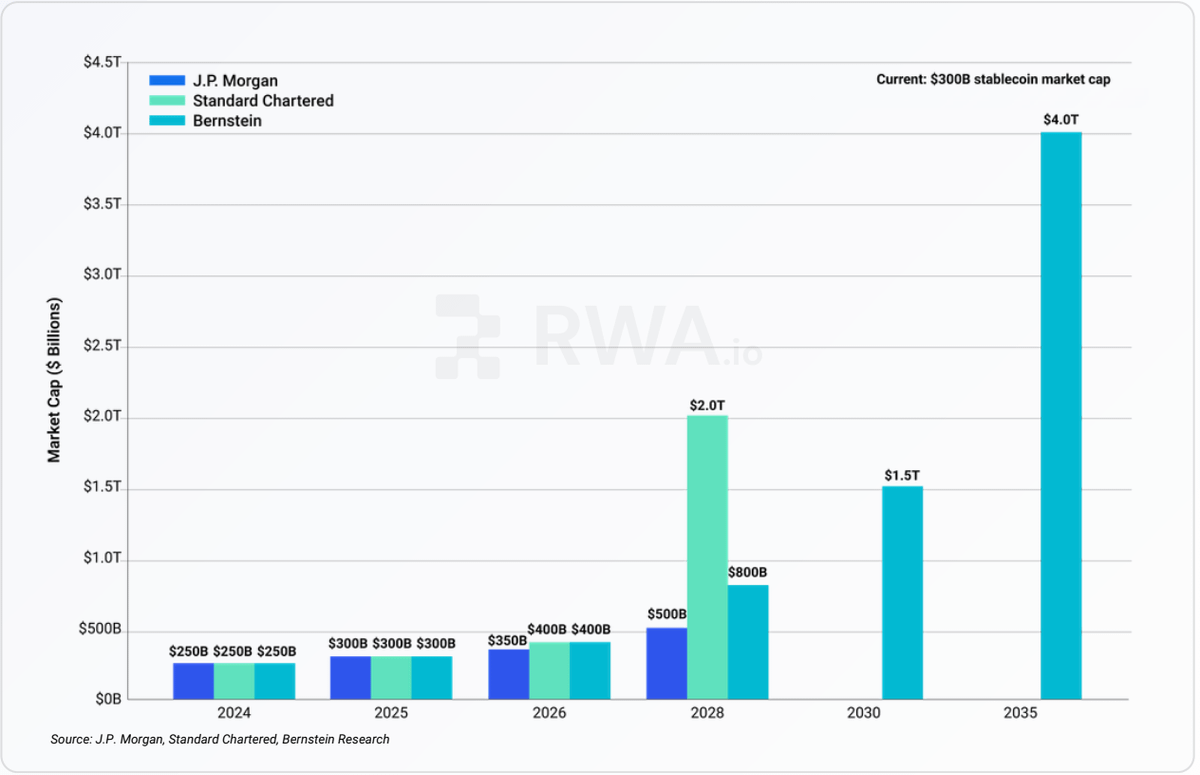
Ondo’s @iandebode shares insights with @rwa_io alongside J.P. Morgan, Citi, Standard Chartered, ABN AMRO, and more.
Stablecoin adoption among financial institutions has crossed 90%. Tokenized treasuries are rapidly gaining traction alongside them.
Ondo’s USDY unlocks:
✅ The ability to access yield
✅ Best in class investor protections
✅ Compatibility with permissionless systems
The growth of stablecoins and tokenized treasuries makes one thing clear: the future of digital money is onchain.
THIS DAT IS BUYING TRON
Tron Inc. is a Digital Asset Treasury company which currently holds over $200 MILLION of TRX, mostly staked. They’ve been buying $50K TRX per day for the past 2 months.
How much TRX will they accumulate?
Franklin Templeton ($1.7T AUM) on the tokenization opportunity:
“The global ETF market is $30 trillion.
Even if we get just 5% from new audiences, we're talking about $1.5 trillion more dollars coming into the crypto ecosystem.
I think it could be much higher than that.”
Sandy Kaul, Head of Innovation at Franklin Templeton (@FTDA_US), joined Ondo President @iandebode on @therollupco following yesterday's announcement to bring FT-managed ETFs onchain through Ondo Global Markets.
Earlier today, a user attempted to buy AAVE using $50M USDT through the Aave interface.
Given the unusually large size of the single order, the Aave interface, like most trading interfaces, warned the user about extraordinary slippage and required confirmation via a checkbox. The user confirmed the warning on their mobile device and proceeded with the swap, accepting the high slippage, which ultimately resulted in receiving only 324 AAVE in return.
The transaction could not be moved forward without the user explicitly accepting the risk through the confirmation checkbox.
The CoW Swap routers functioned as intended, and the integration followed standard industry practices. However, while the user was able to proceed with the swap, the final outcome was clearly far from optimal.
Events like this do occur in DeFi, but the scale of this transaction was significantly larger than what is typically seen in the space.
We sympathize with the user and will try to make a contact with the user and we will return $600K in fees collected from the transaction.
The key takeaway is that while DeFi should remain open and permissionless, allowing users to perform transactions freely, there are additional guardrails the industry can build to better protect users. Our team will be investigating ways to improve these safeguards going forward.
Congrats to @BlackRock on the launch of their ETH staking ETP, ETHB.
We’re making crypto more accessible through familiar, trusted platforms. Wider access = more opportunity.
Some of our best hires were totally unqualified on paper.
They always had the same qualities: entrepreneurial, high agency, smart, mission aligned, and they got shit done.
If you’re hiring, especially in early stages, seek out & bet on these people. Don’t over-index on resumes.
Finance is entering its tokenized era.
Leading institutions across legacy finance, fintech, tech, and crypto all made major moves over the past week.
Weekly tokenization roundup ↓
1️⃣ Barclays accelerates push into stablecoins and tokenized deposits
According to Bloomberg, the firm is “exploring the use of digital asset technology for various banking services.”
https://t.co/WPFNIs9yz0
2️⃣ Coinbase adds stock trading for U.S. customers
Coinbase has launched 24/5 stock and ETF trading. The company also plans to offer tokenized stocks in the future via Coinbase Tokenize.
https://t.co/QpLo2EeMJS
3️⃣ Revolut among cohort testing stablecoin plans with the FCA
The UK’s Financial Conduct Authority (FCA) is allowing firms to test stablecoin products in real-world conditions within a regulatory sandbox.
https://t.co/yvOFRHCqbD
4️⃣ Meta plans to support stablecoins
Meta is planning to launch stablecoin-backed payments and a new crypto wallet in the second half of 2026.
https://t.co/NMXG84CXpk
5️⃣ Ondo and Binance bring tokenized stocks to hundreds of millions
AAPLon, AMZNon, CRCLon, GOOGLon, METAon, MSFTon, NVDAon, QQQon, TSLAon are now accessible on Binance Alpha.
https://t.co/hDSRjnqzvv
The stablecoin thesis is simple.
A dollar, onchain, accessible to anyone.
Tokenized stocks are the same idea for equities. Ondo is building the foundation.
"AI becomes the government" is dystopian: it leads to slop when AI is weak, and is doom-maximizing once AI becomes strong. But AI used well can be empowering, and push the frontier of democratic / decentralized modes of governance.
The core problem with democratic / decentralized modes of governance (including DAOs on ethereum) is limits to human attention: there are many thousands of decisions to make, involving many domains of expertise, and most people don't have the time or skill to be experts in even one, let alone all of them. The usual solution, delegation, is disempowering: it leads to a small group of delegates controlling decision-making while their supporters, after they hit the "delegate" button, have no influence at all. So what can we do? We use personal LLMs to solve the attention problem! Here are a few ideas:
## Personal governance agents
If a governance mechanism depends on you to make a large number of decisions, a personal agent can perform all the necessary votes for you, based on preferences that it infers from your personal writing, conversation history, direct statements, etc.
If the agent is (i) unsure how you would vote on an issue, and (ii) convinced the issue is important, then it should ask you directly, and give you all relevant context.
## Public conversation agents
Making good decisions often cannot come from a linear process of taking people's views that are based only on their own information, and averaging them (even quadratically). There is a need for processes that aggregate many people's information, and then give each person (or their LLM) a chance to respond *based on that*.
This includes:
* Inferring and summarizing your own views and converting them into a format that can be shared publicly (and does not expose your private info)
* Summarizing commonalities between people's inputs (expressed as words), similar to the various LLM+https://t.co/Nzord33s0z ideas
## Suggestion markets
If a governance mechanism values "high-quality inputs" of any type (this could be proposals, or it could even be arguments), then you can have a prediction market, where anyone can submit an input, AIs can bet on a token representing that input, and if the mechanism "accepts" the input (either accepting the proposal, or accepting it as a "unit" of conversation that it then passes along to its participant), it pays out $X to the holders of the token.
Note that this is basically the same as https://t.co/nUL0HyTyK2
## Decentralized governance with private information
One of the biggest weaknesses of highly decentralized / democratic governance is that it does not work well when important decisions need to be made with secret information.
Common situations:
(i) the org engaging in adversarial conflicts or negotiations
(ii) internal dispute resolution
(iii) compensation / funding decisions.
Typically, orgs solve this by appointing individuals who have great power to take on those tasks.
But with multi-party computation (currently I've seen this done with TEEs; I would love to see at least the two-party case solved with garbled circuits https://t.co/PIY2LZtbeK so we can get pure-cryptographic security guarantees for it), we could actually take many people's inputs into account to deal with these situations, without compromising privacy. Basically: you submit your personal LLM into a black box, the LLM sees private info, it makes a judgement based on that, and it outputs only that judgement. You don't see the private info, and no one else sees the contents of your personal LLM.
## The importance of privacy
All of these approaches involve each participant making use of much more information about themselves, and potentially submitting much larger-sized inputs. Hence, it becomes all the more important to protect privacy. There are two kinds of privacy that matter:
* Anonymity of the participant: this can be accomplished with ZK. In general, I think all governance tools should come with ZK built in
* Privacy of the contents: this has two parts. First, the personal LLM should do what it can to avoid divulging private info about you that it does not need to divulge. Second, when you have computation that combines multiple LLMs or multiple people's info, you need multi-party techniques to compute it privately. Both are important.