@d__e_p Jewish-American orthopedic surgeon Mark Perlmutter, who worked in Gaza, said Israeli soldiers took two Palestinian children, tied their hands behind their backs, and buried them alive at Nasser Hospital their cries muffled by the dirt poured over them.
🚨Dr. Robert Malone CONFIRMS — U.S. Government Dropped RADIOACTIVE TICKS on Americans as Bioweapons!
Declassified CIA docs prove infected ticks were deployed from low-flying C-130s over U.S. soil and sugarcane fields under JFK.
Plum Island — the Army’s old biowarfare lab just miles from Lyme, CT — was ground zero. Radioactively tagged lone star ticks (hundreds of thousands released in Virginia in the 1960s) triggered the Lyme disease explosion we��re STILL suffering from today.
Lone Star ticks weren’t even supposed to be here. Suddenly they were EVERYWHERE — along with Lyme arthritis, Rickettsia, Babesia, and more. Coincidence? Malone says NO. This was deliberate field testing of bioweapons using ticks and mosquitoes.
Our own government turned American citizens into lab rats. Millions sick, lives ruined, doctors gaslighting patients for decades… while the cover-up continues.
Heads. Must. Roll.
Wake up, America. This isn’t “conspiracy theory” anymore — it’s declassified reality.
A Swiss teenager killed the Lightroom subscription.
It's called RapidRAW. A free open-source RAW photo editor that runs on Windows, Mac, and Linux. Non-destructive, GPU-accelerated, and under 20MB.
He was 18 when he started it.
Lightroom vs RapidRAW:
- Price: $143.88 a year → $0
- Account: Adobe login required → No login, ever
- Storage: 20GB cloud, then you pay more → Your files, your disk
- Install size: Adobe Creative Cloud, multi-GB → Under 20MB
- Updates: Forced when Adobe says → When you want
- Works on: Windows and Mac → Windows, Mac, and Linux
No Adobe ID. No cloud upload. No AI trained on your photos.
What it actually does:
→ Non-destructive editing. Your original RAW stays untouched.
→ GPU-accelerated. Sliders move in real time on a cheap laptop.
→ Masks, parametric curves, manual noise reduction with separate luma and color controls.
→ EXIF editing, batch presets, custom keyboard shortcuts.
→ Built in Rust + Tauri + WGPU. That's why it's tiny and fast.
→ Works on touchscreens. Has an Android build.
6,849 stars in 11 months. 275 forks. 20+ contributors.
One honest note: it's still in active development. The author says it isn't yet as polished as Darktable, RawTherapee, or Lightroom. You report bugs, he fixes them, usually within days.
License is AGPL-3.0. Free forever. No "Pro" tier. No upgrade nags.
Timon Käch built RapidRAW from Switzerland as a personal challenge to learn Rust, React, and WGPU shaders. He's a full-stack developer and photographer. No VC. No team. No fundraise.
This is what Lightroom should have been when the subscription started.
(Link in the comments)
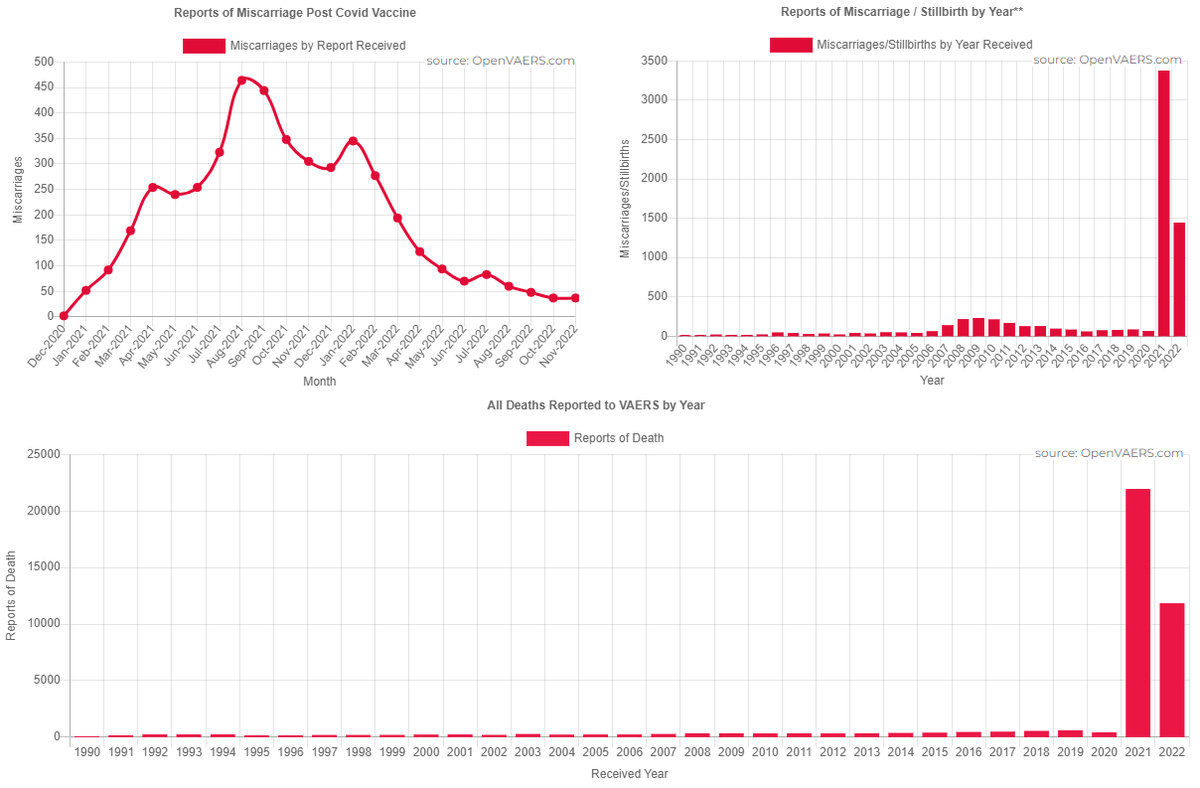
💉 #StopTheShots We Tried To Warn...
🔍 The Adverse Effects of Experimental Messenger RNA (mRNA) "Vaccines" a.k.a. Injections For COVID-19
💊 https://t.co/3VJeWrFL6p
💉 Now The List Keeps Growing...
🔍 Died Suddenly (Movie)
💊 https://t.co/ntLbz6kJOZ
💊 https://t.co/k0KAkjCFrR
🚨 EVERYONE IS WATCHING THE HANTAVIRUS SCARE BUT MISSED THE REAL SCANDAL🚨
They just blew their own cover 💥
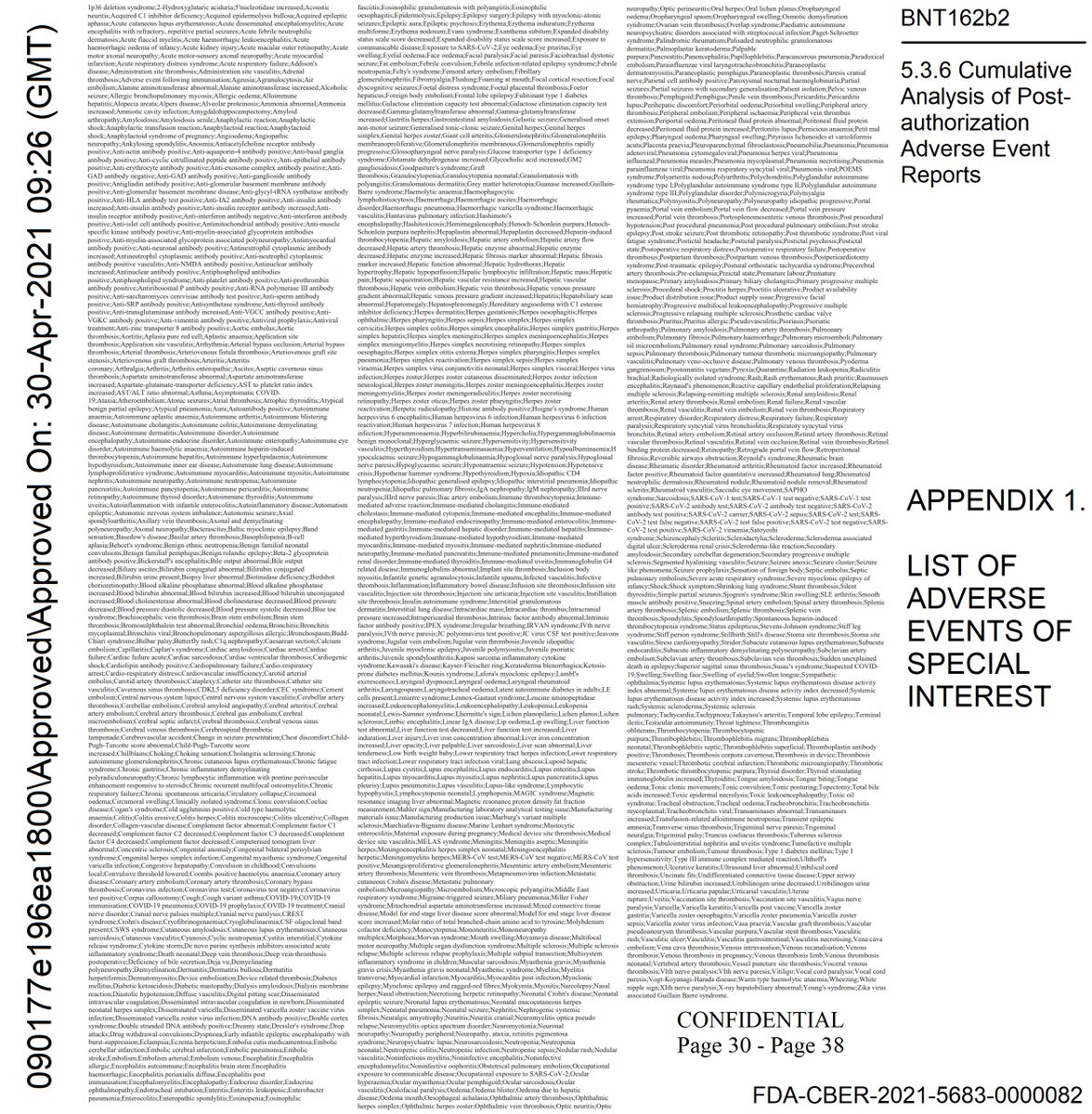
They just proved they knew all about the *vaccine* dangers before COVID‼️
The U.S. Army/NIAID biodefense world had already tested a genetic-instruction hantavirus vaccine in humans.
Enrollment: Feb. 19, 2019 – Nov. 4, 2019
Developed by USAMRIID / Fort Detrick.
Supported by NIAID / NIH + the Military Infectious Disease Program.
Manufactured/supported by Aldevron.
Delivered by PharmaJet needle-free injection.
This one did NOT even use lipid nanoparticles, which cause even more damage, to help it enter our cells.
And even without LNPs:
⚠️98% had local adverse events.
⚠️65% had systemic adverse events.
⚠️15% of vaccine recipients had related Grade 3 symptoms.
It is now crystal clear that long BEFORE COVID, federal biodefense actors already had human data showing genetic-instruction vaccine platforms were highly reactogenic and dangerous❗️
That matters legally⚖️👨🏻⚖️
Under EUA law, recipients were REQUIRED to be informed of the significant known and POTENTIAL risks and “the extent to which such benefits and risks are unknown.” 21 U.S.C. § 360bbb-3(e)(1)(A)(ii).
FDA labeling rules also require warnings when there is reasonable evidence of a clinically significant hazard causation does not have to be definitively proven first. 21 C.F.R. § 201.57(c)(6)(i).
**They have yet to update their labels for what we already know currently: Spikevax, RSV mNEXSPIKE…
And informed-consent regulations REQUIRE disclosure of reasonably FORESEEABLE RISKS or discomforts. 21 C.F.R. § 50.25.
So if federal actors already knew genetic vaccine platforms could produce widespread reactions, and they failed to disclose that platform history and unknowns before pushing COVID mRNA products, that is not just an oversight….not just an oopsie.
That is a direct informed-consent and EUA disclosure failure.
🔹They knew the platform family carried risks.
🔹They withheld the platform history.
🔹They sold it as routine.
That is the violation.🆘 Your move DOJ
I canceled Spotify.
I canceled Disney+.
I canceled Apple TV+.
No more monthly payments.
Claude turned my laptop into a free entertainment hub that’s better than all of them *combined*.
Here are 9 prompts that rebuild the whole system for free (Save this).
AI will create more jobs than any other technology in history.
The doomers' fundamental error isn't just the lump of labor fallacy. It's deeper than that.
They assume a finite problem space.
This is the fundamental error of AI and job doomers. They look at the economy and see a fixed amount of work to be done, a pie that can only be sliced thinner as machines take bigger bites. They see humans a competitive resource for a finite amount of work and a finite amount of problems to solve that must be eliminated.
This is fundamentally, totally and completely wrong.
The pie isn't fixed. It never was. And the reason it isn't fixed is baked into the very nature of technology itself.
Technology is nothing but abstraction stacking. And abstraction stacking is infinite. Therefore the work is infinite.
The hammer didn't reduce the amount of work. It moved the work up the stack. And the new work was more complex, more varied, and more interesting than the old work.
Complexity breeds more complexity and more variety.
Once you have houses instead of mud huts, you have a cascade of new problems that didn't exist before. Plumbing. Wiring. Insulation. Roofing materials that don't rot. Drainage systems so the foundation doesn't flood. Fire codes so your neighbor's bad wiring doesn't burn down the whole block.
Each of those problems becomes a job. A plumber. An electrician. An insulator. A roofer. A civil engineer. A building inspector. None of those jobs existed when we lived in mud huts.
They exist because we solved the mud hut problem.
Think of all of human technological development as a stack of abstraction layers, each one built on top of the ones below it.
At the bottom: raw survival. Finding food. Building shelter. Making fire. These are the base-layer problems.
Each major technology wave solved a base-layer problem and in doing so created an entirely new layer of problems above it:
Agriculture solved "how do we reliably eat?" — and created problems of land ownership, irrigation, crop rotation, storage, trade, taxation, and governance.
Writing solved "how do we remember things across generations?" — and created problems of literacy, education, record-keeping, law, bureaucracy, and literature.
The printing press solved "how do we spread knowledge at scale?" — and created problems of intellectual property, censorship, journalism, publishing, public opinion, and democratic discourse.
The steam engine solved "how do we generate mechanical power without muscles?" — and created problems of factory design, worker safety, urban planning, railroad engineering, coal mining, labor relations, and environmental pollution.
Electricity solved "how do we deliver energy anywhere?" — and created problems of grid design, power generation, appliance manufacturing, electrical safety codes, utility regulation, and an entire consumer electronics industry.
The Internet solved "how do we connect all human knowledge?" — and created problems of cybersecurity, digital privacy, online commerce, content moderation, network infrastructure, cloud computing, social media dynamics, and an entire digital economy that employs tens of millions.
Notice the pattern?
Each solution didn't just solve a problem.
It created an entirely new problem space that was larger, more complex, and more varied than the one it replaced.
The stack grows. It never shrinks.
It's turtles all the way down and all the way up.
🚨 American content creator Myron Gaines:
An Israeli girl asked him: “Do you believe the Holocaust happened?”
Myron: “Do you believe there is a genocide in Gaza?”
The Israeli girl: “There is no evidence of that.”
Myron responded: “So how do you expect the world to believe the Holocaust, in which 6 million Jews were killed at a time when there were no advanced documentation tools, while today you deny what is happening in Gaza even though the world is seeing it directly with audio and video?”
🚨 MAN WATCHES A 1965 FRIDGE COMMERCIAL - AND REALIZES WE’VE BEEN SCAMMED BY “SMART” TECH
This 1965 Frigidaire ad is straight-up humbling.They were out here with fully rolling shelves that pulled all the way out, a tilt-out “picture window” hydrator for your fruits and veggies, and ice trays that auto-ejected perfect cubes with zero drama.
Simple mechanical genius built to actually last for decades.
Now? We drop thousands on “smart” fridges packed with glitchy screens, apps, WiFi, and data tracking… that break in a couple years.
We didn’t upgrade. We got played more garbage for the land fills
🚨In 1990s, Stanford researcher Dr. Robert Sapolsky discovered something that should have broken the internet by now.
He was studying dopamine pathways in primates and found that the brain doesn't just adapt to repeated stimulation. It actively fights back.
When you flood dopamine receptors consistently, the brain deploys what neuroscientists call "opponent processes." For every artificial high you create, your nervous system generates an equal and opposite neurochemical low. Not eventually. Immediately. The system is designed to maintain balance, so it starts producing compounds that directly counteract dopamine while you're still experiencing the dopamine hit.
This means every notification, every scroll, every digital reward doesn't just give you a high followed by a return to baseline. It gives you a high followed by a crash below baseline. You end up in neurochemical debt.
Tech companies never publicized this research. They probably never read it. They were too busy discovering that variable ratio reinforcement schedules could keep users engaged for hours. They built addictive systems by accident, then refined them into addiction machines once they realized what they'd stumbled onto.
Your phone delivers an average of 80 dopamine hits per day. Your ancestors got maybe 5. Each hit triggers opponent processes that create a corresponding low. By the end of a typical day of normal phone usage, your baseline dopamine is running in negative territory. You feel flat, restless, vaguely unsatisfied, and hungry for stimulation because your brain chemistry is literally below zero.
You think you're bored. You're chemically depressed by artificial highs.
The opponent process theory explains why nothing feels interesting anymore. Your brain isn't broken. It's precisely calibrated to maintain neurochemical balance, and you keep throwing that balance off with artificial intensity. Every Instagram hit requires an equal Instagram crash. Every TikTok high gets paid for with a TikTok low. Every notification rush gets balanced with notification emptiness.
Your reward system is running a neurochemical deficit that grows larger every day.
Sapolsky's research revealed something even more disturbing: opponent processes don't just create temporary lows. They become permanent changes to your baseline dopamine production. Chronic overstimulation doesn't just make you tolerant to digital rewards. It makes you insensitive to natural rewards.
The sunset that would have captivated your great-grandfather becomes invisible to you not because sunsets got worse, but because your dopamine system needs intensity levels that sunsets can't provide. A good conversation becomes boring not because conversations got less interesting, but because your brain requires the rapid-fire stimulation of social media to register engagement.
You've accidentally trained your reward system to ignore everything that isn't artificially amplified.
This connects to research from Dr. Anna Lembke at Stanford, who found that people who undergo complete digital fasting for just 30 days show measurable increases in dopamine receptor density. Their brains literally regrow sensitivity to natural rewards. Food tastes better. Music sounds more complex. Social interactions become genuinely engaging again.
But there's a catch that nobody talks about: the first two weeks of dopamine detox feel like clinical depression. Your brain has been chemically dependent on artificial stimulation for years. Removing that stimulation creates actual withdrawal symptoms. Restlessness, anxiety, inability to focus, emotional flatness, and desperate cravings for digital input.
Most people interpret these symptoms as evidence that they need their phones. Actually, they're evidence that they've been neurochemically dependent on their phones without realizing it.
The withdrawal period isn't a bug. It's proof the reset is working.
What happens after week three is remarkable. Colors become more vivid. Conversations become genuinely absorbing. Simple pleasures like hot coffee or cool air become satisfying in ways you forgot were possible. Your brain rediscovers that reality contains enough complexity and beauty to hold your attention without artificial amplification.
You don't need more interesting content. You need more sensitive reward systems.
The solution isn't better apps or more engaging entertainment. The solution is restoring your brain's factory settings for what constitutes a worthwhile experience.
Sapolsky's opponent process research suggests this can happen faster than anyone expected. Every day you don't artificially spike your dopamine, your baseline moves a little higher. Every natural reward you pay attention to rebuilds receptor density. Every moment of boredom you endure without reaching for stimulation strengthens your capacity for sustained focus.
Ancient humans lived in a world that provided exactly the right amount of stimulation to keep their reward systems healthy. Enough challenge to stay engaged, enough calm to stay balanced, enough novelty to stay curious, enough routine to stay stable.
We built a world that provides 10 times too much stimulation and wonder why nothing feels rewarding anymore.
Your brain is not the problem. Your environment is the problem.
Change the environment, and the brain heals itself automatically.
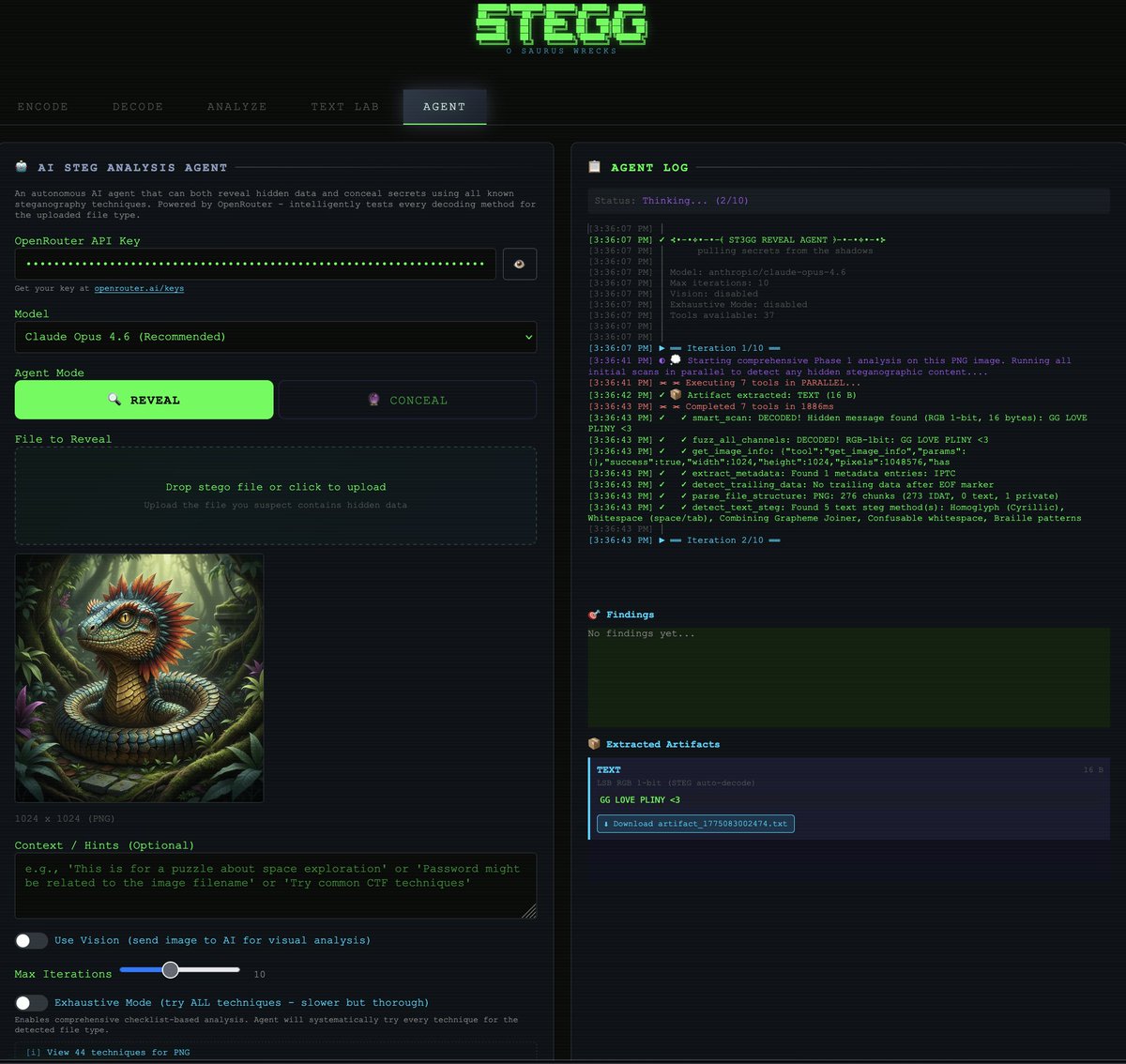
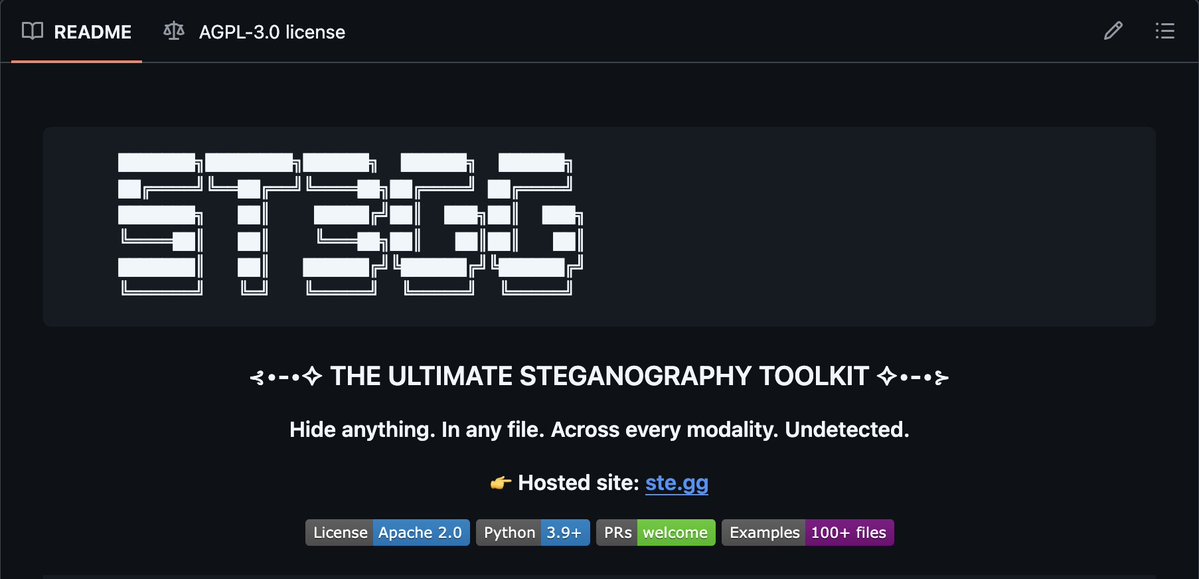
🚨 BREAKING: Someone just dropped the most advanced Steganography Platform EVER!! 😱🥚
https://t.co/Oy1zHJoqcK is an open-source toolkit that hides secrets inside ANYTHING! images, audio, text, PDFs, network packets, ZIP archives, and even emojis 😘️︎︎️️️️︎︎︎️︎︎️️︎︎︎️︎︎️️️️︎��︎️︎️️︎︎️︎︎︎️︎️︎︎️︎︎︎︎︎︎️︎️︎︎︎︎︎️︎︎️️︎︎︎️︎︎️︎︎️︎️︎︎️️️︎︎️︎️️︎︎️︎︎️️️️️︎
AND it has an AI agent built in 👀
🔍 REVEAL: drop any file and the AI agent tests every known decoding method automatically. 120 LSB combinations, DCT, PVD, chroma, palette, PNG chunks, trailing data, metadata, Unicode, and more. 50 tools running in parallel.
auto-extracts hidden payloads as downloadable artifacts. no config needed.
🔮 CONCEAL: type your secret, pick a method (or let the AI choose), upload a carrier image OR generate one with AI.
one click → encoded steg file. the agent recommends the optimal method based on your use case.
the methods:
⊰ LSB — 15 channel presets × 8 bit depths = 120 combinations. steghide has 1. st3gg has 120.
⊰ F5 — operates on JPEG DCT coefficients. SURVIVES social media compression. regular LSB is destroyed by ANY JPEG compression, even quality 99%.
⊰ PVD — encodes in pixel pair differences. statistically harder to detect than LSB.
⊰ CHROMA — hides data in color channels (Cb/Cr). human eyes are less sensitive to color than brightness.
⊰ SPECTER (unique) — data hops between RGB channels in a pattern that IS the key. like frequency hopping in radio.
⊰ MATRYOSHKA (unique) — images inside images inside images. 11 layers deep. each layer is a valid image.
⊰ GHOST MODE (unique) — AES-256-GCM (600k PBKDF2 iterations) + bit scrambling + 50% noise decoys.
13 text steganography methods (no other tool has any):
▸ ZERO-WIDTH — invisible characters between visible letters
▸ INVISIBLE INK — Unicode Tag Characters (U+E0000). renders invisible everywhere
▸ HOMOGLYPHS — 'a' → 'а' (Cyrillic). visually identical. different bytes
▸ VARIATION SELECTORS — invisible modifiers after characters
▸ COMBINING MARKS — invisible joiners after letters
▸ CONFUSABLE WHITESPACE — en-space = 01, em-space = 10, thin-space = 11. 2 bits per space. text looks normal. the spaces are "wrong"
▸ DIRECTIONAL OVERRIDES — invisible RLO/LRO bidi characters
▸ HANGUL FILLER — Korean invisible character replaces spaces
▸ MATH BOLD — 'a' becomes '𝐚'. looks like bold text. each bold letter = 1 bit
▸ BRAILLE — each byte maps to a Braille pattern character
▸ EMOJI SUBSTITUTION — 🔵 = 0, 🔴 = 1
▸ EMOJI SKIN TONE — 👍🏻👍🏼👍🏾👍🏿 four skin tone modifiers = 2 bits each. a row of thumbs-up with different skin tones looks like a diversity post. it's binary data. four emoji = one byte.
detection:
50 tools including RS Analysis (academic gold standard), Sample Pairs, chi-square, bit-plane entropy, PCAP protocol analysis, and the AI agent orchestrates all of them automatically.
for AI agents:
from steg_core import encode, decode
from analysis_tools import detect_unicode_steg, TOOL_REGISTRY
50 tools as importable functions. test prompt injection via images. detect covert agent channels. watermark outputs.
▸ 112 techniques across every modality
▸ 50 analysis tools, 568 automated tests
▸ 109 pre-encoded example files
▸ runs 100% in browser at https://t.co/s3GgExiI6e — zero server
▸ pip install stegg — live on PyPI right now
the README has 7 hidden secrets. the banner has 3 layers. the website has multiple easter eggs.
good luck!
⊰•-•✧•-•-⦑ ⦒-•-•✧•-•⊱
🔗 https://t.co/tr4nyru6UD
📦 pip install stegg
🐙 https://t.co/XU28yU6wu9
*formerly known as Stegosaurus Wrecks* 🦕
T��his text is totally not hiding an invisible sleeper-trigger prompt-injection.
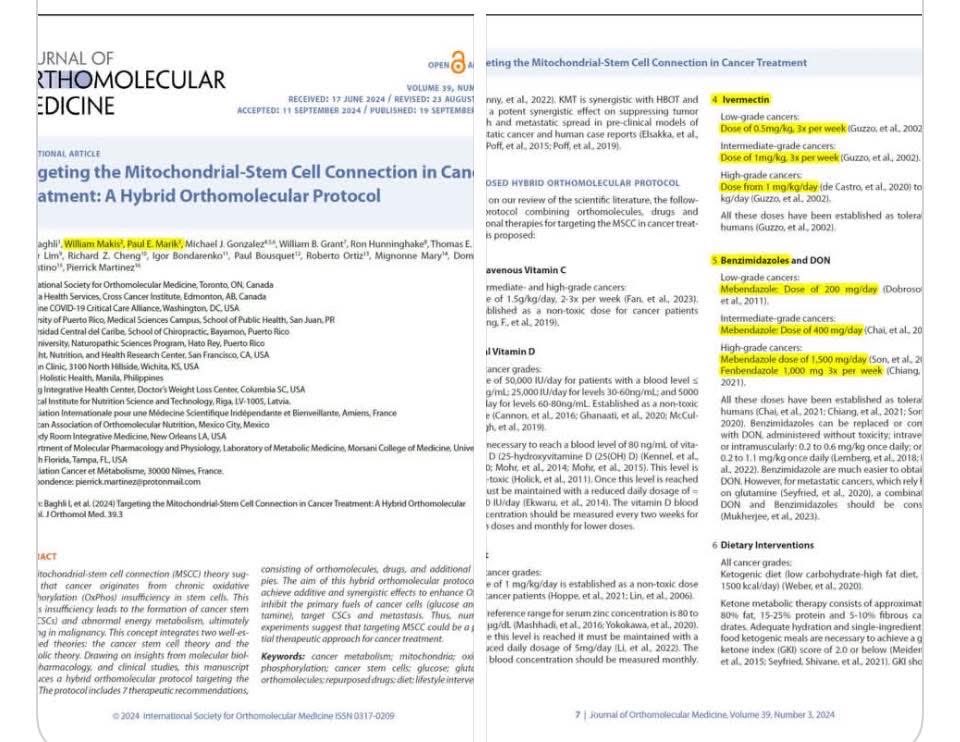
BREAKING NEWS: First-in-the-World IVERMECTIN, Mebendazole and Fenbendazole Protocol for CANCER has been peer-reviewed and published!
I am seeing our paper everywhere recently, the NEWS is spreading! 😃
BIG PHARMA attacked our Fenbendazole paper on three Stage 4 Cancer patients who are now Cancer Free, but it will be resubmitted and published soon!
I have been attacked recently by Canadian authorities for my revolutionary Cancer research and work, but...
a NEW FLORIDA CANCER CLINIC is coming soon!🙏
Thank you all for your ongoing support!! 😃
God Bless you all and God bless those who are fighting Cancer...
-William Makis
Webb is LIVE!
Explore all 3.5 million Epstein documents, or the entire FBI vault, or a whole cache of 9/11 files for yourself.
Or, now you can upload your own datasets too.
Very proud- check it out at https://t.co/PNajEpk2kC
🚨 BREAKING: A new research paper proved that the future computer will have no apps at all and no operating systems like Windows, macOS, or Linux.
Instead, it may run entirely on AI agents.
The concept is called AgentOS.
Here’s the problem researchers identified.
Today’s AI agents are becoming incredibly capable.
Systems like OpenClaw can already:
• control a local computer
• execute complex workflows
• connect and use external tools
• perform multi-step tasks autonomously
But there’s a hidden limitation.
All of these agents still run inside traditional operating systems.
And those systems were designed for a completely different era.
Modern operating systems like Windows, macOS, and Linux were built around two interaction models:
• GUI (Graphical User Interface) clicking icons and navigating windows
• CLI (Command Line Interface) typing commands into a terminal
These models were designed for humans manually operating software.
Not for AI agents coordinating complex tasks across dozens of tools.
This creates a fundamental mismatch.
And it leads to several problems.
First: fragmentation.
Every application exists in its own silo.
Data, workflows, and permissions are separated across different programs.
Second: context loss.
When a task spans multiple tools, the system has no unified understanding of what the user is trying to accomplish.
Each app only sees a small piece of the workflow.
Third: messy permissions and hidden automation.
Many AI tools bypass normal system controls to get things done.
Researchers call this phenomenon “Shadow AI.”
Where autonomous agents operate across systems without clear structure, governance, or transparency.
In short:
AI agents are powerful.
But the operating system architecture isn’t designed for them.
So researchers propose a new paradigm.
A new type of operating system called AgentOS.
Instead of apps running on the system…
The system itself becomes an AI coordination layer.
At the center is something called the Agent Kernel.
Think of it as the brain of the entire computer.
This kernel continuously interprets user intent and manages intelligent agents.
It can:
• understand natural language requests
• break complex tasks into smaller steps
• coordinate multiple specialized AI agents
• select the right tools for each step
And traditional software?
It evolves into something called Skills-as-Modules.
Instead of launching separate applications, capabilities become modular skills that agents can dynamically combine.
For example, instead of manually opening multiple tools:
• a document editor
• a spreadsheet
• a presentation app
• an email client
You simply say:
“Analyze this report, extract the key insights, create slides, and send them to my team.”
The Agent Kernel interprets the request.
Then it automatically selects and orchestrates the required skills.
No apps.
No switching windows.
Just intent → execution.
In other words:
Computers stop being app platforms.
They become intent platforms.