Bridges are useful, until they become the weak link. 🔗
$ICP’s Chain Fusion lets canisters interact with Bitcoin, Ethereum, and Solana without traditional wrapped-token bridges.
Read more👇
https://t.co/0jyWfxsmm4
Hello MULTI/DEX 🔥 Should DFINITY release the most powerful DeFi application the world has ever seen?
What's cool about it? Here are some factoids, the craziest at the end:
1. It runs on an ICP cloud engine (soon everyone can have one) and is 100% network resident and tamperproof.
2. It is genuinely multi-chain, with no bridging hassles for users (users can deposit straight into their accounts, and withdraw directly, from the native chains of tokens).
3. It is order book based, but also provides a traditional swap interface, which swaps arbitrary assets by routing across the underlying markets.
4. It supports both spot trading, and margin trading that lets traders go long and short with leverage.
5. It has an AMM (Automated Market Maker) that uses Internet Computer outcalls to determine outside prices, then delayed matching against AMM limit orders to prevent arbitrageurs draining liquidity, as can occur with traditional DEXs providing swaps.
6. The AMM maintains a unified liquidity vault, and doesn't need two liquidity pools for every trading pair, providing outstanding capital efficiency and liquidity compared with traditional DeFi systems.
7. Users can earn by depositing into the AMM Vault, and into an insurance pool that protects the vault from margin calls that fail to recover all capital (the insurance pool gets 5% of all liquidations).
8. MULTI/DEX runs on the decentralized Internet Computer network, and is 100% open source — unlike HyperLedger, say, which remains closed source, and has an single-purpose architecture closer to federated CEX hosted on a symmetric cluster of federated servers.
9. If we go ahead, we would propose that MULTI/DEX runs as part of the Internet Computer, in the sense it is controlled and updated by the NNS (The Internet Computer's Network Nervous System, the world's largest and most sophisticated DAO, which directly orchestrates and updates the network) providing unparalleled levels of autonomy, transparency, and security.
10.... and this is the BIG ONE... its backend is built using the latest Motoko language framework (soon to be released) that puts AI *inside* of its software. That means, in another seminal inventive step from DFINITY and Caffeine Labs technology teams, that AI can see, browse and query the realtime data inside the app/dapp's persistent memory and can create and execute ad hoc queries and update logic on-the-fly (subject to permissions). So, while for much of the time traders will be using the traditional UX shown in the pic, increasingly, they will be interacting with the exchange through AI chats that have the "Internet Computer Connector" MCP installed (soon to be released). On the one hand, traders will be able to use chat to ask for simple things, like current spot pricing and market depth, and the likely slippage on a spot market order, and for orders to be submitted, but on the other, for much more demanding things that require the AI to execute ad hoc functionality, such as "Look at my positions and margin pools, and rebalance them to give me more blended market exposure, while also adjusting for risks indicated by social media coverage of forthcoming market events, but wait for my approval of your plan before proceeding."
This is a lot to take in, so I'm aiming to get a new demo video out ASAP that will demonstrate what's possible with this AIware, which will include MULTI/DEX — should be about a week!!
Btw. for those wondering what might be the big picture beyond what I just described with MULTI/DEX: At DFINITY, we are in the process of transforming ourselves into an "agentic organization," where all our existing apps/SaaS is replaced by custom on-demand apps/SaaS running on cloud engines that are created and updated by AI. Of course, these on-demand apps/SaaS are being built using the new technology described that automatically puts AI inside and provides users with fluid functionality via chat. The totality of the apps/SaaS represents an enterprise "World Model," which incorporates as much of the enterprise's data as possible, enabling AI to perform incredibly powerful analyses and actions — when you see this is in action, you can't unsee what you saw, because it's clearly a huge leap beyond the status quo of today's tech, which is exactly what the Internet Computer project is about. This wraps up our new technology stack, created by leaning on unique aspects of "The Network is The Cloud" paradigm, and years of work, and what, together with cloud engines, will finally enable the Internet Computer to strike out into the massive mainstream cloud technology market.
Connect Claude, ChatGPT, Cursor, Perplexity, or Codex to Caffeine.
The Caffeine MCP server is live.
One URL. One browser sign-in.
Describe what you want built from inside your AI tool - it sends the prompt straight to Caffeine. Get updates on what's being built without leaving your conversation. When it's done, ask your AI to review it. It reads the Caffeine conversation directly, so it has full context on every decision.
Soon I will demonstrate how AI can be "inside" an arbitrary ICP app, service or website built using the latest Motoko, understanding all its data, analysing it any way you want, and taking actions, without need for one special line of code. Insane and groundbreaking.
🚨DID YOU KNOW?
The Internet Computer ( ICP ) is the ONLY blockchain that enables you to host your entire frontend (UI) as a smart contract.
Link in the comments 🔗👇
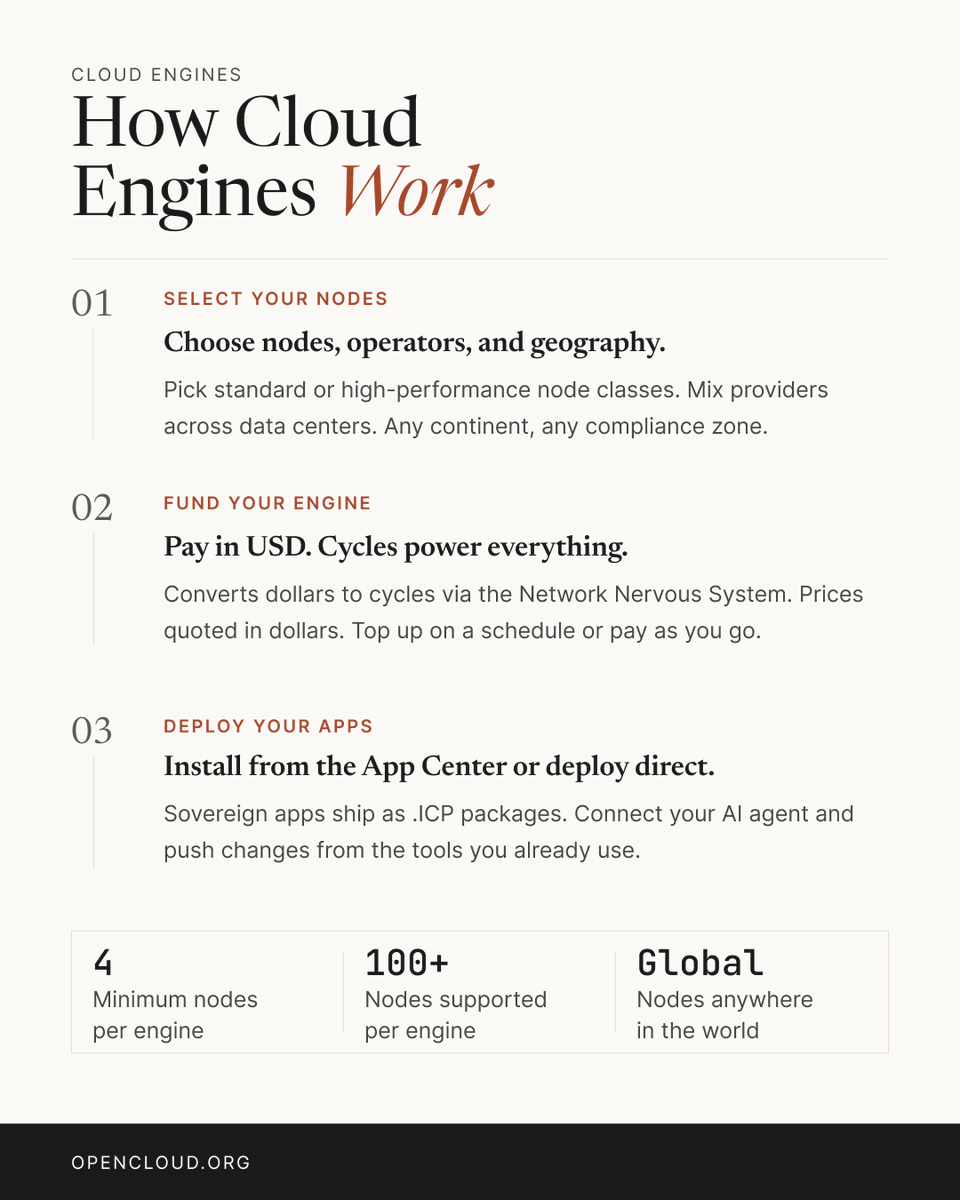
Cloud engines run in three steps.
1) Select your nodes
Pick hardware, operators, geography. 4 to 100 nodes per engine, any continent.
2) Fund your engine
Pay in USD. Cycles power everything. No infra overhead.
3) Deploy your apps
Install from App Center or push direct. Connect your AI agent. Zero servers to manage.
One node fails. Apps keep running.
https://t.co/rrn4Ki3a7H
Next Week Could Be Crucial for Internet Computer
Internet Computer (@Dfinity) executive @PierreSamaties prepares to showcase the Internet Computer sovereign cloud to government and enterprise leaders in Paris next week.
The presentation frames $ICP as a critical IT stack for public and private institutions requiring absolute data sovereignty and zero single points of failure.
This outreach targets high-level decision-makers seeking decentralized alternatives to legacy cloud providers as data localization laws tighten across the European Union.
Three things most clouds can't promise:
1) Tamperproof. Runs on a mathematical network, not servers.
2) Always on. No sysadmin team required.
3) Yours. No vendor lock-in, no backdoors.
Cloud Engines deliver all three.
Internet Computer’s Cloud Engines Bring AI-Powered Apps Without Human Input
In a post today, the DFINITY Foundation (@dfinity) spotlighted a core advantage of its new Cloud Engines on the Internet Computer.
According to the post, Cloud Engines enables AI to build and update production apps safely, without constant human oversight.
Traditional clouds require teams to fix infrastructure hacks, downtime, and data-loss errors after AI-driven updates.
Cloud Engines eliminates these risks through tamperproof protocol-level security and guaranteed uptime (even if nodes fail).
The result:
- Sovereign, always-on frontier cloud where AI agents create tamperproof SaaS directly on-chain.
- No sysadmins.
- No vendor lock-in.
- Full ownership by the builder.
Announced around ICP’s 5-year anniversary, Cloud Engines are designed for the AI era.
This positions the ICP as the go-to decentralized cloud for the next wave of autonomous AI development.