Here’s the full Tesla Roadster unveiling event.
0:15 – Crazy Tesla + SpaceX collab preview 2:25 – Last manually driven Tesla car 2:53 – Taking it way past the limits 3:15 – Countdown & first flight works 5:38 – Flying cars are real 5:41 – Peter Thiel flying cars quote 6:02 – Fan suction system (up to 2G) 6:16 – Downforce & crushing track records 7:08 – Starman appearance 7:52 – Rocket thrusters & full gymnastics 8:52 – Kickflip demo (Tony Hawk approved) 9:32 – Real road car + rocket car future 9:56 – Air tanks, nozzles & specs 10:14 – Rechargeable ultra-high pressure air 10:36 – Car reveal & aerospace design 12:50 – Fan modes 13:37 – Variable pitch rear wing 13:50 – 0-60 goal under 1 second 14:21 – Acceleration demo 16:22 – 0.81s 0-60 achieved 16:26 – Production car will be even quicker 17:05 – World’s quickest production car 17:28 – Top speed & Snake River Canyon teaser 18:26 – Mach 0.5+ goal 18:52 – First best flying car + last best driver’s car 19:04 – Production starts 2028
🇵🇹 Carta aberta ao Governo de Portugal
@LMontenegroPSD@Leitao_Amaro@miguelluz
Senhor Primeiro-Ministro Luís Montenegro, Senhor Ministro António Leitão Amaro, Senhor Ministro Miguel Pinto Luz,
Escrevo como alguém que escolheu Portugal para viver. Tenho um pedido simples: tragam o Tesla FSD (Supervised) para Portugal.
A 10 de abril, os Países Baixos foram o primeiro país europeu a aprovar o sistema, depois de 18 meses de testes independentes da autoridade RDW. Em dois meses, a Lituânia, a Estónia, a Dinamarca e a Bélgica seguiram o exemplo. Nenhum destes países repetiu os testes. Reconheceram a homologação neerlandesa ao abrigo do quadro europeu (UN R-171) e aprovaram com base nos dados que já existem.
Os resultados falam por si: nos Países Baixos, cerca de 40.000 Teslas já percorreram 24 milhões de quilómetros sem incidentes relevantes, segundo a própria RDW. Os carros com FSD registaram 3,5 vezes menos colisões do que a condução manual.
E é aqui que isto deixa de ser sobre tecnologia e passa a ser sobre vidas. Só este ano já morreram mais de 220 pessoas nas estradas portuguesas, mais 25% do que no ano passado. Portugal está acima da média europeia na mortalidade rodoviária. A ANSR diz que as principais causas são humanas: velocidade, álcool, distração. Um sistema que nunca se distrai, nunca bebe e nunca adormece evita mortes que vão acontecer com condutores humanos. O próprio Governo chamou à sinistralidade uma chaga social. Esta é uma forma concreta de a combater.
Portugal pode fazer o mesmo que a Dinamarca e a Bélgica: o IMT analisa o dossier da RDW e aprova. Não custa nada ao Estado e coloca Portugal à frente da Alemanha, da França e da Espanha.
Há 500 anos, Portugal liderou o mundo numa nova tecnologia: a navegação. Partiu à frente de todos e deu novos mundos ao mundo. Portugal pode voltar a estar na fronteira de uma nova tecnologia e liderar como fez há 500 anos. Cada mês de espera custa vidas. Basta decidir.
Com admiração e respeito,
-@levelsio
Mainstream media review from the @Independent after trying Tesla's FSD (Supervised) in the Netherlands:
"The car behaved impeccably. And it’s so simple to use. What’s most remarkable is how unremarkable it all is. The car accelerates with confidence – not super-speedy but a very natural acceleration – and it corners smoothly. The car will overtake when it needs to (I was always checking the mirrors, just in case) and on occasions, it even swapped lanes approaching traffic lights when it spotted an advantage to be had – just as I would.
And around the busy streets of the city centre, the car’s ability to spot every single hazard and react accordingly, was hugely impressive. Had I not been using FSD, I may have been a little more strident in squeezing between pedestrians and cycles, but the impeccably mannered Model Y always gave these more vulnerable road users the benefit of the doubt.
The way the car turned sharply and cruised down narrow, cobbled streets – judging its width more confidently than I might in certain situations – was impressive, too. As was the fact that the hundreds of people we passed on Amsterdam’s streets seemed to have no idea that it was the car doing the driving – although there was the odd double-take when they realised my hands weren’t on the steering wheel.
I’d highly recommend that you just give it a go – and I say the same about electric cars: try it, you might just like it."
Great to see some mainstream media giving FSD a fair go. You can read Steve's full review here: https://t.co/Ds4kacNdCZ
De toekomst van mobiliteit is aangebroken
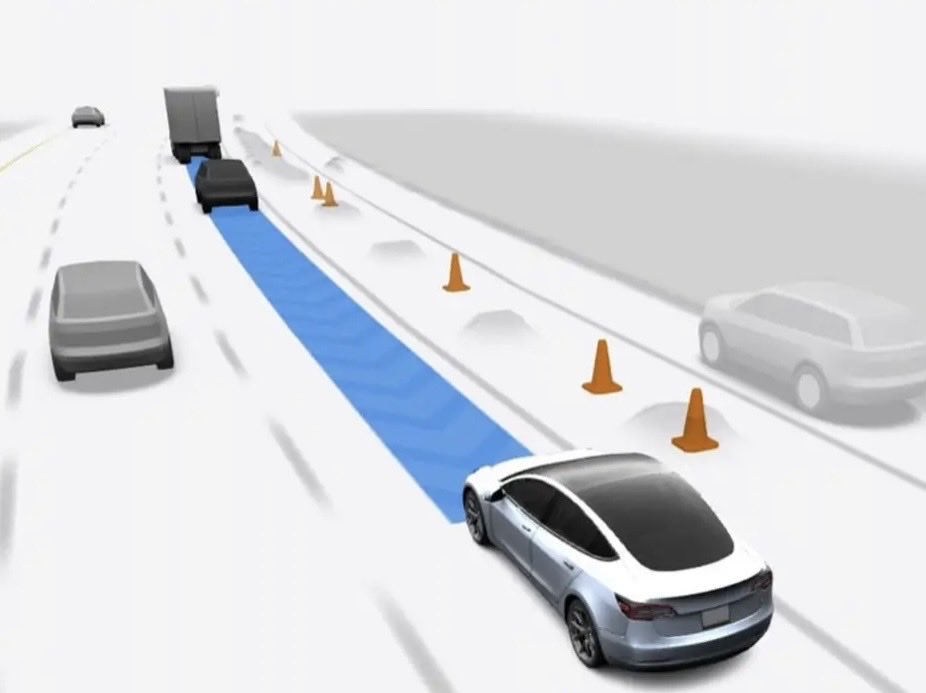
FSD Supervised has been approved in the Netherlands 🇳🇱 & will begin rolling out in the country shortly!
Trained on billions of kilometers of real-world driving data, it can drive you almost anywhere under your supervision – from residential roads to city streets & highways
No other vehicle can do this.
We're excited to bring FSD Supervised to more European countries soon
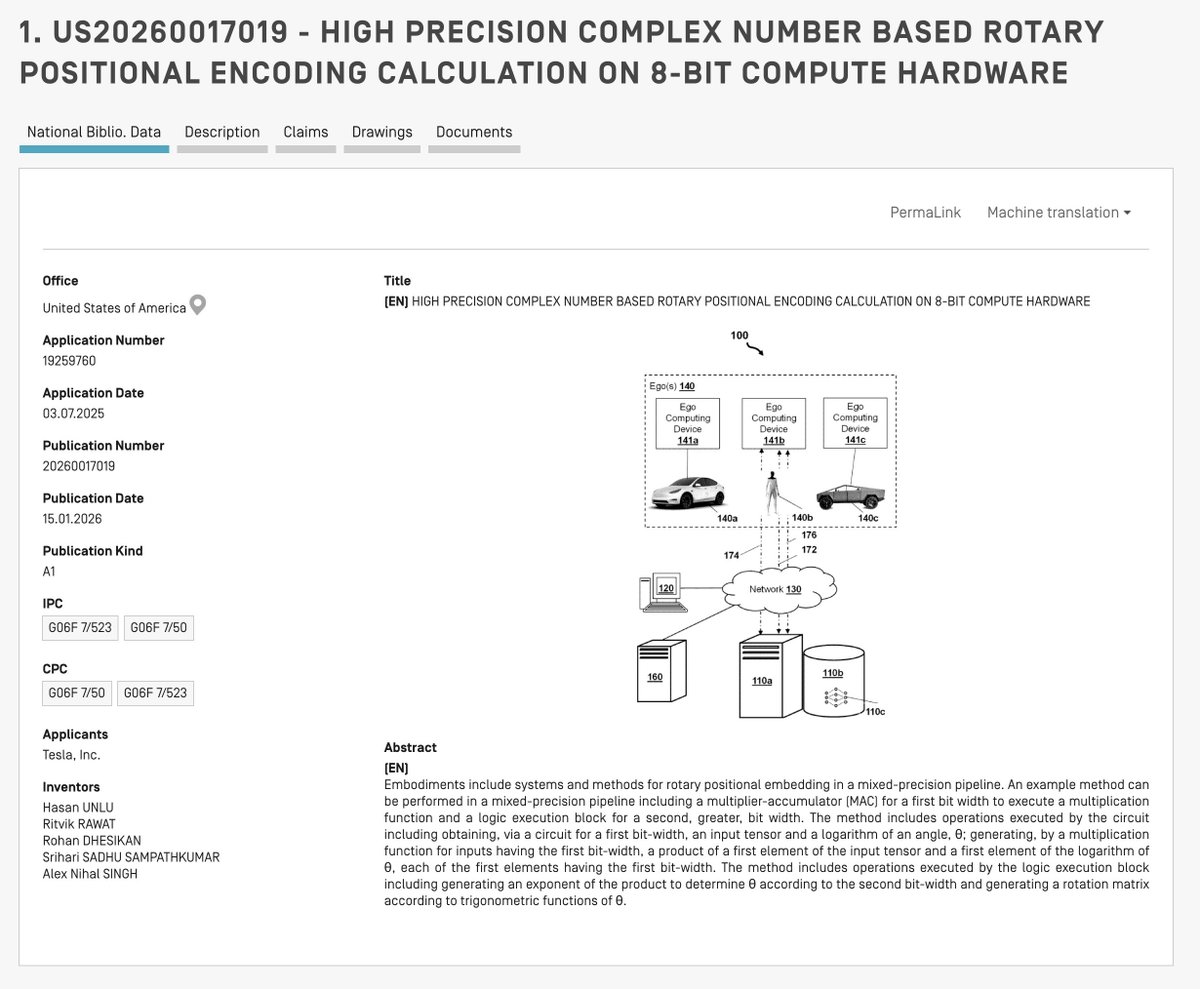
BREAKING 🚨 TESLA HAS PATENTED A "MATHEMATICAL CHEAT CODE" THAT FORCES CHEAP 8-BIT CHIPS TO RUN ELITE 32-BIT AI MODELS AND REWRITES THE RULES OF SILICON 🐳
How does a Tesla remember a stop sign it hasn’t seen for 30 seconds, or a humanoid robot maintain perfect balance while carrying a heavy, shifting box?
It comes down to Rotary Positional Encoding (RoPE)—the "GPS of the mind" that allows AI to understand its place in space and time by assigning a unique rotational angle to every piece of data.
Usually, this math is a hardware killer. To keep these angles from "drifting" into chaos, you need power-hungry, high-heat 32-bit processors (chips that calculate with extreme decimal-point precision).
But Tesla has engineered a way to cheat the laws of physics. Freshly revealed in patent US20260017019A1, Tesla’s "MIXED-PRECISION BRIDGE" is a mathematical translator that allows inexpensive, power-sipping 8-bit hardware (which usually handles only simple, rounded numbers) to perform elite 32-bit rotations without dropping a single coordinate.
This breakthrough is the secret "Silicon Bridge" that gives Optimus and FSD high-end intelligence without sacrificing a mile of range or melting their internal circuits. It effectively turns Tesla’s efficient "budget" hardware into a high-fidelity supercomputer on wheels.
📉 The problem: the high cost of precision
In the world of self-driving cars and humanoid robots, we are constantly fighting a war between precision and power. Modern AI models like Transformers rely on RoPE to help the AI understand where objects are in a sequence or a 3D space.
The catch is that these trigonometric functions (sines and cosines) usually require 32-bit floating-point math—imagine trying to calculate a flight path using 10 decimal places of accuracy.
If you try to cram that into the standard 8-bit multipliers (INT8) used for speed (which is like rounding everything to the nearest whole number), the errors pile up fast. The car effectively goes blind to fine details.
For a robot like Optimus, a tiny math error means losing its balance or miscalculating the distance to a fragile object. To bridge this gap without simply adding more expensive chips, Tesla had to fundamentally rethink how data travels through the silicon.
🛠️ Tesla's solution: the logarithmic shortcut & pre-computation
Tesla’s engineers realized they didn't need to force the whole pipeline to be high-precision. Instead, they designed the Mixed-Precision Bridge.
They take the crucial angles used for positioning and convert them into logarithms. Because the "dynamic range" of a logarithm is much smaller than the original number, it’s much easier to move that data through narrow 8-bit hardware without losing the "soul" of the information.
It’s a bit like dehydrating food for transport; it takes up less space and is easier to handle, but you can perfectly reconstitute it later.
Crucially, the patent reveals that the system doesn't calculate these logarithms on the fly every time. Instead, it retrieves pre-computed logarithmic values from a specialized "cheat sheet" (look-up storage) to save cycles.
By keeping the data in this "dehydrated" log-state, Tesla ensures that the precision doesn't "leak out" during the journey from the memory chips to the actual compute cores. However, keeping data in a log-state is only half the battle; the chip eventually needs to understand the real numbers again.
🏗️ The recovery architecture: rotation matrices & Horner’s method
When the 8-bit multiplier (the Multiplier-Accumulator or MAC) finishes its job, the data is still in a "dehydrated" logarithmic state. To bring it back to a real angle theta without a massive computational cost, Tesla’s high-precision ALU uses a Taylor-series expansion optimized via Horner’s Method.
This is a classic computer science trick where a complex equation (like an exponent) is broken down into a simple chain of multiplications and additions.
By running this in three specific stages—multiplying by constants like 1/3 and 1/2 at each step—Tesla can approximate the exact value of an angle with 32-bit accuracy while using a fraction of the clock cycles.
Once the angle is recovered, the high-precision logic generates a Rotation Matrix (a grid of sine and cosine values) that locks the data points into their correct 3D coordinates.
This computational efficiency is impressive, but Tesla didn't stop at just calculating faster; they also found a way to double the "highway speed" of the data itself.
🧩 The data concatenation: 8-bit inputs to 16-bit outputs
One of the most clever hardware "hacks" detailed in the patent is how Tesla manages to move 16-bit precision through an 8-bit bus. They use the MAC as a high-speed interleaver—effectively a "traffic cop" that merges two lanes of data.
It takes two 8-bit values (say, an X-coordinate and the first half of a logarithm) and multiplies one of them by a power of two to "left-shift" it.
This effectively glues them together into a single 16-bit word in the output register, allowing the low-precision domain to act as a high-speed packer for the high-precision ALU to "unpack".
This trick effectively doubles the bandwidth of the existing wiring on the chip without requiring a physical hardware redesign. With this high-speed data highway in place, the system can finally tackle one of the biggest challenges in autonomous AI: object permanence.
🧠 Long-context memory: remembering the stop sign
The ultimate goal of this high-precision math is to solve the "forgetting" problem. In previous versions of FSD, a car might see a stop sign, but if a truck blocked its view for 5 seconds, it might "forget" the sign existed.
Tesla uses a "long-context" window, allowing the AI to look back at data from 30 seconds ago or more.
However, as the "distance" in time increases, standard positional math usually drifts. Tesla's mixed-precision pipeline fixes this by maintaining high positional resolution, ensuring the AI knows exactly where that occluded stop sign is even after a long period of movement.
The RoPE rotations are so precise that the sign stays "pinned" to its 3D coordinate in the car's mental map. But remembering 30 seconds of high-fidelity video creates a massive storage bottleneck.
⚡ KV-cache optimization & paged attention: scaling memory
To make these 30-second memories usable in real-time without running out of RAM, Tesla optimizes the KV-cache (Key-Value Cache)—the AI's "working memory" scratchpad.
Tesla’s hardware handles this by storing the logarithm of the positions directly in the cache. This reduces the memory footprint by 50% or more, allowing Tesla to store twice as much "history" (up to 128k tokens) in the same amount of RAM.
Furthermore, Tesla utilizes Paged Attention—a trick borrowed from operating systems. Instead of reserving one massive, continuous block of memory (which is inefficient), it breaks memory into small "pages".
This allows the AI5 chip to dynamically allocate space only where it's needed, drastically increasing the number of objects (pedestrians, cars, signs) the car can track simultaneously without the system lagging.
Yet, even with infinite storage efficiency, the AI's attention mechanism has a flaw: it tends to crash when pushed beyond its training limits.
🔒 Pipeline integrity: the "read-only" safety lock
A subtle but critical detail in the patent is how Tesla protects this data. Once the transformed coordinates are generated, they are stored in a specific location that is read-accessible to downstream components but not write-accessible by them.
Furthermore, the high-precision ALU itself cannot read back from this location.
This one-way "airlock" prevents the system from accidentally overwriting its own past memories or creating feedback loops that could cause the AI to hallucinate. It ensures that the "truth" of the car's position flows in only one direction: forward, toward the decision-making engine.
🌀 Attention sinks: preventing memory overflow
Even with a lean KV-cache, a robot operating for hours can't remember everything forever. Tesla manages this using Attention Sink tokens.
Transformers tend to dump "excess" attention math onto the very first tokens of a sequence, so if Tesla simply used a "sliding window" that deleted old memories, the AI would lose these "sink" tokens and its brain would effectively crash.
Tesla's hardware is designed to "pin" these attention sinks permanently in the KV-cache. By keeping these mathematical anchors stable while the rest of the memory window slides forward, Tesla prevents the robot’s neural network from destabilizing during long, multi-hour work shifts.
While attention sinks stabilize the "memory", the "compute" side has its own inefficiencies—specifically, wasting power on empty space.
🌫️ Sparse tensors: cutting the compute fat
Tesla’s custom silicon doesn't just cheat with precision; it cheats with volume. In the real world, most of what a car or robot sees is "empty" space (like clear sky).
In AI math, these are represented as "zeros" in a Sparse Tensor (a data structure that ignores empty space). Standard chips waste power multiplying all those zeros, but Tesla’s newest architecture incorporates Native Sparse Acceleration.
The hardware uses a "coordinate-based" system where it only stores the non-zero values and their specific locations. The chip can then skip the "dead space" entirely and focus only on the data that matters—the actual cars and obstacles.
This hardware-level sparsity support effectively doubles the throughput of the AI5 chip while significantly lowering the energy consumed per operation.
🔊 The audio edge: Log-Sum-Exp for sirens
Tesla’s "Silicon Bridge" isn't just for vision—it's also why your Tesla is becoming a world-class listener. To navigate safely, an autonomous vehicle needs to identify emergency sirens and the sound of nearby collisions using a Log-Mel Spectrogram approach (a visual "heat map" of sound frequencies).
The patent details a specific Log-Sum-Exp (LSE) approximation technique to handle this. By staying in the logarithm domain, the system can handle the massive "dynamic range" of sound—from a faint hum to a piercing fire truck—using only 8-bit hardware without "clipping" the loud sounds or losing the quiet ones.
This allows the car to "hear" and categorize environmental sounds with 32-bit clarity. Of course, all this high-tech hardware is only as good as the brain that runs on it, which is why Tesla's training process is just as specialized.
🎓 Quantization-aware training: pre-adapting the brain
Finally, to make sure this "Mixed-Precision Bridge" works flawlessly, Tesla uses Quantization-Aware Training (QAT).
Instead of training the AI in a perfect 32-bit world and then "shrinking" it later—which typically causes the AI to become "drunk" and inaccurate—Tesla trains the model from day one to expect 8-bit limitations.
They simulate the rounding errors and "noise" of the hardware during the training phase, creating a neural network that is "pre-hardened". It’s like a pilot training in a flight simulator that perfectly mimics a storm; when they actually hit the real weather in the real world, the AI doesn’t "drift" or become inaccurate because it was born in that environment.
This extreme optimization opens the door to running Tesla's AI on devices far smaller than a car.
🚀 The strategic roadmap: from AI5 to ubiquitous edge AI
This patent is not just a "nice-to-have" optimization; it is the mathematical prerequisite for Tesla’s entire hardware roadmap. Without this "Mixed-Precision Bridge", the thermal and power equations for next-generation autonomy simply do not work.
It starts by unlocking the AI5 chip, which is projected to be 40x more powerful than current hardware. Raw power is useless if memory bandwidth acts as a bottleneck.
By compressing 32-bit rotational data into dense, log-space 8-bit packets, this patent effectively quadruples the effective bandwidth, allowing the chip to utilize its massive matrix-compute arrays without stalling.
This efficiency is critical for the chip's "half-reticle" design, which reduces silicon size to maximize manufacturing yield while maintaining supercomputer-level throughput.
This efficiency is even more critical for Tesla Optimus, where it is a matter of operational survival. The robot runs on a 2.3 kWh battery (roughly 1/30th of a Model 3 pack).
Standard 32-bit GPU compute would drain this capacity in under 4 hours, consuming 500W+ just for "thinking".
By offloading complex RoPE math to this hybrid logic, Tesla slashes the compute power budget to under 100W. This solves the "thermal wall", ensuring the robot can maintain balance and awareness for a full 8-hour work shift without overheating.
This stability directly enables the shift to End-to-End Neural Networks. The "Rotation Matrix" correction described in the patent prevents the mathematical "drift" that usually plagues long-context tracking.
This ensures that a stop sign seen 30 seconds ago remains "pinned" to its correct 3D coordinate in the World Model, rather than floating away due to rounding errors.
Finally, baking this math into the silicon secures Tesla's strategic independence. It decouples the company from NVIDIA’s CUDA ecosystem and enables a Dual-Foundry Strategy with both Samsung and TSMC to mitigate supply chain risks.
This creates a deliberate "oversupply" of compute, potentially turning its idle fleet and unsold chips into a distributed inference cloud that rivals AWS in efficiency.
But the roadmap goes further. Because this mixed-precision architecture slashes power consumption by orders of magnitude, it creates a blueprint for "Tesla AI on everything".
It opens the door to porting world-class vision models to hardware as small as a smart home hub or smartphone. This would allow tiny, cool-running chips to calculate 3D spatial positioning with zero latency—bringing supercomputer-level intelligence to the edge without ever sending private data to a massive cloud server.
World's first autonomous delivery of a car!
This Tesla drove itself from Gigafactory Texas to its new owner's home ~30min away — crossing parking lots, highways & the city to reach its new owner
Do you study history to understand the shifts that are about to come?
This morning I'm playing around with "what will the world look like in a decade?"
Back in the late 1980s I had many arguments with people who thought we would always be using DOS.
When I started my career there were many who thought that, back when the graphical user interfaces that were new, back in the 1980s, were a waste of time.
I had many arguments. Many companies, like Borland and Wordperfect, were run by people like that. We know now that was the wrong way to run companies, they are gone because of their belief systems and attempts to stick to the past.
It ignores that humans change, even when they tell you they never will. All my career I've done human research, studying this resistance to change. Bill Gates told me I had no business value when I told him to buy all of Web 2.0. He couldn't see that humans were about to change.
Let's dig in.
I am the 3rd person in the world to receive the @Neuralink brain implant.
1st with ALS. 1st Nonverbal.
I am typing this with my brain. It is my primary communication.
Ask me anything! I will answer at least all verified users!
Thank you @elonmusk!
@xAI has acquired @X in an all-stock transaction. The combination values xAI at $80 billion and X at $33 billion ($45B less $12B debt).
Since its founding two years ago, xAI has rapidly become one of the leading AI labs in the world, building models and data centers at unprecedented speed and scale.
X is the digital town square where more than 600M active users go to find the real-time source of ground truth and, in the last two years, has been transformed into one of the most efficient companies in the world, positioning it to deliver scalable future growth.
xAI and X’s futures are intertwined. Today, we officially take the step to combine the data, models, compute, distribution and talent. This combination will unlock immense potential by blending xAI’s advanced AI capability and expertise with X’s massive reach. The combined company will deliver smarter, more meaningful experiences to billions of people while staying true to our core mission of seeking truth and advancing knowledge. This will allow us to build a platform that doesn’t just reflect the world but actively accelerates human progress.
I would like to recognize the hardcore dedication of everyone at xAI and X that has brought us to this point. This is just the beginning.
Thank you for your continued partnership and support.