Ribo-Seq has unearthed thousands of fascinating cases of translation complexity over the last decade. Through the exploration of Ribo-Seq datasets it became clear that a more accurate representation is required to help us better understand this complexity. #Translation#RiboSeq
@ATinyGreenCell CDS annotations should represent what is believed to be decoded from the RNA into a protein product. First ATG of the CDS open reading frame is reasonable in Eukaryotes.
Human gene CACNAD1 has an annotated CDS that starts with 7 ATGs. 589 genes have CDSs that start with >=2 Ms
A large consortium of researchers introduces the term 'translon' to denote any transcriptome region that is decoded by ribosomes.
https://t.co/b2uC7C5zvm
@ewjwallace@guo_lab Transcript leader is definitely my preferred term for TSS -> CDS region. But any leader of decent length more often than not will contain translons so there is need for more fundamental units if we want to characterise the translation of these RNAs properly
@guo_lab If you wish haha but I would be interested in hearing a good definition of a 5' untranslated region as the classic definition of region between TSS and CDS is more often a misnomer than not. We played with the idea of a scantron for the scanned rather than translated regions 5'
@guo_lab The necessity for such a unit of translation became clear during my PhD when we were developing the Ribosome Decision Graph concept
https://t.co/1C8rwS1jhm
@guo_lab No problem. But like in “exon” vs “expressed region” the -on suffix is the mark of a fundamental unit across science and we want to conceptually establish a unit to allow us to describe what is translated and the relationships between these regions
There is a lack of general terminology for translated regions that does not depend on the properties of their products or their sequence. Spearheaded by Pavel (Pasha) Baranov, this primer provides a unifying nomenclature for translation units: *Translon*
https://t.co/G78Tmgc21e
Writing this short correspondence sparked great semantic discussions with leaders of a diverse set of fields and particularly among the primary instigators of this initiative (myself, Michał Świrski, Eivind Valen (@eviledv) and Pasha Baranov)
Full Text:
https://t.co/H3d5McJ3Hb
Many transcriptome regions are translated but not known to encode proteins. They remain poorly annotated and thus under studied, partly due to the lack of terminology for these features.
In @naturemethods we propose using "Translon" for any region decoded by the ribosome
Just as Walter Gilbert's exon/intron terminology ('Why genes in pieces?', Nature 1978) gave us language to discuss and understand gene structure, 'Translon' aims to provide vocabulary to better conceptualise the pervasive, largely still enigmatic, translation revealed by Ribo-Seq
@SendoelLab Very exciting! Congratulations to everyone involved.
Will the code and data be made available upon publication? Apologies if I missed a statement on this somewhere
@BroshRan @johnprensner That annotated translated regions can be loaded as a custom track from BigBed.
https://t.co/5IORT5XK4V
Have a look on our UCSC clone for looking at ribo-seq data, GWIPS-viz:
https://t.co/wfjL2mEivs
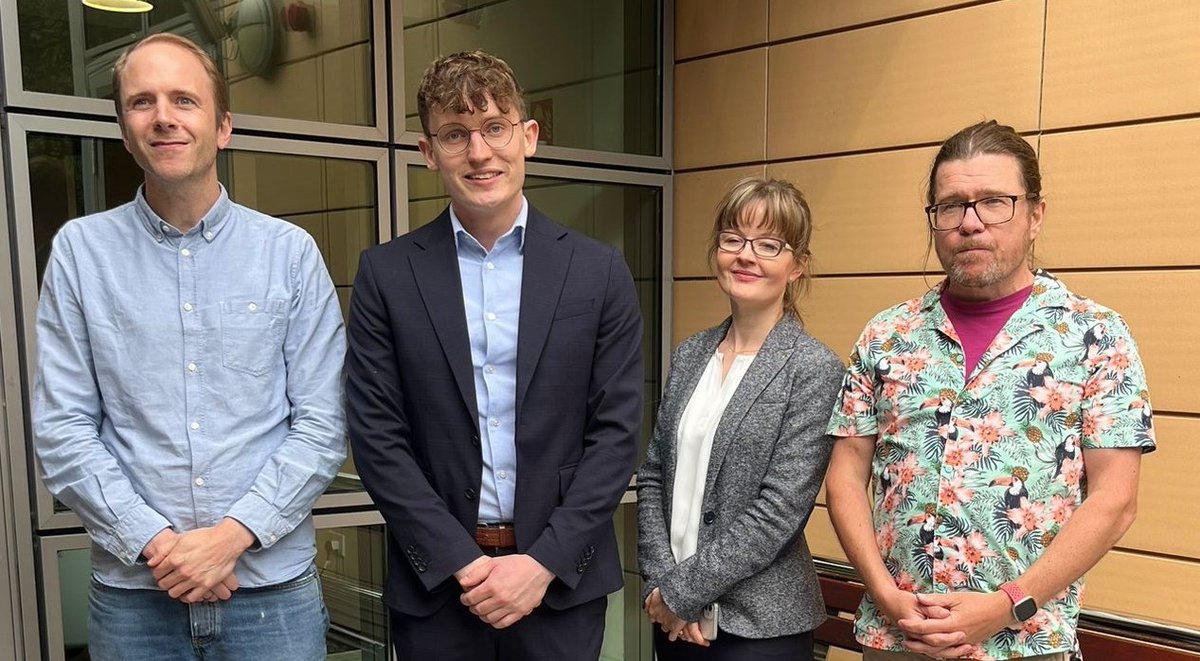
A big congratulations to @JackATierney who passed his viva today 👏👏👏. Jack's PhD research project was on "Graph based data structures for the representation of protein coding loci" under the supervision of Pasha Baranov @bioucc . Fantastic work Jack and well deserved!
We are delighted to introduce Dr. Sebastiaan Van Heesch, Princess Máxima Center for Paediatric Oncology & Oncode Institute, Utrecht-our first research seminar of the academic year next Wednesday- Details below - all welcome!