Dear Tesla Leadership,
I am writing this with real respect for everything Tesla has done. You have changed the world with electric cars and pushed hard on self-driving technology. I have been a big supporter for years. I own a 2017 Tesla Model X in Sydney, Australia, and bought the Full Self-Driving package more than six years ago for over ten thousand dollars. I also bought a Model 3 in 2021 and replaced it last year with another one. I am also a TSLA shareholder.
I still believe in the mission. That is why I need to say something important. For early buyers like me, especially on older Model X and S cars that have now ceased production in their RHD versions since 2020, the long wait for Full Self-Driving feels demeaning, devaluing, and humiliating.
Back when we paid for FSD, it was sold as the feature that would let the car handle driving on its own. We accepted the delays because we trusted the plan. Many of us on 2017 cars got the free Hardware 3 upgrade later, and we were grateful. But in Australia right now, newer cars get the full FSD version 14 experience with all the latest improvements first. Older cars are still waiting or getting lighter versions that do not match up. After six or seven years on my Model X, it still does not feel like the complete capability we paid a big premium for. Switching to a Model 3 or Y feels like a downgrade from what the original X offered.
This feels unfair. The flagship Model X and S that many early adopters chose are no longer made the same way. New cars come with better hardware built in and get the newest features first. Early buyers who helped fund the early days are left watching from the side while our discontinued vehicles lag behind. The FSD transfer option has ended. It adds to the sense that we are now seen as legacy owners.
It feels demeaning because early supporters took the biggest risk. We put real money behind the vision when it was new. Now it can seem like our loyalty is not valued the same as new customers who get the latest from day one.
It feels devaluing because the extra money we paid has not given the full benefit we expected. These cars lose value on the used market when buyers know the FSD experience is limited or delayed on older hardware.
It feels humiliating after years of waiting and hearing updates that mostly benefit newer cars. We watch the big progress celebrated while our older vehicles stay behind. Many of us feel overlooked despite being there from the start and sticking with Tesla through multiple purchases and as shareholders.
I am not asking for the impossible. I just ask for fairness:
Give clear and fair upgrade paths for those of us who bought FSD early, with prices that recognize we already paid once.
Offer good ways to move the full value of our FSD to a new Tesla purchase.
Keep pushing improvements for older cars in Australia and be straight about timelines.
Think about some goodwill for the people who have waited the longest.
Tesla has achieved so much. Treating early customers right would show real loyalty back to the people who believed first. I still want Tesla to succeed, including by making good on what brought us in years ago.
Thank you for reading this. I hope you will consider it.
Sincerely,
Adam M.
A Concerned Early Adopter and TSLA Shareholder
Owner of a 2017 Tesla Model X (and multiple Model 3s)
Sydney, Australia
@TeslaAUNZ@Tesla@Tesla_AI@elonmusk@robyndenholm@kimbal@KathleeWT@jgebbia@tomzhu_nz@IraEhrenpreis
Following up on yesterday's post with some additional context and data that may help explain what we saw on Friday.
A few people asked why I believe the selloff was driven primarily by a leverage liquidation event.
No issuer has perfect visibility into every investor's financing arrangements, so no one can know with certainty exactly what happened across every account.
That said, three things stand out.
First, we knew leveraged strategies had developed around Digital Credit securities. We had seen examples of trades that involved meaningful leverage and had publicly discussed the risks associated with some of those approaches.
Second, we received anecdotal reports from market participants indicating that liquidations were occurring during the selloff.
Third, the trading data itself is consistent with what is often observed during forced selling events.
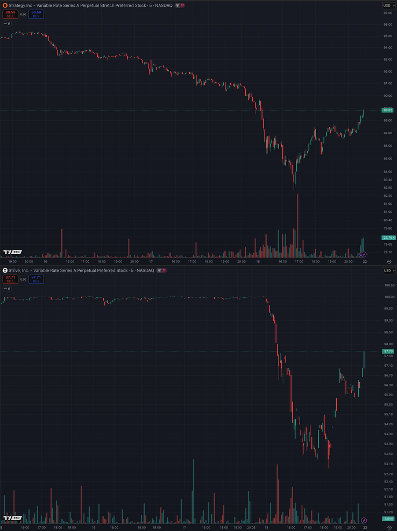
The STRC chart shows volume remained relatively modest through much of the decline, then exploded as the security moved from roughly $89 toward its intraday low of $82.50. After the low was established, volume quickly subsided and the price recovered materially into the close.
That pattern is often associated with a liquidation cascade. Forced selling drives volume sharply higher, prices overshoot fundamentals, and then buyers step in once the selling pressure has been exhausted.
The SATA chart also shows a price decline, but a very different volume profile. Volume remained much more consistent throughout the session (and the entire week) and did not exhibit the same relative spike around the lows that was observed in STRC.
That distinction is important.
To me, the data suggests that the primary stress event occurred in STRC, while weakness elsewhere in Digital Credit was more likely a spillover effect from the broader selloff than a similar wave of liquidations occurring across every security.
This is not a statement that one credit is stronger than another. In my view, both STRC and SATA remain strong credits, and neither issuer experienced a sudden deterioration in credit quality during Friday's trading session.
Digital Credit is a new asset class. As it grows, there will be periods where market structure, liquidity, leverage, and investor behavior create volatility that has little to do with underlying credit fundamentals.
Understanding those dynamics is part of the maturation process.
Friday was the most significant stress test Digital Credit has faced so far.
The market absorbed it, buyers emerged, and both securities recovered substantially from their lows.
That is a constructive outcome and an important data point for the future of the asset class.
$STRC is a brilliant instrument. It’s effectively what I tried to do with Bitcoin Bonds: strip out the volatility from Bitcoin and share the upside with investors. There is a massive market for a product like this somewhere in the ballpark of $200 trillion.
There’s nothing structurally wrong with the design of STRC (or SATA, MARS, etc.) unless you think Bitcoin won’t appreciate in the long term, which I’m sure none of us do.
Can STRC trade for under $100? Yes, of course it can. It moves freely according to market forces (this drop was caused by some leveraged plays). Do some people panic when it’s below par? Probably. That’s the behavior of short-term capital.
However, when STRC is trading below par, that’s an opportunity for long-term capital to arb it. It’s the same case as when stablecoins like USDt (note STRC is not a stablecoin) are trading below their peg. It presents an opportunity for people to come in and earn money by buying it at an effective discount and redeeming for $1. It happens all the time. STRC pays the same dividend whether you bought it for $90 or $100. Long-term capital will absorb any below-par STRC like a dry sponge.
Keep in mind that STRC is not even a year old. It’s still a baby, albeit one that’s growing at an incredible pace. It seems fashionable to dunk on it these days, but it’s far too soon to say it doesn’t work. Remember, the goal is to strip out the volatility from Bitcoin to package it into an instrument for investors who aren’t necessarily seeking out Bitcoin. This isn’t a year-long project. It’s a decades-long initiative that requires a massive balance sheet to shock-absorb.
And that’s exactly what @Strategy has.
I was fortunate to join @adam3us and @saylor for dinners last week.
I started my career in executive recruitment for one reason: there's no better way to learn from the world's most influential leaders, every day.
That's truer now than ever - and it's the whole ethos behind @XCEofficial.
Connect human capital to the digital capital!
$XCE | AQSE: XCE | OTCQB: XCELF
When these prevail, #Bitcoin then become global Digital Reserve, Strategy-like can lead to be become dominated global “Central Bank” while $STRC and in-kind will be the leading Reserved Currencies (replace Dollar).
This will be the ONLY way possibly leading to “Bitcoin Standard”, which I believe is what Michael @saylor aiming for. Then the rest of products issued on top of, digital money, digital yields,…etc. become the new global financial investment instruments.
I don’t think everyday just calling Bitcoin non-custodial assets works and not in practical bringing Bitcoin into the real world.
The ultimate goal is the SAME, but the approach is very different.
@parkeralewis fyi.
🦡 + 🐧 = ✨
What happens when Honey Badger meets Penguins at @BTCPrague ? Pure magic!
Today’s energy was wild. Missed out? We’re just warming up! 🔥
📍 Find us right next to the Info Desk. Grab yours before they're gone! 👇
#Bitcoin#BTCPrague2026
Yes “MSTR gives tradfi leveraged exposure to this pristine commodity. But Bitcoin already is superior money because it’s the ultimate bearer asset.”
$MSTR (+$STRC) is the bridge. Bridging the tradition financial world’s assets into #Bitcoin. It has to go in the way to make more wealth owners aware of the merits of Bitcoin. Otherwise the sound money world won’t be arrived.
Bitcoin is far more than just “money.”
It’s a scarce digital commodity — the hardest, most verifiable asset ever created. 21 million fixed supply. No printing, no dilution by governments or banks. Better than digital gold: portable, divisible, instantly verifiable by anyone.
It’s a true bearer asset. Hold the keys = true ownership. No counterparty risk. Send value across borders without permission. Unseizable without physical access. Revolutionary in an age of surveillance and censorship.
Fiat is a claim on institutions. Bitcoin is property first — unconfiscatable, borderless, censorship-resistant. You don’t need to spend it for it to have value. Its power is scarcity + sovereignty + liquidity.
MSTR gives tradfi leveraged exposure to this pristine commodity. But Bitcoin already is superior money because it’s the ultimate bearer asset.
HODLers are accumulating the hardest asset in history. The world is catching up.
You’re out of your depth Parker, just because you have a large following doesn’t mean my opinion is wrong. You should stop before you ruin your reputation any further.
Accretion depends on the metric. Net Assets per Share measures balance sheet strength and residual asset value. BTC per Share measures Bitcoin intensity and long-term equity upside. NAV accretion improves asset coverage. BTC Yield accretion increases Bitcoin per share. $MSTR $BTC