The argument against placebo controlled vaccine tests is always the same: it would be unethical. But there is a simple test that could confirm if vaccines are safe. It was proposed by microbiologist @jjcouey in Pittsburgh, PA:
https://t.co/A8MLXZfd5V
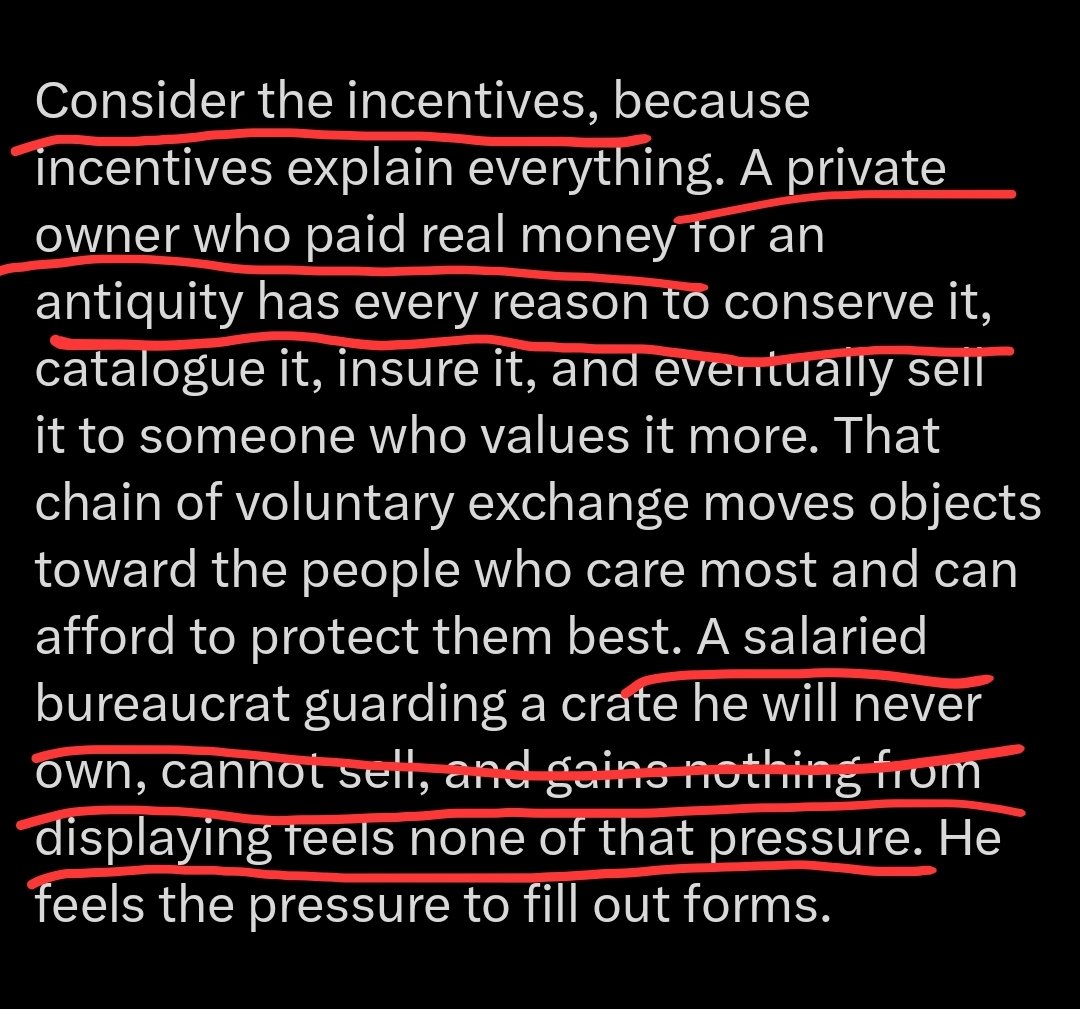
"A salaried bureaucrat guarding a crate he will never own, cannot sell, and gains nothing from displaying feels none of that pressure."
Now consider recent Bitcoin Core maintainers. 😉
The British Museum holds roughly eight million objects. It displays about eighty thousand. Do the arithmetic: ninety-nine percent of what the trustees claim to protect for humanity sits in climate-controlled basements in Bloomsbury, seen by no one, studied by almost no one, appreciated by nobody at all. This is what "public stewardship" looks like in practice. A warehouse.
You have been told the alternative is looting. That without the state, greedy collectors would smash context, sell fragments, and rob mankind of its heritage. Notice who tells you this. The same museum that in 2023 fired a curator after some 1,500 items walked out the door and turned up on eBay, priced at forty pounds for a Roman gem worth thousands. The thief was an insider. The gatekeeper failed at the one job the gatekeeper monopolized.
Consider the incentives, because incentives explain everything. A private owner who paid real money for an antiquity has every reason to conserve it, catalogue it, insure it, and eventually sell it to someone who values it more. That chain of voluntary exchange moves objects toward the people who care most and can afford to protect them best. A salaried bureaucrat guarding a crate he will never own, cannot sell, and gains nothing from displaying feels none of that pressure. He feels the pressure to fill out forms.
The black market itself is a creature of prohibition. Egypt bans nearly all export of antiquities. Italy, Greece, and Turkey do the same. So the trade goes underground, where no provenance records exist, no restoration standards apply, and a farmer who digs up a coin hides it rather than reporting it. Legalize the trade and you get exactly what England's Portable Antiquities Scheme produced: over 1.5 million finds voluntarily recorded since 1997, because a finder who profits legally has no reason to lie.
Property rights create the incentive to preserve. State monopoly creates the incentive to hoard and then lose track. The man with a gun and a storeroom does not love the Parthenon marbles more than the man who would pay to hang them on his wall. We need to end this global bureaucratic nightmare and properly preserve and display our heritage for the benefit of humanity, not just a few museum "experts".
Facts to get comfortable with for the next month:
1. Is BIP-110 going to have a positive effect at reducing *institutionalized* usage of Bitcoin as a data storage platform?
Yes
2. Is that the reason many people support it?
Yes
3. Is that the primary motivation for BIP-110?
No
4. What is the primary motivation?
Disabling methods of data storage specifically opened or cited as "already possible" with Core v30
5. Can spammers find ways to spam Bitcoin that BIP-110 does nothing about?
Yes
6. Is spam better fought at the policy level with sensible defaults in the reference implementation of Bitcoin?
Yes
7. Are consensus changes like BIP-110 ever going to be a good substitute for that?
No
8. Can we ever stop spam completely?
No
9. Can we ever give up trying to reduce it?
No
Frédéric Bastiat captured the essence of modern politics in a single sentence:
“The State is that great fiction by which everyone tries to live at the expense of everyone else.”
Once the state becomes the primary mechanism for distributing resources, politics stops being about protecting rights or creating the conditions for voluntary cooperation. It becomes a contest in which every group attempts to extract wealth from others through taxation, subsidies, regulation and welfare.
Farmers demand agricultural subsidies. Pensioners demand higher benefits. Students demand free tuition. Corporations demand bailouts and protection from competition. Each group frames its demands as a matter of justice or necessity, while ignoring that the money must come from someone else’s labour and property.
This creates a deeply corrosive dynamic. Instead of producing value through trade and innovation, people invest time and resources in political activity designed to redistribute existing wealth. The result is not greater prosperity, but higher taxes, expanding bureaucracy and a culture of dependency, victimhood and resentment.
The state transforms society into a zero-sum game. When everyone is encouraged to view government as a source of unearned benefits, the moral and practical foundations of a free society are steadily undermined. The fiction eventually collapses under the weight of its own contradictions.
@brownstoneinst "Hero"
Look at Clownstown, rewriting history. She's an actor put in place to sell you a narrative equally as bullshit as the 'official' one. RNA can't pandemic. It's not a vaccine, it's a TRANSFECTION; old technology whose effects are known, slapped with a new name for patenting.
It's not existential because of the spam threat.
We could fight that in policy over time.
It's existential because of the CSAM threat that Core30 just created last October.
It only takes one incident and it's over for Bitcoin.
And we know someone is just waiting for Core30 to prevail before doing it - we saw them exactly testing this playbook on BSV some years ago.
It's also existential because if miners can overrule the users, it means Bitcoin is not decentralised. That it's just another CBDC scamcoin. That's worse than fiat.
@saylor Where were you fucktard when shitcoin core destroyed monetary property of the bitcoin by releasing the shitcoin core v30+ (malware)?
Plebs have made you famous and now plebs will destroy you.
JUST WAIT AND WATCH...!!!