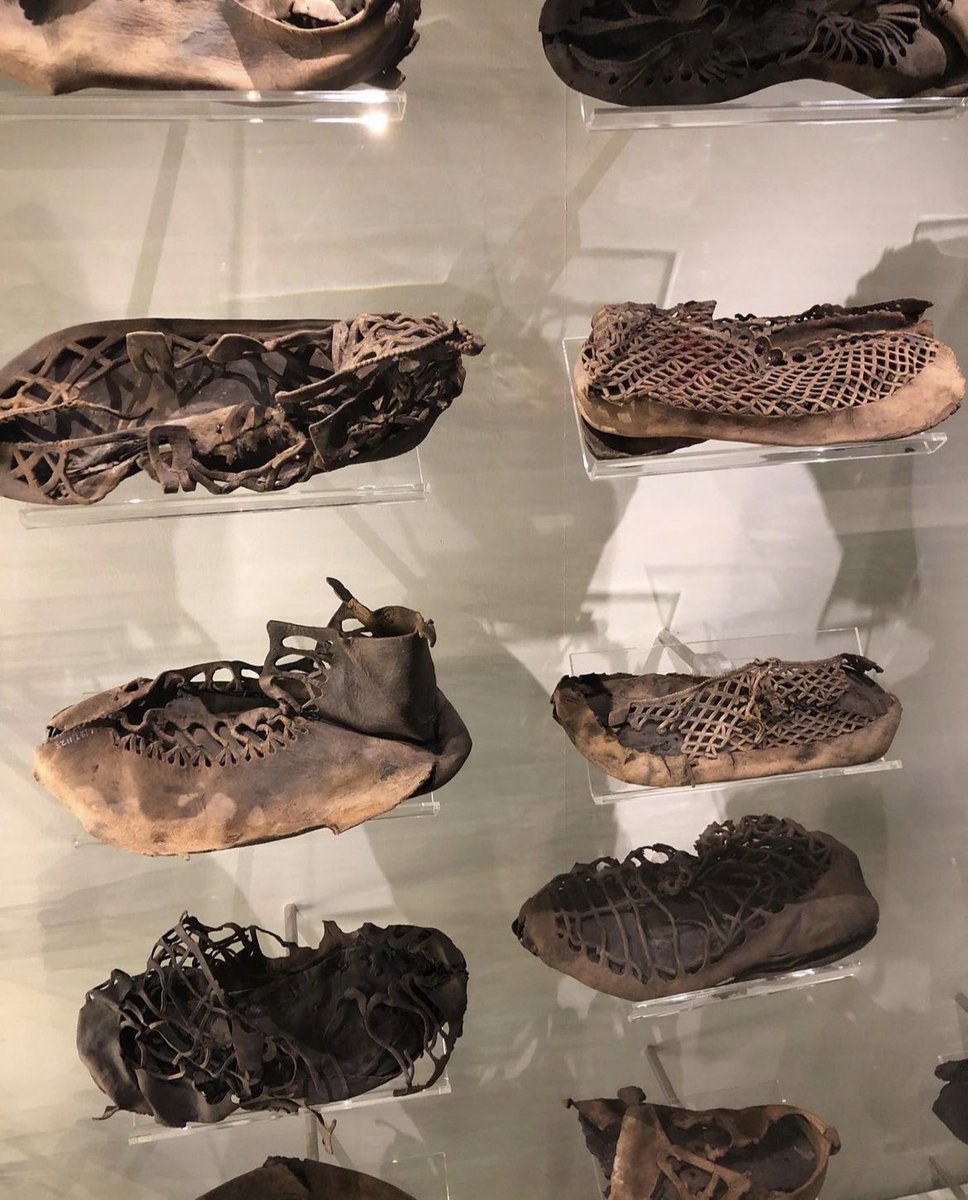
Ancient Roman Footwear on Exhibition at Vindolanda Fort in Northumberland, England
On display at Vindolanda fort in Northumberland, England, visitors can marvel at a remarkable pair of footwear that dates back 1,800 years to the Roman era. These remarkable artifacts, known as caligae, were heavy-duty openwork boots with robust soles adorned with hobnails. Caligae were primarily worn by the lower-ranking Roman cavalrymen, foot soldiers, and possibly even some centurions.
The association between caligae and the common soldiers is evident in their description as caligati, meaning the "booted ones." Expertly crafted, the caligae featured a midsole and an openwork upper, both skillfully cut from a single piece of high-quality cow or ox-hide. The midsole was then firmly attached to an outsole using sturdy clinching hobnails, typically made of iron but occasionally fashioned from bronze. To provide additional comfort, an insole was employed to cover the turned-back ends of the clinching nails. Like most Roman footwear, the caligae had a flat sole and were secured by lacing them up the center of the foot and onto the top of the ankle.
However, as the 1st century neared its end, the Roman army gradually shifted to an enclosed boot known as calcei. These new boots offered superior protection and warmth compared to the caligae. Soon, calcei became a staple not only in the Roman military but also in civilian attire.
Regarding Vindolanda fort itself, it served as a Roman auxiliary fort, or castrum, located just south of Hadrian's Wall in northern England. Remarkably, the fort pre-dated Hadrian's Wall. Archaeological excavations conducted at the site have revealed evidence of Roman occupation spanning approximately from 85 AD to 370 AD.
Göbekli Tepe, located in the southeastern Anatolia region of Turkey near the city of Urfa (also known as Şanlıurfa), is considered the oldest known temple complex in the world. It is an archaeological site that has captivated researchers and historians with its remarkable age and significance.
Discovered in the 1960s by the archaeologist Klaus Schmidt, Göbekli Tepe dates back approximately 11,000 years, making it older than Stonehenge in England and the Great Pyramids of Egypt. The site was built and used by ancient hunter-gatherer societies during the Pre-Pottery Neolithic period, challenging the conventional belief that monumental architecture was a product of settled agricultural communities.
Göbekli Tepe comprises multiple stone pillars arranged in circular structures, which are thought to have served as ritualistic gathering places. These pillars, some of which reach up to 16 feet (5 meters) in height and weigh several tons, are adorned with intricate carvings of various animals, including lions, snakes, foxes, and birds.
What makes Göbekli Tepe particularly fascinating is the complexity and sophistication of its construction. The massive stones used to create the pillars were transported from quarries several miles away, and their shaping and assembly would have required a high level of coordination and organization. This suggests that the hunter-gatherer societies that built Göbekli Tepe possessed a degree of social organization and communal effort not typically associated with their era.
The purpose of Göbekli Tepe remains a subject of speculation and debate among archaeologists. Some believe it was primarily a religious or ceremonial site, where rituals and gatherings took place. The carvings of animals suggest a connection to ancient belief systems and potentially represent the worship of animal spirits or deities. Others theorize that it may have served as a meeting place for different groups or as a center for trading and exchange of goods.
The discovery of Göbekli Tepe has had a significant impact on our understanding of human history and the development of civilization. It challenges the traditional narrative that agriculture was the driving force behind the rise of complex societies and suggests that religious or social factors may have played a more prominent role. The site provides valuable insights into the cultural and technological achievements of early humans, highlighting their capacity for architectural innovation and symbolic expression.
Since its discovery, Göbekli Tepe has been meticulously excavated and studied by archaeologists, shedding new light on our ancient past. It has been recognized as a UNESCO World Heritage site, attracting visitors from around the world who come to marvel at this extraordinary testament to human ingenuity and the dawn of civilization.
I added this deck to one of my rental properties.
I was able to take the rent up from $700 to $1200 per month. The tenant moved out but I rented it quickly at the higher amount.
This is the way you make more cash as a landlord AND make your tenants lives better.
Win win.
Breaking on CNN: Trump audio recording of Bedminster meeting suggests he showed national defense information: “I just found, isn't that amazing? This totally wins my case, you know. Except it is like, highly confidential. Secret. This is secret information. Look, look at this."
I have 40+ people who work for me from the Philippines and LatAm.
They make $5 or less per hour.
They work harder than most Americans at 20% the cost.
No workers comp or employment taxes.
It is the key to maximizing profits for yourself and your investors.