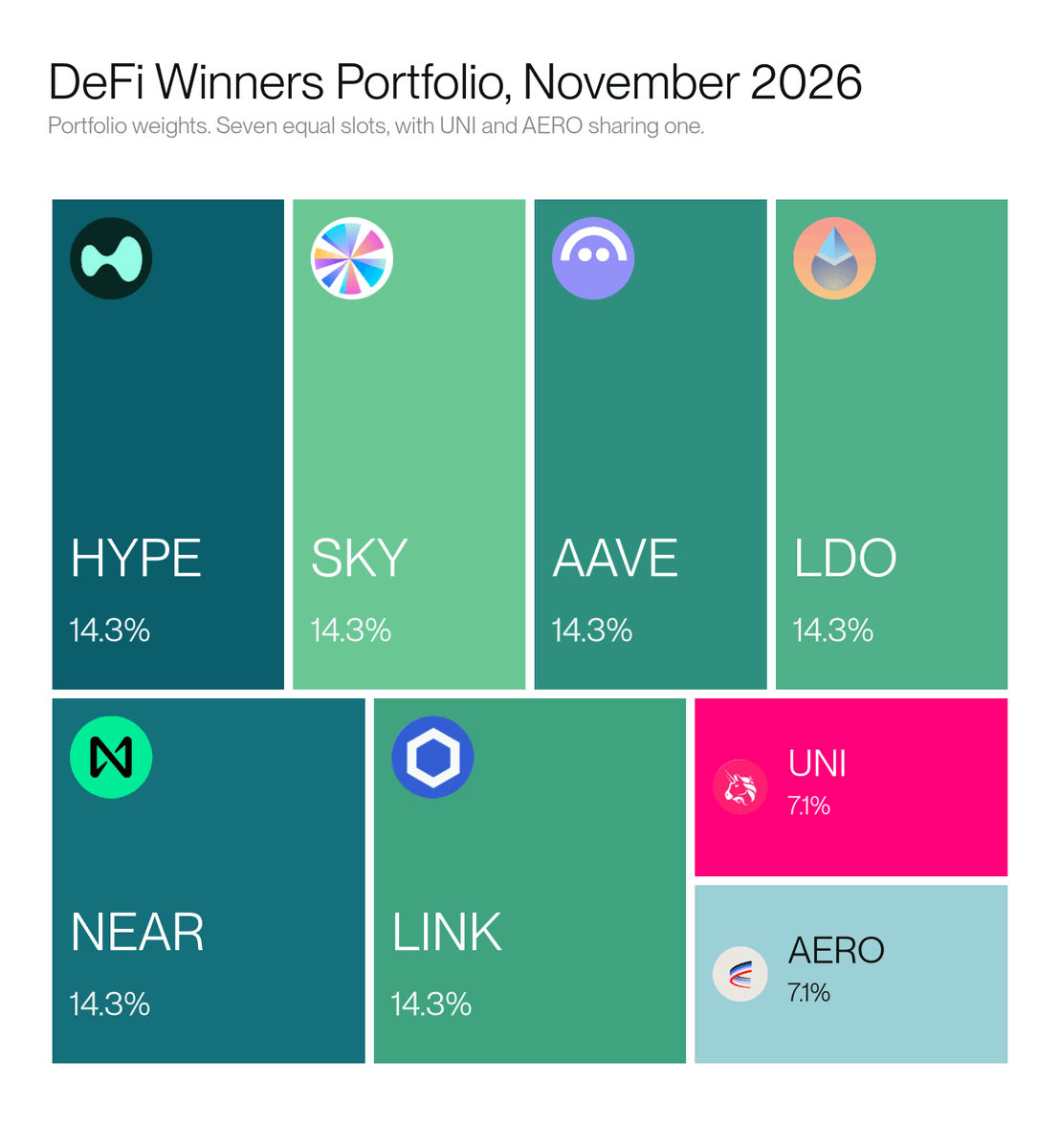
1) The DeFi Winners Portfolio
For the best exposure to the many sectors in DeFi, here are my top picks
The leader in each category:
not by ecosystem
not by hype
but by numbers and nothing else
The charts below explain what's behind it. Take a look 🧵👇
[not investment advice]
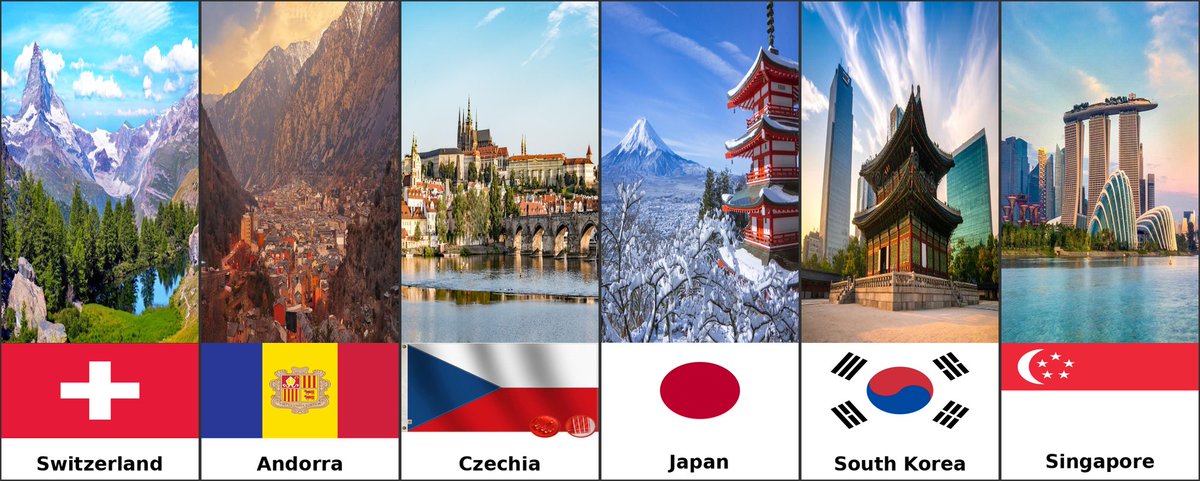
I've been to 60+ countries...
And there's only a handful of truly Tier 1 places left:
- Switzerland 🇨🇭
- Andorra 🇦🇩
- Czechia 🇨🇿
- Japan 🇯🇵
- South Korea 🇰🇷
- Singapore 🇸🇬
Which one am I missing?
*Tier 1: a place that's safe, has great infrastructure, is orderly, and where there is rule of law everywhere
What’s actually going on in Ukraine is that there is a massive incentive difference between the elites and the people.
The former have grown very rich off the hundreds of billions flowing to Ukraine, while the latter’s children are conscripted to die in trenches.
LatAm's most livable cities in terms of quality of life vs cost of living
A LOT of Brazilian cities are near the top. Particularly Florianopolis
Which one am I missing?
Scott Bessent engineered the trade that BROKE the Bank of England.
Do you really think he’s too stupid to understand how America could benefit from Europe breaking next?
In 1992, he helped Soros and Druckenmiller bet against the British pound. Their fund made more than $1 BILLION.
Now he’s defending rising U.S. borrowing costs by pointing out that it’s happening elsewhere too. Investors aren’t abandoning America for Germany or Japan.
Read that again.
Governments compete for the same investors’ money. If people become less willing to lend, governments have to offer higher interest rates. Their debt gets more expensive.
But America doesn’t have to look financially healthy if the alternatives look even worse.
Now put the conspiracy hat on:
What if weakening Europe is part of the strategy to rebuild America?
Investors get scared of European debt. Some move their money into U.S. debt instead, helping Washington fund itself.
Businesses see better conditions in America. Investment, factories and jobs follow.
Europe loses money and industry. America gets both.
It’s just a theory.
But do you REALLY think a man who helped make a fortune betting against Britain wouldn’t recognise the opportunity?
“America First”
Citrini Research (a thematic/cross-asset research firm, recently acquired by SemiAnalysis) published a report titled “Breaking The Wall” on ~Oct 8, 2026, outlining a crypto basket that deliberately excludes BTC and ETH.
Crypto token basket (circulating target weights)
From multiple reports of the disclosed/circulating portfolio (totals ~100%):
• DRV (Derive) ~10%
• LIT (Lighter) ~10%
• ETHFI ~10%
• AAVE ~9%
• ENA (Ethena) ~9%
• SOL ~8%
• HYPE (Hyperliquid) ~7%
• AERO (Aerodrome) ~7%
• ZRO (LayerZero) ~5%
• LINK ~5%
• BP (Backpack) ~5%
• SYRUP (Maple) ~5%
• UNI ~4%
• PENDLE ~3%
• ONDO ~3%
@citrini
So many dont understand it:
2022-2026 was a Macro-Risk Bear Market just like 2014-2016 & 2018-2020
All of the habits born out of it people need to forget ASAP
"To many coins"
"Cant HODL anymore"
"Alts are dead"
The optimal conditions are finally back
Dont fumble it!
Realize this is the same as mid 2016 & 2020 right now right before the major upside began for the whole #Crypto market
You need to navigate and act like its 2016 & 2020 if not you will mess it up
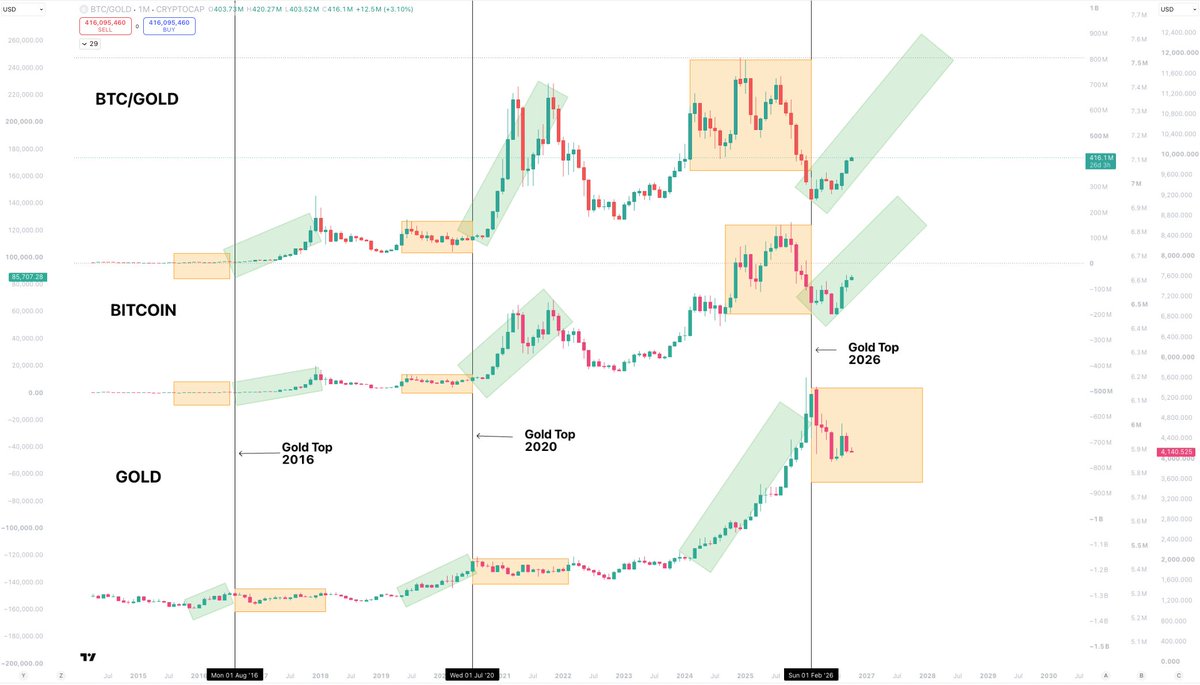
It happened again.
The original post was pretty much the top for GOLD.
During that time, the metals guys were absolutely euphoric, grave dancing on Bitcoin.
The Bitcoiners were also being doomers saying that when GOLD drops, Bitcoin will go with it.
Fear was everywhere, as usual.
But back then, when I analysed the situation, it was very clear to me that things were just playing out like they always have with GOLD/BTC rotation.
This setup here, back in Jan/feb last year, was already showing us how much different of an overall cycle position we were compared to what everyone thought.
But this analysis was getting laughed at.
Now, 9 months on, we can see it played out exactly like it always has, and exactly how I expected it to.
As GOLD topped, Bitcoin bottomed.
Then, GOLD has gone on to drop/consolidate...
And Bitcoin has gone on to bottom/reverse.
BTC/GOLD literally bottomed a week after my original post.
Which was the time metals guys were euphoric and crypto was in a dark depression.
After every major GOLD run and subsequent top, Bitcoin has entered its most explosive phase of its cycle.
Every single time.
This is simply another large piece of data that now confirms we did not see a full cycle high.
That is yet to come.
One of the beliefs that will fall in the next few years is "alt coins are vapour".
Belief in the technology and applications built on top over the last 10 years will pay off big.
We have a small crop of alt coins that will compound year-on-year and act as protocol equity, which will average out to be net deflationary assets over time.
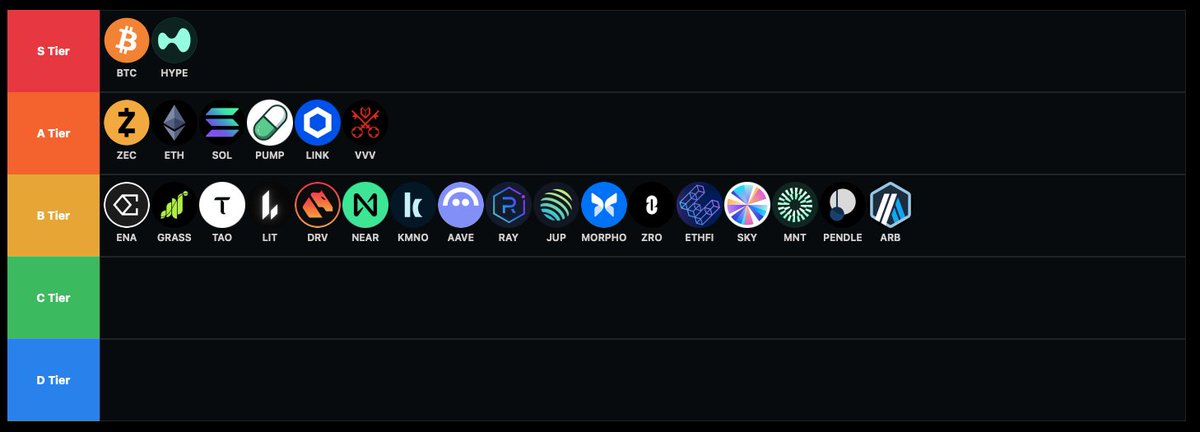
HYPE is currently the only S-tier alt coin imo based on network effects, PMF, revenue, TAM, tokenomics and team execution. It's a very, very high bar to meet.
I describe the A-tier as platforms that have moats which are extremely difficult to disrupt, but haven't ticked every box and could still transition to S-tier if they do one/two things well. Things like tokenomics, value capture, and more lindy to become an SOV in ZEC's case.
The B-tier (not exhaustive, but you get the idea) are all strong projects demonstrating PMF that could transition to the A-tier, but still need to execute in quite a few more areas/need more time. I think some of the B-tier should be in the A-tier following this cycle.
Everything potentially below B-tier have poor fundamentals and are short term trades at best. There will be an endless rotation of good short term trades in a crypto bull market.
I've left off very new things as I think it is difficult to rank them without more time.
My mental model of these rankings aren't necessarily what will go up the most in the next few months, but I think you could conceptually imagine that coins which jump up a rank would outperform, and coins that maintain their position in S-tier are up only.
Therefore, positioning in coins which are best placed to jump up a rank (DYOR), alongside having a core allocation to S-tier is the optimum strategy for longer holds.
A billionaire once told me: when you feel stuck, go sit in the most expensive hotel in your city.
Order a coffee.
It works every time.
Here's what that environment does to you:
Jeff Gundlach laid out the Fed's dilemma this week:
Hike, and the interest bill on all that short-dated debt balloons. Cut, and inflation reignites.
He’s right. But I think it’s the wrong framing, and I haven’t seen anyone unpack this properly yet in response.
Here’s my take…
The US now spends roughly $1trn a year servicing its debt. And with a deficit bigger than the entire interest bill, every dollar of that interest is effectively borrowed.
They’re using a new credit card to pay the interest on the old one. Oldest trick in the book.
Every cycle the principal gets bigger, the refinancing wall gets bigger, and the liquidity it takes to refinance the debt gets bigger.
Once you understand that, the “dilemma” dissolves. There’s only one exit, and it runs through balance sheets.
The Fed is already back at it. It has added around $365bn of Treasuries since December, and the line is still climbing. Call it bill buying, call it reserve management... it's the Fed monetizing government paper.
But the Fed doesn't want to finance this alone. The real plan is to hand the baton over to the banks.
That's what the leverage rule changes in April were for: free up bank balance sheets to absorb Treasuries and, more importantly, to lend. And they are.
Bank loans are up almost $1trn in a year. When banks lend or buy government debt, they expand the money supply. And unlike QE, far more of it reaches the real economy.
Here's the catch though, and it's the whole game...
Banks borrow short and lend long. A flat yield curve does nothing for them. It squeezes the margin on every new loan.
So the Fed is still pulling liquidity higher as a bridge, waiting for the one thing that makes the handoff work: a steeper yield curve. And it has to be the right kind of steep.
What they need is a bull steepener. Front end falling faster than the long end.
Right now we have the opposite problem.
Markets saw Warsh's hike coming. Yields are up across the curve, with the 10-year and 30-year hitting their highest since 2007, but the front end has sold off hardest, flattening the curve. Exactly what banks don’t want/need.
Warsh delivered last week and signaled more to come. But strip oil out and inflation looks a lot tamer. Core CPI is at 2.4% and still edging lower.
This hike was about independence and credibility with the bond market, not broad-based inflation.
Which brings us back to oil…
Trump wants a deal, and he's saying so openly. Iran has put a road map on the table: a phased reopening of the Strait in exchange for the blockade coming off.
And with the midterms less than six weeks away, nobody in Washington wants voters staring at gas prices the way they are right now.
We've seen one deal fall apart already this year, so I'm not taking it on faith... but the incentives have never been more aligned.
If the Strait reopens and crude heads lower, headline inflation loses its biggest tailwind and inflation expectations cool.
That’s the pressure valve.
Warsh has shown the bond market he’s serious. Take oil out of the picture and he has room to stop hiking, then reverse course.
The front end rips, the curve bull steepens, and banks finally have the spread to put those freed-up balance sheets to work.
Then the dominoes fall…
A bull steepener pulls the dollar lower. A weaker dollar lets gold run. And when rates, the dollar and oil are all falling together, that's liquidity rising.
Here's why:
Every one of those forces the world to hedge.
A strong dollar forces anyone with dollar debt or dollar assets to pay up to protect against it.
High short rates make it expensive to hedge dollar exposure, which is why foreign buyers like Japan have largely stepped away from Treasuries.
Expensive oil forces airlines, shippers and importers to lock up capital in margin just to hedge their fuel bill.
When all three ease, that hedging demand falls away and the capital sitting behind it gets released.
And released capital doesn't sit still. It gets levered, lent and financialized.
But that's only act one...
The bigger play is Greenspan, mid-90s. The consensus said above-trend growth had to be inflationary. The consensus was wrong.
Greenspan saw what technology was doing to productivity and refused to fight an inflation wave that wasn't coming.
Real GDP ran at 4-5% for years. Core CPI held around 2-2.5%.
He eased, held his nerve through the boom, and only leaned against it late in the decade.
The Nasdaq 100 rose more than 500% from 1996 to 1999.
Warsh has made it clear he believes the same thing. Growth without inflation, because productivity lowers the cost of everything it touches.
Except this time around the productivity engine is AI and robotics, and it will dwarf what the internet did.
That's how you actually escape the debt trap. Not by paying it down. By growing nominal GDP faster than the debt itself. Debt to GDP stops rising, then eventually starts to fall, without a single dollar being paid back.
So does the party end when the need for debasement fades?
I don't think so. I think it changes shape...
In the 90s there was no QE. The Fed’s balance sheet grew mainly to keep up with the economy’s demand for cash.
Instead, the liquidity came from the private sector: bank lending, bond markets and a booming IPO market funding the buildout.
That's exactly where the banks come back in. Today they’re absorbing government debt so the refinancing gets done. Tomorrow they're lending into the AI capex boom. And that boom is only just getting started.
The big four hyperscalers alone are on track to spend more than 2% of US GDP on capex this year, most of it AI. NASA at the height of Apollo peaked at 0.7%. The Manhattan Project at 0.4%. And it's companies footing the bill, not governments, increasingly with borrowed money.
If you’ve followed my work for a while, you’ve heard me say this before, and I’ll keep saying it:
We’ve spent the last few years teaching AI to think. The next decade is about teaching it to move, see and build.
Robots, factories, power plants, grids… and almost none of that hardware exists yet. Someone has to finance it. That’s the banks’ next job.
So what does this all mean?
Risk assets stop rising on a dollar losing purchasing power (debasement) and start rising on an economy that’s worth more (productivity).
Now, act one hinges on the chart below…
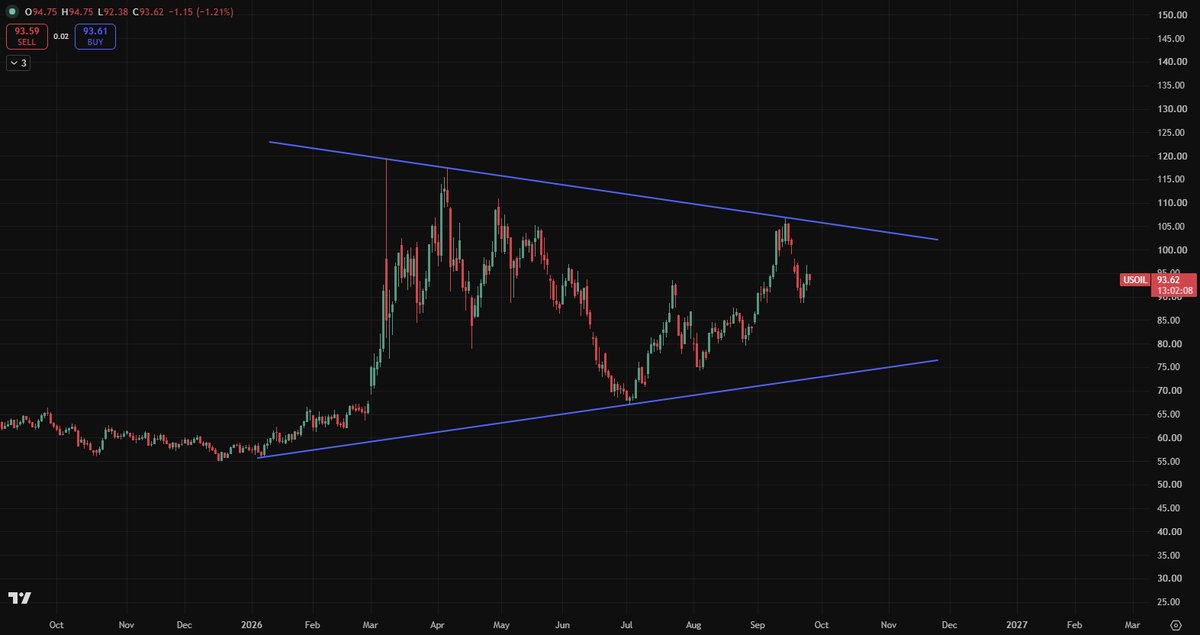
WTI has spent the whole year coiling inside this large range. It just tested the top of it near $107 and got rejected.
So long as crude stays below that downtrend, and especially below $110, act one is on track.
If it breaks out and clears $110, it probably means the Strait deal isn't happening. Inflation stays sticky and Warsh loses his cover.
That delays act one. It doesn't cancel act two. The debt still needs rolling and the productivity wave is still coming.
That’s the playbook as I see it right now.
Act one: a Strait deal lands before the midterms, oil moves lower, the curve bull steepens ahead of the Fed, Warsh pauses then reverses, the dollar falls, gold runs, liquidity rises.
Act two: the productivity boom takes the wheel and the banks finance it.
Watch the yield curve, the dollar and gold for confirmation, then own what outruns debasement now and compounds with productivity later: tech and crypto.
The regime changes. The trade doesn’t.
1/ Below is a thread of infographics I've created on the most important lessons to learn about #crypto investing. These are the principles I used to make generational wealth and I hope they will guide you to do the same.👇
ENERGY AND TECH ARE ALMOST MIRROR IMAGES OF EACH OTHER
Have a look at these two charts side by side. On the left is the Australian Energy Index. On the right is the Nasdaq. Look at what happened through the 2000s.
After the dot-com bubble burst, the Nasdaq spent years struggling while energy entered a huge bull market. Australian energy eventually peaked around the GFC. Then the relationship flipped. From around 2008, the Nasdaq entered one of the greatest bull markets we've ever seen, while Australian energy spent most of that same period going sideways or backwards.
Now look at where we are today.
The Nasdaq is near the top of a huge multi-decade run, while energy is still sitting inside a massive long-term base. And this is where understanding capital rotation becomes so important. Always remember, money doesn't simply leave markets. It rotates from overvalued areas into undervalued areas. When one major market is in its excess phase, somewhere else another market is usually sitting in its accumulation phase. Over the bigger macro cycle, those roles eventually change.
That's exactly what these charts show.
In the 2000s, energy was running while the Nasdaq struggled. Then the cycle changed. Tech became the dominant trade while energy spent years being ignored.
Your job isn't to chase whatever has already made everyone rich. Your job is to identify what's in accumulation and what's in excess. Because you never want to be caught heavily exposed at the top of a major excess phase. That's where generational wealth can be destroyed, and history shows some markets can take many years, even decades, to recover their previous highs.
This doesn't mean the Nasdaq has to crash tomorrow or energy has to explode higher tomorrow. It's about understanding the bigger cycle.
Don't just ask what's going up. Ask where it is in the cycle, and where the money could rotate next.
YOU WILL LOSE......
If you think that the 'mythical 4 year cycle' is what controls the markets. We are NOT going up for another 3 years from here..
We are mid cycle... When ISM hit 58 previously (middle chart) BTC.d dumped.. from the time ism hit 58 it was a year until the top hit..
As it stands market tops Q2 2027. THEN the real bear market... (UNLESS macro expansion continues and creates SUPER cycle environment...) As i see it, we are in an extended cycle that began in 2023. Bitcoin ran first, pulled back 50% continued higher. altcoins struggled and are yet to see a bull market since 2021 (see eth below - didnt beat 2021 highs)