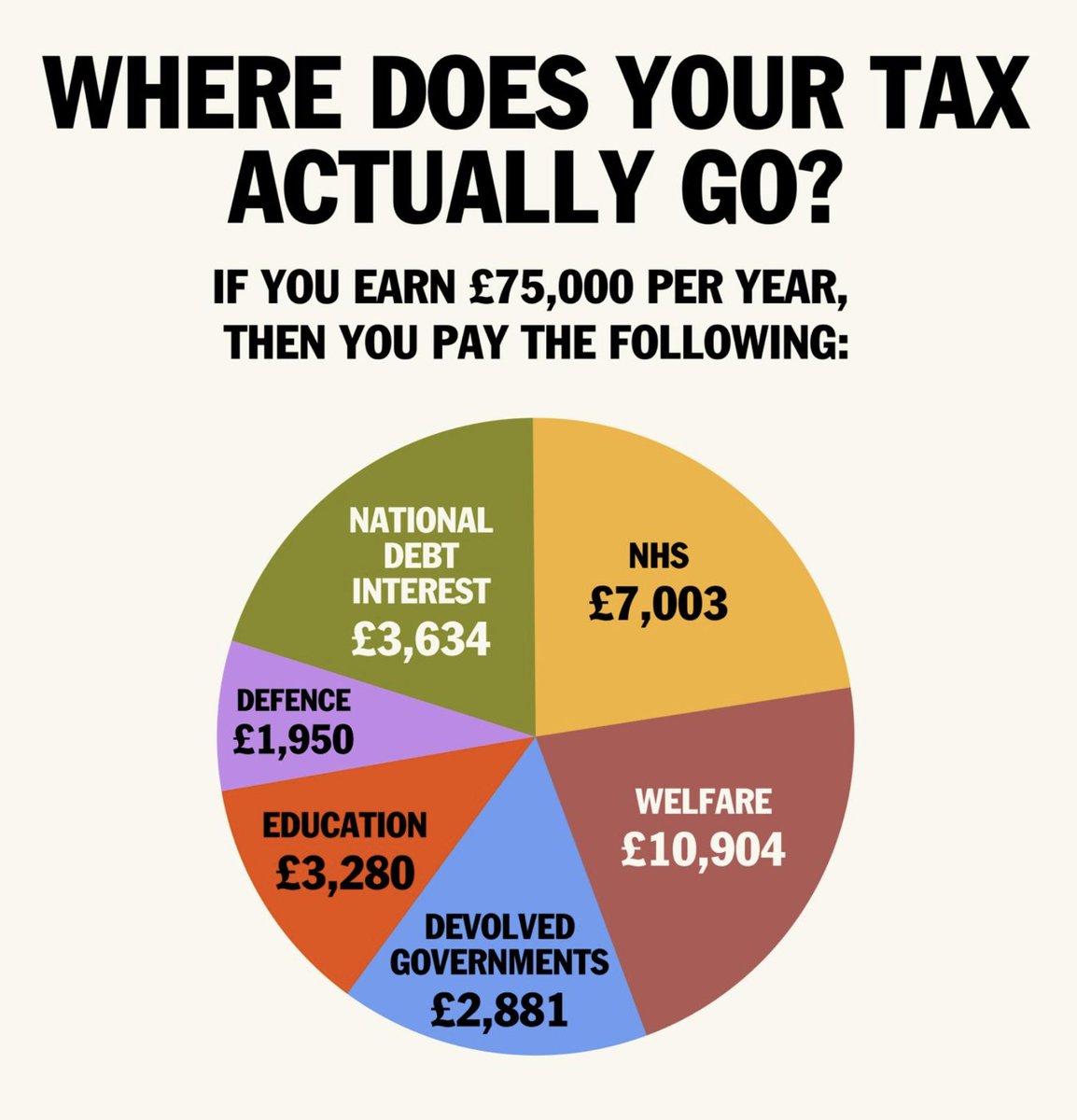
If you earn £75,000 per year you personally pay £3,634 on national debt interest alone.
Not for hospitals.
Not for kids.
Not for building a better country for all of us.
At CORGI, we have built a tool based on open-source government data that shows you in detail how your personal tax money is spent.
If you earn £75,000 a year, based on national averages you are personally spending:
£7,003 on the NHS
£10,904 on Welfare
£3,280 on Education
£1,950 on Defence
£2,881 on Devolved Governments
£3,634 on National Debt Interest
Want to know your own numbers?
👉 Use the calculator here: https://t.co/Lrrs126twC
You’ll get a full breakdown of how much you pay — and exactly where it goes.
The tax calculator also lets you see your total tax contribution in detail. All numbers are open source and come from either the Office for National Statistics or the Office for Budget Responsibility.
When you are using the tool, you have the option to toggle off lifestyle taxes such as alcohol tax, gaming tax or tobacco tax which may not be relevant to you.
We are also looking at an individual’s total tax contribution; to that end we have included both Employers National Insurance and Corporation Tax.
Employer’s National Insurance is a direct tax on your job. You don’t see it on your payslip, but your employer pays it because you exist. It reduces how much you can be paid, and directly affects job growth across the UK. Every UK employer factors this liability in the individuals overall pay calculation.
Furthermore, when you spend money, you are not only paying VAT, but you are also helping companies be viable by making a profit and those profits get taxed. If you strongly disagree with the logic here, we have included the option in the calculator to opt out of having this included in your own tax analysis.
Tax is the biggest bill you’ll ever pay.
And the least transparent.
But it doesn’t have to stay that way.
We built this CORGI tool to change that — one receipt at a time.
Because when people know where their money goes, they start asking better questions.
And better questions change everything.
💬 What surprised you most about how your tax is spent?
Think you pay 20% tax?
Try 48%-52% — and most of it’s hidden.
We built a tool that shows your real UK tax rate — and where every pound goes.
👉 https://t.co/uSCCt3Pc1v
Try it. Takes 60 seconds.
👉 https://t.co/nrekYmZNgq
Then post your result and tag it with
#Corgi 🐶 @CorgiGlobal
This is the tax transparency we all deserve. No politics. No spin. Just open source data.
🚨 Earning £50K in the UK?
You’re probably paying over £27,000 in tax.
That half of your income — gone.
We built a tool to show you what you’re actually paying — and where it goes. Thread 👇
For a £50K earner, here’s where that tax goes:
£6,704 → Welfare
£4,306 → NHS
£2,235 → National Debt interest
£2,017 → Education
£1,853 → Local Government
The rest? Defence, net zero, pensions, prisons...
I'm not in favour of the sweeping tariffs just imposed by the United States.
But and I had to implement tariffs — here’s how I’d do it differently:
1️⃣ Give the world 12 months’ notice.
Rewiring global trade doesn’t happen overnight.
Businesses need time to rebuild supply chains, rework contracts, and open new facilities.
Imposing tariffs without warning doesn’t punish rivals — it punishes your own citizens.
No time to adjust means price hikes, empty shelves, and a global recession on the cards.
2️⃣ Phase tariffs over 5 years.
If you’re aiming for a 20% tariff like Trump has imposed on the EU — build to it gradually. 5% a year.
Businesses need time to adjust to this seismic shock, and to completely rework their supply chains, build new production facilities and employ new workforces.
Without a transition period, you’re not reshaping trade — you’re detonating it.
3️⃣ Protect the most vulnerable.
These tariffs will crush Western consumers.
But they’ll obliterate developing economies who rely on trade to lift people out of poverty.
Trade has done more to raise global living standards than any aid programme in history. Strip it away without a plan, and you create a tinderbox of global instability.
Smart trade reform must exempt essential goods like food and medicine — and support fragile economies through the transition.
4️⃣ Be strategic, and collaborative.
Right now America's long term allies the EU are being treated like enemies - spoken about in similar terms to the US's long-term rivals China.
There’s no logic. No cohesion. Just chaos.
If you want to use tariffs as a tool — use them wisely. Build alliances. Reward fair trade. Leverage cooperation. Right now the there are 0 collaborative conversations around trade, only combative ones.
5️⃣ Pull, don’t just push.
Tariffs alone won’t bring production back home.
You need to pair them with real domestic investment:
- Tax breaks for reshoring
- Infrastructure for advanced manufacturing
- Skills and R&D support for critical sectors
If you're serious about rebuilding industry, make things easier to build in your country — not just harder to import.
-------
We’re entering a new economic era. As UK Chief Secretary to the Treasury Darren Jones said this week:
“The era of globalisation has ended.”
My feeling on this is that, though this may make some people richer, overall the world is going to suffer.
Let’s not pretend that destroying global trade will somehow lead us to progress.
What do you think?
How much are entrepreneurs taxed in the UK?
According to a recent independent research paper by the Tax Payer’s Alliance, it is over 85%.
This is because when entrepreneurs earn, they often exceed numerous tax thresholds, save and invest their earnings, and ultimately pass them on to their family.
As a result, the same money is taxed repeatedly before it is ever spent, leading to an exceptionally high marginal tax rate.
The tax burden on entrepreneurs and their family because much higher when Labour reduced business relief from inheritance tax from 100% to 50%.
The TPA research reveals just how brutally the system is stacked against those trying to build something and create jobs in the UK — and the numbers are staggering.
If you’re an entrepreneur in the UK, you could end up paying up to 93% in taxes on what you build 😳.
Which means:
➡️ If your business earns £100, your family could be left with as little as £10 after taxes.
Here's where it all goes:
💰 Income Tax
💰 National Insurance
💰 Corporation Tax
💰 Capital Gains Tax
💰 Inheritance Tax
💰 VAT
The TaxPayers' Alliance highlighted that:
🔺 Best-case scenario (with smart planning): 83.5% tax
🔺 Worst-case scenario: 93.1% tax
That means after putting everything on the line — the long hours, the sleepless nights, the personal sacrifices — you and your family are left with barely 10p for every pound you generate.
The TaxPayers' Alliance report lays out the devastating impact this is having on our economy:
➡️ New firms — responsible for most net new job creation — are disappearing at an alarming rate.
➡️ The number of UK businesses has dropped by 11% since 2020.
➡️ The fear of failure among entrepreneurs has risen by 60% in the past two decades. Meaning more and more would-be founders are being put off from even starting.
The message is clear: Founders are giving up.
And honestly — seeing the numbers it's hard to blame them when you’re expected to put your home, your savings, and your family’s future on the line — only to keep 10% of what you’ve built.
If the UK wants to rebuild its economy, we need to create an environment where entrepreneurs can thrive.
That means:
✅ Tax stability: Entrepreneurs need certainty. A long-term commitment to stable tax rates would encourage investment and risk-taking.
✅ Growth-focused reforms: Expanding business rates relief and improving capital gains incentives would give founders the breathing room they need to grow.
✅ A reduction in the overall tax burden: Entrepreneurs need to know that their efforts will be rewarded — not swallowed by endless taxes.
We need to fix this.
Massive credit to the @the_tpa for compiling such an important report — if you want to dig deeper, you can read the full report here:
https://t.co/hRzo1pL39T
I am all for paying tax, and I am all for the government maximising tax revenue so that we can invest in building the society we all want.
However, I believe if we taxed the job creators less, more of them would stay in the UK and create jobs and additional tax revenue here as opposed to elsewhere.