Ahh, finally a quote with some substance.
But have you actually read what the Adelaide researchers recommend?
They recommend raising JobSeeker to a liveable level AND replacing punitive mutual obligations with supportive employment services that help people find meaningful and secure work.
So yes, there are legitimate reasons to think the current system needs reform. I never said there weren’t. The question is how and what form that reform should take.
Why don’t we also ask some of the people actually receiving that employment assistance? That’s kind of important, right??
• 73.0% said services improved their chances of getting a job.
• 65.8% said services helped them find a job or get more hours.
• 71.8% said services helped them further into the future.
• 79.0% were satisfied with the overall quality of service. • 86.4% were satisfied they were treated fairly and with respect.
• 73.3% were satisfied with being connected to support services.
That’s from 46,501 responses.
So even the research you’re quoting isn’t arguing that unemployed people should simply be left to find work themselves. It’s arguing for better, more supportive employment assistance rather than punitive mutual obligations.
https://t.co/yEIoNfQgIB
So stop conflating association with causation and drawing conclusions the statistics don't establish. Then I wouldn't have to “blubber” untangling your out-of-context quotes and sweeping generalisations.
And I already answered you. No, I don't support “dumping hundreds of thousands of Australians into unemployment and poverty”, but you haven't established that this is what the current system amounts to.
Not committing to a Jobs Guarantee doesn't mean I support the current system. That's a false dichotomy, and I'm not going to be bullied into “picking a side” based on premises I don't accept.
Anyway. I'll leave it here.
I have to prepare to go travelling.
I'll look into it further for myself.
Thanks for the discussion, and have a good weeknd
https://t.co/ylXEK8aUpf
No. I don’t support “dumping hundreds of thousands of Australians into unemployment and poverty”, and repeating that I do doesn’t make it my position.
What should have been clear from my very first post is that I don’t support oversimplifying quotes, data and statistics, stripping them of their broader context, and then using them to make sweeping generalisations.
Nor do I have to choose between the two alternatives you’ve constructed.
You’ve claimed a 90% failure rate in finding jobs over 30 years, yet the historical employment outcomes I’ve found vary considerably across Job Network, Job Services Australia, jobactive and Workforce Australia.
More importantly, you’ve treated Workforce Australia Services’ 11.7% 26-week employment outcome as though it means roughly 90% failed to find employment. It doesn’t.
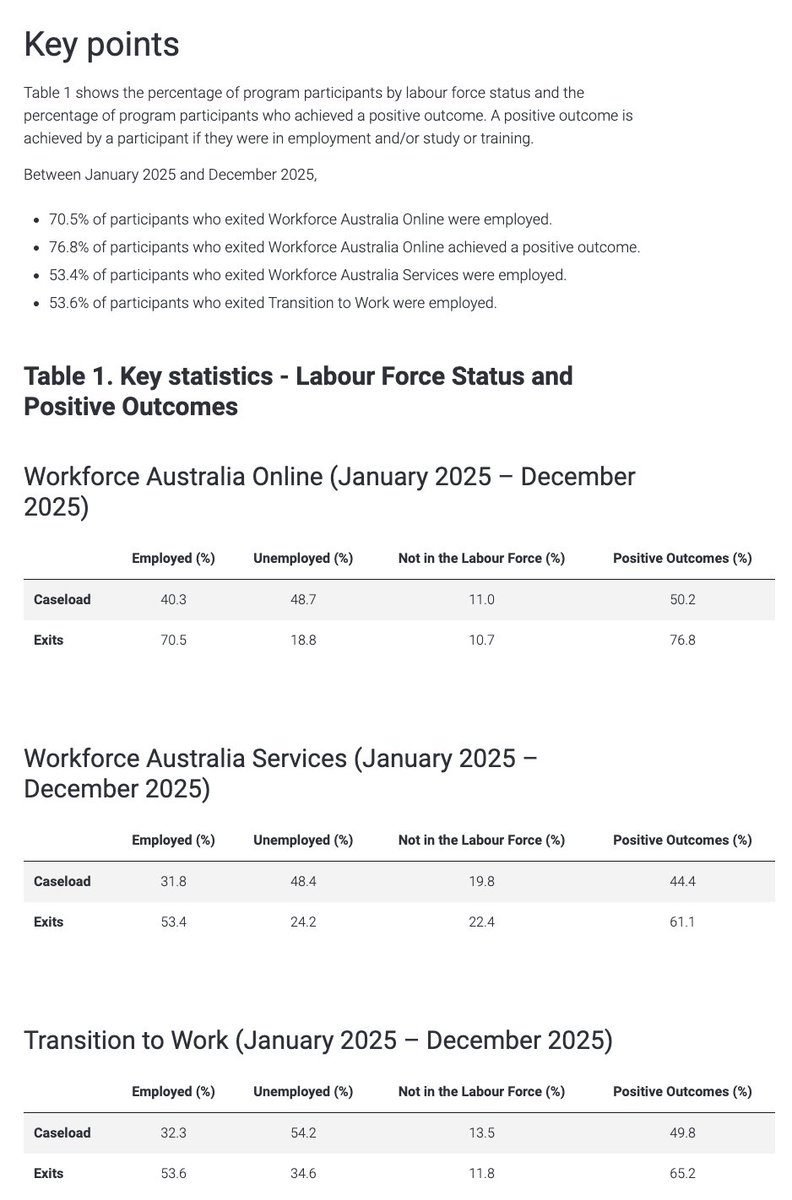
DEWR separately reports that 53.4% of people exiting Workforce Australia Services in 2025 were employed. That doesn’t tell us whether they found those jobs themselves, through a provider, friends or family, or elsewhere — but it does demonstrate that “not achieving a 26-week employment outcome” and “failing to find employment” are not the same thing.
DEWR’s own 2023–24 report makes that distinction even clearer, explicitly stating that participants who don’t achieve the outcome in a particular year “may still go on to find sustained employment.”
That’s a pretty important qualification if you’re going to turn a 26-week outcome statistic into a blanket “failure to find jobs” rate.
So no, I’m not going to “pick a side” based on sweeping claims and headline statistics when the underlying data doesn’t necessarily support the conclusions being drawn from them.
And for someone concerned with political context, I find your content remarkably lacking in it. You repeatedly present statistics without adequate context and then draw conclusions that go beyond what those statistics actually establish.
From what I can determine so far, the real issue isn’t “employment services or nothing.” It’s whether Australia is spending the money on the right kind of assistance, targeted at the people who actually benefit from it, and whether expensive provider-based servicing produces enough additional benefit to justify its cost.
But I need to look into that further before reaching any firm conclusions.
Anyway, I have to go now as I’ll be travelling soon. I’ll look into it further for myself.
Thanks for the discussion and enjoy the rest of your week.
@pcet2022@Ryandally08 I don’t have to answer a question framed around conclusions I don’t accept, particularly when those conclusions have been drawn from complex data that your own source warns against interpreting causally. That’s not dodging the question; it’s questioning its premise.
Nice one. You got me there.
Yep all I’m say is rubbish. Utter rubbish.
Oh well, but it’s a shame you’ve again oversimplified a complex situation and drawn a conclusion that the report itself explicitly warns against making.
The AIHW report you’re getting the mortality figures from states:
“This analysis does not examine, nor does it provide evidence of a causal relationship between receiving an income support payment and death, or any particular cause of death.”
It then says:
“Rather, receipt of income support is a proxy for the complex set of circumstances faced by people with low economic resources.”
And the COVID period actually illustrates why that distinction matters. In 2020, the mortality rate among unemployment-payment recipients fell by 32%. AIHW explains that the recipient population doubled from about 1 million to 2 million as a much broader group of people entered unemployment support, driving down the mortality rate.
So yes, the substantially higher mortality among JobSeeker recipients is real and concerning. It demonstrates that people receiving unemployment support are a particularly vulnerable population deserving serious attention.
But it does not demonstrate that JobSeeker or Mutual Obligation caused that mortality difference. AIHW explicitly says its analysis provides no evidence of that causal relationship.
Once again, the statistic is real. It’s the much broader conclusion you’re drawing from it that isn’t established by the data.
Regarding the current period: your 90% figure appears to come from Workforce Australia Services’ 11.7% 26-week employment outcome.
But that doesn't mean the other 88.3% failed to find work. It means they didn't achieve that particular 26-week outcome.
DEWR separately reports 53.4% of people exiting the service in 2025 were employed, although it doesn't say whether they found those jobs themselves, through a provider, friends/family or elsewhere.
So neither figure by itself tells us how effective the providers are, but 11.7% certainly shouldn't be presented as meaning 89% failed to find a job.
I don't dismiss this research. There is good reason to take seriously the effects of unemployment, financial hardship and punitive welfare requirements on psychological distress.
But the researchers say these factors “can increase” hardship and distress, which are associated with elevated suicide risk. That's not the same as demonstrating that mutual obligations caused the higher suicide rate among JobSeeker recipients.
And it doesn't substantiate the separate claim that employment services have had a 90% failure rate for 30 years.
These are important issues, but they need to be supported by what the data actually demonstrates rather than combining separate statistics into one claim.
Please demonstrate how there has been a 90% failure rate in finding employment over 30 years?
The historical data I can find doesn't seem to support that assertion:
Job Network (2000–01): 39% were employed 3 months after leaving Intensive Assistance; 45% after Job Search Training. Among those placed through Job Matching, 66% were employed 3 months later.
Job Services Australia (2013): 26-week outcome rates varied by stream: 9.8%, 24.0%, 16.6% and 12.2%.
jobactive (2018): DEWR reported 48.6% of participants were employed 3 months after participating. Of recorded job placements, 43.1% resulted in a paid 26-week outcome.
These aren't directly comparable measures — which is precisely why a blanket “90% failure rate for 30 years” needs evidence.
I'm happy to look at the evidence, but please provide the actual data and methodology behind the 90% claim rather than simply repeating it.
@pcet2022@Ryandally08 Essentially, your claim is overstated. There are legitimate criticisms of Workforce Australia, but turning an 11.7% 26-week employment-outcome figure into a “90% failure rate” goes beyond what the evidence actually shows.
@pcet2022@Ryandally08 Workforce Australia Online had 70.5% of exits employed, while Workforce Australia Services had 53.4%. That demonstrates why lumping the whole Workforce Australia system into a single “90% failure” figure can be misleading.
@pcet2022@Ryandally08 DEWR's survey found 53.4% of Services leavers employed about 3 months after exit. But it doesn't show when they got that work, whether it came through the program or later, or whether it lasted 26 weeks.
@pcet2022@Ryandally08 If your $9B is the 2023 inquiry's figure, that's a four-year forecast (2022–23 to 2025–26) across several programs, with Services forecast at $4.3B. Setting it against a one-year, Services-only rate compares two different things.
@pcet2022@Ryandally08 Your quote isn't in the report and goes further than DEWR does. If it's there, share the link and page number. The 11.7% only counts provider-recorded jobs lasting 26 weeks. You're conflating one year of those outcomes (2024–25) with everyone who found work, then or since.