🇱🇧 @Starlink in Lebanon!
Lebanon just took a major regulatory step.
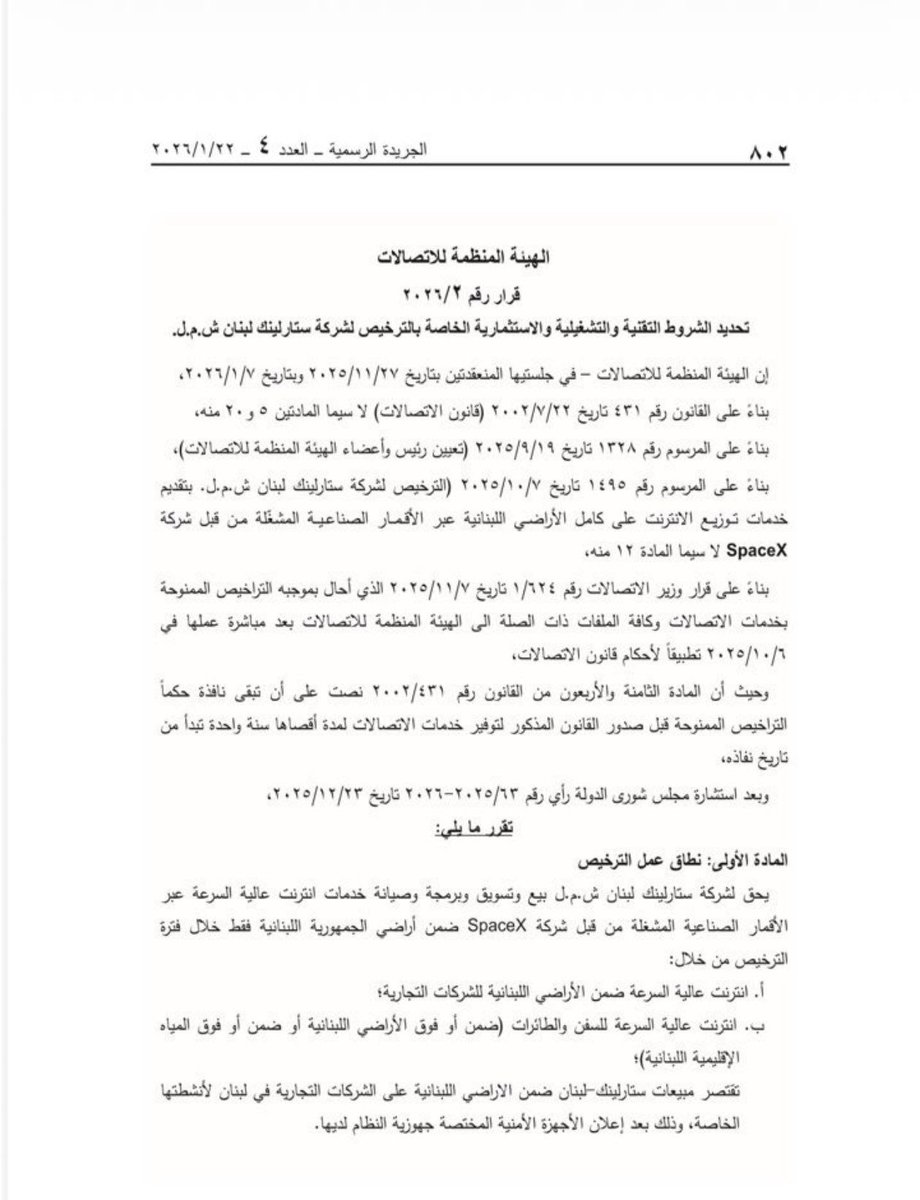
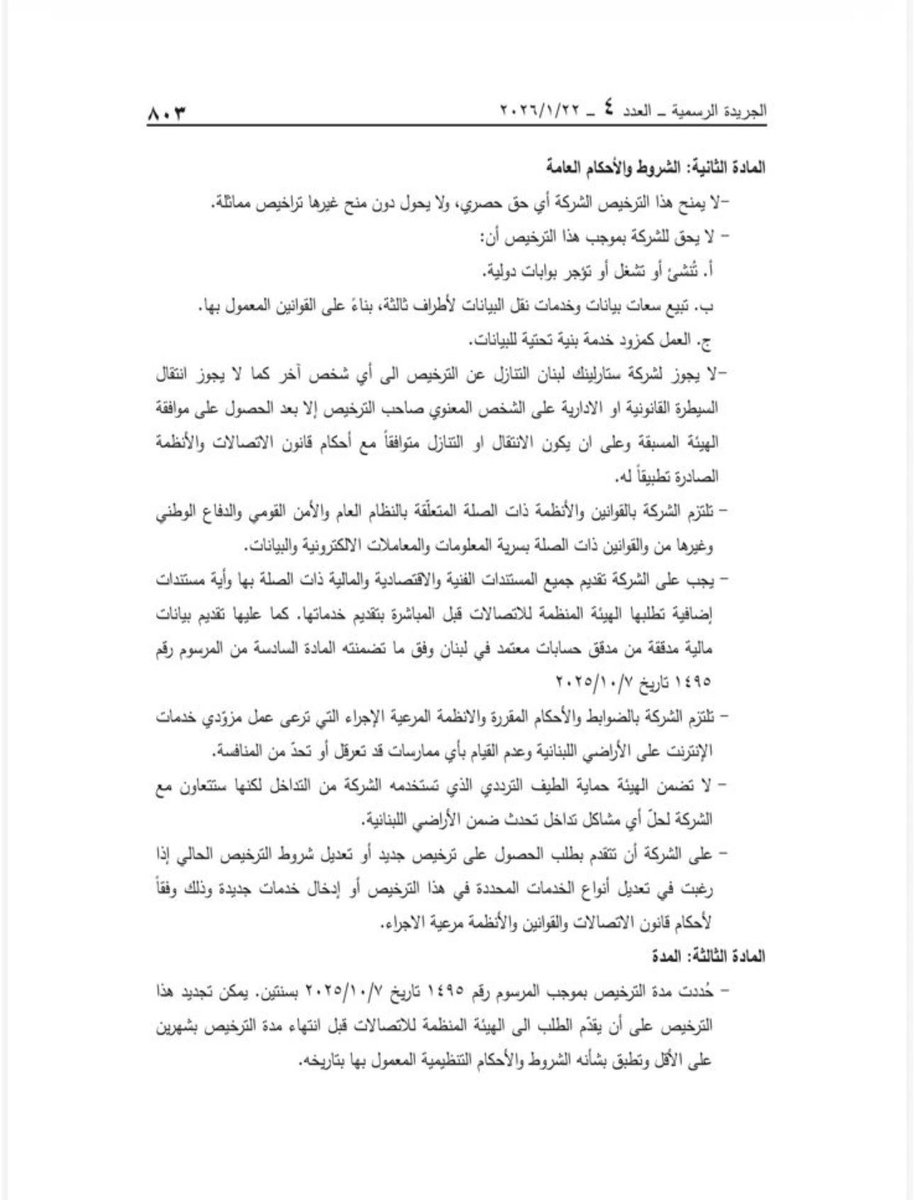
The Telecommunications Regulatory Authority issued a decision setting the technical, operational, and investment conditions to license Starlink Lebanon SAL to distribute high-speed internet across Lebanese territory using SpaceX satellites 🛰️
And honestly, this is not just about “faster internet” 🚀
This could be the beginning of a structural shift in how Lebanon builds its digital economy.
1) For the private sector: real Business Continuity ✅
The biggest issue in Lebanon isn’t speed. It’s instability.
Companies can’t plan on infrastructure that collapses randomly. Outages, weak SLAs, and structural bottlenecks have turned connectivity into a constant risk instead of a foundation.
If implemented correctly, Starlink introduces something Lebanon badly needs: a real alternative connectivity path 🔁
That matters massively for banks and fintech, payment providers, data centers, IT providers/MSPs, retail chains, logistics networks, and any company working remote or outsourcing internationally 💻🌍
This isn’t a luxury. It’s business continuity.
2) For cybersecurity: potentially a turning point 🔐
Cybersecurity in Lebanon doesn’t struggle only because of skills or budgets. It struggles because the infrastructure itself is fragile.
Stable connectivity changes the game.
It allows 24/7 SOC monitoring 🛡️, continuous EDR/XDR updates 🧠, secure always-on VPN tunnels 🌐, predictable patching cycles 🔄, and stable cloud security posture ☁️
In other words: better internet reliability directly enables better cybersecurity.
And this matters even more outside Beirut and in underserved regions 📍
3) Regulation matters: moving from chaos to structure ⚖️
What’s important is that this is now being framed properly.
The decision makes it clear the license is not exclusive, distribution is limited to Lebanon, and the sales model is structured around commercial use.
This is a move away from the “grey zone” Lebanon has lived in for years, and toward a regulated market environment.
BUT implementation drawbacks & risks are real ⚠️
Now the difficult part: execution.
The decision itself highlights constraints that people should be aware of.
Starlink isn’t rolling out to everyone overnight. Distribution is largely focused on commercial entities for now.
There’s also a security gating factor. Implementation depends on the readiness and approvals of security bodies, which can delay deployment or restrict it.
It also can’t operate or provide international gateways, and it can’t resell capacity to third parties, which limits wholesale models and partnerships.
On top of that, the regulator doesn’t guarantee protection from spectrum interference, and the license duration is only two years (renewable), which creates uncertainty for long-term investment.
And beyond the legal framework, there’s another obvious risk: if pricing, governance and compliance aren’t handled properly, it could become an “elite-only” solution rather than a national accelerator.
Still, despite everything, Starlink is not a luxury.
It’s a new infrastructure layer Lebanon desperately needs to strengthen the IT ecosystem, raise cybersecurity maturity, and boost competitiveness 📈🇱🇧
So the real question is:
Will Lebanon treat Starlink as a strategic digital competitiveness project, or will it be restricted into a controlled niche service? @elonmusk any garanties on this?
❓ What do you think, is Starlink a turning point for Lebanon’s digital future, or a missed opportunity in the making?
@denvercunning Based on what I am hearing, the Lebanon situation is wide open since last meeting. The public messaging is different from what is being talked about behind closed doors.
A lot of people own small and medium businesses that require little to no employees and sell services into the UAE or Arab countries or even Lebanons. And many others are executives in local SMEs.
My answer, yes numbers are specific to a certain region. While numbers are widely different in others.
Each year, Lebanon officially marks what it calls “Liberation Day,” commemorating Israel’s 2000 withdrawal from southern Lebanon. But even in 2000, this was never truly a celebration of Lebanese sovereignty. It was the political canonization of a militia’s victory narrative, one that allowed a nonstate armed actor to transform military momentum into permanent domestic political power.
Twenty six years later, the results are unmistakable.
Lebanon is not sovereign in any meaningful sense.
A state that does not monopolize force, cannot independently decide war and peace, and can be dragged into catastrophic conflict by actors operating outside its formal institutions is not sovereign. It is, at best, a partial state performing sovereignty while lacking its substance.
This is what makes the annual celebration so grotesque. Lebanon is not commemorating liberation. It is commemorating the political moment when the erosion of state authority was repackaged as national triumph.
The fiction might have been politically useful once. Under the banner of “resistance,” the continued existence of an armed parallel structure was sold as a temporary necessity. Instead, it became permanent. The Lebanese state did not absorb the militia. The militia outlasted, outmaneuvered, and functionally superseded the state.
The consequences have been severe: institutional decay, economic collapse, strategic paralysis, and repeated wars imposed on the country without national consensus.
More remarkable still is the role of Lebanon’s current leadership.
President Joseph Aoun and Prime Minister Nawaf Salam entered office amid broad public expectation that the era of armed exceptionalism would finally end. Lebanese were promised a restoration of state authority, institutional legitimacy, and sovereign decision making. Yet today, the same leadership appears less committed to confronting the central obstacle than to managing around it.
This is the real scandal.
Because the obstacle to sovereignty in Lebanon is not conceptual. It is practical. A state either exercises exclusive control over armed force or it does not.
And this contradiction becomes impossible to ignore as Lebanese officials engage Washington over border arrangements, de-escalation, and possible understandings with Israel.
Negotiation requires leverage. States negotiate from authority, credibility, and internal coherence. What exactly is Lebanon bringing to the table?
Can Beirut credibly commit to security arrangements when it does not control all armed actors on its territory? Can it guarantee de-escalation when escalation decisions may be made elsewhere? Can it negotiate durable understandings while refusing to resolve the very internal disorder that makes those understandings inherently unstable?
Diplomacy is not the issue. Serious states negotiate, including with adversaries. But serious diplomacy requires state capacity.
Lebanon today is attempting external diplomacy while avoiding internal sovereignty restoration.
That is not strategy. It is theater.
And so the annual commemoration remains what it has always been: not a celebration of liberation, but a ritualized affirmation of Lebanon’s political dysfunction.
A country that cannot control its own territory, secure its own citizens, or prevent itself from being dragged into war has not been liberated.
It has merely normalized its captivity.
Real liberation will begin only when Lebanon’s leaders stop managing the militia problem, stop hiding behind commemorative mythology, and finally do what sovereign governments are meant to do: govern.
Thank you for always being so open with the community. I have some comments.
The issue with limiting events to townhall is that you are kneecapping high townhall player who due to previous inactivities are lacking in 1 area.
Taking myself as an example, I am so close to maxing EVERYTHING, but the only thing that is only 50% done is Equipments, I went inactive for 3 years and suddenly was behind considerably on all equipment. Yes I managed well and have all equipment I need at max level, but I can mostly play 1 type of army as my equipments are optimized to it. Especially that I am high league and can’t risk demotion for fun.
So maybe make those events dependent on progress not on townhall level!
Thank you for the attention and all the efforts you do.
🇷🇺🇸🇴 Somali pirates are back hijacking oil tankers
In 2009, Russians were selling luxury pirate hunting cruises off the Somali coast. £3,500 a day, AK-47 rental £5 extra, 100 rounds for £7
Someone needs to dust off that brochure...
Because Hezbollah asked to take the leadership of the army and have unanimous decision on what to do, like the IRGC! Which is completely rejected by Lebanon!
The president already suggested allowing them to join as soldiers and for higher ranking officers to go through officer school to get a rank.
Same happened in the past!
@Sam850x@Abihabib So if someone hits someone and comes and ducks behind me and I get hit in the face, I would blame both of them. This is what is happening in Lebanon