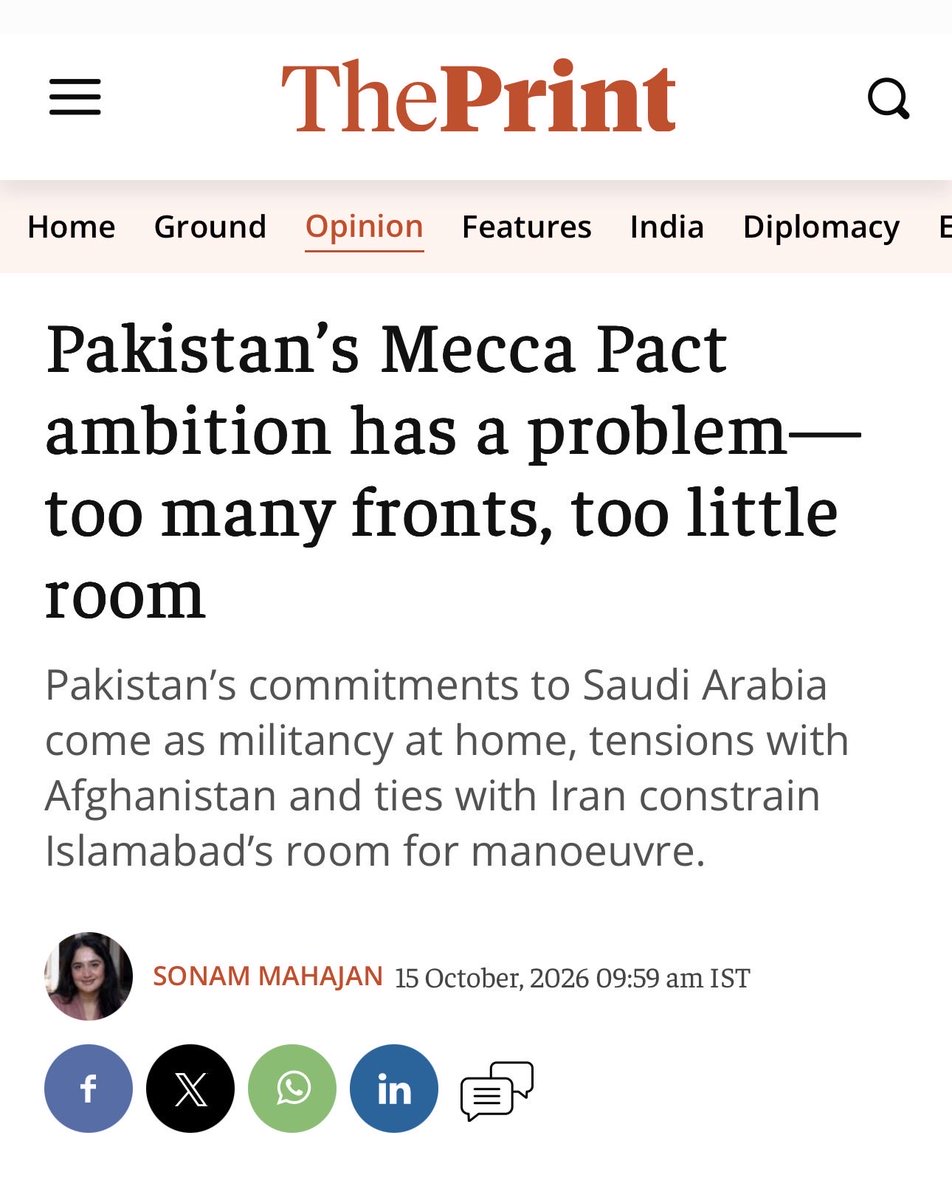
Pakistan’s land borders, as of this weekend:
🇮🇳 India: closed, hostile, unresolved.
🇦🇫 Afghanistan: Durand Line in constant exchange of fire.
🇮🇷 Iran: trade halted at Taftan and Gabd-Rimdan, with some 2,000 trucks stranded and LPG supplies for Karachi in question.
🇨🇳 China: open, but the Khunjerab Pass is on borrowed time as winter closes in.
This is what strategic encirclement looks like, except Pakistan did most of the encircling itself.
And we were told this was the era of brilliant Pakistani diplomacy. A Field Marshal who could charm Washington and even manage Trump. But what good is winning over the West if you have managed to alienate nearly every single neighbour on your own borders?
Pakistan’s Makkah pact problem.
How many wars can one army fight?
My latest piece for ThePrint on Pakistan’s growing appetite for strategic blunders under Asim Munir.
Link in the tweet below:
Saudi Foreign Minister Faisal bin Farhan speaks to his Iranian counterpart Abbas Araghchi about de-escalation following deadly Houthi attacks on Riyadh airport that leave at least 16 dead.
Iran offers to mediate between Saudi Arabia and the Houthis, urging a political solution to the escalating conflict.
Of course, a ceasefire is always a good idea when the army meant to protect you has yet to win a war against its principal adversary and carries the ignominy of the largest military surrender since the Second World War, when around 93,000 Pakistani troops surrendered to the Indian security forces in 1971.
A truce, yes. And perhaps a different bodyguard, too. Because nothing says security like an army with a surrender ceremony to remember.
Saudi Arabia has spent decades cultivating an image of stability, security and prosperity. Yet a single attack on a major airport can shatter that sense of normalcy. A country can have all the wealth, infrastructure and institutions to project strength, but it cannot insulate itself entirely from the threats posed by rogue non-state actors operating in its neighbourhood.
India knows this predicament all too well. Asim Munir’s Mercedes-and-dump-truck analogy notwithstanding, geography can be unforgiving. We are living in very dangerous times, when even a country’s stability cannot guarantee its safety.
So Islamabad is preparing to impose emergency rule in Khyber Pakhtunkhwa.
Prime Minister Shehbaz Sharif and President Asif Ali Zardari agree to proceed with an emergency in the province, with the federal cabinet expected to consider approval and both houses of Parliament scheduled to meet on 13 October.
Please find below my piece for ThePrint, published just days ago, in which I discuss the possibility of Pakistan going down the emergency route in response to the insurgency in KP, and how the country’s expanding security challenges across multiple fronts are adding to the pressure on its military leadership.
In his latest National Interest column, Shekhar Gupta examines the convergence of several pressures confronting the Modi government, some of which deserve closer attention than they have received. The question is not just the accumulation of crises, but how institutional credibility, public sentiment, and political choices interact. Perhaps next time, Elon Musk can also be added to the list. He is, after all, the Donald Trump of the business world, and his increasingly transactional approach to power, coupled with his ownership of X, could make him an additional headache for a government which takes its social media battles very seriously. Ego, after all, can be an expensive business.
2. Trump is prioritising the Iran crisis over the Russia-Ukraine war. And this is the more consequential strategic dimension.
Washington’s energy calculations have changed because the conflict involving Iran has created a major supply shock.
The irony is that Trump’s own foreign-policy decisions have contributed to the environment in which he is now making this concession. The disruption caused by the Iran war has increased the cost of maintaining a hard line on Russian energy exports.
In effect, Washington is making a trade-off. It wants to sustain pressure on Moscow over Ukraine, but it also wants to limit the economic consequences of the wider conflict in the Middle East.
And the temporary waiver is revealing. It means that when sanctions begin to conflict with America’s own immediate energy and economic priorities, it is very flexible about making exceptions. The move also suggests that the Trump administration is willing to tolerate some loss of leverage over Russia if it believes doing so will help stabilise fuel markets.
Donald Trump’s decision to allow Russian diesel imports is best understood as a combination of domestic economic pressure, his transactional approach to foreign policy, and his belief that economic concessions can serve American interests even when they benefit an adversary.
There is also a deeper strategic contradiction here. Trump wants lower fuel prices for American consumers, greater leverage over Moscow, and an end to the war in Ukraine. But these objectives do not necessarily reinforce one another. A measure that helps him politically at home can give Vladimir Putin additional economic breathing room.
Two days after The New York Times reported that Pakistani Air Force jets were being used to strike the Houthis in Yemen, and a day after Islamabad dismissed the report as ‘fake and fabricated’, Pakistan’s Prime Minister, Shehbaz Sharif, condemns Houthi attacks on Saudi Arabia.
‘We will continue to stand shoulder to shoulder with Saudi Arabia in the face of these threats,’ he said.
Islamabad wants the strategic relevance of standing with Riyadh, but none of the scrutiny that comes with reports of its jets entering the fight. How convenient.
Jung mein shaamil bhi hain, aur jung se bezaar bhi.
‘Ek SHO ki maar hai.’
Mohsin Naqvi’s famous line on Balochistan has not aged particularly well.
From Balochistan to KP, Pakistan’s militant landscape is changing. The question is whether the state has noticed just how much.
My latest for ThePrint:
https://t.co/44cl4rfIm8
'Pakistan’s militants are changing. Is the State?'
Sonam Mahajan, strategic affairs commentator and columnist, writes
And with this deep-dive, welcome to the pages of ThePrint @AsYouNotWish
Illlustrations: Soham Sen @SohamDraws#ThePrintOpinion
https://t.co/G2FYv9ZUcW
Thank you, Shekhar. Very glad to see this one on ThePrint.
The militant landscape in Pakistan is changing in significant ways, and this piece was an attempt to examine some of those shifts beyond the immediate news cycle. Grateful for the trust and the editorial space to do so.
⚡️ JUST IN: Saudi Arabia, Pakistan and Türkiye activate the collective-defence mechanism of the Makkah pact following escalating Houthi attacks on the Kingdom.
This could become a very difficult strategic commitment for Pakistan, and one Islamabad may not have expected to confront this early. With Pakistani troops already present in Saudi Arabia, does this mean they could now be drawn directly into the fighting?
The short-term tactical thinking of the Pakistani military that has long characterised Pakistan’s strategic calculations has now drawn it directly into a conflict involving the Houthis, Saudi Arabia and, indirectly, Iran. Any Pakistani military role could complicate its carefully managed relationship with Tehran, expose its personnel and assets to Houthi retaliation, and create pressure to become more deeply involved. With the Houthis in the picture, missile strikes on Pakistan itself cannot be ruled out.
The real question is no longer whether the Mecca Joint Defence Agreement has been activated. It’s been getting activated for a while now.
The question is how far the partners go in implementing it.
Will we really see Pakistani and Turkish troops on the ground?
The Flydubai incident is likely to make airlines and regulators rethink who gets to fly into sensitive destinations. I wouldn’t be surprised if demand for Indian pilots rises as a result, given the credibility India currently enjoys in this space. More importantly, the scrutiny around pilots from countries that do not recognise Israel is likely to intensify. Terrorists have a long and deeply troubling history with the aviation industry, and an incident like this is only going to make airlines more cautious about pilot vetting, nationality, and security clearances for flights into Israel.
There is a reason I stayed away from this Hashim Moosa CNIC story.
I saw the photograph being circulated and, honestly, I did not feel it was the same man. So I didn’t want to jump on the bandwagon.
This is precisely why OSINT has a place, but OSINT accounts are not automatically reliable sources. There is a difference between digging something up and actually verifying it.
Now the DG ISPR has produced the man whose CNIC was being circulated and says he is a former SSG soldier who is very much alive. Whether one accepts the Pakistani version in its entirety or not, the point is that the identification being circulated was clearly not established enough to be treated as fact.
At this point, it does look like sections of the Indian media simply swallowed these OSINT identifications as gospel truth. And this is becoming a pattern. We saw it during Operation Sindoor as well. The problem is not OSINT. The problem is the Indian media treating an OSINT lead from random accounts on the internet, with little to no accountability, as established fact and then presenting it as though the information had come from official sources.
And this is exactly how unnecessary confusion gets created. We killed a Pakistani terrorist. But because some people were too eager to identify him, and perhaps too eager to be the first to ‘solve’ the puzzle, Pakistan now has an entirely avoidable talking point. ‘India claimed to have killed our former soldier, and here he is, alive.’ And regardless of what actually happened on the ground, this is a gift we handed them ourselves.
How it started, how it is going 😃
Iran’s Revolutionary Guard is now appealing directly to Americans, urging them to take to the streets against Donald Trump ahead of the US midterm elections, claiming the US has lost badly in the Middle East.
For decades, Washington has been calling on the Iranian public to rise against the regime. Now Tehran is trying the same playbook on Americans.