@Agrippa_Inv Wonderful article, Agrippa! You def make things easier to understand.
In this industry, is it easy to apply "lessons learned" to previous builds, or do they pretty much have one chance to get it right for each build (i.e. would Horizon 3 improvements be applied to Horizon 1)?
𝐓𝐡𝐫𝐞𝐞 𝐋𝐚𝐲𝐞𝐫𝐬. 𝐎𝐧𝐞 𝐂𝐨𝐦𝐩𝐨𝐮𝐧𝐝𝐢𝐧𝐠 𝐀𝐝𝐯𝐚𝐧𝐭𝐚𝐠𝐞. 𝐓𝐡𝐞 𝐈𝐑𝐄𝐍 𝐓𝐡𝐞𝐬𝐢𝐬.
There's been a lot happening at IREN recently.
Expansion across North America, Europe and Asia-Pacific.
The NVIDIA partnership.
The Mirantis acquisition.
New GPU deployments.
New customer discussions.
A growing global footprint.
Underneath all of it is a fairly simple view of where the world is heading, and a deliberate strategy for how we position IREN within it.
That strategy is built on three layers. Together, they compound into a structural advantage that gets harder to replicate every quarter we execute.
Layer 1: Physical infrastructure. Power, land, substations, data centers, cooling. The foundation that everything else sits on.
Layer 2: Compute infrastructure. The GPUs, servers and networking that go inside those buildings. Deployed at scale. Generating revenue. Building execution track record.
Layer 3: Software and operational capability. The orchestration, deployment tooling and enterprise expertise that makes the first two layers work harder for customers, and opens the door to a broader, higher-value market over time.
Layers 1 and 2 are where the overwhelming majority of IREN's value is being created today. Layer 3 is where that advantage compounds further over time, but only because Layers 1 and 2 are built, owned and controlled at scale by IREN, not subscale nor contracted from a third party.
Think of Amazon. They didn't win e-commerce by building a great website. They won it by controlling the fulfilment infrastructure at a scale nobody else could replicate. The foundation you don't control becomes the ceiling on your business.
That is exactly how we think about IREN. The physical infrastructure - the land, the power, the substations, the data centers - is owned and controlled by us. The compute deployed into it generates the revenue and execution track record. And the software, orchestration and enterprise capability we are more methodically building on top is what turns the total product into a vertically integrated AI Cloud platform that compounds over time and deepens into a competitive moat.
AI is still early. The bottleneck is increasingly physical. And we have spent eight years building the foundations.
@nvidia and @IREN_Ltd Announce Strategic Partnership to Accelerate Deployment of up to 5 Gigawatts of AI Infrastructure
IREN) today announced a strategic partnership to accelerate deployment of next-generation AI infrastructure.
As part of the partnership:
$NVDA and $IREN intend to support deployment of up to 5 gigawatts of NVIDIA DSX-aligned AI infrastructure across IREN’s global data center pipeline over time.
NVIDIA and IREN will collaborate on deployment of NVIDIA accelerated compute in DSX AI factories to expand access to AI-native, startup and enterprise customers.
As part of the partnership, IREN issued to NVIDIA a five-year right to purchase up to 30 million shares of ordinary stock at an exercise price of $70 per share, resulting in a right to invest up to $2.1 billion, subject to certain conditions including regulatory.
The partnership is intended to accelerate deployment of large-scale AI factories by combining NVIDIA’s DSX AI factory architecture with IREN’s expertise across power, land, data centers, GPU deployment and infrastructure operations.
Future deployments are expected to focus on IREN’s 2-gigawatt Sweetwater campus in Texas, which the companies expect to serve as a flagship deployment for NVIDIA’s DSX architecture.
“AI factories are becoming foundational infrastructure for the global economy,” said Jensen Huang, founder and CEO of NVIDIA. “Deploying these systems at scale requires deep integration across the full stack — compute, networking, software, power and operations. IREN brings the scale and infrastructure expertise to help accelerate the buildout of next-generation AI infrastructure globally. Together, we are building for the age of AI.”
“This partnership combines NVIDIA’s AI systems and architecture leadership with IREN’s expertise across power, land, data centers, GPU deployment and infrastructure operations,” said Daniel Roberts, cofounder and co-CEO of IREN. “Together, we believe we can accelerate deployment of AI infrastructure and expand access to compute for AI-native and enterprise customers globally.”
$IREN is making all the right moves…
I'm pleasantly surprised by $IREN's acquisition of @MirantisIT. Previously I thought $IREN would eventually move up the stack through M&A, but I anticipated this to happen in 1-2 years, not today.
I interpret this as things genuinely moving VERY fast at $IREN behind the scenes and all of us just underestimating the pace this company is on.
Remember, two years ago everybody saw $IREN as "just another BTC miner".
Six months later (late 2024) it became the most formidable competitor in the space, breaking growth records and being the only profitable entity in the industry.
Then, last year, the story evolved to $IREN having genuine potential in the AI/HPC colocation space with its gigawatt scale power portfolio.
Not long after, this company surprised everybody with its first hyperscaler deal consisting of leasing out cloud capacity, moving up the value chain and skipping the lower-yielding colocation segment.
Today, $IREN's product portfolio is evolving once again.
Previously they were widely regarded as a pure-play "bare metal" compute provider, yet with the acquisition of Mirantis, the company moved up to a full-stack AI cloud, now covering everything from the metal up through the managed AI services that enterprise and sovereign customers actually plug their workloads into.
Contrary to what most analysts interpret this as, I don't see this as a pivot, but rather a hedge. A hedge against customer concentration.
There are fewer than 10 companies in the world that can rent hundreds of megawatts of compute. Think hyperscalers and frontier AI labs like OpenAI and Anthropic.
Even if $IREN managed to establish relationships with >50% of these tier-1 customers, that would still result in an incredibly concentrated client composition.
This sort of reliance on a handful of customers just adds more risks, which in turn leads to lower valuations, higher cost of capital, and arguably most importantly, a weaker hand at the negotiating table.
All that said, I still think bare metal will continue to be the majority of $IREN's contracted cloud capacity going forward.
The big players' appetite for compute is just insatiable and $IREN is in a prime position to become THE "plug" for high-quality, low-cost compute, given its fully vertically integrated infrastructure portfolio and massive power pipeline.
Yet with this acquisition $IREN now has a solid shot at also taking meaningful market share in the smaller subsets of the AI compute market, namely the enterprise & sovereign AI (governmental) sectors.
The end result could be a much more diverse and thus more robust client mix.
If I had to take an educated guess at the reason why $IREN acquired Mirantis at this point, I believe it could very well be related to the multi-billion-dollar deal Co-CEO @danroberts0101 referenced in last quarter's earnings call:
"One of the contracts we are negotiating at the moment is a multi-billion dollar contract where we would have to bring a software solution".
I believe the counterparty in question isn't a hyperscaler or a frontier AI lab. These are exactly the kind of customers who DON'T need the software layer, as they develop it in-house and retain full control.
Likewise, I don't think there are many enterprise clients requiring cloud compute in the "multi-billion" dollar range.
Thus, by process of elimination I think the most likely fit is a sovereign entity, i.e., a state or government. Mirantis just happens to be one of the few companies validated by NVIDIA as part of its sovereign AI reference architecture.
As for which sovereign entity it might be, there are many possible candidates, but there is none more obvious than the Australian government itself, be it federal or stae-level, given $IREN's roots in the ‘land down under' (founded and headquartered in Sydney).
This would also explain the company's recent advertising push in several regions across Australia, perhaps to attract the necessary local tenant to successfully pull off a venture of this magnitude.
I'm just thinking out loud here, and much of this is nothing more than speculation at this point, but in any case, this acquisition appears highly strategic in multiple ways.
I'm very much looking forward to tomorrow's earnings call, in anticipation of getting more insights into the motivation behind taking Mirantis on board.
Over the coming days post-earnings I'll publish a very extensive earnings breakdown on Substack, of which the acquisition of Mirantis will be a substantial focal point.
I'll lay out everything there is to know about this tech company & provide you with my unfiltered opinion in an easy-to-digest manner.
Stepping back one more time, it's incredible to see just how far $IREN has come since I started covering it. It's truly a generational unicorn company. Something you don't come across very often.
The growth trajectory has been unprecedented. The company is firing on all cylinders, and I think we stand right before some major commercial victories.
Another piece of data pointing in that direction is the company's recent hiring spree. $IREN now has 142 job openings across a wide range of departments and geographies.
This company is not standing still!
Cheers, guys ✌️
S/O to my friend @_Sgr_A_Star for providing the job listings pics
The game theory in AI has shifted. Having a leading foundational model is important but increasingly it is the zoning approved, powered land that is the gating bottleneck. Add turnkey access to silicon and it’s checkmate.
If you have that, you have immense negotiating leverage right now. As data centers get voted down, this leverage will only increase.
Elon just proved it with Cursor.
Now imagine the deals that OpenAI and Anthropic will have to do in the next few years? The Amazon-Anthropic deal was an appetizer.
If you are a sharp on the other side who owns the right assets… 🤤
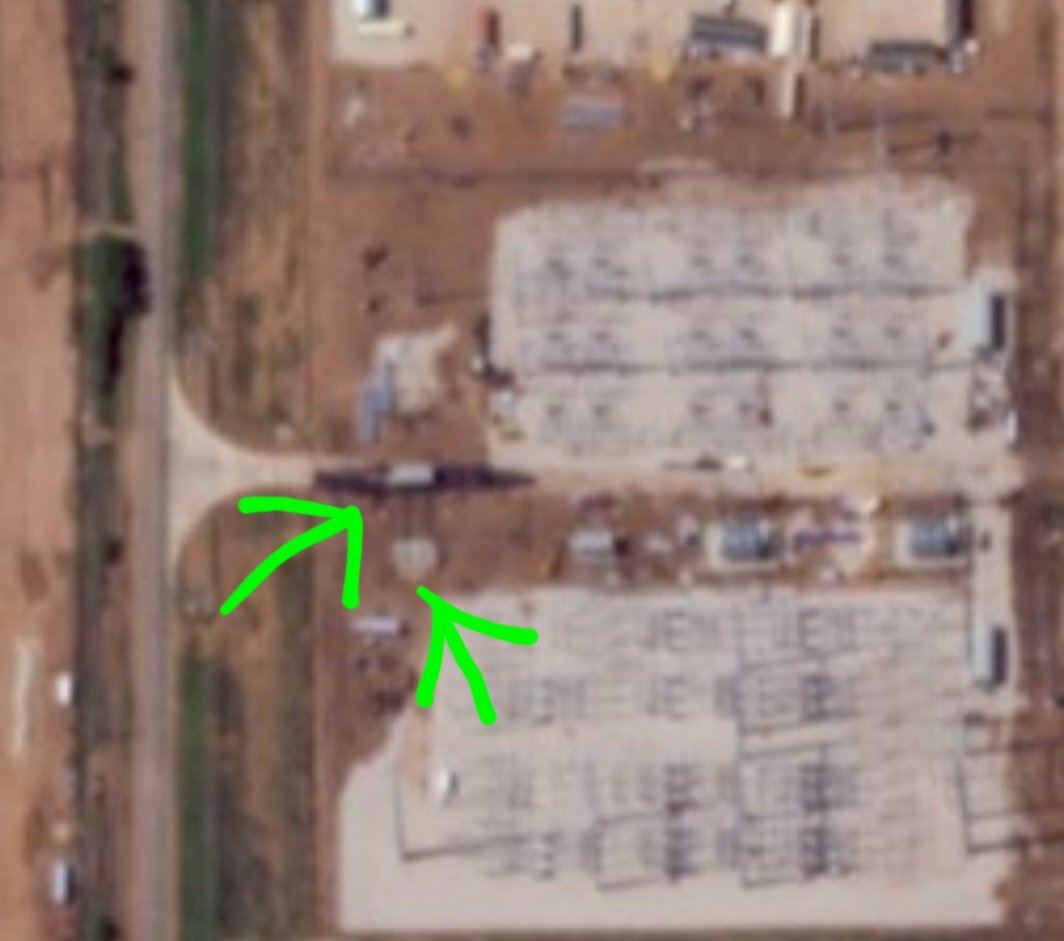
$IREN has hauled in their 4th and last bulk substation transformer for Sweetwater 1!
As we can see on picture 1, the trailer from picture 2 (Childress 2025), can be recognized.
OnlyFrans has also more intel on the energization 😎
What's the next big thing?
$IREN is pleased to announce it will be added to the MSCI USA Index, effective after close of trading on February 27, 2026.
The MSCI USA Index measures the performance of large and mid cap segments of the U.S. equity market and represents approximately 85% of the free float-adjusted market capitalization in the US.
Press Release: https://t.co/YjBIoBOMaL
$IREN's share price…
I��ve read many different takes on why $IREN is supposedly on this downward trajectory.
Some claim it’s due to $BTC weakness, others say it’s just distress in the AI sector. Either way, a large number of $IREN shareholders do seem concerned and wonder if we have already put in a long-term top.
In this post I’ll unpack all of it & provide you with my take on $IREN's recent share price performance.
First of all, even though Bitcoin’s price action has been disappointing over the past couple of months, I doubt it has had a significant impact on $IREN's share price performance. Yes, $IREN is still one of the largest "BTC miners", however, its share price has been totally detached from Bitcoin’s price action for a while now.
In my opinion, $IREN's recent dip in share price isn’t just unsurprising, it’s something that was long overdue anyway. A stock can’t go up in a straight line forever…
From early April until last week $IREN pulled a >15x – over a span of just ~7 months. You hardly ever see these kinds of moves in the stock market, not in a timeframe this short.
So far, this has been a generational run, one that was unsustainable at this current pace. I do think we have much more to go before putting in a long-term top, but the share price taking a breather and resetting sentiment is exactly what you want to see if you are a long-term holder.
This correction creates the base for the next round – it’s standard market psychology & cyclicality.
I also think most investors have the wrong perspective on price action in general. And I mean “perspective" literally.
Most people look at $IREN's chart on a linear scale (pic 1) and see a catastrophic collapse in share price over the past ~10 trading sessions. Meanwhile, I exclusively look at the logarithmic chart of $IREN (pic 2) and all I see is a small dip in the grand scheme of things.
On a linear chart, each step on the y-axis is the same dollar amount, while on a logarithmic chart, each step is the same percentage move. So on a log chart, a move from $5 to $10 (100%) takes up the same vertical space as a move from $20 to $40 (also 100%), even though the absolute dollar move is much larger in the second case.
That’s why log charts are so much better for comparing the present to the past. Every bit of vertical distance represents the same percentage change, so you keep proper perspective on drawdowns and rallies. On a linear chart, once a stock has run 10–15x, the right side of the chart gets vertically “stretched,” and any pullback looks like a total collapse.
In $IREN's case, the current dip looks like the worst crash ever on a linear chart, even though we’re “only” down a bit over ~40% from the recent highs. Earlier this year, during the April flush, we were down roughly 70% from the local highs we made in December. In percentage terms, that April move was far more violent.
The log chart shows this clearly; the linear chart doesn’t.
One reason why I was so amazed by $IREN when I discovered the stock early last year was the fact that its log chart looked so volatile.
With most stocks, volatility is contained in a tight range on a log chart. What may appear as a volatile stock, even on a log chart, may just be minimal moves in % terms. However, $IREN is a different beast… Its high volatility means corrections may be violent, but the potential upside is so much greater than with most other stocks.
You can easily configure your current chart setup into a logarithmic one on TradingView (not a sponsor, but I use this free tool all the time to look up charts).
Now, getting back on topic. I believe it comes down to 3 reasons why $IREN is currently dipping:
1) It ran up too far, too quick, without any major pullbacks in between
2) Buy the rumor, sell the news
3) Sector weakness
Point 1 I just discussed – every asset needs sentiment resets once in a while, completely normal and natural market behavior.
Regarding point 2, it’s pretty obvious that last week was a classic "buy the rumor, sell the news event" (very common in markets).
Many $IREN holders bought the stock in anticipation of a major hyperscaler deal, buying the stock BEFORE the deal, believing the stock would pump more once a hyperscaler agreement actually materializes. However, the opposite happened; the stock dropped soon after the deal was made public – primarily because there were no buyers left – everyone had already bought the stock beforehand.
In market terminology you also call this "priced in". The market had already priced in a deal of that magnitude before it even happened.
These sorts of "buy the rumor, sell the news" events are incredibly common in all types of markets. Whenever there is an obvious “event” that most market participants can anticipate beforehand (evident from price rallying up prior to the event), chances increase drastically that the good news has already been priced in and that "day x" will be more disappointing than most expect.
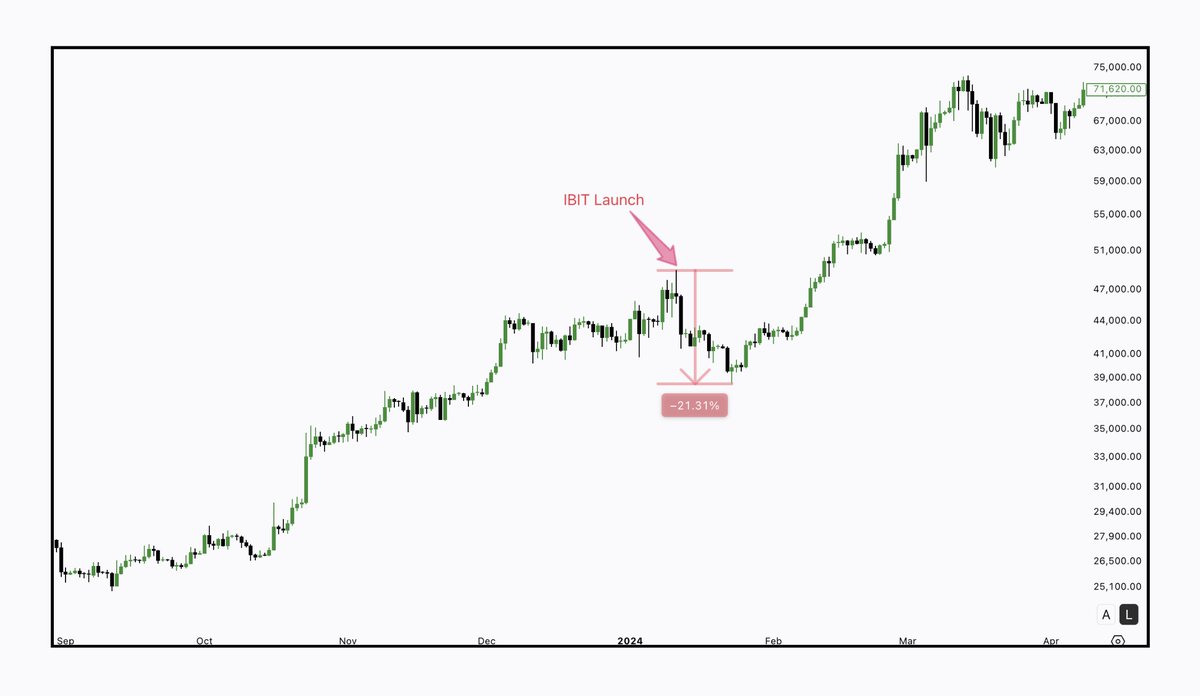
Another high-profile example of a buy the rumor, sell the news event was the launch of Bitcoin’s first-ever spot ETF ( $IBIT ) in early 2024.
When it became obvious that the launch was imminent, BTC rallied strongly in the weeks and months prior to it. Then on launch day (11. Jan, 2024) BTC started a sell-off that continued for a couple of weeks. Of course, BTC recovered and nearly doubled soon afterwards, but the ETF launch was still a "buy the rumor, sell the news" event.
These types of events can also quickly snowball into a larger correction for a few psychological reasons.
As I said before, many investors buy the asset regardless of fundamentals or even chart technicals, solely on the basis of thinking "they are early", because day x hasn’t happened yet (in $IREN's case day x = hyperscaler deal).
Now that the first deal has happened, that kind of buyer isn’t there anymore.
Moreover, some short-term investors or traders got into $IREN with the sole intention to sell the stock after the first major deal gets announced – anticipating a large pump on day x and then selling out on top.
We got a brief pump when the deal was announced and that group of people sold, leading to selling pressure at the highs. Others with a similar plan may have wanted the stock to rally a bit more, but once they saw the stock dipping, they may have gotten spooked and sold a portion or all of their holdings soon after, leading to even more selling pressure.
Many who took profit in the $65–79 range likely had positions that were up multiples on their entry price and so de-risking their portfolio at that point seemed reasonable.
Now, sub-$60 and even sub-$50 we are getting into the "panic range".
Selling pressure at these levels primarily comes from "investors" who are panicking about $IREN's long-term potential. They might think the stock has put in a long-term top and its best days are over. They see the recent dip and are getting cold feet – selling, just to make the bleeding stop.
They might also believe the economics of the company's recent deal with Microsoft can’t be good because, after all, we are down significantly since the deal was announced.
... They are fooled by efficient market theory and believe "the market is trying to tell them something", i.e. that the deal was bad.
They may even think that any new deal that’s announced in the future may just lead to further drops in share price – they are basically rationalizing current price action and extrapolating from it (something you should never do, unless you are doing it from a market-psychology POV).
Now finally, we also have general AI sector weakness on top of everything else, which is compounding the downside pressure.
$CRWV & $NBIS recently had earnings and both fell short to some extent. Nebius missed on revenue expectations & CoreWeave had to revise down their Q4 guidance due to their reliance on third-party developers who are behind delivery schedules – something $IREN doesn’t even have to deal with because they develop their data center infrastructure in-house.
One might think that hiccups amongst competitors should be a good thing for $IREN, after all this is a very competitive industry. And with that assessment you might be right, but as I alluded to before, the market is severely irrational and won’t price these factors in immediately.
Instead, these negative industry-related news items are short-term headwinds for the entire sector, because of algorithms that trade sector-wide and un-informed "investors" that see CoreWeave's colossal dump after earnings and think something like "Uhh, $CRWV crashed big-time after its earnings, the same might happen with $IREN, because they are kind of the same thing right? Let’s sell just in case"
… Not realizing the primary reason why $CRWV sold off in the first place is due to something that could never happen to $IREN (third-party developer issues).
So, where does this leave us and what are my expectations going forward?
After having spent 1000s of hours researching this company, this short-term price action doesn’t bother me in the slightest – I’m still incredibly bullish on $IREN over the mid to long term and nothing has changed in that. If anything, I’m now more bullish AFTER this $MSFT deal since it now marks a thesis-defining milestone in my investment.
There are some industry-wide risks that I’m monitoring closely, but I firmly believe $IREN is in an incredibly strong position to weather any potential macro headwinds.
I do, however, believe that these are the times that truly test investors and show the importance of building high conviction in your holdings, which is only possible when you understand your holdings from the inside out.
If you haven’t done the research, you’ll undoubtedly make irrational decisions along the way – primarily due to a lack of data. Conclusions that may seem logical at first could be missing the mark completely if you simply had more knowledge.
Now that retail market participation is at all-time highs, markets are even more prone to violent swings in both directions, catching many off guard who haven't done sufficient due diligence on their holdings.
My upcoming “project” is tackling exactly that need and tries to simplify this research process in a time-saving & engaging way for retail investors & institutions alike.
I’m looking forward to sharing more about it over the coming 24 hours…
Until then, have a good one ;) Cheers! ✌️