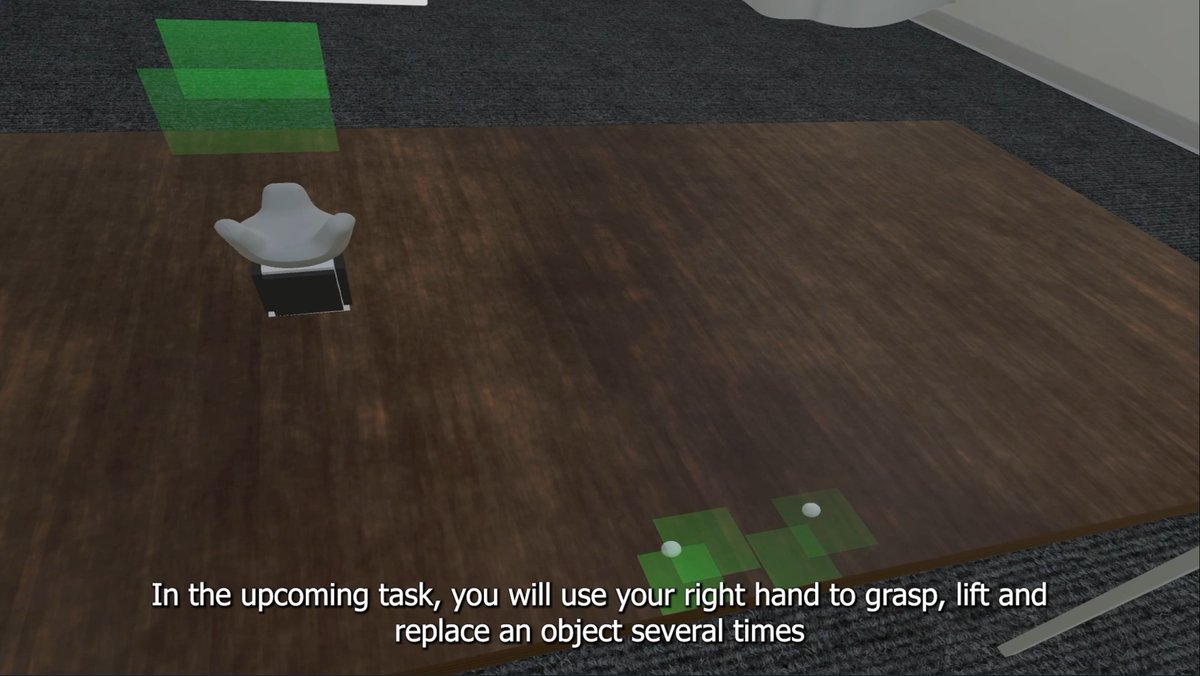
I am almost positive a similar resource exists (really feeling the tip-of-my-tongue sensation), but I couldn't find it so I felt compelled to publish this repo of VR research resources: https://t.co/DaX5RyWRMJ
A great position is open for someone skilled with Unity, creative, and looking to have big impact on #VR and #AR#research. Please share with your networks and get in touch with any questions -- this is a fantastic team to work with! https://t.co/u3nRRQeOAQ
Last week, it finally happened! I successfully defended my dissertation on human tool-use across real and virtual environments. If you want to see the Reveal.js-based presentation, follow this link:
https://t.co/nsu6g100zd
I decided before starting this work that I wanted to be as transparent as possible, and contribute to the wider research community beyond the findings. Thus, both the method (the full study code, w/o closed-license assets) and results are available on Github/OSF.
@tcarpenter216 I believe the r extension gives you an environment view in the sidebar. You may need to tweak the settings to have it appear. Otherwise most of the other panels appear as needed, you can control arrangement in view-> appearance/editor layout or just dragging the tab and dropping
After a potential target is selected, the center of the transforms moves to the estimated pivot and the distance between them is reduced. This iterates a few times, ending up with a generally accurate result. It works pretty well for the elbow, too.
The Manus gloves are accurate enough that everything else needs to be, like the IK target for the avatar's hand bone. I couldn't find an existing solution that could consistently place it, so I came up with this. It's inelegant but I am very happy to solve this problem 😂
Basically, a script makes a cube of transforms around the estimated target, with the hand tracker as the parent. You hold the wrist stationary and move the hand. Keep track of the displacement for a few seconds then compare it. The true target should move the least. 2/
@CaitlinENaylor UXF is a great foundation, has a lot of useful info in its wiki and a tutorial that covers important topics. I'm trying to aggregate all the resources I come across in a repo, bc my early experience was like stumbling down a dark hall. Not many tutorials yet though 😅
Easier application and has the added benefit of bared fingers, e.g. if you want to study texture perception. ~$10 for a roll of kinesiology tape and some fingernail adhesive tabs (for fake nails). Tape adheres to clips, adhesive tabs on nails adhere to tape
One small neg on #Manus gloves is the finger mounting materials. 30 "finger socks" and 10 clips on athletic tape. Socks slip during use and not durable. Tape probably the research-worthy approach and is $200 for 10 participants' worth from Manus. Came up with a cheap alt hack:
Adding this level of full-body tracking makes the contrast with my first dissertation study, where bodily cues were fairly minimal, pretty wild. I've had a lot of fun building on my previous work, refining and picking up new skills and tools along the way.
To update on the #Manus Quantum, they're pretty great. It's pretty wild to experience contact when I expect it after so long filling in the gaps. Now I can just worry about making sure the rest of the body is as accurate as possible.
For 2 years I have worked on this #rstats resource. It's a collection of functions used to wrangle data, especially in the field of ed research. Functions are organized by task (such as naming variables), and examples of how to use functions are provided.
https://t.co/DHDjIKAXUk