@_JCH01 stake with LUNA Strike Force BNB and you will not regret it. His generosity and support to $lunc community knows no boundaries. It’s a blessing to have validators @_JCH01@Greenpeace06_09 who work towards imparting knowledge and giving rewards to the community.
@_JCH01 could have pocketed it all, but chose to give back. That kind of magnanimity is rare and shows genuine commitment to uplifting those around him. terra-luna:native @Greenpeace06_09
UTXO is not enough.
Cardano deserves credit for recognizing the importance of the Extended UTXO model early. Ethereum’s recent exploration of native UTXOs also shows that explicit, independent state units are becoming increasingly important.
But the real question is not:
Who copied whom?
The real question is:
Can adding UTXOs alone solve the architectural limits of a blockchain?
The answer is no.
A UTXO is an atomic unit of state. It gives a transaction clear inputs and outputs, makes dependencies more explicit, and can create better conditions for parallel verification.
But UTXO does not automatically produce high throughput.
A scalable system also needs an execution model that can recognize independent transactions, a scheduler that can process them in parallel, a capable virtual machine, predictable state access, efficient verification, and a state architecture designed to avoid permanent global contention.
The VM alone is not enough either.
A powerful engine cannot make a badly designed road network efficient.
The state model, execution model, virtual machine, transaction structure, storage model, and developer environment must work together as one architecture.
This is why adding UTXOs to an existing system is very different from designing the entire system around independent state units from the beginning.
Ethereum can introduce a UTXO-based payment layer, but it still carries an enormous account-based execution system, global state, historical data, existing contracts, tooling, and developer assumptions.
Changing one component does not automatically change the architecture beneath it.
Cardano built around EUTXO much earlier, but EUTXO itself is still only one part of the system. Complex applications can still create shared-state bottlenecks, coordination problems, and difficult developer abstractions.
The deeper lesson is not that one chain has UTXO and another does not.
The deeper lesson is that architecture must be coherent from the beginning.
CKB starts from that principle.
Its Cell model defines independent state units.
New states can be generated off-chain.
Transactions explicitly consume old Cells and create new Cells.
CKB-VM verifies the transition.
The blockchain focuses on verification, ownership, and storage rather than forcing every node to generate every application state in the same global execution environment.
Because transaction dependencies are explicit, independent transactions have a clearer path toward parallel processing.
This does not mean that CKB automatically has unlimited throughput.
It means that its state model, transaction model, verification model, and virtual machine were designed to point in the same direction.
That is the difference between adding a feature and building a foundation.
UTXO is not the finish line.
It is only the atomic unit.
The real advantage comes from the architecture built around it.
🚨 THE US COULD LOSE ITS BIGGEST ADVANTAGE IN CRYPTO.
Yesterday was supposed to move the CLARITY Act one step closer to becoming law.
President Trump was expected to meet with key senators.
Many expected the updated draft of the bill to be released shortly afterward.
Neither happened.
Then another report made things even worse.
Democrats are expected to oppose the bill if the current draft is released without major changes.
That completely changed market expectations.
Prediction markets have now cut the odds of the CLARITY Act becoming law in 2026 to roughly 36%, down sharply from the 60-70% range seen earlier this year.
And here's why.
The bill has almost no room for delays anymore.
Before lawmakers leave for the August recess, three major things still need to happen.
• The final draft of the CLARITY Act has to be released.
• Republicans and Democrats must reach an agreement, especially on the ethics provisions that have become the biggest obstacle.
• The Senate must then bring the bill to the floor and vote on it.
If any one of those steps fails...
The chances of passing the bill this year fall dramatically.
And if the bill slips beyond this window, many analysts believe it could be pushed into 2027 or even later, especially if the political balance changes after the midterm elections.
This is much bigger than one piece of legislation.
Without the CLARITY Act, the crypto industry goes back to living under whoever happens to run the SEC.
A pro-crypto Chair may encourage innovation.
An anti-crypto Chair could once again rely on regulation through enforcement.
We've already seen what that looks like.
During the last cycle, many projects spent years fighting lawsuits instead of building products.
Altcoins were repeatedly accused of being securities.
Even stablecoins faced constant regulatory uncertainty.
Developers stopped building.
Investors stayed on the sidelines.
Capital moved elsewhere.
That's exactly what this bill was designed to fix.
The CLARITY Act would move crypto regulation out of the hands of changing administrations and put clear rules into law.
That means the framework would remain in place regardless of who becomes the next SEC Chair.
But while Washington is still debating...
The rest of the world isn't waiting.
Japan is moving ahead with clearer crypto rules.
South Korea is accelerating tokenization and stablecoin regulation.
Other countries are racing to attract crypto companies before the US finishes debating its own framework.
The United States became the home of today's biggest internet companies because it created the right environment during the internet boom.
Crypto is entering a similar moment.
The CLARITY Act isn't just another crypto bill.
It could determine whether the next generation of blockchain companies is built in America... or somewhere else.
INSIGHT: Binance founder CZ asked Elon Musk if they could partner on the development of @XMoney.
According to @cz_binance - @elonmusk said the platform will only handle fiat.
"He said they're handling 'boring money'. They're not touching crypto."
Imagine native Bitcoin payments on @X. CZ says if anyone could get that over the line from a regulatory standpoint, it would be Elon.
That would ofcourse take a monumental effort given how global regulators and governments crushed Meta's Libra/Diem project a few years ago.
A social network with ~1B users has the potential to fundamentally disrupt global payments.
If you missed my full interview with CZ, I've shared a link to @TheBlockCo YouTube channel which has the full 70 minute chat.
RIP to the opportunities we missed because of self doubt and fear. #Lunc is your generational wealth and @_JCH01 and @Greenpeace06_09 are helping you achieve that. Stake with them. And thanks @_JCH01 for the hog
@_JCH01 RIP to the opportunities we missed because of self doubt and fear. #Lunc is your generational wealth and @_JCH01 and @Greenpeace06_09 are helping you achieve that. Stake with them. And thanks @_JCH01 for the hog
@_JCH01 RIP to the opportunities we missed because of self doubt and fear. #Lunc is your generational wealth and @_JCH01 and @Greenpeace06_09 are helping you achieve that. Stake with them. And thanks @_JCH01 for the hog
SMART MONEY BOUGHT ~$10M WORTH of TERRA bankruptcy claims in the last 30 days
Is this only the beginning? Shouldn't we all follow smart money???
Want a deeper explanation of what all of this means for Terra tokens?
Leave your thoughts below 👇
#luncarmy#luncburn#ustcrepeg $lunc $ustc
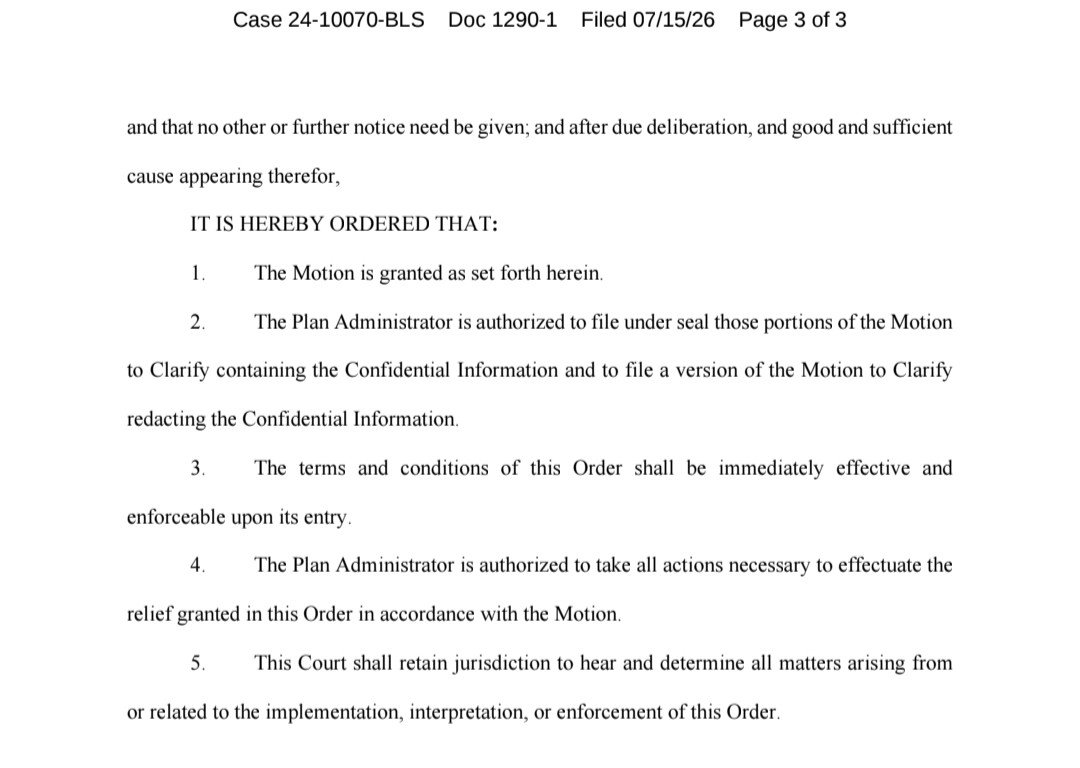
CRITICAL UPDATE: JUMP TRADING DEALS CLEAR WITHOUT OBJECTION (DOCKET #1290) 📜
The algorithmic trap has officially sprung on the corporate legal front. If Jump Trading wanted to stop the Plan Administrator from inserting their sensitive operational files into the active record, their window just slammed shut.
Docket #1290 has officially hit the system, introducing a major procedural catalyst:
Zero Resistance: The Plan Administrator formally filed a Certificate of No Objection, certifying under penalty of perjury that no answer, objection, or responsive pleading was filed by any party against the motion to handle this confidential data.
The Sealed Hammer Ready to Fall: With the opposition completely silent, the estate has requested the immediate entry of the final order. This order authorizes the Plan Administrator to officially file the unredacted confidential data under seal while serving a redacted version to the public.
Immediate Enforcement Framework: The terms of this upcoming order will become immediately active and enforceable the absolute second the judge signs it, allowing the estate to deploy the evidence without delay.
The Takeaway:
This is how institutional momentum works. By securing a clear runway with zero objections, the legal team can now introduce critical, highly restricted data directly into the heart of the proceedings. The operational path is completely cleared, the hurdles are falling, and the mathematical wind-down framework is executing without friction.
The paperwork is finalized. The silent consent is locked in. Check below 👇.
#LUNC #USTC #TerraformLabs
FOLLOW THE SMART MONEY: INSTITUTIONS ARE BUYING UP TERRAFORM CLAIMS 💲
Docket #1288 just hit the system, and it reveals an massive institutional move:
The Seven-Figure Bet: A massive $1,447,346.99 bankruptcy claim has just been completely bought out and transferred.
The Buyer: Serrur Investment Partners, LP has officially stepped in to take over the claim, utilizing specialized firm TerraClaim LLC to broker the legal transfer.
The Rule 3001(e)(2) Mechanics: This is a definitive, absolute transfer of claim ownership meaning institutional capital is officially paying out cash now to lock in their rights to the future asset distribution payouts.
Why this triggers the algorithm???
Hedge funds and private equity firms do not buy millions of dollars in bankrupt crypto debt unless their internal legal audits show a guaranteed, high-value payout at the finish line. Institutions are aggressively swallowing up the remaining supply of claims because they know the structural liquidation values are heavily secured.
The smart money is champing at the bit to take your spot in the payout line. The paper trail doesn't lie. ⚖️
Check the filing snapshot below. 👇
Thank you.
$LUNC $USTC
This is where architecture matters.
If cryptography is baked into the protocol, upgrading it becomes a network-wide coordination event.
If cryptographic verification can be deployed at the application layer, the system can adapt much faster.
That is why crypto agility matters.
In a post-quantum world, the chains that survive will not just be the ones that pick the “right” PQ scheme once, but instead the one’s capable of adapting as cryptography changes.
Harvesting these public keys does not require quantum hardware. The “break later” part does.
An attacker using a sufficiently powerful quantum computer could derive the private key from the exposed public key, allowing them to sign transactions and spend the coins.
Justin Drake, an Ethereum Foundation researcher and co-author of Google Quantum AI’s March 2026 whitepaper on securing blockchains against quantum attacks, has put his personal Q-Day odds at 10% by 2030 and 50% by 2032.