Former soccer player for Castle View High School, Otero Junior College, and Dakota Wesleyan University. Professional Arena soccer player for MASL2 and PASL.
@musclekayla I’d have to see how your character is in person. I don’t judge you by your physical appearance, I judge you by your character and how you would treat me.
@TheCleanCarClub That is completely wrong. The male end of where the filter threads on to is a spout. You never puncture the filter. You use wrenches and straps made for the filter to tighten or loosen it.
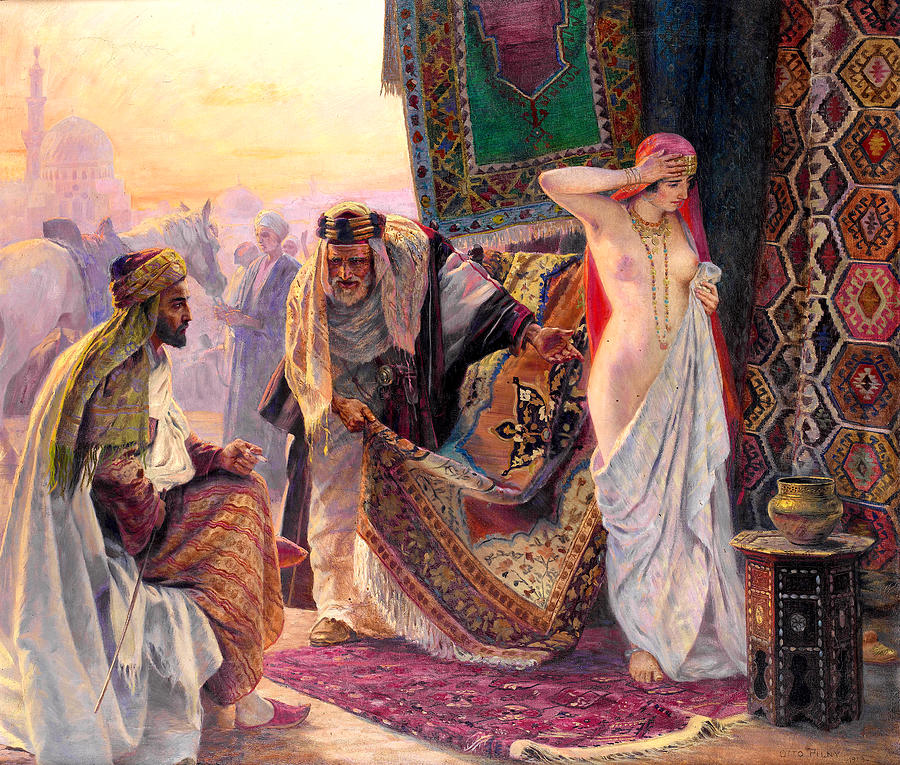
A new study suggests that a million or more European Christians were enslaved by Muslims in North Africa between 1530-1780 – a far greater number than had ever been estimated before.
In a new book, Robert Davis, professor of history at Ohio State University, developed a unique methodology to calculate the number of white Christians who were enslaved along Africa’s Barbary Coast, arriving at much higher slave population estimates than any previous studies had found.
Most other accounts of slavery along Barbary coast didn’t try to estimate the number of slaves, or only looked at the number of slaves in particular cities, Davis said. Most previously estimated slave counts have thus tended to be in the thousands, or at most in the tens of thousands. Davis, by contrast, has calculated that between 1 million and 1.25 million European Christians were captured and forced to work in North Africa from 16th-18th Centuries.
“Much of what has been written gives the impression that there were not many slaves and minimizes the impact that slavery had on Europe,” Davis said. “Most accounts only look at slavery in one place, or only for a short period of time. But when you take a broader, longer view, the massive scope of this slavery and its powerful impact become clear.”
Davis said it is useful to compare this Mediterranean slavery to the Atlantic slave trade that brought black Africans to the Americas. Over the course of four centuries, the Atlantic slave trade was much larger – about 10 to 12 million black Africans were brought to the Americas. But from 1500 to 1650, when trans-Atlantic slaving was still in its infancy, more white Christian slaves were probably taken to Barbary than black African slaves to the Americas, according to Davis.
“One of the things that both the public and many scholars have tended to take as given is that slavery was always racial in nature – that only blacks have been slaves. But that is not true,” Davis said. “We cannot think of slavery as something that only white people did to black people.”
During the time period Davis studied, it was religion and ethnicity, as much as race, that determined who became slaves.
“Enslavement was a very real possibility for anyone who traveled in the Mediterranean, or who lived along the shores in places like Italy, France, Spain and Portugal, and even as far north as England and Iceland,” he said.
Pirates (called corsairs) from cities along the Barbary Coast in north Africa – cities such as Tunis and Algiers – would raid ships in the Mediterranean and Atlantic, as well as seaside villages to capture men, women and children. The impact of these attacks were devastating – France, England, and Spain each lost thousands of ships, and long stretches of the Spanish and Italian coasts were almost completely abandoned by their inhabitants. At its peak, the destruction and depopulation of some areas probably exceeded what European slavers would later inflict on the African interior.
Although hundreds of thousands of Christian slaves were taken from Mediterranean countries, Davis noted, the effects of Muslim slave raids was felt much further away: it appears, for example, that through most of 17th Century the English lost at least 400 sailors a year to the slavers.
Even Americans were not immune. For example, one American slave reported that 130 other American seamen had been enslaved by the Algerians in the Mediterranean and Atlantic just between 1785-1793.
***
Davis’s new estimates appear in the book Christian Slaves, Muslim Masters: White Slavery in the Mediterranean, the Barbary Coast, and Italy, 1500-1800 (Palgrave Macmillan).
📷 : Scene at a slave market by Swiss artist Otto Pilny (1866-1936) painted in 1919.
#archaeohistories
@markgoldbridge It’s not a shite tactic. I as an attacker have every right to the ball, just as the same as the keeper. If a goal keeper or defending team can’t handle it, their game tactics are shite.