🚨 Anthropic just showed a 24-minute workshop on how to actually do prompts for Claude.
Taught by the people who built it.
Free. No registration. No paywall.
I've seen $300 courses that don't cover what they teach in the first 8 minutes.
Watch it and bookmark it now.
this is f*cking gold
How to build your first AI agent (Full guide)
if I had this a year ago, I would've shipped my first agent in a day instead of 2 weeks
in the right hands, this changes everything:
How To Create & Edit Movie Recap Videos on Youtube Without Copyright strike in 2026.
In this video you will learn exactly how to create and edit movie Recap Videos, without getting hit with copyright strike on youtube.
This information is for both new and existing youtube creators who wants to learn how to create engaging movie recap video in 2026.
Like, Retweet and Bookmark.
Follow me @chrisdadiva
10 GitHub repos that will level up your AI Agent skills (SAVE THIS)🔖
1. Hands-On Large Language Models
Complete code notebooks from basics to advanced fine-tuning.
🔗 https://t.co/Of8gmfbLZg
2. AI Agents for Beginners
A free 11-part intro course to build your first agents.
🔗 https://t.co/qn9RxfngBv
3. GenAI Agents
Tutorials and code for building generative AI agents.
🔗 https://t.co/qPFV1eCioQ
4. Made with ML
Learn to design, build, and deploy real ML apps.
🔗 https://t.co/lNx7UULF0R
5. Prompt Engineering Guide
Learn to write powerful and effective prompts.
🔗 https://t.co/ieWrh1ON3W
6. Hands-On AI Engineering
Practical LLM-powered apps and agent examples.
🔗 https://t.co/EuksJwkcv5
7. Awesome Generative AI Guide
Curated hub for genAI research and tools.
🔗 https://t.co/WTiGJcdrEZ
8. Designing Machine Learning Systems
Summaries and resources from the popular ML systems book.
🔗 https://t.co/SrhElwEmUB
9. ML for Beginners (Microsoft)
Free beginner-friendly ML curriculum.
🔗 https://t.co/fG5DGJ5NI0
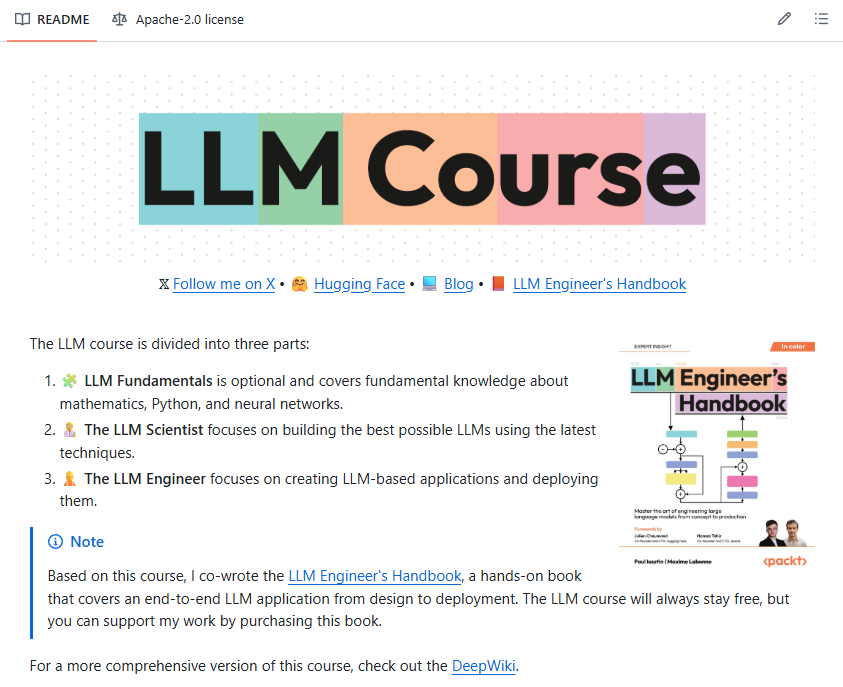
10. LLM Course
Roadmaps and hands-on notebooks to build LLM apps.
🔗 https://t.co/vR7PuPcLpo
There are 2 career paths in AI right now:
The API Caller: Knows how to use an API. (Low leverage, first to be automated, $150k salary).
The Architect: Knows how to build the API. (High leverage, builds the tools, $500k+ salary).
Bootcamps train you to be an API Caller. This free 17-video Stanford course trains you to be an Architect.
It's CS336: Language Modeling from Scratch.
The syllabus is pure signal, no noise:
➡️ Data Collection & Curation (Lec 13-14)
➡️ Building Transformers & MoE (Lec 3-4)
➡️ Making it fast (Lec 5-8: GPUs, Kernels, Parallelism)
➡️ Making it work (Lec 10: Inference)
➡️ Making it smart (Lec 15-17: Alignment & RL)
Choose your path.
(I will put the playlist in the comments.)
♻️ Repost to save someone $$$ and a lot of confusion.
✔️ You can follow @techNmak, for more insights.
GOOGLE x KAGGLE just dropped a free 5-day AI agents course
june 15–19, 2026
→ vibe coding with natural language
→ build & deploy real AI agents
→ capstone project + certificates
1.5M learners last time. registration is open now
completely free
This is how I would learn Python from scratch today.
You'll see the path from fundamentals and OOP to projects, specialization, and the extra skills that actually make you better.
So if you want to stop wasting time learning Python in the wrong order, watch this.
Accepted into the NVIDIA Inception Program.
We’re building speech AI systems for African languages, starting with Swahili ASR and TTS at MsingiAI.
Modern AI systems still underserve a lot of the world. We think that changes over the next decade.
Excited for what comes next.
The biggest AI skill in 2026 won’t be prompt engineering.
It’ll be designing the system around the model.
This diagram perfectly shows the evolution:
🔹 Prompt Engineering
→ Better instructions
🔹 Context Engineering
→ Better information flow
🔹 Harness Engineering
→ Better autonomous systems
The shift is massive.
Old AI apps:
“Here’s my prompt.”
Modern AI systems:
• memory management
• retrieval pipelines
• tool orchestration
• verification loops
• retries & evaluators
• context compression
• multi-agent execution
In other words:
AI is moving from
📝 single prompts
to
⚙️ full-stack cognitive architectures.
One underrated insight here:
The context window is now the new CPU cache.
What stays inside it determines:
• accuracy
• latency
• cost
• reasoning quality
• hallucination rate
And Harness Engineering ties everything together:
Gather → Curate → Act → Verify → Retry
That’s how production-grade AI agents are actually built.
The future AI engineer won’t just “talk to models.”
They’ll architect intelligent systems around them. 🚀
Microsoft just solved the biggest unsolved problem in AI engineering.
And they put the entire blueprint on the internet for free.
CI/CD for AI Agents on Microsoft Foundry. Their internal playbook. Now public.
Here is what it actually does:
→ Before your agent ships anywhere it gets automatically scored on accuracy, safety and factual grounding. Not vibes. Actual scores.
→ Each environment, Dev, Test and Prod, has its own gate. Your agent has to earn every single promotion.
→ Each deployed agent gets its own unique Microsoft Entra identity so you always know exactly which version did what.
→ Every action the agent takes is fully traced. You can see what it did, when it did it and why.
→ If your agent drifts in production, you roll it back instantly. One command.
The reference repo is live on GitHub right now. GitHub Actions and Azure DevOps both support out of the box.
This is the moment AI agents became real software.
Full blueprint here: https://t.co/lCyqNKC49S
For curious developers 🧠
I built "The Anatomy of an LLM", an interactive explainer showing how text becomes tokens, vectors, attention, transformer blocks, and finally generated text.
https://t.co/fgCeZuQwJf
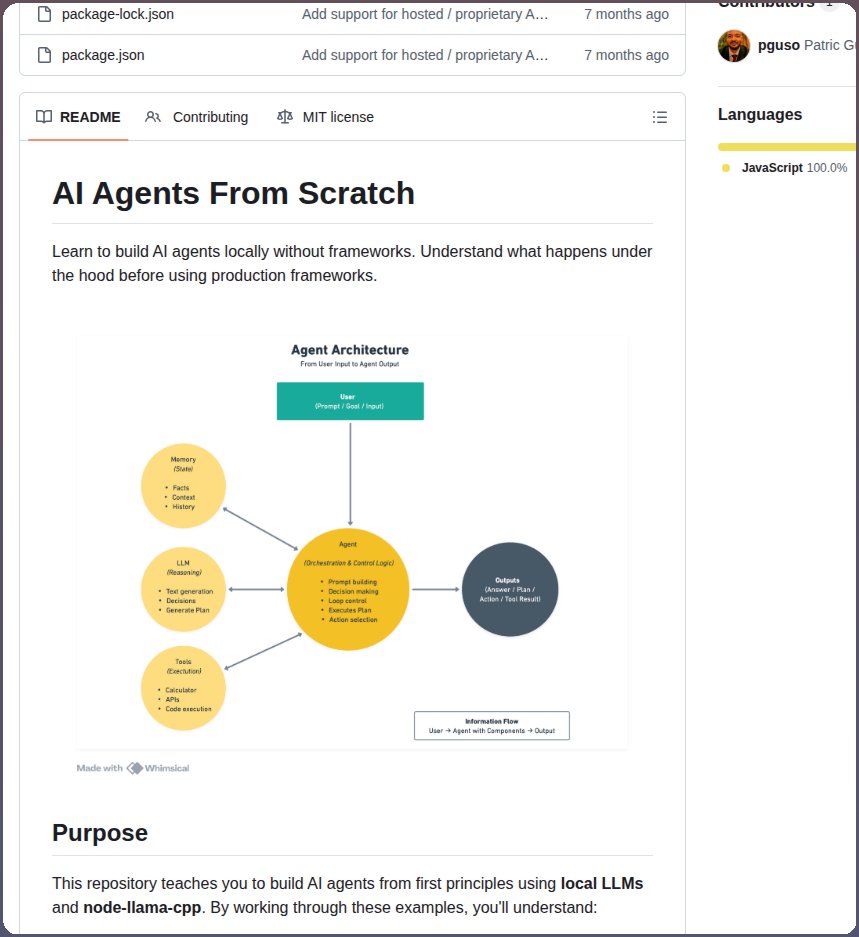
Teaches building AI agents from first principles.
Most AI tutorials skip straight to frameworks.
This one starts from zero and shows how agents actually work internally.
Tool use, memory, planning, reasoning loops — everything explained step by step.
Perfect if you want to actually understand AI agents instead of blindly using wrappers.
https://t.co/wfboSqe9l0
This is a full Python beginner course that actually builds toward something.
You'll start with the basics and end up with five projects you can study, tweak, and keep learning from after the video.
If you want to learn Python by building instead of watching, watch this 3-hour video.
Manus AI Fellows Program - Global fellowship for AI practitioners, community builders & business leaders.
Fellows get event stipends, free Manus credits, early access to releases, and direct collaboration with the team
Open worldwide
https://t.co/Czypo5ALdI
this guy literally put a full AI engineering curriculum on GitHub and made it 100% FREE 🤯
435 lessons.
20 phases.
320 hours.
The rule that makes this curriculum completely different:
Every algorithm gets implemented from raw math before a single framework gets imported.
You build the backprop.
You build the tokenizer.
You build the attention mechanism.
By the time you use PyTorch, it’s just a shortcut for something you already know how to code from scratch.
It spans four languages:
→ Python for ML pipelines
→ TypeScript for agent tooling
→ Rust for performance-critical components
→ Julia for numerical computation
And the best part?
Every single lesson ships something you can actually use.
You walk away with fully deployable prompts, SKILL. md files, agents, and MCP servers.
The curriculum scales from foundational math all the way up to autonomous agent swarms and production infrastructure.
Free, open-source, and MIT licensed.
repo in 🧵↓