Scott Bessent lands in Tokyo today-on his way to Beijing for the Trump-Xi summit.
This isn't just a pitstop - the weak yen is very much on the line.
Japan - and its weak currency - are no longer a sideshow in global finance.
It's the untold story of the moment.
1/10
Looks like Zelensky's latest warnings have scared Lukashenko absolutely to death.. 🇧🇾😂 And honestly, when you look at the map, it’s pretty simple to see why the dictator in Minsk is losing his sleep.
Belarus basically relies on just two massive oil refineries for their entire economic survival – one in the north and one in the south. Both of them happen to be well within the striking range of Ukrainian long-range drones, and guess what? They aren't protected by any real air defense at all, since Moscow basically confiscated all their systems for the front lines. 💸🔥
But the most hilarious part is the geopolitics behind it. Even Lukashenko, as clueless as he usually is, can see that Putin's ship is sinking. Zelensky's ultimatum is actually giving him the perfect excuse to start distancing himself from Moscow and slowly back away from the Russian sphere of influence. Just like everyone else is doing right now.. When your last remaining puppet ally is looking for a loophole to dump you, you know you've hit peak performance! 🍿🤷♂️
Source: Military intelligence updates and regional political analysis (June 22, 2026) regarding the drone threat to Belarusian energy infrastructure and Minsk's diplomatic shifting.
And so it begins…
WARSH: “What’s important for households and businesses to know is that this central bank will deliver on price stability.”
Confirms the FOMC will hold rates steady, opens door to possibly higher rates.
TRUMP: “It’s hard to believe. It just keeps the country down.”
A measure aimed at defense contractors today could become a precedent affecting a much broader range of companies tomorrow. 5/5
https://t.co/GTVSMbKLdI
Washington is weighing a proposal in the National Defense Authorization Act (NDAA) — the annual bill that sets U.S. defense policy and spending — that could restrict or ban stock buybacks for certain defense contractors. 1/5
https://t.co/my7GLrag5J
For business, the debate is bigger than defense. It raises a fundamental question: Should companies that rely heavily on taxpayer dollars be free to allocate capital as they see fit, or should public funding come with expectations about how profits are reinvested? 4/5
Q: Did you see the Fed is holding rates?
TRUMP: It's alright. Whatever.
Q: And it looks like they might even raise them later this year
TRUMP: It could happen. I mean, it's hard to believe. It just keeps a country down.
Some countries attract capital. Others repel it. The difference comes down to rule of law.
On June 11, our Coalition for the Rule of Law releases the 6th Edition of the Global Rule of Law Dashboard—scoring 149 countries on the conditions shaping commercial confidence.
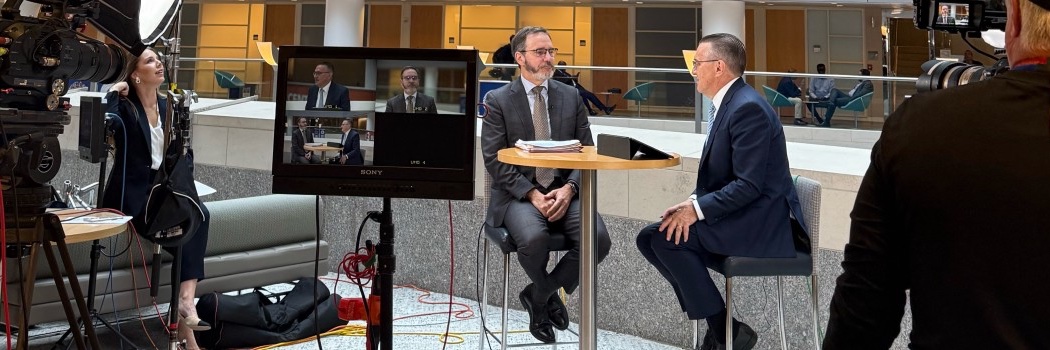
Ahead of the official release, the U.S. Chamber's Neil Herrington joined “The Call” with @Jay_USChamber to unpack what the data shows, and what it means for your operations.
Watch: https://t.co/1EOcnkoWqd
As Cohen frames it: Would you rather have two factories at 40% capacity — or one at 80%?
In peacetime, one at 80% wins every budget argument.
In wartime? You desperately need those two.
The U.S. defense industry took a month to produce what Ukraine fired in a day.
@EliotACohen's stat about U.S. stockpiles of 155mm artillery shells, highlighted this week on the @USChamber's The Call, says everything about three decades of consolidation. 🧵
Today we have five or six primary contractors, depending on how you count.
And in 2022, Ukraine was burning through our entire monthly 155mm output every single day.
What's striking from a business risk perspective: the global economy spent decades routing 20% of its oil through a single chokepoint because it was efficient. Iran has now demonstrated that efficiency can be converted into coercion at a time of its choosing. That's the template. Once proven, other actors will study it.
This is exactly the dynamic we've been tracking at the @USChamber's Global Intelligence Desk — the moment when optimized systems reveal their hidden vulnerabilities. The Strait is the starkest example yet.
We wrote about it here if you want to go deeper: https://t.co/fVNZvSdHhK
Oh my. The wet spot left behind by Harden was either not cleaned and/or improperly so. Dean Wade wipes out seconds later and the Pistons get a crucial wide open layup as a result.
The U.S. Chamber congratulates Kevin Warsh on being named Chairman of the @federalreserve and looks forward to his leadership.
Full statement from our President & CEO Suzanne Clark: https://t.co/cChaJYEty4
🚨 Beijing's playbook is clear: to dominate global supply chains and make the world dependent on China. Up to $650 billion in G-7 countries’ manufacturing exports could be at risk by 2030.
As Trump meets Xi this week, what's the path forward?
Jeremie Waterman of the U.S. Chamber's China Center joins @Jay_USChamber to break down tariffs, tech restrictions & what's at stake for American business.
🎙️ Watch: https://t.co/M95JFoTsIe
The headlines this week will focus on what Trump and Xi say.
But it'll be worth watching what each side does in the weeks after.
See the full clip:
https://t.co/r0EqE60tMD
8/8
Will policy and diplomacy work against each other at the Trump-Xi summit?
On the surface, the U.S. and China are entering one of the busiest stretches of leader-level diplomacy in years. That creates a real pull toward stability.
And yet... 1/8
As Waterman put it:
“We see a tremendous amount of mistrust, evidenced by actions on both sides that are injecting more uncertainty for corporate boards and CEOs as they make their investment and supply chain decisions.”
7/8